

Pyramid Principle in Consulting: A Practical Guide
The pyramid principle structures a recommendation so the answer comes first: state the governing thought, then group the supporting arguments so each one holds up on its own logic. This guide covers the three-layer structure, real examples, common mistakes, and how the pyramid principle becomes a slide.
What Is the Pyramid Principle?
The pyramid principle is a method for structuring a written or spoken argument so the conclusion comes first, followed by the reasoning that supports it. Instead of building up through background, analysis, and data before finally stating a recommendation, a pyramid-structured communication opens with the governing thought, the single sentence that states the answer, and only then explains why.
The name comes from the shape of the structure: one governing thought at the top, a handful of supporting arguments in the middle (the key line), and the underlying data and analysis at the base. A reader who stops at any level should already have a complete, if less detailed, understanding of the argument.
Consultants, bankers, and strategy teams use the pyramid principle because executive audiences read top-down. A partner or board member with ninety seconds needs the recommendation immediately, not at the end of a long memo. The same logic that structures a document also structures a single slide: the headline states the so-what, and the body of the slide supports it.
Answer first
The governing thought states the recommendation in one sentence, before any supporting detail appears.
Grouped support
The arguments underneath are grouped so no two overlap and nothing relevant is left out.
The Pyramid Structure, Built Top Down
Four steps take a rough set of findings and turn them into a pyramid a reader can follow at any level of detail.
State the governing thought
Write the answer in one sentence before anything else. A reader who stops after this sentence should already know your recommendation, not just your topic.
Group the supporting arguments (the key line)
Sort everything that answers "why" into three or four buckets. Each bucket should be mutually exclusive and the set should be collectively exhaustive, the same test a MECE breakdown applies.
Choose deductive or inductive logic
Deductive means each argument is a premise that leads to the next, so if A is true then B follows and the governing thought results. Inductive means the arguments are independent reasons that all point to the same conclusion. Most business recommendations use inductive grouping because each argument can stand on its own.
Support each argument with data
Give each key line argument its own layer of evidence underneath it, only as deep as needed to defend that single argument. Data that does not defend one of the three or four arguments does not belong in the pyramid.
Step two is where a pyramid and a MECE breakdown meet directly. Every key line grouping is really a small MECE test applied to your own argument. For the full test and worked examples, see our guide to the MECE principle.
8 Pyramid Principle Examples
Each example states the governing thought first, then the three supporting arguments underneath it, the same order a reader would see them in a memo or on a slide.
Notice that every governing thought is a decision, not a topic. "Market entry options" is a topic. "Enter through a joint venture" is a governing thought. If your top line could be followed by a question mark instead of a period, it is not a governing thought yet. For a full set of prompts that walk Claude through building a storyline like these, see 22 Claude prompts for storyline.
Common Pyramid Principle Mistakes
Writing bottom-up. Leading with background, then analysis, then finally the recommendation on the last page. By the time the reader reaches your answer, they have already formed their own opinion from the data. Fix it by moving the governing thought to the first sentence, then explaining why.
Too many supporting arguments. Five or six key line points instead of three or four. A reader cannot hold that many parallel arguments in working memory, so the structure stops reading as a pyramid and starts reading as a list. Group further or cut, do not list everything you found.
Mixing inductive and deductive logic in one group. Some arguments say "A, B, and C are all true, therefore X," while others say "if A then B then C." Pick one logic per grouping and hold it, or the key line stops feeling like a single coherent argument.
How to Apply the Pyramid Principle to a Slide
A pyramid gives a slide its structure before any design decision happens. The governing thought becomes the headline, the key line arguments become the body of the slide, and the supporting data sits underneath each one. The exhibit below shows the same three-layer structure that opens this guide, laid out the way it would appear on a single slide.
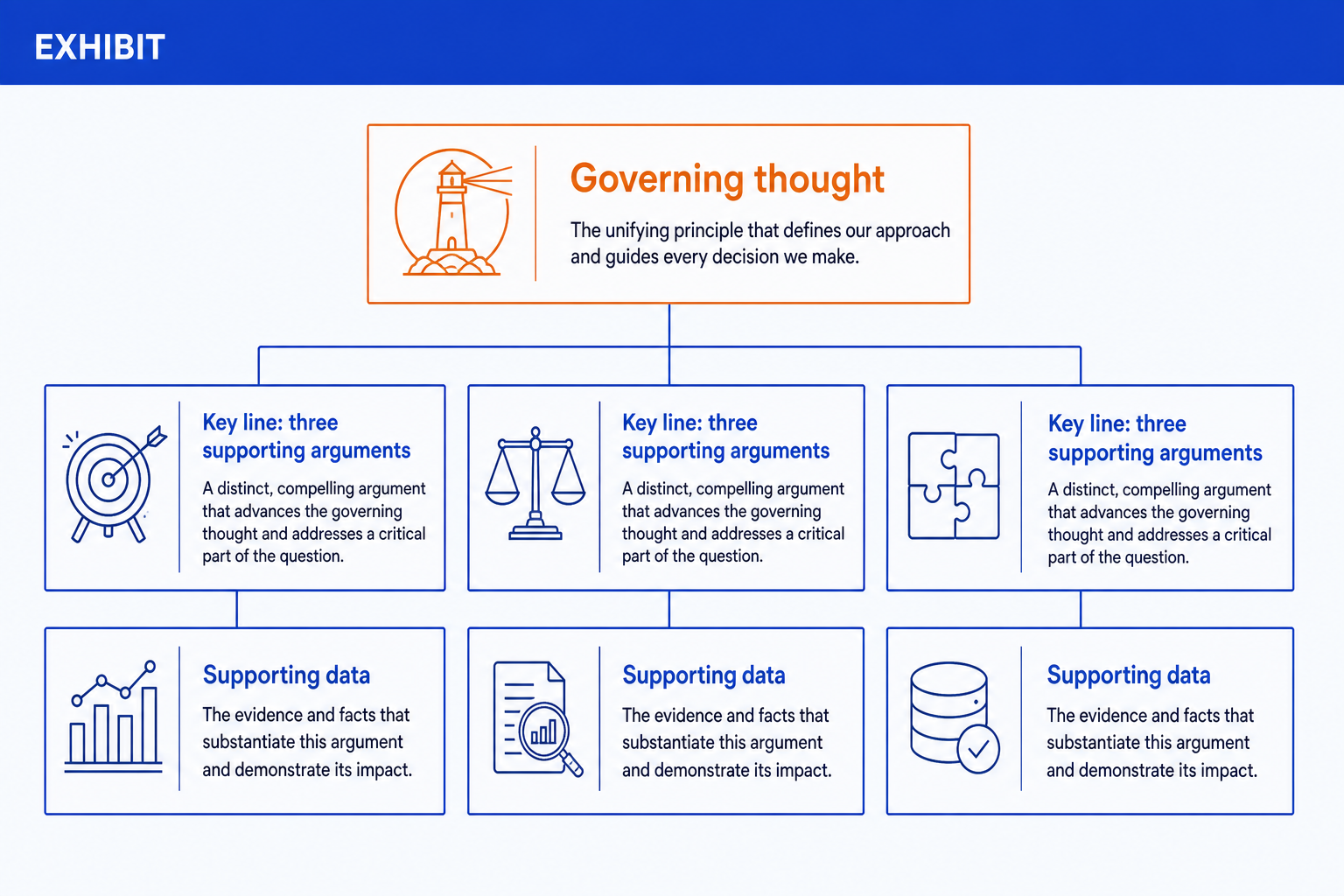
Building that slide by hand means placing the headline box, drawing three boxes underneath it, connecting them, and getting the spacing even, before a single word of the actual content gets written. Oria's Text-to-Slide workflow skips the manual layout step: describe the pyramid in a sentence and it returns 2 to 5 design options in 30 to 40 seconds, each one a fully editable native PowerPoint slide.
Example prompt
"Create a slide with a headline box at the top stating the recommendation, three boxes underneath it side by side for the three supporting arguments, and a short row of supporting bullet points under each of the three boxes. Add a thin connector line from the top box down to each of the three."
The same layout works for the executive summary slide at the front of most decks, which is really a governing thought with its key line laid out under a situation, complication, resolution frame. Our guide to the executive summary slide walks through that specific layout step by step.
Frequently asked questions
What is the pyramid principle?
The pyramid principle is a method for structuring a written or spoken argument so the conclusion comes first. A single governing thought states the answer, a small set of supporting arguments (the key line) explains why, and supporting data sits underneath each argument. The structure reads top-down instead of building up to a conclusion at the end.
How is the pyramid principle different from MECE?
The pyramid principle is the overall shape: answer first, then grouped support, then data. MECE is the test each grouping inside the pyramid has to pass, checking that the supporting arguments do not overlap and do not leave a gap. A pyramid uses MECE grouping at the key line level, but MECE alone does not tell you what order to present things in.
How many supporting arguments should the key line have?
Three or four is typical, and it is rare to need more than five. A reader cannot hold more than a handful of parallel arguments in working memory at once, so more than that tends to blur together rather than strengthen the case.
What is the difference between inductive and deductive grouping?
Deductive grouping chains arguments together, where each one leads logically to the next until the governing thought follows. Inductive grouping lists independent reasons that all point to the same conclusion without depending on each other. Most business recommendations use inductive grouping because each argument can be checked on its own.
Does the pyramid principle apply to a single slide, or only to full documents?
It applies to both, and the logic is identical at any scale. A single slide's headline is the governing thought, the body of the slide holds the key line arguments, and any chart or table underneath is the supporting data. A full deck simply repeats the same structure once per slide and once again across the whole document.