

MECE: What It Means, Worked Examples, and How to Test a Breakdown
MECE means mutually exclusive, collectively exhaustive. Five worked breakdowns with the test applied to each, including one that fails it, plus the mechanics of building branches that survive being challenged.
Most breakdowns fail in the room they are shown in. Someone names a case that fits two of your boxes at once, or a case that fits none of them, and the rest of the analysis stops being discussed. MECE is the rule that prevents both, and the decision it actually asks you to make is narrower than the acronym suggests: which single dimension are you splitting on, and how do you know there is nothing outside the split?
Those two questions are the whole method. What follows is the definition, five worked breakdowns with the test applied out loud to each, one of which fails and is shown beside its fix, then the mechanics of branches and what changes when the breakdown becomes a slide.
What does MECE mean?
The term comes from Barbara Minto, who coined it while developing the structured writing method she later published as The Pyramid Principle. It describes one level of a structure at a time, not a whole document.
MECE stands for mutually exclusive, collectively exhaustive. It describes a breakdown in which no case belongs to two categories and no case belongs to none. Splitting a company's costs into fixed costs and variable costs is the standard example: every cost behaves one way or the other as volume changes, and the two together account for the entire cost base. To test any breakdown, take ten real cases and place each one. A case that lands in two categories means the split is not mutually exclusive. A case that lands in none means it is not collectively exhaustive. Both failures have the same fix: name the single dimension you are splitting on, and split on that dimension alone.
Mutually exclusive
No two branches share a case. A cost, a customer or a lost deal sits in exactly one branch, never two.
Collectively exhaustive
The branches together cover every case. Nothing relevant sits outside the structure, including the cases nobody thought of.
What is a MECE example?
The most quoted MECE example is the cost split above, and it is worth walking through slowly, because it shows what the test is doing. The question is what happens to costs if volume falls by a fifth. Split the cost base into fixed and variable, then take any line in the ledger: raw materials, the lease, hourly labour, the annual audit fee. Each behaves one way or the other and none behaves both ways, so the split is mutually exclusive. There is no third behaviour available, so nothing sits outside it and the split is collectively exhaustive.
The dimension is behaviour with volume, and only that dimension is in play. Change the question to where the money goes and the same cost base needs a different split. That choice is what the five breakdowns below are really demonstrating.
MECE examples: five worked breakdowns
Each one names its question, names the dimension it splits on, lists its branches and submits to both checks in writing. The fifth fails, and is shown next to the version that passes.
1. Revenue: split the change, not the total
Revenue questions are asked about a total and answered about a change. The bridge from last year to this year is exhaustive by construction, because the four movements below are the only ways a customer relationship can move the number.
The question
Why is revenue up 3% when the plan said 12%?
The dimension
What happened to each customer relative to last year.
The branches
- New: customers who bought this year and did not exist last year.
- Expansion: customers who existed last year and spent more this year.
- Contraction: customers who existed last year and spent less this year.
- Churn: customers who existed last year and spent nothing this year.
Mutually exclusive? Yes. Each customer has one status against last year, so each dollar of movement belongs to one branch.
Collectively exhaustive? Yes, by construction. The four movements reconcile to the change in total revenue, and that reconciliation is the check.
Volume, price and mix is a different dimension over the same revenue, equally MECE on its own. What is not MECE is a slide showing new customers, expansion and price increases side by side, because a price rise inside an existing account is already counted in expansion. Our guide to issue trees works that dimension through a full profit tree.
2. Cost: one definition, applied once
The same cost base on a different dimension, for a different question. It is exhaustive because the chart of accounts already maps every cost centre to exactly one line.
The question
Where does the operating cost base actually go, and which part is growing fastest?
The dimension
What the money buys.
The branches
- Cost of goods sold: what it costs to deliver what was sold.
- Sales and marketing: what it costs to win and keep the customer.
- Research and development: what it costs to build the next thing.
- General and administrative: what it costs to run the company itself.
Mutually exclusive? Yes, once the mapping rule is written down. Every cost centre reports into one line, and shared functions are allocated by a stated rule.
Collectively exhaustive? Yes. The four sum to total operating cost, so a cost fitting nowhere is a mapping error, not a missing branch.
The common failure here is adding people cost as a fifth branch. It is real and usually the largest number in the business, but it is a cross-cutting view of the same base rather than a peer of the four, so it belongs on its own slide.
3. Customers: one dimension, with the boundaries written down
Segmentations lose exclusivity in the punctuation. A band written as 25 to 250 and the next as 250 to 1,000 overlap at the boundary, and the account sitting exactly on it gets counted twice.
The question
Which customers should the new service tier be built for?
The dimension
Annual spend in the last twelve months, one currency, one measurement date.
The branches
- Under 25,000: the long tail.
- 25,000 up to but not including 250,000: the middle.
- 250,000 and above: the top accounts.
Mutually exclusive? Yes, because the boundary rule is stated and the thresholds do not share endpoints.
Collectively exhaustive? Yes. The bottom band has no floor and the top has no ceiling, and open ends are what make a banded split exhaustive.
Enterprise, mid-market, small business and healthcare is the version that fails: three sizes and one industry, so a large healthcare account belongs in two branches at once. Pick one, and make the other a second level underneath.
4. Market entry: the options split that is usually not exhaustive
Build, buy or partner is the most repeated options breakdown in strategy work, and it quietly fails the second test. Licensing, franchising, a minority stake and serving the market by export are all real entry modes, and none is comfortably any of the three. One dimension fixes it.
The question
How should we enter this market within eighteen months?
The dimension
How much of the local operation we own and control.
The branches
- Wholly owned: build it ourselves, or acquire an operator outright.
- Shared: a joint venture, or a minority stake with an agreement attached.
- Contractual: a licence, a franchise or a distribution agreement, with no equity.
- None: serve the market from where we are and own nothing locally.
Mutually exclusive? Yes. Ownership is one continuum, so any proposal sits at a single point on it.
Collectively exhaustive? Yes. The branches span full ownership to none, so no fifth position exists.
Build versus buy has not disappeared. It has moved to where it belongs, as a question inside the wholly owned branch. The cost of stopping at three options is measurable: Paul Nutt of Ohio State University tracked 356 decisions in medium and large organisations across the United States and Canada and reported in the Academy of Management Executive in November 1999 that managers developed multiple options in fewer than 20% of them, and that where they did, the success rate rose from 56% to 70%. An options split that is not exhaustive is the mechanism by which the better option never gets considered.
5. A MECE case study example: the breakdown that fails, and its fix
Every sales system carries a lost-reason list, and almost none are MECE. Here is the usual one, tested honestly.
The question
Why are we losing deals? (the list as it usually exists)
The dimension
None stated. Price, competition, budget, product and timing are four dimensions in one level.
The branches
- Price too high.
- Lost to a competitor.
- No budget.
- Missing feature.
- Bad timing.
Mutually exclusive? No. A deal lost to a cheaper competitor belongs to two branches, and no budget and bad timing are often one event described by two sellers.
Collectively exhaustive? No. Deals where nobody reached the person who decides belong nowhere, so the largest category is the missing one.
The fix is not a better set of reasons. It is a dimension. Every lost deal stopped at exactly one point in a sequence, and the sequence has no fifth place to stop.
The question
Why are we losing deals? (split on where the deal stopped)
The dimension
The last stage the deal reached before it died.
The branches
- Never qualified: the need we serve was not present.
- Qualified, never shortlisted: we were not in the evaluation.
- Shortlisted, not selected: we were compared and lost.
- Selected, never signed: we won and the money or the signature did not arrive.
Mutually exclusive? Yes. A deal stops once, and the stage it reached is recorded, not judged.
Collectively exhaustive? Yes. The stages run from no contact to signature, so every lost deal stopped on that line.
Price, competitors and features are still interesting. They now live as a second level under the stage they explain, which is where they stop overlapping. Notice what the original list did: it hid an entire category by not listing it, and that effect has been measured. In a 1978 study in the Journal of Experimental Psychology: Human Perception and Performance, Baruch Fischhoff, Paul Slovic and Sarah Lichtenstein showed people a fault tree for the causes of a car failing to start, then deleted three of its branches without saying so. Readers of the pruned tree should have raised the residual all other problems category to 46.8% to account for what was gone. They raised it to 14.0%, and only one of the 55 people who saw a pruned tree compensated properly. The authors' summary was blunt: "People were quite insensitive to what had been left out of a fault tree." A missing branch does not announce itself.
How do you build a MECE breakdown?
Four steps, in this order. Most broken breakdowns skipped the second one.
- 1Write the question the breakdown has to answer, as a question. The same cost base splits four ways depending on what is asked, so the dimension cannot be chosen until the question is on the page.
- 2Name the dimension before you name a single branch. One phrase: behaviour with volume, what the money buys, where the deal stopped, how much we own. Skipping this step is how two dimensions end up in one level.
- 3Close the split. Either the branches span the dimension by construction, as an identity, a sequence or a binary does, or you close it with a residual you can name and size.
- 4Place ten real cases, not imagined ones. This is the only step that finds the failures the other three created.
How do you test whether a breakdown is MECE?
Four checks, in the order that finds the most problems fastest. They take a few minutes, and they are cheaper than the meeting that finds the same faults for you.
Put ten real cases through it
Not imagined ones. Pull ten rows from the ledger, the CRM or the customer list and place each. Anything landing twice breaks exclusivity; anything landing nowhere breaks exhaustiveness.
Check for nesting
Ask whether any branch sits inside another. A category and one of its own subsets is the commonest overlap and the hardest to see, because the subset is the more interesting idea and reads as the bigger one.
Say the dimension out loud
Name what you split on in one phrase. If naming it needs the word and, you have crossed two dimensions in one level, which is the failure behind most overlapping branches.
Open the residual and look inside
If the split ends in other, name three things living in it and size them. What you can name and size is a branch. What you cannot is a gap wearing a label.
The second check earns its place because nesting is close to invisible from the inside. In the study Amos Tversky and Daniel Kahneman published in Psychological Review in 1983, 142 undergraduates were asked which was more probable: that Linda is a bank teller, or that Linda is a bank teller and is active in the feminist movement. The second describes a subset of the first, so it cannot be more probable. 85% chose it anyway, and the authors reported no effect of statistical sophistication: doctoral students in decision science made the same error as students who had never taken a statistics course. Knowing the rule does not make you see the overlap, which is why this check has to be written down.
What are MECE branches, and how many should you have?
Branches are the categories sitting at one level of a breakdown, and MECE is a property of that level rather than of the whole structure. A breakdown can be faultless at the top and broken two levels down, so the test gets rerun at every level.
There are two ways a set of branches becomes exhaustive. Either they span the dimension by construction, which is what identities, sequences and binaries do, or you enumerate and close the list with a named residual. The first cannot be challenged without challenging the arithmetic. The second always can be.
The count follows from the dimension. A binary gives two, a funnel gives one per stage, an identity gives whatever it contains. A level with one branch is not a split, and a level with eight or nine is almost always two dimensions crossed and flattened. Barbara Minto's rule in The Pyramid Principle is the shortest statement of the same idea: "ideas in each grouping must always be the same kind of idea." Branches that are not the same kind of thing are not branches of one split, however neatly they sit on the slide.
How we chose the examples and tests on this page
Five criteria, applied identically to every breakdown above and every pattern below:
- Each breakdown had to state its dimension in one phrase. Anything needing two was rejected rather than rewritten.
- Each had to say how exhaustiveness is achieved, by construction or by a named residual, rather than assert that nothing is missing.
- Each had to survive the ten-case test on real data, which is what removed the lost-reason list in its original form.
- Each had to be usable outside a case interview. Population sizing puzzles were left out because they teach arithmetic, not structure.
- Every number and quotation had to come from a source we could open and read. Several widely repeated claims about MECE did not survive that.
Ignored on purpose: how the acronym is pronounced, case-interview scoring folklore, and the recycled claims about how much faster structured problem solvers work, which lead back to no published study.
Key takeaways
- Exhaustive by construction beats exhaustive by argument. If the branches reconcile to a total by definition, nobody can name a missing case. If they only feel complete, someone eventually will, and the meeting becomes a search for the gap.
- You can defend the split you can name in one phrase. A breakdown survives a challenge when the dimension behind it is single and stated. Once a reviewer can point at two branches drawn on different dimensions, the whole structure is in play.
- Cheap splits are cheap because the work is already done. An identity that reconciles, or a process whose stages are already dated in a system, gives you a MECE split in minutes. Choosing a fresh dimension for a segmentation takes a day of argument.
- The dimension sets the branch count, not a rule of thumb. A binary gives two, a bridge gives whatever the identity gives, a funnel gives one per stage. Trimming branches to reach a number you liked is editing the slide and calling it analysis.
- Match the pattern to the question you were asked. Totals and changes want arithmetic. Things that fail inside a sequence want stages. First cuts want a binary. Populations want one dimension with stated boundaries. Most bad breakdowns are good patterns aimed wrongly.
Which MECE split pattern should you use?
Four patterns cover almost every breakdown worth showing anyone, scored on the five decision rules above. Rows run from most structurally safe to most judgement-dependent, not from best to worst.
| Pattern | Gap risk | Survives a challenge | Time to build | Branches you get | Best for |
|---|---|---|---|---|---|
| Arithmetic split | None. The branches reconcile to the total by definition. | Yes, unless the identity itself is disputed. | Minutes, if the numbers already tie out. | Whatever the identity gives, usually two to five. | Revenue, cost, margin, headcount, anything that adds up. |
| Process-stage split | Low. Every case stops somewhere in the sequence. | Yes, once each stage is observable and dated. | An hour, plus the argument about stage definitions. | One per stage, usually three to six. | Funnels, lost deals, cycle times, failure analysis. |
| Binary split | None. The complement covers everything else by definition. | Yes, but it only settles where the line is. | Minutes. | Exactly two, nested as deep as you need. | First cuts, scoping, screening a long list. |
| Single-dimension segmentation | Real. Leave the top and bottom bands open or cases fall out. | Only if the dimension and the boundaries are written down. | Half a day, most of it spent choosing the dimension. | Three to five bands before the slide stops reading. | Customers, products, markets, suppliers. |
Read the first column first. Gap risk is the only column where a bad answer cannot be fixed later in the analysis.
The arithmetic split: when does it work?
Use it whenever the thing being split is a number that adds up: a revenue bridge, a cost base, headcount, a margin walk, a variance against plan. Exhaustiveness is free because the branches reconcile to the total, and that reconciliation is the check. If the parts do not tie to the whole, you have found a missing branch or a mapping error before anybody else does.
The trade-off: unarguable structure, but it describes what happened rather than why, and a bridge with no causal layer under it tells a board nothing it could act on.
The process-stage split: when does it work?
Use it whenever the cases you are splitting pass through a sequence and stop somewhere: lost deals, applications, claims, manufacturing defects, hiring pipelines, anything with a funnel behind it. Exclusivity comes free because a case stops once, and exhaustiveness comes free because the sequence has a start and an end.
The work is in defining the stages so that the stage a case reached is observed rather than opined. Once it is, the reasons you care about become a clean second level underneath.
The trade-off: it turns arguments about causes into a question about records, but it only works on things that actually move through a process, and it says nothing about cases that never entered one.
The binary split: when does it work?
A branch and its complement: in scope and out of scope, contracted and not contracted, served today and not served today. It is the only pattern that is exhaustive with certainty at any level of ignorance, because the complement is defined as everything else, including the cases you have not imagined.
Nest two or three binaries and you have a defensible structure before you understand the domain, which makes it the right first cut on an unfamiliar problem.
The trade-off: guaranteed coverage and almost no insight. A tree of binaries is safe, repetitive and hard to read on a slide, so it usually belongs in the working file rather than in the pack.
The single-dimension segmentation: when does it work?
Use it to split a population you intend to treat differently: customers, products, markets, suppliers, sites. It carries the most judgement and therefore the most risk, because you choose both the dimension and the boundaries.
Two rules keep it honest. Write the dimension and the measurement date on the slide, and leave the end bands open. If a second dimension matters, it becomes a second level, never a fifth branch.
The trade-off: the only pattern that produces segments you can actually act on, and the only one where a reviewer can reasonably argue that a different dimension would have been better.
Where should you go next?
MECE is one rule applied to one level. Most of the time it is a step inside a larger job, and that job has a better home than this page.
| If you need | Go to | Why that one |
|---|---|---|
| A multi-level tree, not one split | Our issue tree guide | MECE is the rule for one layer. A tree is the artefact that applies it all the way down, with worked trees for market entry and profit decline. |
| To test one answer rather than map a space | Hypothesis-driven problem solving | When you already believe you know the answer, the sub-claims under it get the MECE test instead of the problem space. |
| A named framework off the shelf | The consulting frameworks field guide | Some splits were done for you decades ago and are already exhaustive over their own dimension. |
| Claude to draft and test the tree | The MECE issue tree skill | A downloadable skill that decomposes to two levels, tests each branch, and flags the assumptions it had to make. |
| A diagram you will keep editing for weeks | Miro, Lucidchart or the free draw.io | Restructuring is cheap in a canvas tool and expensive in a slide. Move it to a deck at the end. |
| A visual-first deck: fundraising, launch, campaign | Gamma, Canva, Pitch or Beautiful.ai | Where the job is visual impact rather than a defensible structure, a design-led tool wins and looks better doing it. |
| The breakdown on a policed corporate template | Native PowerPoint shapes, or Oria | Shapes cost you the layout time. An add-in keeps the master and returns an editable slide. |
The four in-house routes: issue trees, hypothesis-driven problem solving, the consulting frameworks field guide and the downloadable MECE issue tree skill for Claude.
How do you turn a MECE breakdown into a slide?
A finished breakdown already contains the layout. Branches become boxes, a sequence becomes columns left to right, a banded segmentation becomes stacked tiers, a bridge becomes a waterfall. The exhibit below shows a revenue question split into three branches.
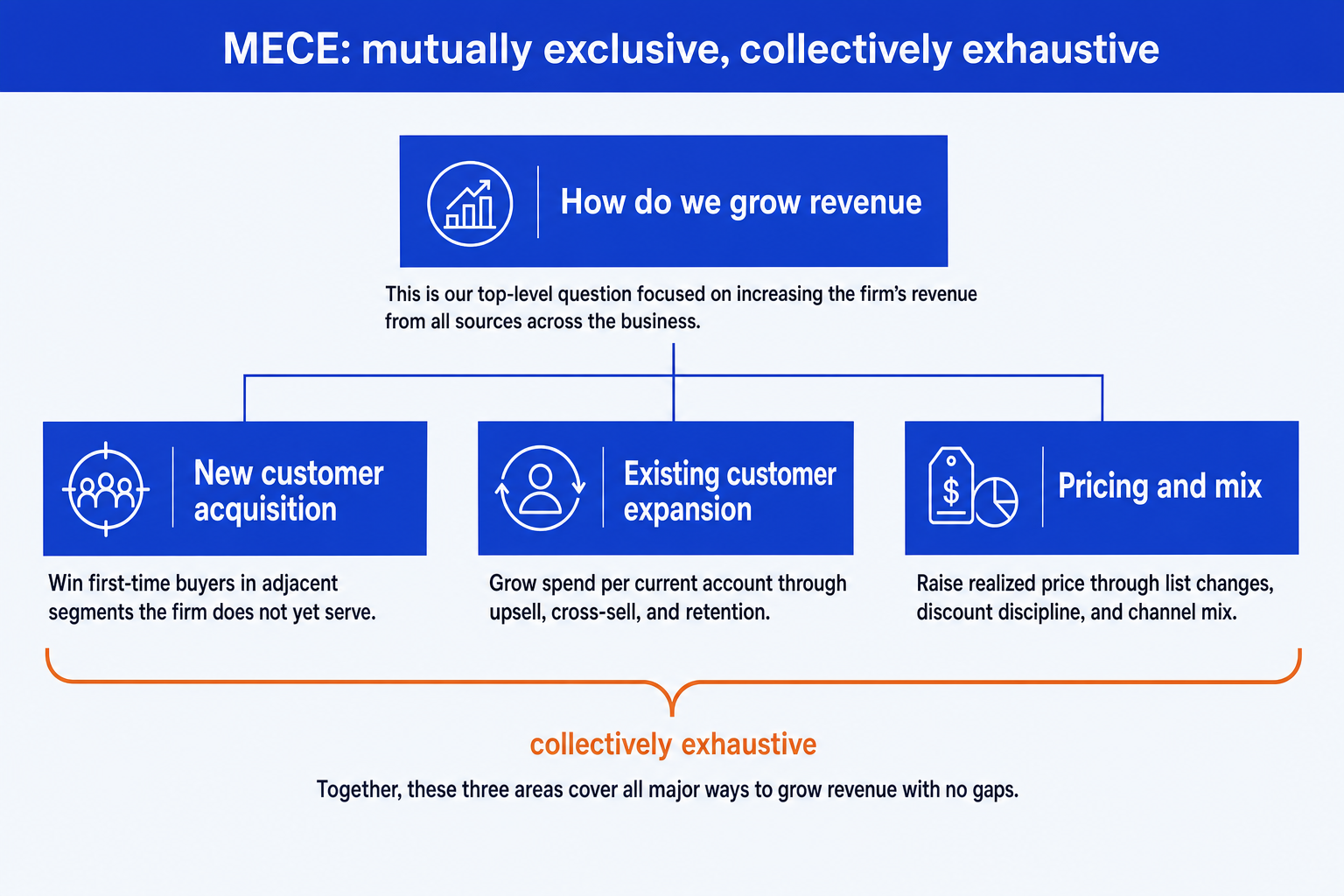
One rule survives the move to the page: show the exhaustiveness argument, do not assume it. A bracket labelled with the dimension, a residual with a number on it, or a total that ties all do the same job, which is answering the question a reviewer was about to ask. Four routes get the shape onto a slide.
Native PowerPoint shapes or SmartArt. Free, installed already, and compliant with whatever template you are held to. Three or four boxes take minutes; a fifth branch means moving everything. The trade-off: total control, paid for in alignment work.
Design-led generators. Gamma, Canva, Pitch and Beautiful.ai turn a description into something that looks designed, usually better than most people would draw. Reconciling that with a policed corporate master is manual work. The trade-off: the best looking slide in the least time, and the wrong tool when the template is not negotiable.
A chat assistant on its own. Claude or ChatGPT will draft, challenge and repair the breakdown itself, which is the part of the job that matters most. What comes back is text, not a slide. The trade-off: the best thinking partner and no artefact at the end of it.
Oria. Built for corporate and consulting documents specifically: board packs, steering committee decks, diligence exhibits, operating-model slides, dense frameworks held to an enforced template. It runs two ways, as a PowerPoint add-in on Windows, macOS and PowerPoint for the web, and as a connector for Claude and ChatGPT over MCP, so the slide can be built from the chat without opening PowerPoint. On data handling: customer content is not used for training, Professional and Team do not persist presentation content after delivery, and Enterprise adds private cloud deployment and custom LLM integration. The trade-off: built for the corporate environment only, so on visual-first work, founder fundraising, launch decks, marketing one-pagers, a design-led tool will beat it and look better doing it.
Example prompt
"Create a slide with a top box asking 'How do we grow revenue,' branching into three boxes: new customer acquisition, existing customer expansion, and pricing and mix. Add a one-line description under each box and a bracket beneath all three labelled 'collectively exhaustive.'"
The same sentence works for any of the five breakdowns above. For the wider workflow from question to finished deck, see the consultant's guide to Claude, and for framing the question before any of this, the issue-framing workflow.
Frequently asked questions
What does MECE stand for?
MECE stands for mutually exclusive, collectively exhaustive. Mutually exclusive means no case belongs to two branches of a breakdown. Collectively exhaustive means the branches together cover every case, with nothing left outside. It is a test applied to one level of a structure at a time.
What is a MECE example?
Splitting a cost base into fixed costs and variable costs is the standard MECE example. Every cost behaves one way or the other as volume changes, so nothing is counted twice, and there is no third behaviour, so nothing is left out. The dimension being split on is behaviour with volume.
What are some MECE case study examples?
The five worked here are a revenue bridge, an operating cost split, a customer segmentation by annual spend, a market entry options split, and a lost-deal analysis shown failing the test beside its corrected version. Each names its dimension and applies both checks explicitly.
What is a MECE breakdown?
One level of a structure whose branches never overlap and never leave a gap. Building one takes four steps: write the question, name the single dimension you will split on, close the split by construction or with a residual you can size, then place ten real cases through it.
How many branches should a MECE breakdown have?
As many as the dimension produces. A binary gives two, a funnel gives one per stage, an identity gives whatever it contains. Trimming branches to hit a number breaks exhaustiveness, and a level with eight or nine is usually two dimensions crossed rather than one split.
How do you know if something is MECE?
Place real cases, not imagined ones. A case fitting two branches means the split is not mutually exclusive. A case fitting none means it is not collectively exhaustive. Then check whether any branch sits inside another, which is the overlap people are least likely to notice.
Is MECE the same as an issue tree?
No. An issue tree is the artefact, a question broken into branches and sub-branches. MECE is the rule each layer of it has to pass. A tree can be drawn without being MECE, and one MECE breakdown is not yet a tree.