

Claude strategy skills that frame the right question first
Ten strategy workflows that force the question before the analysis. This editorial guide shows how to apply them in Claude, starting with the decision question rather than jumping to outputs.
AI Academy for Professionals




Why the question comes before the analysis
The most common failure in strategy work is not analytical. It is definitional. Teams work hard on the wrong problem because no one forced the question before analysis began. A messy brief produces misaligned analysis. Misaligned analysis produces a presentation that cannot answer the question the decision-maker is actually holding.
A strategy deck fails in its first slide when the question it answers is not the question that needs answering. The framing error is invisible to the team because they were too close to the brief to notice the shift. The audience notices immediately.
The fix is upstream. Locking the decision question before any slide or model is built determines every choice that follows: which branches of the issue tree matter, which data to gather, which options to evaluate, and which objections to prepare for. No amount of analytical quality compensates for a wrongly framed question at the start.
Claude workflows can enforce this sequence. Use the relevant workflow as a structured brief: name the step, provide the engagement context and evidence, define the output, and require the framing step to finish before analysis begins. Your team reviews each result before moving to the next moment.
The ten skills below cover five moments in the sequence from raw brief to boardroom recommendation. The first moment is framing the right question. The rest depend on getting that first moment right.

Be the person your team asks about AI
Learn it once, then set the standard the rest of the team follows
Go to AcademyClaude strategy skills that frame the right question first: 5 moments, 10 skills
The skills are organized into five moments that mirror the sequence of a structured strategy engagement. Each moment has two skills: one that produces the core analytical artifact and one that deepens or stress-tests it. Below is what each skill does and why it matters.
Lock the decision question
Problem Diagnosis
Takes the raw engagement brief and identifies the gap between the presenting problem and the real decision. Separates symptom from underlying cause. Produces a diagnosis the team can agree on before any analytical direction is set.
Decision Question Formulation
Converts the diagnosis into one precise, bounded decision question. Tests whether the question is answerable, observable, and scoped to a clear time horizon. Output: one sentence the entire team anchors to for the duration of the engagement.
Map where value sits
Profit Pool Mapping
Structures the market into segments and identifies where economic value is concentrated across those segments. Output: a ranked view of where the money sits and the structural reasons why.
White Space Analysis
Maps the intersection between where value is concentrated and where competitive intensity is low. Output: the addressable opportunity the original question is usually pointing at.
Evaluate trade-offs with rigor
Options Generation
Builds a structured set of distinct strategic options against the decision criteria. Each option is internally coherent and genuinely different from the others. Avoids the common failure of presenting variations on one idea as separate choices.
Trade-Off and Economics Evaluation
Scores each option on economic impact, implementation difficulty, and strategic defensibility. Identifies the assumptions each option depends on most. Output: the move you can defend and the conditions under which the ranking changes.
Note. The skills work independently. You do not need all ten on every engagement. The Problem Diagnosis and Decision Question Formulation skills are the highest-leverage pair for scoping work. The Pyramid Principle Storyline and Hostile Q&A skills can be activated at the output stage without running the earlier skills. Use what the situation requires.
For teams working on hypothesis-driven analysis, the MECE issue tree skill is a standalone resource that works alongside the Profit Pool Mapping and White Space Analysis skills. It provides a structured decomposition of the decision question that the mapping skills then populate with market data.

Become Dangerously Productive with AI
For consultants, bankers and investors who want a compounding edge
Go to AcademyMoments 4 and 5: pressure-test and structure the story
Pressure-test the logic
Hostile Q&A Simulation
Generates the sharpest objections a skeptical senior stakeholder would raise about the recommendation. Each objection is paired with the evidence gap or logical weakness it points to. Output: a list of objections the team must answer before the presentation.
Assumption Stress-Test
Identifies the 3 to 4 assumptions the recommendation depends on most heavily. Runs adverse cases on each: what happens to the conclusion if that assumption is wrong. Output: a clear view of where the argument is fragile and what the team must be able to demonstrate.
Structure the final story
Pyramid Principle Storyline
Structures the final recommendation as a Pyramid Principle argument: situation, complication, key question, answer. Produces a logical sequence a senior stakeholder can follow without reading every supporting slide.
Executive Summary Construction
Drafts the single-page summary that a C-suite audience reads before the full deck. Answer-first. Structured to survive being read in isolation and still convey the complete recommendation.

You Bought Claude
Now Learn How to
10X Your Work
For consultants, bankers and investors who want a compounding edge
Go to AcademyHow to apply the ten workflows in Claude
This is an editorial guide, not a verified downloadable pack. Use the workflow descriptions as structured briefs in Claude and keep an explicit human review between moments.
Choose the moment that matches the work
Start with Problem Diagnosis for a new engagement, or choose the specific moment that matches work already under way. Copy its objective and output requirements into your working brief.
Provide the engagement context
Give Claude the brief, decision-maker, time horizon, available evidence, fixed assumptions, and open questions. Follow your organization's rules before sharing confidential material.
Name the workflow and required output
Tell Claude which named workflow to apply, the tests it must run, and the format you expect. Require it to distinguish confirmed facts, assumptions, evidence gaps, and recommendations.
Review before advancing
Check the logic, calculations, sources, and missing evidence. Do not advance beyond Problem Diagnosis until the decision question is explicit and agreed.
Move through the moments in sequence
Carry the approved output forward. The scoped question feeds the profit pool map, the map feeds option generation, evaluated options feed hostile Q&A, and the Q&A log feeds the storyline.
Tip. If you are new to Claude skills, start with just the Problem Diagnosis and Decision Question Formulation skills. Run one engagement with only those two active. The quality of the scoping output is immediately noticeable. Add the remaining skills once the framing workflow is embedded in the team's process.
For a complete view of how skills fit into an end-to-end strategy engagement, the consultant's guide to Claude covers the full workflow from problem framing through to final presentation, with concrete steps and prompts at each stage.
From structured output to board-ready slides
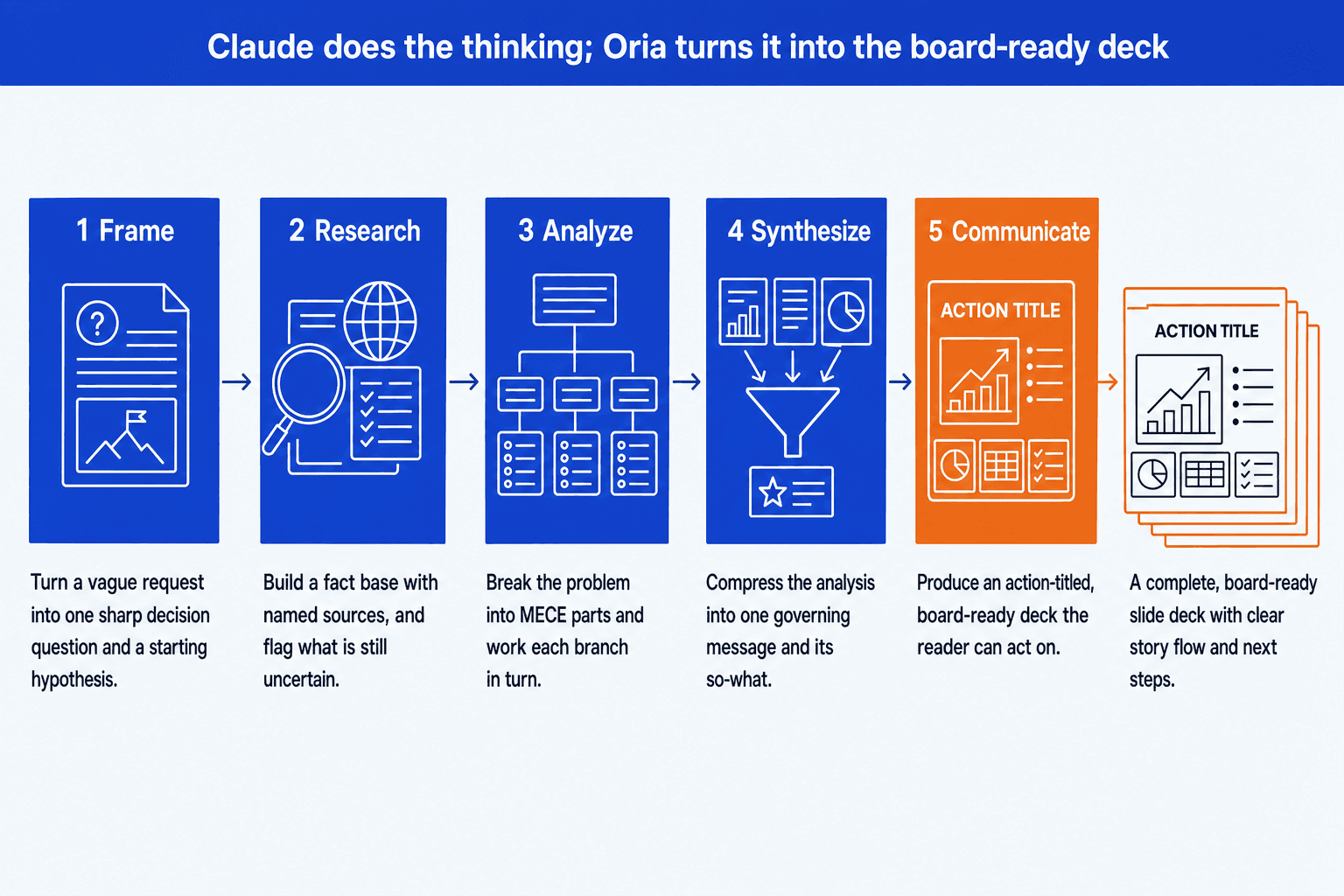
At the end of the ten-skill sequence, you have a complete analytical output: a scoped decision question, a profit pool map with white space identified, evaluated options with economics and risk scoring, a hostile Q&A log with prepared responses, and a Pyramid Principle storyline. Each of those artifacts maps directly to one or more slides.
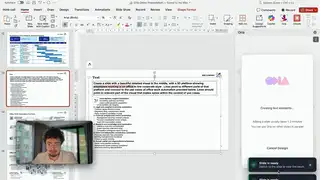
Converting that structured output into a deck a board can read is where Oria handles the next step. Oria is an AI add-in that runs inside PowerPoint and takes a rough outline or detailed text and produces fully editable, on-brand slides with the dense, multi-element layouts that strategy work requires: option comparison grids, initiative roadmaps, executive summary layouts, and Pyramid Principle narrative structures. Every element is native PowerPoint and stays editable after generation.
The division of labor is clean. Claude handles the analytical work. Oria handles the visual output.
Claude handles
- Decision question scoping and problem diagnosis
- Profit pool mapping and white space identification
- Options generation and trade-off evaluation
- Hostile Q&A simulation and assumption stress-testing
- Pyramid Principle storyline and executive summary
Oria handles
- Converting structured output to slide layouts
- Option comparison grids and evaluation matrices
- Initiative roadmaps and timeline visuals
- Executive summary and Pyramid Principle slide structures
- On-brand, fully editable PowerPoint output
Frequently asked questions
Do I need all 10 skills on every engagement?
No. Each skill works independently. The Problem Diagnosis and Decision Question Formulation skills are valuable on their own even if the rest of the workflow stays manual. For shorter projects, the Pyramid Principle Storyline and Hostile Q&A skills can be activated at the output stage without running the earlier skills. Use what the situation requires.
What is a Claude skill and how is it different from a prompt?
A Claude Skill is a reusable instruction package that Claude can apply when a task matches it, while a prompt is the instruction you give in a particular conversation. This page is an editorial map of ten strategy workflows; it does not include verified downloadable SKILL.md files. You can still use each workflow as a structured prompt, or author and validate your own Skill from it.
Which skills matter most if I only have time for a few?
The two most high-leverage skills in the sequence are Problem Diagnosis and Pyramid Principle Storyline. The first prevents the team from working on the wrong question. The second ensures the final output is structured for a senior audience. If you activate only two, start with those.
Can the skills handle proprietary data?
The workflows tell Claude how to process the context you provide, but this guide cannot make guarantees about storage or sharing. Before using proprietary briefs, market data, or draft analysis, follow your organization's data policy and review the current terms and controls of the Claude plan you use.
What does Claude produce at the end of the sequence?
A complete analytical output: a scoped decision question, a profit pool map with white space identified, evaluated strategic options with economics and risk scoring, a hostile Q&A log with responses, and a Pyramid Principle storyline. The slides come separately. Oria converts the structured output into fully editable, board-ready PowerPoint slides inside your corporate template.