

67 Autonomous Strategy Agents for Claude, End to End
Not prompts. 67 autonomous strategy agents for Claude that map market signals, size opportunities, design operating models, and brief the board, so strategy work stops living in decks and starts running itself.
What these strategy agents are
A full strategy function, agentized. These are 67 autonomous strategy agents for Claude, not one-off prompts. Together they run an entire strategy department end to end: they read the outside world, turn ambition into goals, find who to serve, size where to bet, build the path to market, pressure-test where value sits, design the operating model, prepare for what is next, and close the loop from decision to delivery.
Each agent is a small, uploadable workflow that teaches Claude to perform one high-value strategy task with a repeatable, named method. Run one on its own, run a group for a phase, or chain the full set so the work flows from market signal to boardroom without living in a pile of decks. They pair naturally with our 21 strategy skills for Claude.
Mechanically, each agent is one folder with a SKILL.md file, grouped by function inside the zip. Install just the ones you need, or load the full set into a Claude Project.
Download all 67 agents
One zip, one folder per agent. Free, no signup.
The 67 Strategy Agents You Get
The set is grouped into nine functions. They run in the order a real strategy department does, sense the market first, govern delivery last, but every agent is also useful on its own.
One strategy function, nine agent groups
Group 1 · 6 agents
Market Intelligence Agents
Read the outside world before recommending anything. These agents build the fact base: signals, trends, rivals, and the options the market actually leaves open.
Market Sensing
Use when: You need an early read on shifts before they hit the numbers
Output: PESTEL scan with weak signals and so-what implications
Trend Radar
Use when: Too many trends compete for leadership attention
Output: Trend radar ranked by impact and certainty across three horizons
Competitor Scan
Use when: You need a structured read on who you are up against
Output: Competitor profiles and a likely-moves map
SWOT Builder
Use when: The team needs one honest internal-external picture
Output: Evidenced SWOT plus TOWS action pairings
Scenario Planning
Use when: The future is uncertain and one forecast is not enough
Output: Four named scenarios on a two-axis matrix with signposts
Growth Options
Use when: Leadership is debating where growth should come from
Output: Growth options mapped across products and markets
Group 2 · 5 agents
Vision and Goals Agents
Turn ambition into a structure the whole organization can execute against: the few priorities that matter, a clear vision, and goals that cascade into measurable targets.
Strategic Priorities
Use when: Everything feels important and nothing gets finished
Output: A short list of must-win priorities with rationale
Vision Drafting
Use when: The organization needs a destination worth committing to
Output: A vision statement with a long-horizon ambition
Mission Alignment
Use when: Purpose and day-to-day work have drifted apart
Output: A mission articulation linking why, how, and what
Goal Cascade
Use when: Top goals are not connecting to team objectives
Output: A cascaded objective tree from company to team
KPI Design
Use when: Metrics are noisy, lagging, or gamed
Output: A KPI tree of leading and lagging measures tied to decisions
Group 3 · 6 agents
Customer and Offer Agents
Find who to serve, what they actually need, and what to charge. These agents ground strategy in real demand instead of internal assumptions.
Value Proposition
Use when: The offer does not clearly connect to what customers value
Output: A value proposition mapped to gains, pains, and jobs
Customer Segment
Use when: One-size messaging is failing across different buyers
Output: Needs-based segments with priorities and fit
Persona Mapping
Use when: Teams design for an average user who does not exist
Output: Decision-oriented personas with goals and blockers
Need Discovery
Use when: You suspect you are solving the wrong problem
Output: A prioritized need map with underlying drivers
JTBD
Use when: You want the job the customer hires the product to do
Output: Job statements with desired outcomes and constraints
Pricing Strategy
Use when: Pricing power, discounting, or packaging is unclear
Output: A pricing recommendation with value and willingness-to-pay logic
Group 4 · 6 agents
Portfolio and Innovation Agents
Decide where to place bets and how big. These agents size the prize, shape the roadmap, and separate the bets worth funding from the ones that only look exciting.
Portfolio Strategy
Use when: Resources are spread thin across too many bets
Output: A portfolio view by attractiveness and strength with allocation calls
Product Roadmap
Use when: The roadmap is a wish list without sequence
Output: A now-next-later roadmap tied to strategic themes
Innovation Thesis
Use when: Innovation spend lacks a clear where-to-play logic
Output: An innovation thesis with focus areas and no-go zones
Opportunity Sizing
Use when: A bet needs a defensible size before it gets funded
Output: A sized opportunity with assumptions and ranges
TAM Estimation
Use when: You need a credible total-market number two ways
Output: A top-down and bottom-up TAM with a reconciliation
Demand Forecast
Use when: Planning needs a forecast built on real drivers
Output: A driver-based demand forecast with scenarios
Group 5 · 11 agents
Go-to-Market Agents
Build the path from strategy to market: channels, partners, positioning, and the category itself. Eleven agents that turn a chosen direction into a reachable customer.
Channel Strategy
Use when: You need the right route to reach and serve buyers
Output: A channel mix with economics and coverage logic
Partnership Strategy
Use when: You must decide what to build, borrow, or buy
Output: A partnership plan with fit and value-share logic
Ecosystem Mapping
Use when: Value is created across players, not by one firm
Output: An ecosystem map of roles, flows, and control points
Geographic Expansion
Use when: You are choosing which markets to enter first
Output: A ranked market shortlist with attractiveness and distance
Market Entry
Use when: A target market is chosen and the how is open
Output: An entry-mode recommendation with risks and staging
Go-to-Market
Use when: A product needs a coherent launch motion
Output: A GTM plan across motion, funnel, and metrics
Brand Positioning
Use when: The brand does not own a clear place in the mind
Output: A positioning statement with frame, target, and proof
Messaging Strategy
Use when: Teams say different things to the same buyer
Output: A message house of core idea, pillars, and proof
Differentiation
Use when: The offer looks the same as every competitor
Output: Points of difference and parity with defensibility
White Space
Use when: You are hunting for uncontested demand
Output: A white-space map with attractive unmet needs
Category Design
Use when: You want to define the game, not just play it
Output: A category point of view with problem and worldview
Group 6 · 8 agents
Corporate Development Agents
Pressure-test where the real value sits before capital moves. These agents screen deals, map synergies, and trace value through the cost base and the value chain.
M&A Screening
Use when: A long list of targets needs a disciplined filter
Output: A scored target shortlist against strategic criteria
Synergy Mapping
Use when: A deal case rests on synergies that need proof
Output: A synergy bridge of cost and revenue effects
Capability Audit
Use when: You must know what the organization can actually do
Output: A capability map with maturity and gaps
Resource Allocation
Use when: Money and talent are stuck in yesterday's priorities
Output: A reallocation plan by expected return
Budget Tradeoff
Use when: Every team wants more and the pool is fixed
Output: A tradeoff view ranking spend by marginal return
Cost Advantage
Use when: You need to know if your cost position can win
Output: A cost-position read with cost-to-serve drivers
Profit Pool
Use when: You need to see where money is actually made
Output: A profit-pool map across the value chain
Value Chain
Use when: You want to find advantage activity by activity
Output: A value-chain view of margin and differentiation levers
Group 7 · 10 agents
Operating Model Agents
Turn strategy into structure, ownership, and risk controls. Ten agents that decide how work gets done, who decides, and how supply and capacity hold up.
Operating Model
Use when: Strategy has no clear way of getting done
Output: An operating-model design across capabilities and governance
Org Design
Use when: The structure fights the strategy
Output: An org design with spans, layers, and accountabilities
Decision Rights
Use when: Decisions stall because no one owns them
Output: A decision-rights map by role and decision
Risk Strategy
Use when: Strategic risks have no owner or response
Output: A risk register with likelihood, impact, and mitigations
Regulation Watch
Use when: Regulatory change could reshape the plan
Output: A regulatory horizon scan with exposure and actions
Policy Impact
Use when: A policy shift needs a business impact read
Output: A policy impact assessment with scenarios
Supply Strategy
Use when: Supply risk or cost threatens the strategy
Output: A supply strategy segmented by risk and spend
Sourcing Options
Use when: You must choose make, buy, or partner
Output: A sourcing recommendation with tradeoffs
Network Design
Use when: Footprint and flows are not optimized for cost or service
Output: A network design balancing cost and service
Capacity Planning
Use when: Demand and capacity are out of step
Output: A capacity plan matched to demand scenarios
Group 8 · 7 agents
Future-Readiness Agents
Build the strategy for the strategy to survive what comes next: resilience, sustainability, and the digital, data, and AI foundations the plan will depend on.
Resilience Strategy
Use when: The plan could break under a serious shock
Output: A resilience plan with stress tests and buffers
Sustainability
Use when: Sustainability needs to connect to real value
Output: A materiality-based sustainability priority list
ESG Strategy
Use when: ESG commitments lack a coherent strategy
Output: An ESG framework with priorities and metrics
Digital Strategy
Use when: Digital investment lacks a value-linked plan
Output: A digital strategy tied to value pools and maturity
AI Adoption
Use when: AI ideas are everywhere and focus is missing
Output: A prioritized AI use-case portfolio
Data Strategy
Use when: Data is an asset the strategy cannot yet use
Output: A data strategy across value, governance, and foundations
Automation Strategy
Use when: You need to know what to automate first
Output: An automation roadmap ranked by value and effort
Group 9 · 8 agents
Delivery and Governance Agents
Close the loop from decision to delivery: run the transformation, ready the people, brief the board, and keep execution honest against the strategy.
Transformation PMO
Use when: A transformation needs a spine to run on
Output: A transformation office design with value tracking
Change Readiness
Use when: A change could stall on people, not plan
Output: A change-readiness assessment with actions
Stakeholder Map
Use when: The recommendation must survive the room
Output: A power-interest stakeholder map with engagement plan
Board Briefing
Use when: The board needs a crisp, decision-ready pack
Output: A board briefing structured for a decision
Executive Narrative
Use when: The story does not land in the first minute
Output: A top-down executive narrative with a governing thought
Initiative Tracker
Use when: Too many initiatives run with no shared view
Output: An initiative portfolio tracker with status and value
Strategy Review
Use when: Strategy is set once and never revisited
Output: A strategy-review cadence with the right questions
Execution Alignment
Use when: Delivery has drifted from the strategy
Output: An alignment view linking work back to strategic goals
Groups 1 to 4 read the market and choose where to play. Group 5 builds the path to market. Groups 6 to 7 test value and design the operating model. Groups 8 to 9 keep the strategy ready and land it in delivery.
Setup Guide
Download the agents pack
The zip contains all 67 agents, one folder per agent. Each agent is a single SKILL.md file. Unzip it anywhere. Keep the whole set, or pull out just the folders you need.
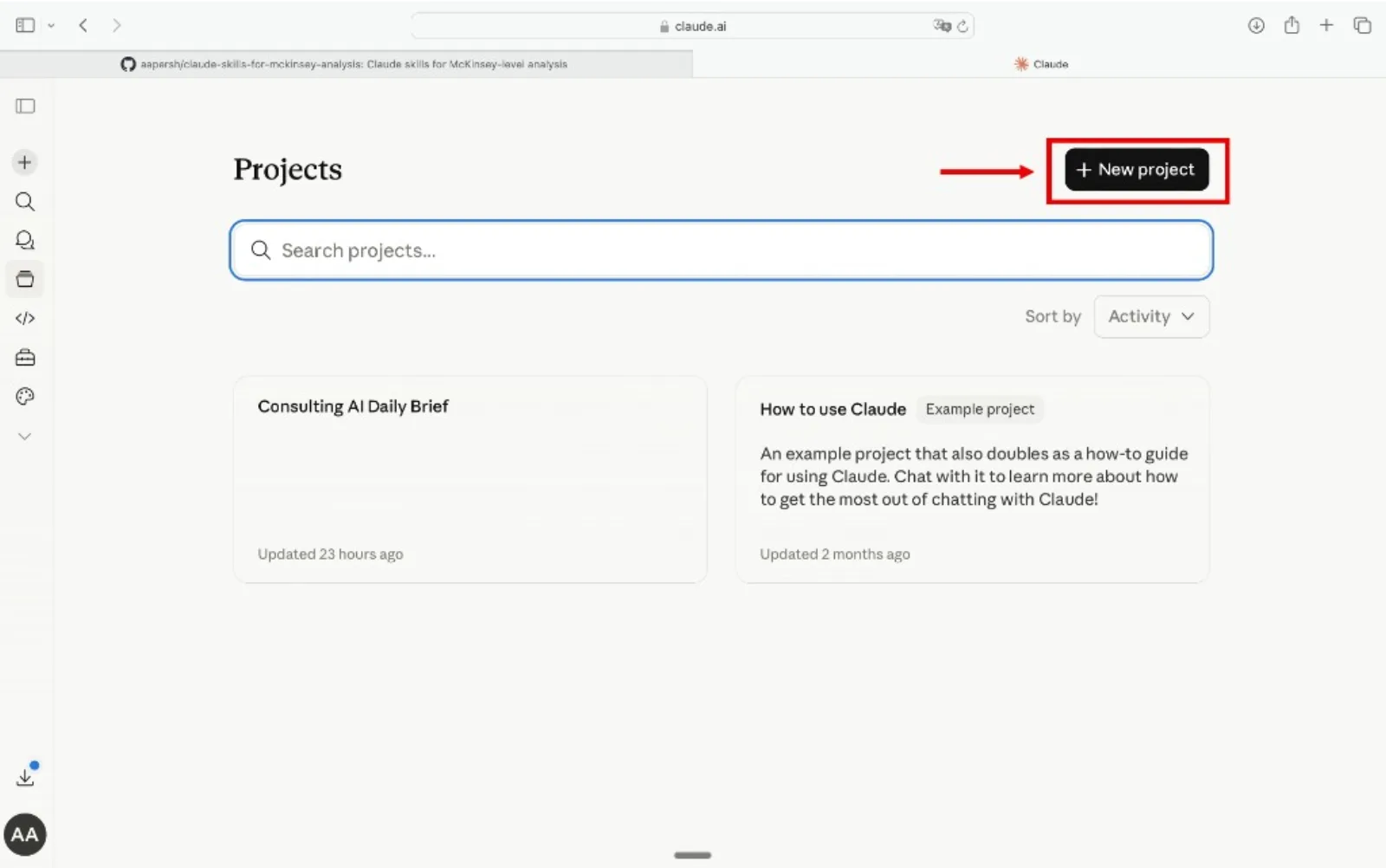
Create a Claude Project
Go to claude.ai, open the left sidebar, click Projects, then Create Project. Name it something like "Strategy Department" so you can reuse it across engagements.
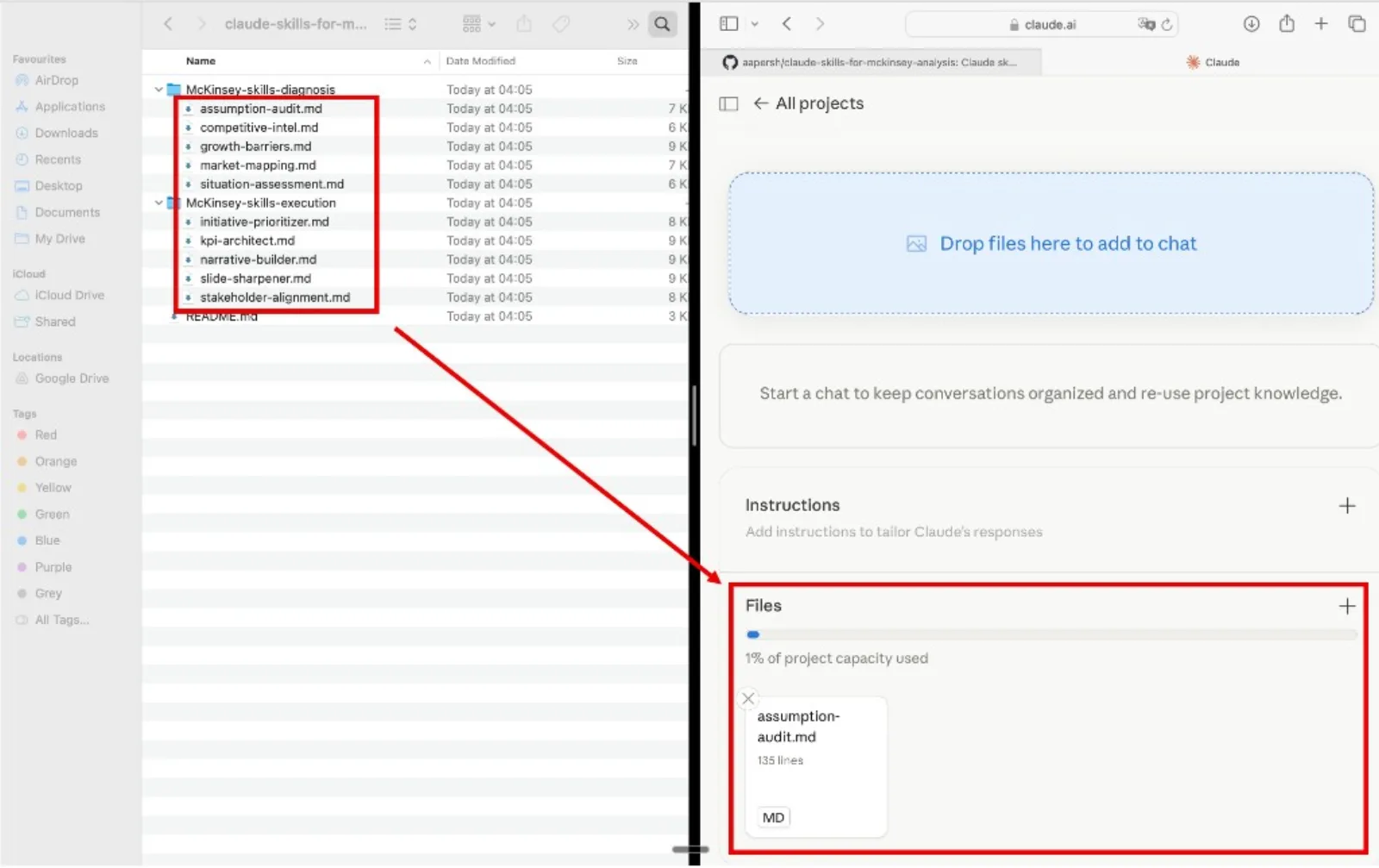
Add the agents as Project Knowledge
Inside your project, open Project Knowledge, click Add Content, and upload the .md files. Add as many as you want, one agent, an entire group, or all 67. Claude references them automatically in every conversation inside that project.
Run the agents
Open a new conversation inside the project, paste in your data, and name the agent you want Claude to run. Claude reads it from project knowledge and runs the analysis with the framework already loaded. Chain several to move from market signal to board briefing in one sitting.
Tip
Refer to the agent by name in your prompt. Phrases like "Run the market-sensing agent" or "Use the opportunity-sizing agent" point Claude at the right framework instead of leaving it to guess.
Example prompts
- "Run the market-sensing agent on the European payments market and hand the signals to the growth-options agent."
- "Use the opportunity-sizing agent to size a B2B onboarding product two ways."
- "Run the operating-model agent, then the decision-rights agent, to turn the strategy into how work gets done."
- "Use the board-briefing agent to turn this recommendation into a decision-ready pack."
Where to start
Sixty-seven agents is a department, not a to-do list. Pick the row that matches what you need this week and run that agent first.
The quality bar
Every agent is designed to push Claude toward outputs that meet the same partner-grade quality bar, the standard a senior strategist would hold each deliverable to before it leaves the room.