

10 Claude Skills for Strategy Professionals
Framework-grounded workflows that replace ad-hoc strategy work. They run inside Claude, use the language of management consulting, and apply the methods a strong strategy team uses to diagnose, choose, execute, and communicate.
Independent and unaffiliated. The skills, prompts, and frameworks referenced on this page are not created by, endorsed by, or affiliated with any consulting or financial-services firm whose methods may be referenced here. They are built on publicly available frameworks and ways of working, and are inspired by how such approaches are used to tackle complex business problems.
Claude skills for strategy professionals
Ten skills take a strategy question, such as diagnosing where the business really is, finding the growth barrier, prioritizing initiatives, or building a partner-review narrative, and run it through proven methods including MECE, SCQA, the Pyramid Principle, Porter's Five Forces, jobs-to-be-done, theory of constraints, pre-mortems, and war-gaming.
Each source-verified skill is packaged locally as one folder with a SKILL.md file. Upload it through Claude's Skills settings and name it in your prompt. The output is structured, framework-grounded, and written in the register of a senior consulting associate briefing a partner.
These work for consulting teams as well as in-house strategy groups. Our consultant's guide to Claude explains how to fit them into engagement work.
Download all 10 skills
One zip, one folder per skill. Free, no signup.
The 10 skills you get
Diagnosis
Situation Assessment
What it does: Establish a fact-based truth about where the business actually is, before any recommendation is made. Uses SCQA, three-lens performance triangulation (financial / market / operational), 2x2 performance mapping, and MECE issue trees.
Competitive Intel
What it does: Model competitor capabilities and likely next moves. Uses Porter's Five Forces, a three-ring competitive set, a force-ranked capability matrix, behavioral thesis writing per competitor, and pre-committed response logic.
Market Mapping
What it does: Size the market and find white space. Uses TAM / SAM / SOM with top-down and bottom-up triangulation, jobs-to-be-done segmentation, a demand vs. supply quality quadrant, and growth decomposition.
Assumption Audit
What it does: Surface and stress-test the unstated beliefs underneath a strategy. Uses an assumption register, importance × confidence 2x2, A to F evidence grading, kill-shot test design, and a pre-mortem narrative.
Growth Barriers
What it does: Identify the real constraint holding growth back. Uses arithmetic growth decomposition, inflection point dating, a full funnel waterfall, cohort retention curves, MECE issue trees, and five-whys to structural cause.
Execution
Initiative Prioritizer
What it does: Reduce a long initiative list to the 3 to 5 that matter and sequence them. Uses an impact × feasibility 2x2 with capital as bubble size, capacity slot modeling, dependency-aware sequencing, kill lists, and pre-committed kill criteria.
Stakeholder Alignment
What it does: Map who needs to say yes and design the engagement plan to get them there. Uses an influence × interest 2x2, motivation analysis per key player, engagement cards per swing vote, and a pre-mortem of the formal decision meeting.
Narrative Builder
What it does: Build the story that lands a recommendation in the first sixty seconds. Uses the Pyramid Principle, SCQA, a three-level supporting pyramid, a Day-1 slide, four narrative lengths, and hostile-question preparation.
KPI Architect
What it does: Design the metrics system that ties daily operations to strategic outcomes. Uses a north-star metric, MECE KPI tree decomposition, a three-layer metric set, target triangulation, action thresholds, and proxy-failure stress tests.
War-Gaming
What it does: Stress-test a strategy against realistic opposition. Uses structured scenario design, a four-role team (Blue / Red / Yellow / Control), three-turn execution with second and third-order effects, failure mode registration, and pre-committed response thresholds.
Skills 1 to 5 sharpen the thinking before commitment. Skills 6 to 10 carry the strategy from decision to delivered result.
Setup Guide
- Step 1Download all 10 skills (.zip)
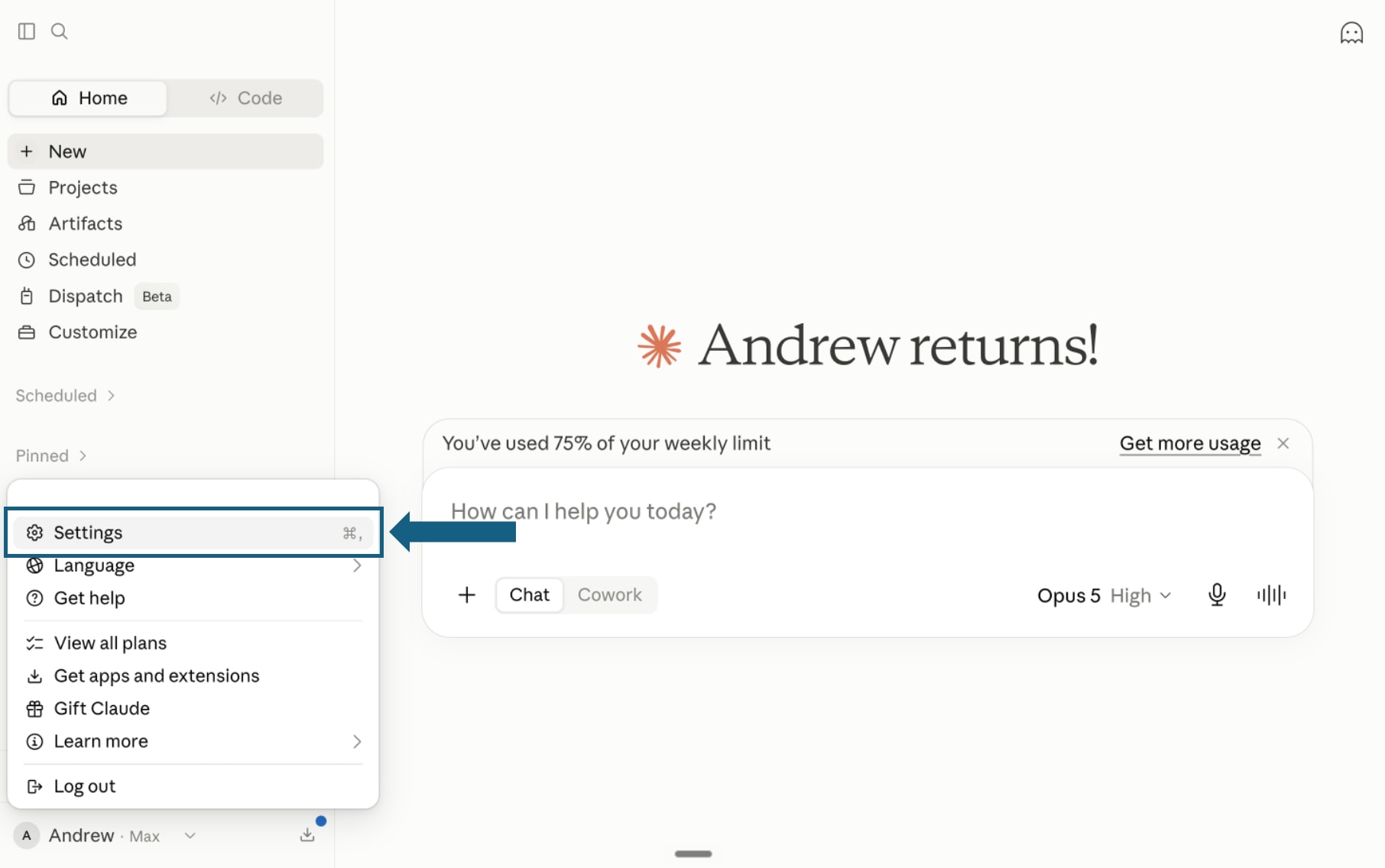
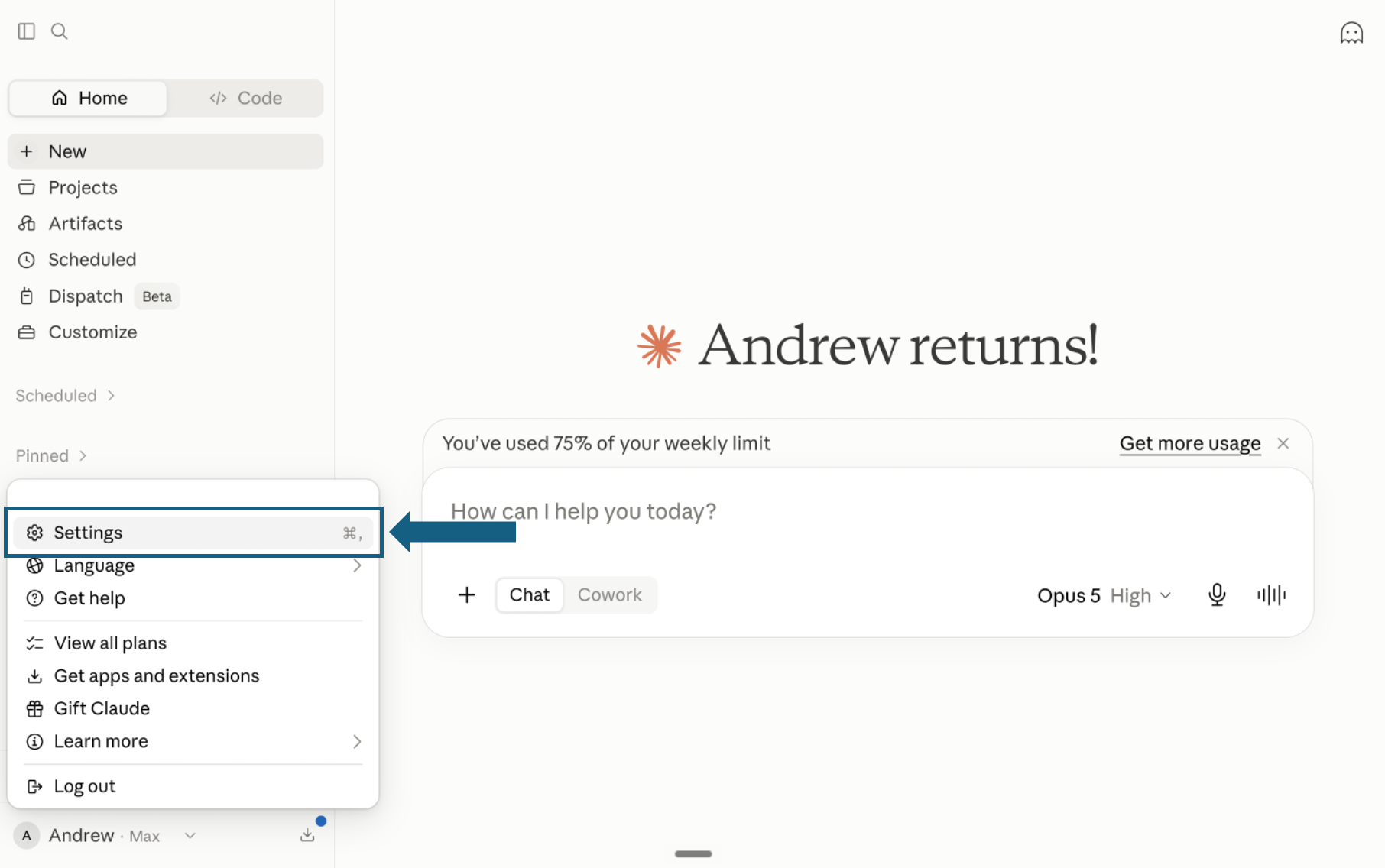
Download the pack and open Settings
Download and unzip the pack so every skill remains in its own folder with a SKILL.md file. In Claude, open your profile menu and select Settings.
Open the screenshot to view it full size. - Step 2
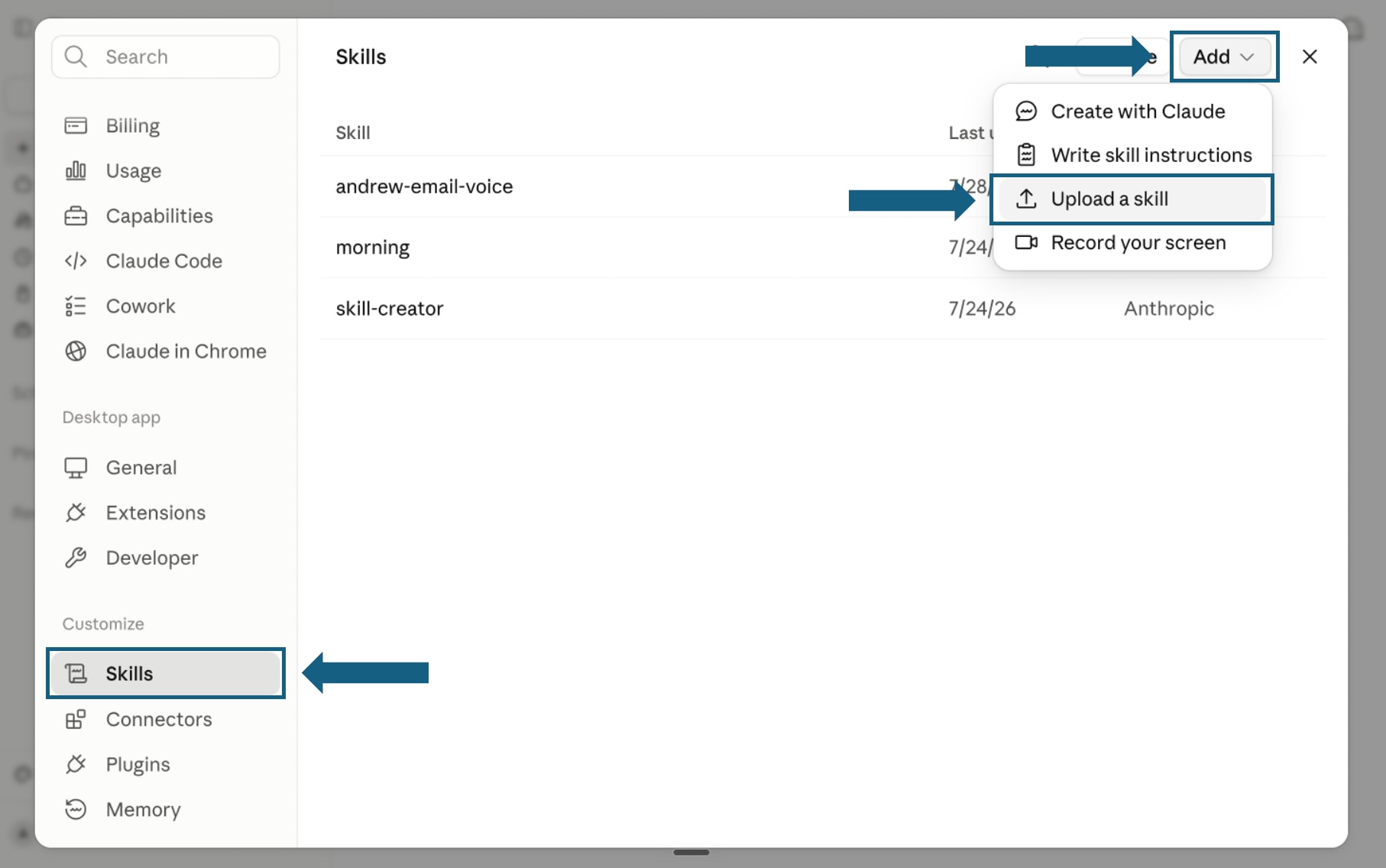
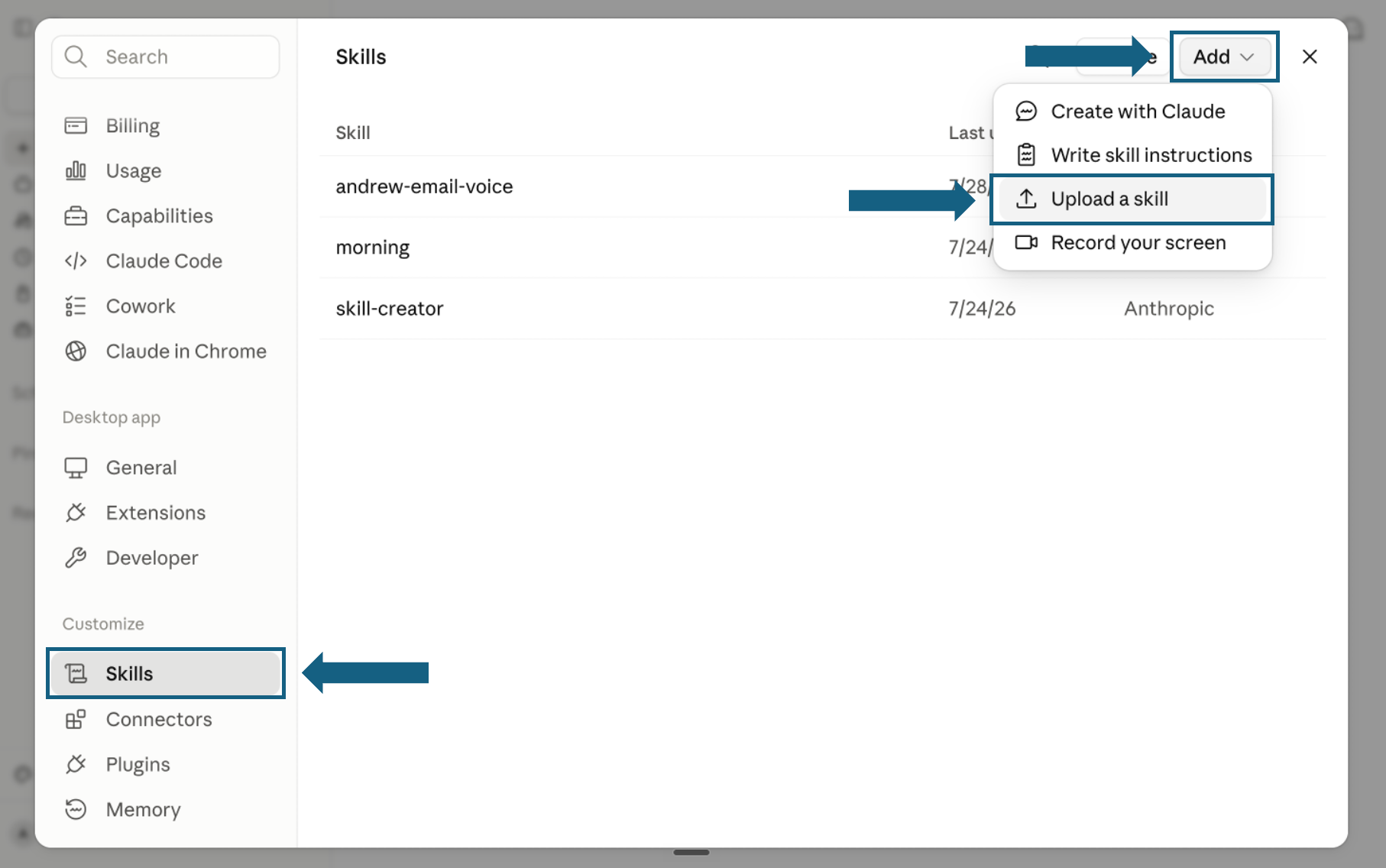
Open Skills and start an upload
In Settings, select Skills under Customize. Open Add and choose Upload a skill.
Open the screenshot to view it full size. - Step 3
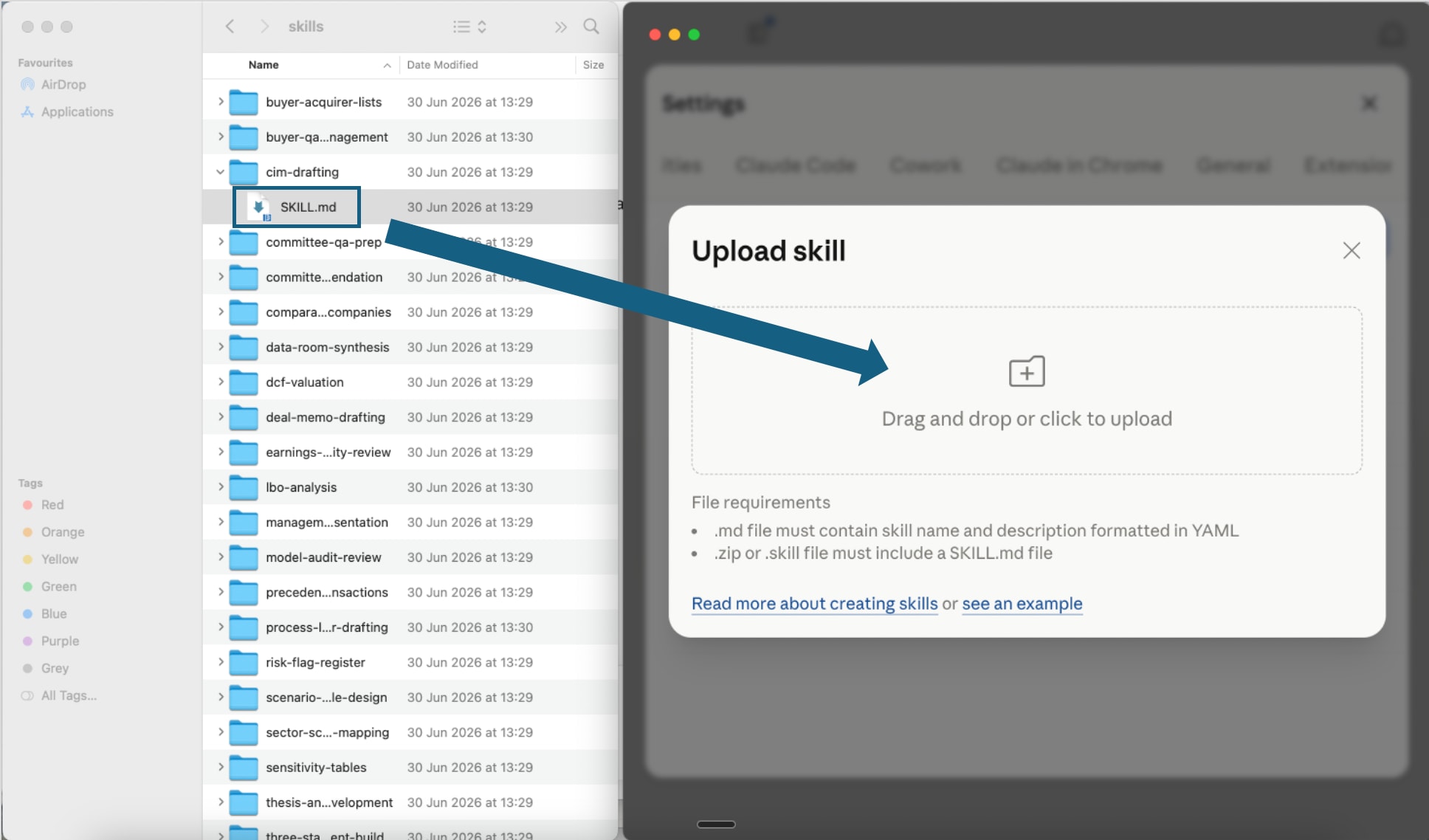
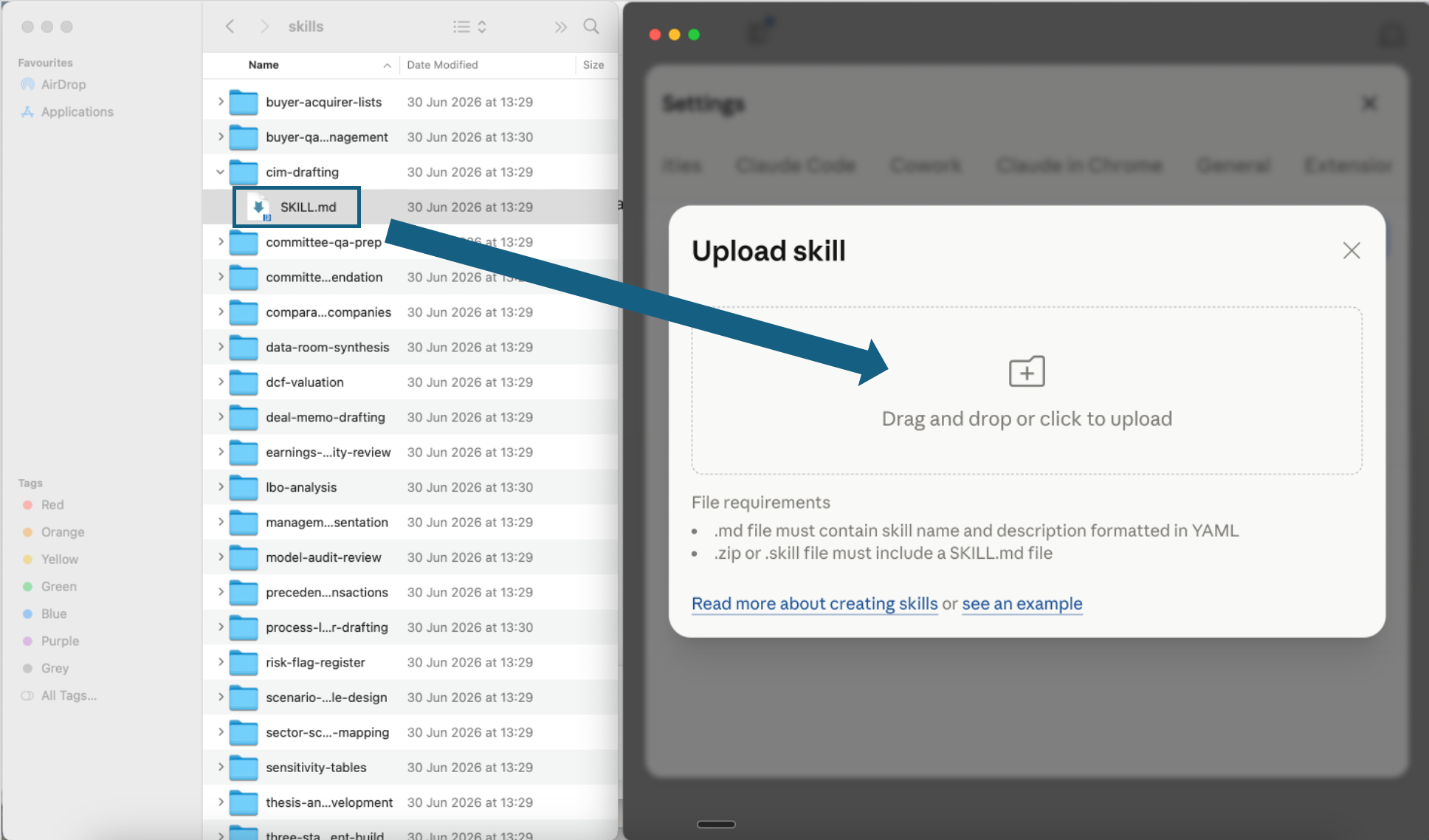
Upload one skill file
Open one extracted skill folder and drag its SKILL.md file into the upload window, or use the file picker. Repeat for every skill you want.
Open the screenshot to view it full size. - Step 4
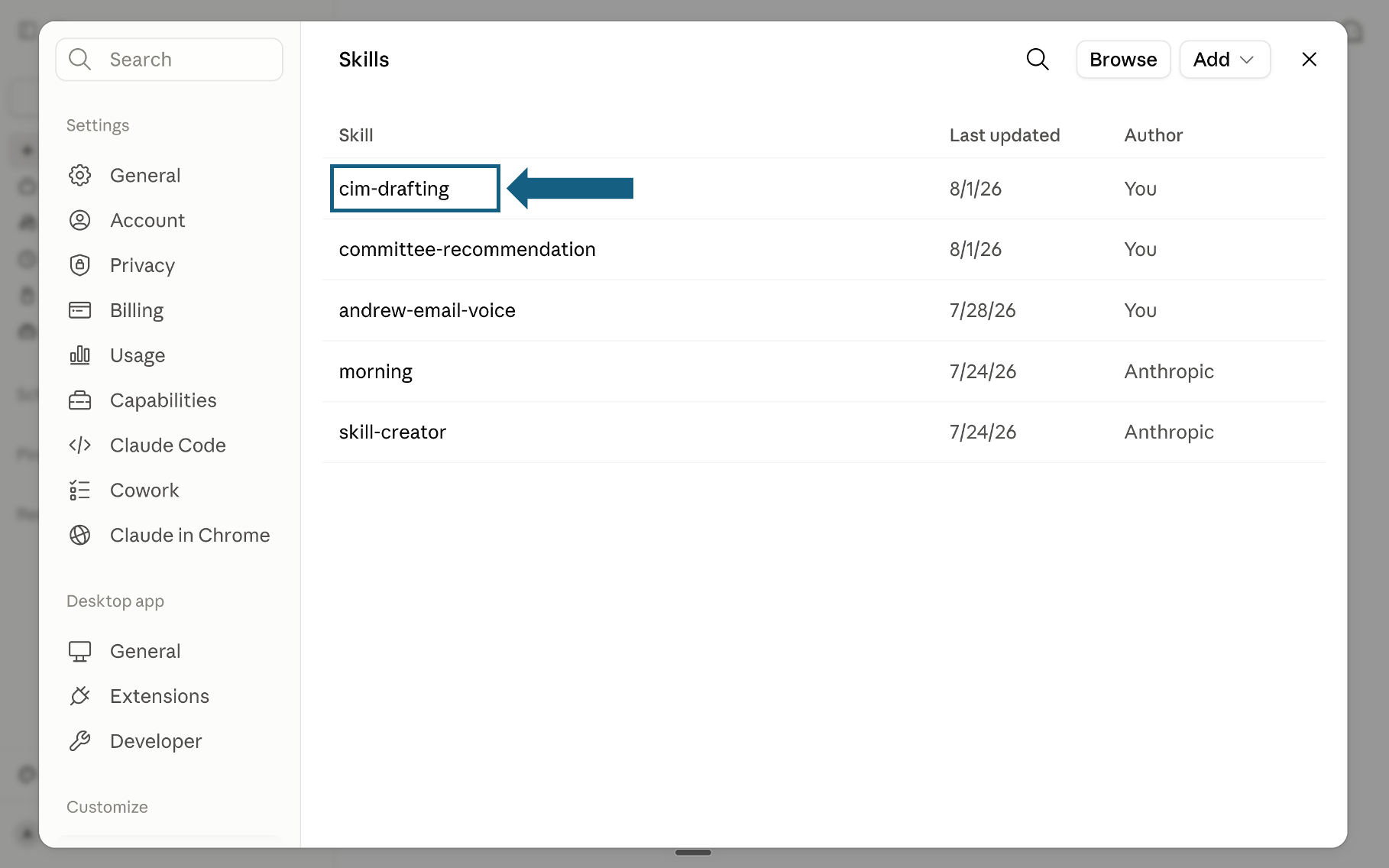
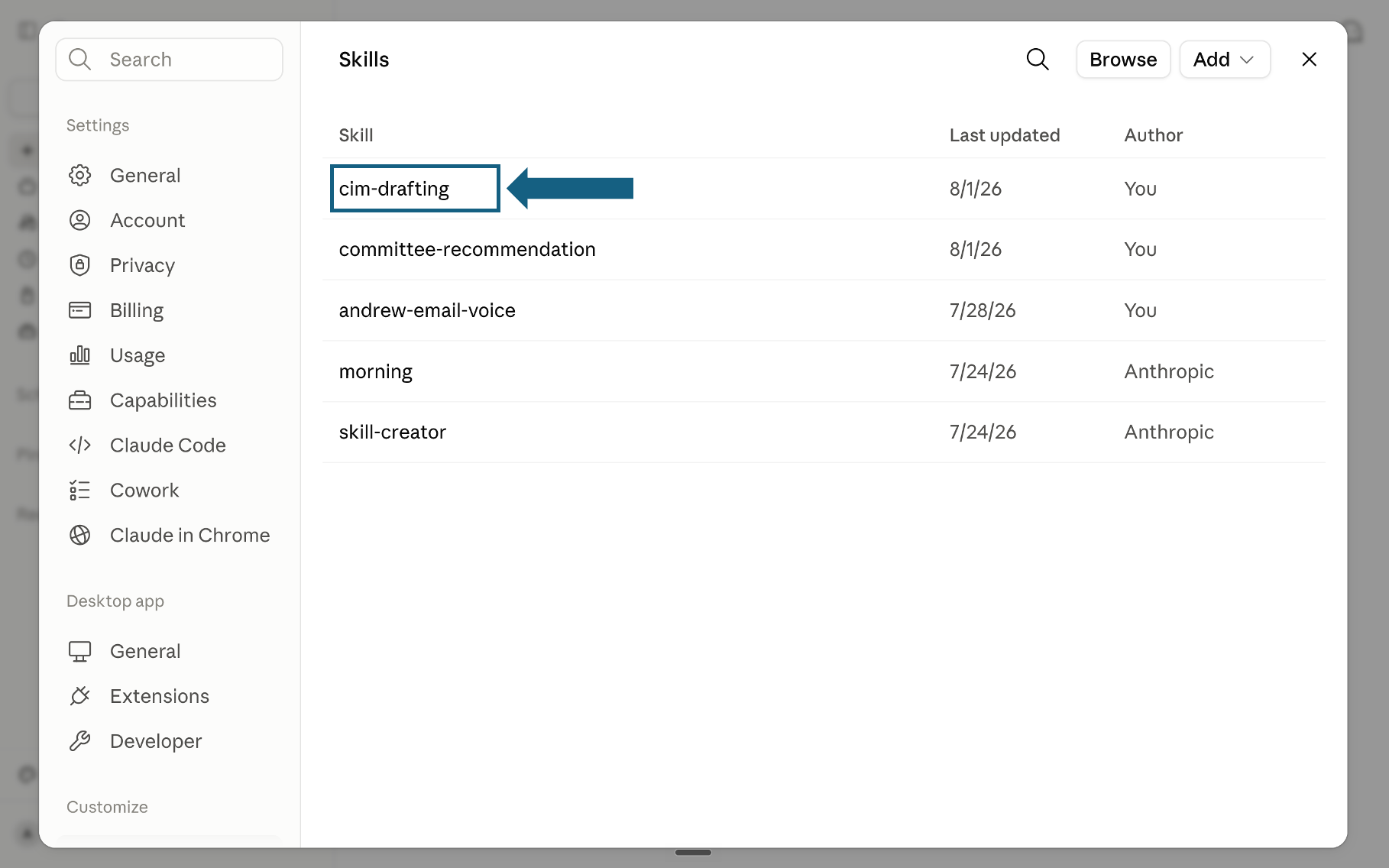
Confirm the skill was added
Return to the Skills list and check that the skill appears. Select its name to open it.
Open the screenshot to view it full size. - Step 5
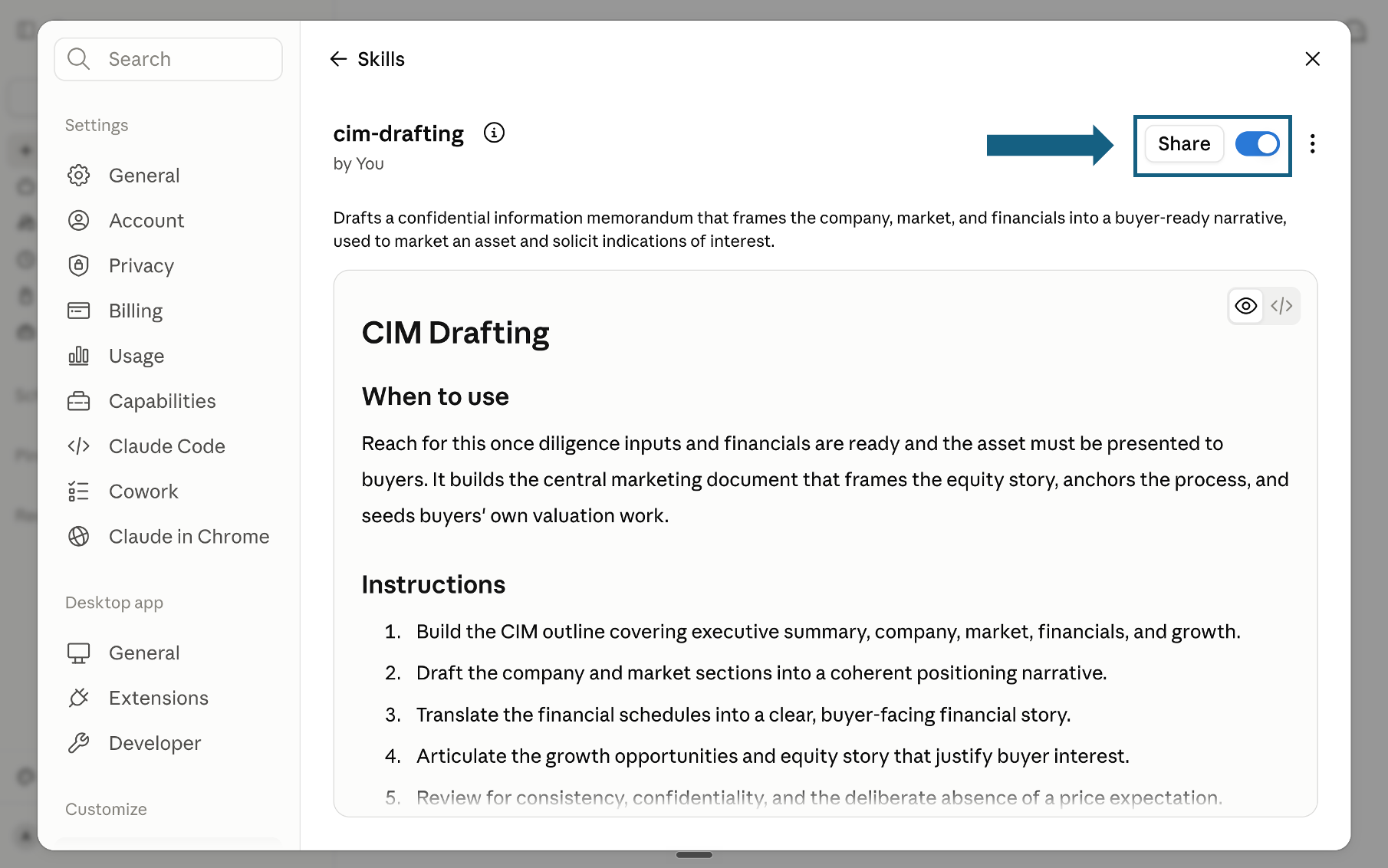
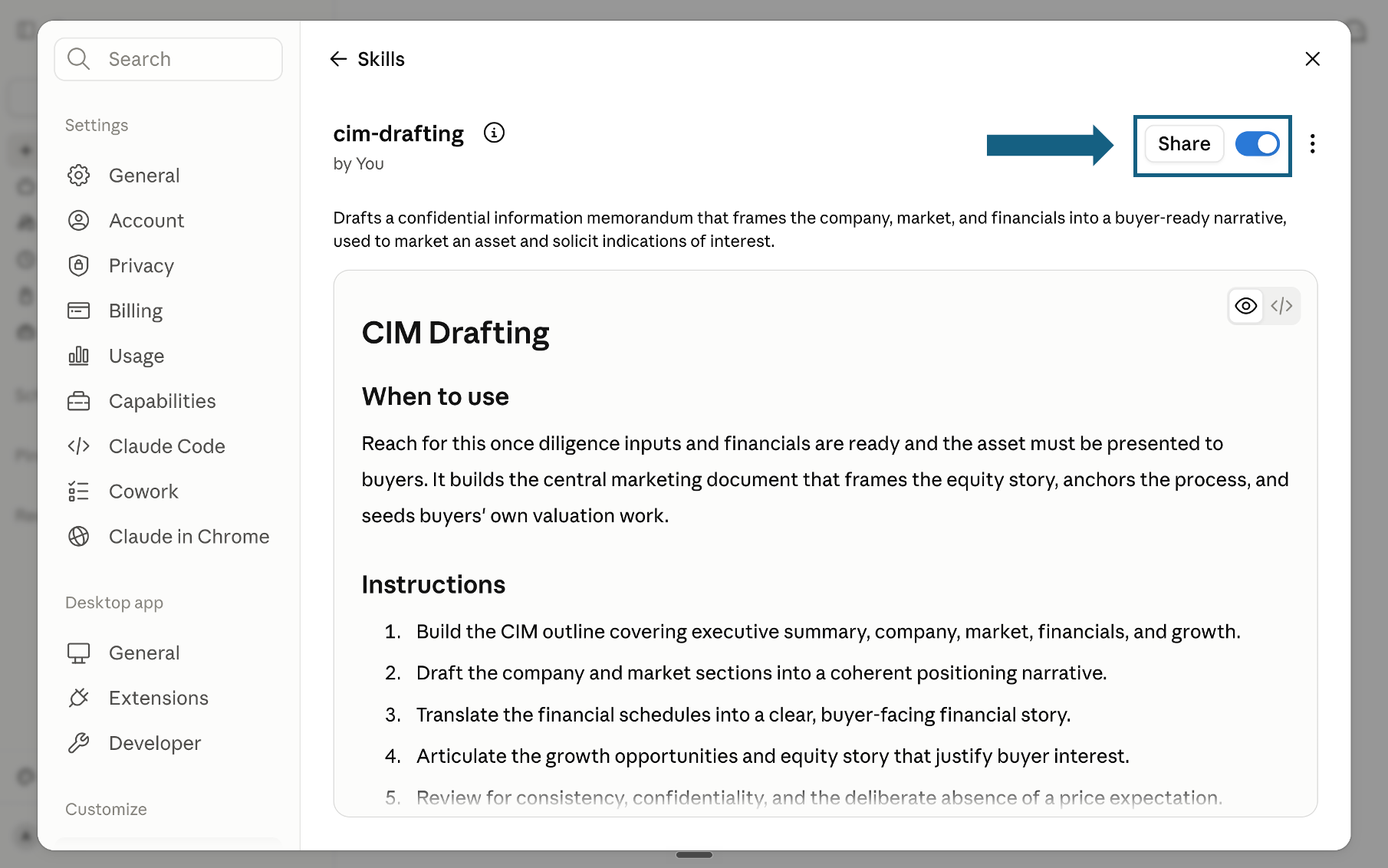
Review and turn on the skill
Review the skill's name, description, and instructions, then make sure the switch beside Share is on. A blue switch means the skill is turned on; sharing it is optional.
Open the screenshot to view it full size.
Try a skill
Name the skill and provide the business context, data, and decision question. Review every output before sharing it.
- "Use the situation-assessment skill to diagnose this business using financial, market, and operational evidence."
- "Use the market-mapping skill to size this opportunity and identify the most attractive white space."
- "Use the initiative-prioritizer skill to reduce these 18 initiatives to the few our capacity can support."
- "Use the war-gaming skill to stress-test this market-entry strategy against competitor response."
The 4 most used
1. Situation Assessment
Feed it the business context, recent performance data, and the question you have been asked. It returns a fact-based picture of where the business actually is, what the real problem is, and what is and is not yet known. It uses SCQA, MECE issue trees, and three-lens triangulation.
Replaces the "open ten tabs and re-read the deck three times" warm-up before a real conversation can start.
2. Growth Barriers
Decomposes growth into new, expansion, churn, and contraction. Identifies the inflection point, walks the full funnel waterfall, reads the cohort retention curves, and traces the structural constraint with five-whys. Outputs the real bottleneck, not the loudest one.
Run on any business asking "why has growth slowed?" before you propose a single initiative.
3. Initiative Prioritizer
Takes a long list of candidate initiatives and reduces it to the 3 to 5 that matter. Plots each on impact × feasibility, sizes capital, models capacity, sequences for dependencies and cash flow, and writes an explicit kill list with reasons.
Run before any strategy meeting where the list of "things we could do" has crossed twelve items.
4. Narrative Builder
Builds the recommendation story using the Pyramid Principle and SCQA. Produces a Day-1 slide, four narrative lengths (30 seconds / 2 minutes / 10 minutes / 60 minutes), and a list of hostile questions with answers ready.
Use the night before any partner review, steerco, or board update.
The frameworks under the hood
Every skill is grounded in a specific consulting framework. Each one names the framework it uses, the steps it follows, the hypotheses it pressure-tests before sharing, and the failure modes it watches for.