

9 Claude workflows for strategy
The strategic consultant's operating system. Nine copy-paste Claude prompts that schedule the weekly scans, syntheses, issue trees, and executive memos a strategy team actually runs. Paste, set the cadence, walk away.
What this is
The same strategic questions come back every week: what changed, what competitors did, what signal matters, and what the partner needs to know by Monday.
Instead of answering them manually, you can schedule them. The workflows below are copy-paste Claude prompts with a clear cadence, mode, and expected output.
No platform, no dashboard, no setup. Just structured prompts for consultants, founders, analysts, and strategy teams who need senior-associate-level briefings on repeat.
Cadence over effort
Strategy compounds when the same questions run on a clock, not when someone heroically does them once.
Frameworks, not vibes
Each workflow names the frame it uses (MECE, JTBD, SCQA, Pyramid Principle) and runs it explicitly.
Output the executive reads
Every workflow ends in a format senior leaders actually read: a memo, a narrative, a one-page brief.
The 4 most used
Start here. These four cover ~80% of the value in the first month, with anchors across industry, competitor, and brand intelligence.
Industry Pulse Brief
Open the month with the trends, voices, and capital flows that matter.
Weekly Competitor News Scan
Know what each competitor moved on, before the partner asks.
Company Reputation Pulse
Hear what the market is actually saying about you this week.
AI & Market Signal Monitor
Convert the news firehose into three signals that matter.
The 9 prompts · 3 categories
Industry → Competitor → Brand. The same arc a senior associate runs in their head: market, peers, ourselves, written down and put on a clock.
Industry intelligence
Zoom out first. Three workflows that read the industry, including trends, capital flow, regulatory action, and the strongest public statements from the people who actually move it, and synthesize the result into something an executive can read in five minutes.
Open the month with the trends, voices, and capital flows that matter
Pulls a structured 30-day picture of your industry: analyst notes, earnings commentary, regulator action, and the strongest public statements from CEOs, investors, and senior policymakers. Synthesizes using a MECE structure (demand, supply, capital, policy) and ends with the implications most likely to change a board-level decision in the next 90 days.
Give me an executive-ready brief on [industry] over the last 30 days. Cover four lanes (MECE): demand-side trends, supply-side trends, capital flow, regulatory and policy shifts. Pull the strongest recent statements from the CEOs of the top 5 players, the two most influential investors, and any regulator or senior policymaker who moved the room. For each lane, write 3 lines: what changed, the evidence, and the so-what for [our company]. Separate signal (recurring across multiple sources) from noise (one-off). End with: the 3 implications most likely to change a board-level decision in the next 90 days, and the 2 leading indicators to watch next month. Tone: confident, exec-readable, no fluff.
Convert the news firehose into three signals that matter
Tracks AI launches, capability shifts, regulation, and macro signals in your sector. Filters out noise. Returns the three signals worth a five-minute conversation, each with a so-what for your roadmap and a leading indicator to watch next.
Monitor AI and market signals over the last 7 days relevant to [our sector / business model]. Cover: model launches, pricing or capability shifts, new regulation, capital flow, demand-side macro. Filter to the 3 signals most likely to change a board-level decision in the next 90 days. For each, give a 2-sentence summary, the so-what for our strategy, and the leading indicator I should watch next week.
Steal the lesson from a market that already ran the experiment
Pulls 2 to 3 international cases (different geography, similar dynamics) where the question we are debating has already played out. Compresses each into Situation → Action → Result → Lesson, with one sentence on what we should copy, what we should not, and why.
Find 2 to 3 international case studies where companies in [adjacent or analogous market] already faced [our current strategic question]. Format each as Situation, Action, Result, Lesson. End with: which lesson transfers to our context, which does not, and why. Keep it under 600 words and no executive-jargon padding.
Competitor intelligence
Zoom in. Three workflows that watch the moves competitors are actually making across announcements, positioning, pricing, hiring, and capital, then decode what each move says about their bet and what it means for ours.
Know what each competitor moved on, before the partner asks
Reads the past 7 days across earnings calls, press releases, regulatory filings, product changelogs, and senior hires for a named competitor set. Returns one paragraph per competitor with a single concluding line: what it implies for our strategy.
Scan the last 7 days for [Competitor A, Competitor B, Competitor C]. Cover earnings or investor commentary, product or pricing changes, leadership moves, regulatory or M&A news. For each, write one paragraph of facts and one line on the strategic implication for [our company]. Rank the three most material moves at the top.
Decode the moves, not just the announcements
Tracks 30 days of positioning, pricing, packaging, and partnership moves from a named competitor set. Triangulates from product changelogs, press releases, sales reps' public posts, and third-party reviews. For each move, decodes the audience it targets and the capability gap it closes, then ends with the play in your roadmap most exposed and one concrete counter-move.
Track the last 30 days of strategic moves from [Competitor A, B, C]: positioning shifts (homepage copy, ICP messaging, category framing), pricing or packaging changes, partnership announcements, and product launches. Triangulate from product changelogs, press releases, sales reps' public LinkedIn posts, and third-party review sites. For each competitor: list the 1 to 2 positioning moves that matter, the 1 pricing or packaging change, and the partnerships and what they unlock. Lead with the single move per competitor most likely to affect us, then the supporting evidence (Pyramid Principle). End with: the one play in our roadmap most exposed by these moves, and one concrete counter-move with a recommended owner and timeframe.
Read the leading indicators: hiring, funding, customer sentiment
Reads competitor job postings, recent funding, executive hires, and customer sentiment across G2, Reddit, X, and podcast mentions. Separates one-off noise from recurring signal. Returns a ranked view of which competitor is most likely to enter your segment in the next six months, with the evidence.
For [Competitor A, B, C], pull from the last 60 days: open roles (especially senior or net-new functions), funding or M&A activity, departures and incoming senior hires, and customer sentiment from G2, Reddit, X, and podcast mentions. Separate signal (recurring across stakeholders or sources) from noise (one-off complaints). Output per competitor: capability buildup (what they're hiring for and the implied bet), capital position and likely deployment, sentiment trend (positive / neutral / negative + the single recurring theme). Organize by business impact: which signal most affects our segment, our pricing, our talent pool. End with: a ranked list of which competitor is most likely to enter our segment in the next 6 months, with the evidence, and one early counter-move.
Company / Brand intelligence
Turn the camera on yourself. Three workflows that read what the market actually says about your company across press, social, podcasts, communities, and analyst commentary, then turn it into the narrative gaps you should close this quarter.
Hear what the market is actually saying about you this week
Reads what people are currently saying about your company across media, social media, podcasts, forums, and online discussions. Returns an overview of conversations and opinions organized by source, the dominant themes (praise, criticism, neutral observation), the sentiment shift since last week, and the strategic implications you should act on this week.
What are people currently saying about [our company] across media, social media, podcasts, forums, and online discussions over the last 7 days? Structure the answer as an overview of conversations and opinions, organized by source: press coverage, social media (LinkedIn, X), podcasts, communities (Reddit, niche forums). Identify the 3 dominant themes (praise, criticism, neutral observation) and quote one representative line per theme. Note any sentiment shift versus the prior week. End with the strategic implications: what we should respond to publicly, what we should ignore, and the one narrative gap we should close in our own communication this week.
Find the recurring praise, criticism, and the risks underneath
Cuts through the noise to find recurring themes in how the market talks about your company. Maps praise vs criticism by stakeholder type (customers, prospects, analysts, employees) and surfaces the two narrative risks and two opportunities that show up in more than one place.
Synthesize what's been said about [our company] across customer reviews (G2, Trustpilot, App Store), forum discussions (Reddit, niche communities), employee channels (Glassdoor, LinkedIn), and analyst commentary over the last 30 days. Cluster recurring themes (MECE): capability and product, customer service, pricing and value, brand and trust, leadership and people. For each theme, separate signal (recurring across stakeholders or sources) from noise (one-off). Map the picture by stakeholder type: customers, prospects, analysts, employees. End with: the 2 narrative risks visible in more than one place, the 2 opportunities, and one recommended next action per risk and per opportunity (with a recommended owner).
Track what analysts and influential voices say about you specifically
Tracks named-source coverage from industry analysts, journalists, newsletter writers, and influential operator voices. Captures the framing each one uses, the narrative they're building, and the factual gaps in their take. Outputs a ranked list of the three voices to engage next, by reach × accuracy of framing, and the one factual gap to fix in your own messaging.
Pull all named-source coverage of [our company] from the last 60 days: analyst notes, journalist coverage, industry newsletters, and influential operator commentary on LinkedIn, X, and podcasts. For each source, capture: the framing they use to describe us, the narrative they're building, and the factual or perception gaps in their take. Cluster sources by stance: champion, neutral, skeptic. End with: the 3 voices most worth engaging next quarter, ranked by reach × accuracy of framing, and the one factual gap we should fix in our own messaging this month. Tone: confident, exec-readable, no fluff.
How to schedule these prompts
Three steps. Five minutes. The cadence runs itself from then on.
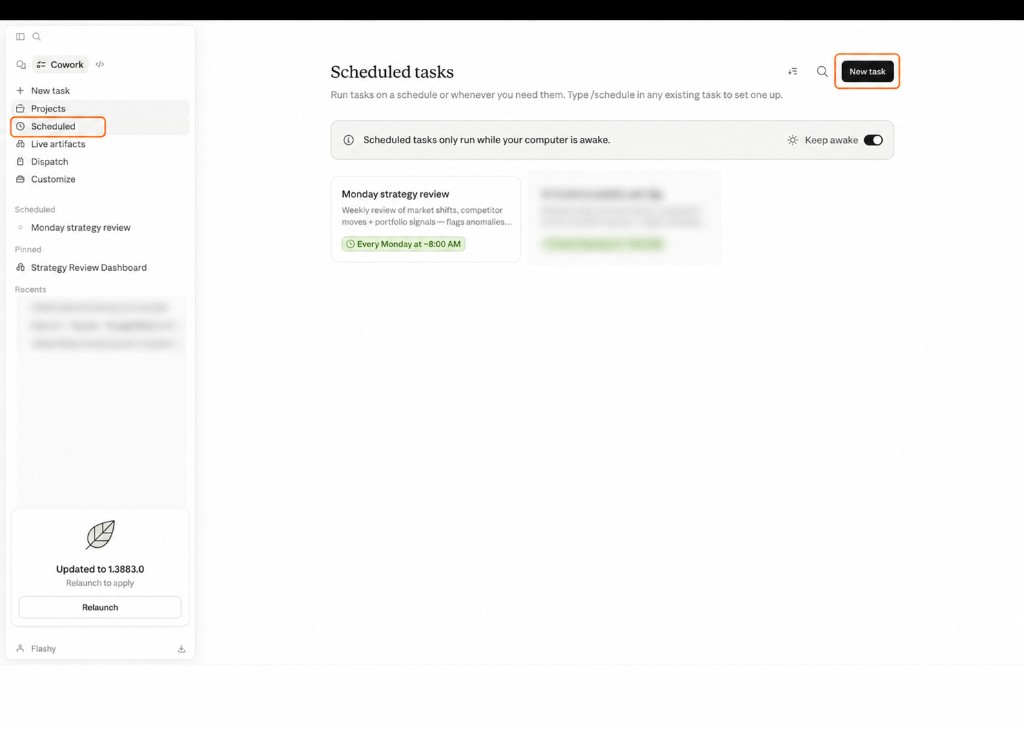
Open Claude and go to Scheduled tasks
Open Claude in your browser or the desktop app. In the left sidebar, open Cowork and click Scheduled. This is where every recurring strategy prompt lives, and where your weekly industry, competitor, and brand intelligence will land each Monday.
Create a New Task
On the Scheduled tasks page, click New task in the top right. Each task is one recurring prompt, chosen from the nine below. Give it a descriptive name ("Mon 7am · Competitor Scan" reads cleaner in your task list than "Untitled task-3") so future-you remembers what it does when it lands in the Monday review.
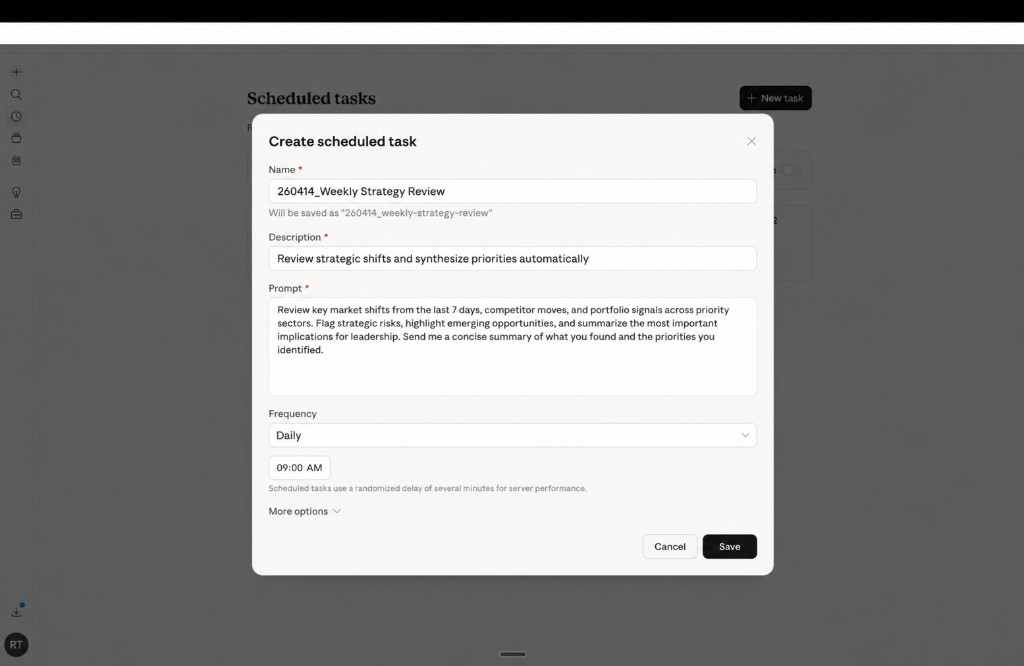
Enter the Prompt and Frequency
In the Create scheduled task modal, paste any of the nine prompts below verbatim into the Prompt field. Pick the suggested cadence under each card in the Frequency field. Save. The task fires on schedule and the result lands as a message in your Claude conversation, ready to read, react to, or paste into the deck.
Pattern
Start with the read-only ones because they observe and need no human pass. Run the review-first ones on demand for a couple of cycles before putting them on cron, so you trust the synthesis. The two output-only ones (the industry brief and the analyst tracker) are themselves the deliverable, so schedule them when you're ready to ship. The point is the cadence, not the automation.
What you get back each week
When the nine are running on cadence, this is what shows up in your inbox / Claude conversation by Monday 9am.
- An executive-ready industry brief, with the 3 implications most likely to change a board-level decision in the next 90 days.
- Three market signals worth a five-minute conversation, each with the leading indicator to watch next.
- An international case study digest, with the lesson that transfers and the lesson that does not.
- A ranked list of every material competitor move in the last 7 days, with the strategic implication for your business.
- A decoded view of competitor positioning, pricing, and partnerships, ending with the play in your roadmap most exposed and one concrete counter-move.
- A capability and sentiment watch on competitors, ranking who is most likely to enter your segment next.
- A weekly pulse on what people are saying about your company in media, social, podcasts, and online discussions, plus the narrative gap to close this week.
- A 30-day theme and sentiment synthesis across customers, prospects, analysts, and employees, with two narrative risks and two opportunities.
- A ranked list of the analysts and influential voices to engage next, with the one factual gap to fix in your own messaging.
Tone in the prompts
Every prompt above ends with the same instruction: confident, exec-readable, no fluff. Strategy outputs that get read are short, specific, and willing to commit to a position. Keep that line in your prompts even when you edit them.
FAQ
Do I need any tooling other than Claude?+
No. The nine prompts are plain text. Paste them into Claude, schedule them with Cowork (or whatever scheduler your team already uses), and the cadence runs itself. If you want live data access, such as fresh search results, your CRM, or your sheets, connect an MCP. Without one, Claude works off the context you put in the project.
Can I edit the prompts?+
Yes. Every prompt is a starting point. The exact competitor names, the exact strategic question, the geographies, and the target metric should be tuned to your context before saving. Keep the structural language ("MECE," "Pyramid Principle," "Day-1 slide," "kill list") because that's what makes the output usable.
What's the difference between read-only, review-first, and output-only?+
Read-only runs without ceremony and observes the world (the AI and market signal monitor, the case study digest, the competitor scan, the competitor capability watch, the reputation pulse). Review-first needs a human pass before it's used in a decision (the competitor positioning decoder, the theme and sentiment synthesizer). Output-only is the deliverable itself (the industry pulse brief and the analyst coverage tracker), meant to be polished and pasted into a doc, a Slack thread, or a slide.
How long until this pays off?+
Two cycles. In week one, the cadence sets in and the team gets used to opening Monday with synthesis they didn't have to make. By week two, the review meeting opens with a fact pattern and the conversation starts at "so what," not "what happened." The ROI is the meeting that no longer needs an analyst to brief it.