

Claude Finance Skills: 20 Free Skills for Valuation, FP&A and Board Reporting
The decision here is not whether Claude can do finance work. It is which parts of your month you hand over, and where the handover stops. A Claude finance skill is a written method: the sources it may use, the arithmetic it must run, the conventions it must hold, and the point at which a named person signs. Get that boundary right and a skill saves a day of assembly. Get it wrong and you have moved an unchecked assumption into a board pack. The 20 skills below cover the plan, the close, the analysis and the board narrative, and every one of them ships with its stopping rule attached. They are free, they are plain Markdown, and you can read each file before you run it.
AI Academy for Professionals





Quick answer: which Claude finance skills do you need?
Most teams do not need twenty methods on day one. They need the four that cover work repeating on a fixed calendar, and a rule for where each hands back.
For most finance teams the four Claude finance skills that earn their place first are Scenario Modeler, for base, upside and downside cases with the triggers that separate them; Revenue and Margin Monitor, for decomposing a movement into price, volume, mix and currency; Reconciliation Reviewer, for finding breaks before they reach a report; and Business Case Builder, for turning cash flows into a recommendation with explicit decision gates. Budget Architect matters if you own the annual plan. Board Deck Packager runs last, after the numbers are approved, and hands a storyline to a slide tool. Everything else in a twenty-skill pack is a variation on those five jobs.
Agent-first playbook
PDF · Skill setup, work orders, review gates, and the slide handoff
20 free Claude finance skills
ZIP · 20 Markdown definitions · Installable where supported, usable manually elsewhere

Be the person your team asks about AI
Learn it once, then set the standard the rest of the team follows
Go to AcademyHow we chose these 20 finance skills for Claude
The twenty methods were selected against five criteria, applied to work a finance team runs on a calendar rather than to demonstrations.
- Repeatability over cleverness. The method had to produce the same shape of answer twice on the same inputs. Anything that only worked because of how one person phrased it was left out.
- A stopping rule that can be stated in one line. Every skill names where it hands back. Methods where the boundary was fuzzy, such as accounting treatment, were cut rather than fenced.
- Arithmetic you can check. Preference went to methods that show a formula, emit a script or return a break list, over methods that assert a number inside a persuasive paragraph.
- What we ignored: benchmark scores and model versions. Leaderboard positions change every few weeks and none survives a plan cycle. The methods are written to be model-agnostic and to fail loudly rather than to exploit one model's strengths.
- What we ignored: sector templates and live market data. A method that only works for one industry is a template, not a skill, and anything needing a live data terminal belongs to your data team.
Key takeaways
- Judge a skill by what it demands, not what it promises. A finance skill that will accept any spreadsheet you throw at it has no conventions written into it. The useful ones refuse to start until entity, period, currency basis and approved sources are named.
- Prefer exceptions over conclusions. Output you can check in ten minutes beats output you have to believe. A break list with source references and owners is auditable; a confident paragraph about the same numbers is not, and reads better while being worse.
- Every skill needs a point where it stops. Assumptions, accounting treatment, model changes, external distribution and release all need a named human. A skill without a stopping rule is not faster, it moves the review to after the deck has gone out.
- Decide how the method runs before you write it. A Skill folder loads itself when the description matches, a subagent owns a workflow you invoke, and a script does arithmetic you can diff. Most finance methods want two of the three, and almost all of them want the script.
- Know which jobs belong on another page. Workbook construction, the fifty-agent modelling roster and the slide build are separate problems with better homes. A skills pack that claims all three is telling you it has not tested any of them properly.
The Claude finance skills compared
Ordered by how often a finance team runs them, rather than by preference. The five columns are the five decision rules above, in the same order, so a row tells you what a skill wants, what it returns, where it has to stop, how to run it, and when another page is the better answer.
| Skill | What you feed it | What comes back | Where it has to stop | Run it as | Covered better elsewhere |
|---|---|---|---|---|---|
| Revenue and Margin Monitor | Actuals, prior period, approved driver list, FX rates | A price, volume, mix and FX decomposition with no unexplained residual | Before any variance explanation becomes management commentary | Subagent plus a script for the bridge arithmetic | Workbook build: the Excel modelling pack |
| Reconciliation Reviewer | Two balance sets, the mapping, supporting evidence | An exception list with source reference and owner per break | Before a reconciled number enters a decision document | Subagent; never a self-loading Skill | Covered here |
| Scenario Modeler | Driver tree, base case, the uncertainty you actually care about | Base, upside and downside sharing drivers, each with an observable trigger | Before a case is presented as a plan | Skill folder, once your driver tree is stable | Stage-by-stage deal version: the six-stage operating system |
| Board narrative and the deck build | Approved numbers, the recommendation, the claim-evidence map | An answer-first storyline plus exhibit specifications, then the slides themselves | Nothing goes to the deck before the numbers are signed | Board Deck Packager for the storyline, Oria for the corporate slide build | Visual, high-impact decks: Gamma, Canva, Pitch or Beautiful.ai |
| Business Case Builder | Assumptions, cash flows, the alternatives already on the table | A recommendation with sensitivities, risks and explicit decision gates | At the assumptions, before anything is calculated | Subagent with a mandatory restate-first step | Covered here |
| Budget Architect | Strategic objectives, constraints, the driver tree, named owners | A driver-based budget with owners and review checkpoints | Before targets are communicated to owners | Skill folder plus the annual work order | Domain-by-domain version: the CFO skill set |
| Executive Q&A Simulator | The finished pack and the list of people in the room | The questions the pack invites and where the answer is thin | It never edits the pack; it only reports | Subagent, run last | Covered here |
The pack contains 20 definitions across Plan, Operate, Close, Decide and Communicate. These six cover evidence, model, narrative and deck between them, and are the ones to read first.
This is the skill
Budget Architect
What it does: Converts strategic objectives into a driver-based budget, with operating assumptions, constraints, accountable owners, and review checkpoints.
When to use it: At the start of the annual plan, reforecast, or a major resource-allocation cycle.
Access it: Download the 20-skill pack for its definition and work order.
This is the skill
Scenario Modeler
What it does: Builds internally consistent base, upside, and downside cases, exposes the drivers behind each case, and defines observable triggers.
When to use it: Before approving a plan, forecast, financing choice, or other decision sensitive to uncertain assumptions.
Access it: Download the 20-skill pack for its scenario workflow.
This is the skill
Revenue and Margin Monitor
What it does: Reconciles performance and decomposes movement across price, volume, mix, foreign exchange, and other approved commercial drivers.
When to use it: During weekly trading, month-end performance review, forecast updates, or management reporting.
Access it: Download the 20-skill pack for its performance workflow.
This is the skill
Reconciliation Reviewer
What it does: Compares balances, mappings, and supporting evidence; identifies breaks; and returns exceptions with source references and owners.
When to use it: During close, before management reporting, and before a reconciled number moves into a decision document.
Access it: Download the 20-skill pack for its review workflow.
This is the skill
Business Case Builder
What it does: Converts assumptions and cash flows into a recommendation with scenarios, sensitivities, alternatives, risks, and explicit decision gates.
When to use it: Investments, pricing changes, product launches, restructuring, hiring plans, or capital-allocation decisions.
Access it: Download the 20-skill pack for its decision workflow.
This is the skill
Board Deck Packager
What it does: Turns approved analysis into an answer-first board storyline, exhibit specifications, source notes, and a numerical and narrative QA checklist for the human review team.
When to use it: Only after the numbers, recommendation, and claim-evidence map pass review.
Access it: Download the 20-skill pack, then use Oria to build the approved storyline as slides.
What is a Claude finance skill, and how is it different from a prompt?
A prompt is an instruction you retype. A Claude finance skill is the same instruction written down once, with the parts that must not drift fixed in place: which sources are authoritative, which period and currency convention applies, how missing data is treated, what the output has to contain, and where the work stops for a person to sign.
The difference shows on the second run. A prompt gives a different answer because you phrased it differently; a skill gives the same shape of answer because the phrasing is no longer yours to vary. That is worth more in finance than almost anywhere else, because the value of a variance bridge is that it was built the same way as last month's.
It matters more than the model choice. Gartner's November 2025 survey of 183 CFOs and senior finance leaders found 59% of finance functions using AI, against 58% a year earlier. Marco Steecker, senior director of research in Gartner's finance practice, put it plainly: "The momentum in finance AI adoption has slowed following a sharp increase from 37% in 2023 to 58% adoption last year." The models improved a great deal that year. The number of teams who had written down how they wanted the work done did not.
The trade-off: writing a method down costs an afternoon and freezes it. If your close process is still changing every month, a skill will encode last month's and keep applying it until somebody notices.
Which Claude skills for finance should you install first?
Start where the work repeats and the inputs are stable. Budget Architect and Scenario Modeler pay back fastest, because a plan cycle has the same shape every year and the cost of an inconsistent downside case is high. Budget Architect converts objectives into a driver-based budget with named owners and review checkpoints. Scenario Modeler builds base, upside and downside cases that share drivers, then attaches an observable trigger to each, so a case becomes something you can watch rather than something you argue about in a meeting.
Install those two before anything in the close stack. The close skills are more valuable per run, but they depend on your reconciliation conventions, and those take longer to write down than a driver tree does.
Claude can carry the modelling underneath. Anthropic reports that FundamentalLabs tested Claude Opus 4 as an Excel agent and it passed five of seven levels of the Financial Modeling World Cup, scoring 83% accuracy on complex Excel tasks. Eighty-three per cent is good enough to draft a schedule and not good enough to release one, which is precisely the boundary a skill exists to write down.
The trade-off: the two planning skills need your driver tree before they are useful. If nobody on the team can name the eight drivers that move your P&L, these will produce a tidy budget built on somebody else's drivers.
Claude skills for financial analysis: which one catches a broken number?
Reconciliation Reviewer and Revenue and Margin Monitor are the two skills that exist to find the number that is wrong. The Monitor decomposes a movement across price, volume, mix and currency and refuses to park a residual in an "other" line. The Reviewer compares balances, mappings and supporting evidence, then returns the breaks with a source reference and an owner attached rather than an explanation.
Neither is a substitute for reading the workbook. Vals AI's Finance Agent v2 benchmark, updated on 15 September 2026, puts 927 expert-reviewed questions about public company filings to frontier models. The top score on that board is 60.60%, and Claude Opus 5 sits at 58.63%. On the work of an entry-level analyst answering questions from filings, the best available model is wrong close to two times in five. A skill does not change that hit rate. What it changes is whether a wrong answer arrives with its workings attached, so the two in five are findable in the time you actually have.
That is why both are written to output exceptions rather than conclusions. An exception list can be checked in ten minutes. A confident paragraph about the same numbers cannot be checked at all without rebuilding it.
The trade-off: exception-first output is duller to read and harder to paste into a report. If you want clean commentary you will have to write it yourself, from the exceptions, which is rather the point.

Become Dangerously Productive with AI
For consultants, bankers and investors who want a compounding edge
Go to AcademyHow do you turn a finance method into a Skill Claude loads by itself?
Once a method survives a few runs unchanged, stop pasting it. A Skill is a folder with a short SKILL.md at the top plus whatever reference files, templates and scripts the method needs. The description line is the load-bearing part: it has to say both what the Skill does and when Claude should reach for it, because that line is what the model reads when it decides whether this method applies to the request in front of it. Follow Anthropic's Skill authoring guidance for the file structure.
Test four cases before you trust it: a normal one, one with a missing input, one where two approved sources disagree, and one high-stakes case that must refuse to proceed. The fourth is the one people skip, and the only one that proves the stopping rule works.
Push the arithmetic into code wherever you can. In the same Gartner survey, the AI use case finance leaders ranked highest for impact was code generation, by a significant margin. A skill that emits a short script to run the reconciliation can be read line by line and diffed next month. A skill that performs the reconciliation in prose cannot be either.
The trade-off: a Skill that loads itself will sometimes fire on a request you did not mean it for. Narrow, boring descriptions are safer than clever ones, and a method that must never run unasked should stay a named subagent instead.
Which tool turns approved finance analysis into a board deck?
The last skill in the pack, Board Deck Packager, produces a storyline, exhibit specifications, source notes and a QA checklist. It does not produce slides. Something else has to build them, and that choice depends entirely on what kind of document you are making.
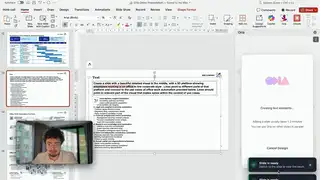
Oria is built for that step and for one kind of document: corporate and consulting output, which means board packs, steering committee decks, diligence exhibits, operating-model slides and dense frameworks held to an enforced template. It reaches you two ways, as a PowerPoint add-in in the task pane on Windows, macOS and PowerPoint for the web, and as a connector for Claude and ChatGPT over MCP, so a slide can be built from the chat you are already in without opening PowerPoint. On posture, stated plainly: it does not train on customer content, Professional and Team do not persist presentation content after delivery, and Enterprise adds private cloud deployment and custom LLM integration.
It is a corporate tool and loses outside that box. Where the deck is a founder fundraising story, a launch or campaign narrative, a student presentation or a marketing one-pager, the job is visual impact rather than defensible content, and Gamma, Canva, Pitch and Beautiful.ai will beat it and look better doing it. Send that work there.
The trade-off: Oria enforces a template. That is why the output holds together across forty slides, and why it will refuse to make the one beautiful slide you had in mind.
Can a Claude finance skill build the business case and make the call?
Business Case Builder converts assumptions and cash flows into a recommendation with scenarios, sensitivities, alternatives, risks and explicit decision gates. It is the most useful skill in the pack and the one that most needs a gate in front of it.
The published evidence on autonomous financial research is nowhere near sign-off quality. The Finance Agent Benchmark paper (arXiv 2508.00828) put 537 expert-authored questions across nine financial task categories to frontier models with search and EDGAR filing access. The best performer, OpenAI o3, reached 46.8% accuracy at an average cost of $3.79 per query. That is a useful research assistant and a poor decision-maker, and the gap between those two descriptions is the entire reason for the review gate.
So the skill is written to stop. It restates the work order, lists missing inputs and conflicts, and proposes a plan before it calculates anything. It labels every material number as a reported fact, a calculation, a management explanation or an analyst judgment, and it will not merge those four categories into one confident sentence. A named person approves the assumptions before the case is written up, and a named person approves the release.
The trade-off: the stopping rule adds a round trip, and it will sometimes stop on something you already knew. Teams that strip it out get a faster first draft and lose the audit trail that makes the second draft defensible.
Give every Claude finance skill a work order
A skill says how the method runs. A work order says what this particular run is for. "Analyse this company" is not a work order, and it is the single most common reason a good skill returns an answer nobody can use. Seven fields make the difference, and they take about four minutes to fill in.
- 1
Objective: decision, audience, owner, deadline, and action.
- 2
Deliverables: workbook, memo, or deck; structure and template.
- 3
Evidence: approved sources, versions, cut-off date, and conflict hierarchy.
- 4
Method: calculations, scenarios, sensitivities, and missing-data treatment.
- 5
Conventions: entity, periods, currency, units, signs, and accounting basis.
- 6
Review gates: where Claude must stop and what it must never do.
- 7
Acceptance tests: tie-outs, tolerances, citations, open issues, and sign-off.
Begin consequential work with: "Restate the work order, list missing inputs or conflicts, and propose the plan. Do not calculate or edit files yet." This creates a review point before weak assumptions enter a model, which is far cheaper than finding them in the board pack. The template ships in the pack as WORK_ORDER_TEMPLATE.md.
How do you install the 20 Claude finance skills?
The pack is a ZIP of plain Markdown. Unzip it and you get a .claude/agents/ folder holding the twenty numbered definitions, from 01-budget-architect.md through to 20-executive-qa-simulator.md, plus a README, a quickstart, a routing map and the work order template.
Drop that folder at the root of a project directory and Claude Code picks the definitions up as project subagents. In Claude's desktop and web products, where project subagents are not available, the same files work as Project attachments or pasted instructions: the content is identical and only the loading differs. If you want a definition to load automatically by description rather than by name, convert it into a Skill folder with its own SKILL.md as described above.
Read them before you run them. Every file is under six kilobytes and states its sources, conventions, review gates and acceptance tests in the first screen, which is the whole reason the pack ships as text you can diff rather than a configuration you have to trust.
The trade-off: plain Markdown means no versioning, no install check and no telemetry. You own keeping the twenty files in step with your own close calendar and chart of accounts, and nothing will warn you when they drift.
What is the difference between a Claude finance skill and a Claude finance agent?
The two words get used interchangeably and are not the same thing. A skill is a method: a written procedure Claude applies when the request matches it. An agent is a worker: a bounded role that owns one workflow end to end, decides which steps to run, and returns a defined output. The files in this pack are authored as agent definitions because each owns a workflow, and each is also a method you can lift into a Skill folder.
Practically, the choice is how much of the sequencing you delegate. If you know the steps and want the same answer every time, write it as a Skill. If you want something to work out the steps within a fenced remit, run it as an agent and give it the fewest permissions the job needs.
If it is the roster you came for rather than the method, the fifty-agent financial modelling pack is the better page. It ships the prompt each agent runs, grouped by stage, and is written for the agent question rather than this one.
The trade-off: agents are easier to start and harder to audit. A skill leaves a written method behind. An agent leaves a transcript, and a transcript is not a control.

You Bought Claude
Now Learn How to
10X Your Work
For consultants, bankers and investors who want a compounding edge
Go to AcademyIf you need X, go to Y
This page is the method library: what a finance skill is, which ones to write down first, and where each has to stop. Several neighbouring jobs are served better elsewhere, including by tools that are not ours, and it is quicker to say so than to let you find out.
| If you need | Go to | Why |
|---|---|---|
| The full financial modelling agent roster | The 50 Claude finance agents | It ships the prompt each agent runs, grouped by stage. It is the page that owns the agent question, not this one. |
| A CFO-level skill set organised by domain | The CFO guide to Claude | 24 skills across eight finance domains, from rolling forecasts to covenant monitoring. |
| One pack covering everything Claude does in finance | Claude for Finance, the complete pack | 12 skills, 12 guides and 7 workflows, with a main prompt to sit above them. |
| Workbooks built, not methods written | Claude skills for Excel modelling | Three-statement models, debt schedules and returns waterfalls are a construction problem, not a method problem. |
| A stage-by-stage workflow rather than a file set | The six-stage finance operating system | Frame, analyse, value, execute, control and communicate, with one prompt per stage. |
| Deal-side M&A skills | Claude M&A skills for investment banking | Origination, valuation, the CIM and merger maths, mapped to the deal execution process. |
| A prompt library rather than a method library | The Claude finance kit | Use it when you want something to paste today, not a procedure to maintain. |
| A dense corporate deck built from approved analysis | Oria | Board packs, steering committee decks and diligence exhibits held to an enforced template, via the PowerPoint add-in or the MCP connector. |
| A visual, high-impact deck | Gamma, Canva, Pitch or Beautiful.ai | Fundraising, launch and campaign decks are a design problem. Design-led tools win there and look better doing it. |
| Vendor-built finance agent templates | Anthropic's finance agent templates | Ten ready-to-run templates that bundle skills, connectors and subagents, if you would rather adopt than author. |
Whichever route you take, the controls do not move with it. Every material number traces to a source, cell, formula or explicit assumption; reported facts, calculations, management explanations and analyst judgment stay separated; arithmetic and reconciliation run deterministically wherever possible; and a named human approves assumptions, model changes, external distribution, ledger actions, compliance decisions and release. Review every file, permission, script and connector before use.
Frequently asked questions
What are Claude finance skills?
A Claude finance skill is a written method Claude applies the same way each time: a folder with a SKILL.md file naming the approved sources, the conventions, the calculations, the output structure and the point at which the work stops for a person to sign. The free pack on this page packages 20 such methods for valuation, FP&A and board reporting as plain Markdown you can read and edit.
What are the best Claude skills for finance?
The ones that pay back first are Scenario Modeler, Revenue and Margin Monitor, Reconciliation Reviewer and Business Case Builder, because each covers work that repeats on a fixed calendar with stable inputs. Budget Architect matters if you own the annual plan, and Board Deck Packager runs last, after approval. Skills that depend on conventions your team has not written down yet are the ones to install later.
Are the Claude finance skills free?
Yes. The 20-skill pack and the playbook on this page are free to download, with no account and no trial. The pack is a ZIP of plain Markdown definitions plus a README, a quickstart, a routing map and the work order template, so you can inspect every file before running any of it and adapt the conventions to your own chart of accounts.
Which Claude skills help with financial analysis?
For financial analysis specifically, start with Revenue and Margin Monitor, which decomposes a movement across price, volume, mix and currency, and Reconciliation Reviewer, which returns breaks with source references rather than explanations. Both are written to output exceptions instead of conclusions, which is what makes an analysis checkable. Variance Investigator and Profitability Mapper in the same pack extend them. Run them before the commentary is written, not after.
Can I use the pack in every Claude product?
Behaviour varies by Claude product, plan, operating system, administrator settings and feature status. The definitions load as project subagents in Claude Code; elsewhere the same files work as Project attachments or pasted instructions, because the content is identical and only the loading differs. Follow the included installation notes and inspect the files before enabling them. A manual-instructions fallback ships for products where project subagents are unavailable.
Do Claude finance skills replace a financial analyst?
No, and the published benchmarks do not support that claim. These are bounded methods for drafting and analysis. Qualified professionals stay responsible for assumptions, accounting treatment, recommendations, approvals, transactions, posting, compliance and release. The value is in the assembly time the skill removes, not in the judgment it does not have. On Vals AI's Finance Agent v2 benchmark the leading model answers under 61% of entry-level analyst questions correctly.
Where does Oria fit?
Oria is the slide build, and only after evidence, numbers and narrative are approved. It is aimed at corporate documents: board packs, steering committee decks and diligence exhibits held to an enforced template, reachable as a PowerPoint add-in or as a connector for Claude and ChatGPT over MCP. For visual, design-led decks a tool such as Gamma or Canva is the better choice.