

Presentation Design Agency vs AI: Cost, Speed, Quality
A presentation design agency and an AI tool solve the same problem in very different ways. Here is the honest breakdown of cost, turnaround, and output quality, so you can pick the right one for your next deck.
Presentation design agency vs AI: the bottom line
A presentation design agency and an AI tool like Oria both exist to turn rough content into a board-ready deck, but they get there in very different ways. An agency assigns a human designer, or a small team, to your brief and delivers a hand-built PowerPoint on a project timeline measured in days to weeks. Oria is an AI add-in that lives inside PowerPoint and turns your outline, sketch, or rough slide into an editable, on-brand deck in minutes, at a fraction of the cost per slide.
A design agency is for
A single, high-stakes presentation where bespoke art direction and a dedicated creative point of view matter more than turnaround time or cost per slide.
Oria (AI) is for
The recurring flow of dense, brand-controlled decks that consultants, bankers, and strategy teams build every week, where speed and cost per slide decide the tool.
For a one-off, highly bespoke presentation, an agency's dedicated art direction is genuinely hard to beat. For everything else, the economics below make the case for AI.
The honest cost table: presentation design agency vs AI
The table below compares the two paths on the dimensions that actually decide a deck's budget and deadline. Oria figures are documented product facts. Agency figures describe how project-based design pricing and timelines typically work, without inventing a specific rate card, since every agency prices differently.
Oria pricing and timing are current published product facts. Agency figures are described structurally, since project pricing varies by firm and scope.
Two paths to a finished slide
The clearest way to see why the cost and turnaround differ so much is to lay the two workflows side by side. One runs through a person's calendar. The other runs through a render.
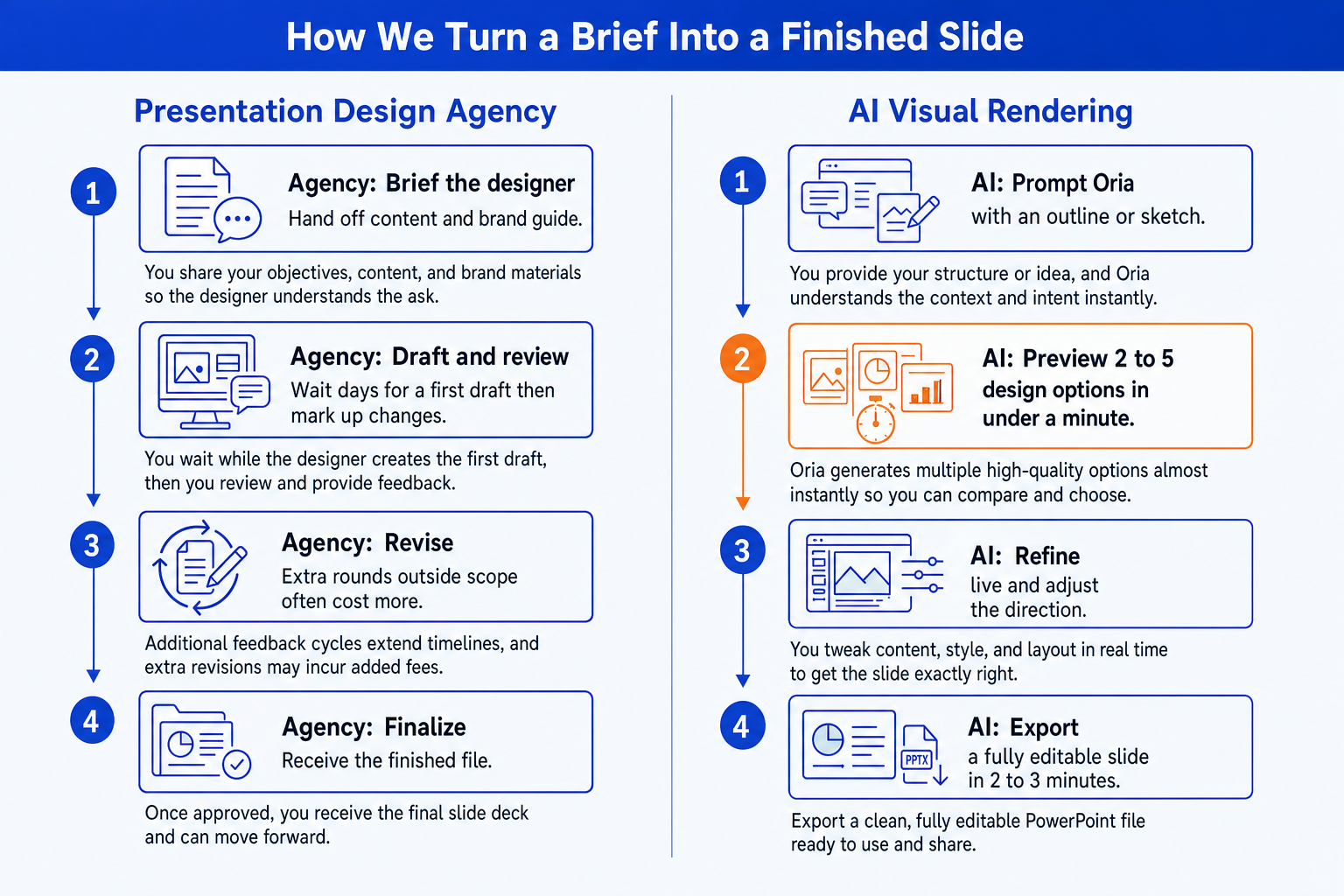
The agency path. You brief a designer, wait for a first draft, mark up changes, and wait again for the revised file. Each round adds days, and the quality ceiling is set by how much time the brief allows for.
The AI path. You prompt Oria with an outline, a sketch, or a messy existing slide. It previews 2 to 5 design options in 30 to 40 seconds, you pick a direction, and a final editable slide is ready in 2 to 3 minutes.
The reason the AI path can move this fast without collapsing into a generic template is a question of technical approach. Read our guide to the best AI for PowerPoint to see why most AI slide tools still look AI-generated, and what Oria does differently.
Where a presentation design agency wins
A good agency is not obsolete. It brings a level of dedicated craft that a tool alone cannot replace, and there are real situations where that is exactly what the deck needs.
Bespoke creative direction. For a fundraising roadshow, a rebrand launch, or an all-hands keynote, a dedicated art director builds a single, coherent creative point of view across the whole story.
A human who owns the narrative. An agency team can shape how the story is told, not just how the slides look, pushing back on structure and pacing in a way a tool does not.
Custom illustration and iconography. Bespoke illustration, custom iconography, and motion built from scratch are still squarely a designer's craft.
Nothing to learn or prompt. You brief the work and wait for a file. There is no tool to install, no template to upload, and no prompt to get right.
Accountability across a large deck. For a fifty-slide investor deck, a single point of contact who owns consistency end to end has real value.
Where AI wins on cost and speed
Oria is positioned as AI for complex professional slides, built for the dense, brand-controlled work that consultants, bankers, and strategy teams produce on a recurring basis. Its advantages compound the more often you need a deck.
Cost per slide near $0.25 to $0.35. Against a project fee that does not scale down for a short deck, the per-slide economics of a subscription change fast once you are producing more than one deck a month.
Minutes, not days. 30 to 40 seconds to preview design options, 2 to 3 minutes to a final editable slide, roughly 6 to 8 minutes for a 10-slide deck.
Fully editable native output. Every shape, text box, icon, line, and chart stays native PowerPoint, so the next small tweak does not have to go back through a designer's queue.
It holds your brand automatically. Upload your corporate template and Oria maintains fonts, colors, logos, and layout patterns across every slide, without a person applying them by hand.
No project minimum. A free plan is available with no credit card required, and paid plans start at $20 a month, so a single small deck never has to carry an agency's minimum spend.
If your team is producing a new deck every week rather than once a quarter, our guide to the best AI for PowerPoint compares the tools that keep up with that pace.
Quality: what good looks like from each path
A skilled agency designer brings judgment a tool does not have: knowing when to break a grid on purpose, when a chart should become an illustration, when the story needs a different slide order entirely. That judgment is real, and it is what you are paying for.
On the AI side, quality depends heavily on the tool's underlying approach, not just the brand name. Tools that force your content into a small library of fixed templates lose detail fast. Tools that build the slide as HTML and convert it to PowerPoint tend to look AI-generated, with inconsistent margins and font sizes. Oria takes a third approach: it renders the slide as a complete design first, then decomposes that render into native PowerPoint elements with a patent-pending engine, which is closer to how a human designer actually works.
The honest comparison is not agency quality versus AI quality in the abstract. It is whether the specific job in front of you needs one dedicated creative point of view, or a fast, editable, on-brand version of a structure you already know, applied to a strict corporate template. Our library of Claude skills for consulting-grade slide design covers the structure side of that question in more depth.
When to pick which
Pick a design agency when
- It is a single, high-stakes, one-off presentation
- You need bespoke illustration or custom motion
- Budget and timeline can absorb a days-to-weeks process
- You want one person accountable for the full story
- There is no in-house team to brief and iterate with AI
Pick AI when
- You build decks on a recurring, ongoing basis
- Cost per slide and turnaround decide the budget
- Output must stay fully editable in PowerPoint
- A strict corporate template must apply every time
- The deadline is measured in hours, not days
Many teams end up using both: an agency for the handful of moments a year that justify bespoke creative direction, and an AI add-in for the weekly flow of dense, brand-controlled decks in between. For a wider look at how the AI options compare with each other, see our guide to the best AI for PowerPoint.
Frequently asked questions
Is a presentation design agency worth it?
For a single, high-stakes presentation where a dedicated creative point of view matters, an agency's hand-built craft and account management can be worth the cost and the wait. For the recurring flow of internal decks, client updates, and board packs most teams produce every week, the per-project pricing and multi-day turnaround of an agency stop making sense, and that is where an AI add-in like Oria changes the economics.
How much does a presentation design agency typically charge?
Agencies generally price by the project or by the day rather than per slide, often with a minimum spend that does not scale down for a short deck. That structure makes sense for a bespoke, one-off engagement, but it means a five-slide update and a fifty-slide investor deck can carry a similar price floor.
Can AI replace a presentation design agency entirely?
Not for every job. AI slide tools handle the dense, recurring, brand-controlled decks that consultants, bankers, and strategy teams produce constantly, fast and at a fraction of the per-slide cost. A design agency still has an edge for a one-off keynote, a rebrand launch, or any presentation where custom illustration and a dedicated art director are the point.
Does Oria produce an editable file like an agency would?
Yes, and it is one of the clearest differences from most AI slide tools. Oria renders the slide as a design first, then decomposes it into native PowerPoint elements with a patent-pending engine, so every shape, text box, icon, and chart stays fully editable after generation, the same as a hand-built agency file.
What is the fastest option for a deck needed in a day?
An AI add-in is the fastest path when the deadline is measured in hours. Oria previews 2 to 5 design options in 30 to 40 seconds and produces a final editable slide in 2 to 3 minutes, versus a typical agency turnaround of days. For a same-day deadline, a design agency is rarely realistic without a rush fee.