

Tier-1 Strategy Skills for Claude: Which Ones Clear the Bar
Most "best Claude skills for strategy" pages assume every skill in the download folder clears the same bar. It does not. A single SKILL.md file can enforce MECE structure and refuse to invent a number, or it can be a five-line prompt wearing a folder, and nothing about the file format tells you which one you installed. This page sets the bar tier-one consulting work is actually held to, then checks six ways to get strategy skills into Claude against it, a five-skill sequence, a ten-skill engagement pack, an enterprise rollout, a build-your-own factory, the 50-skill system below, and where Claude hands off to a slide tool once the analysis is done. None of them clears the bar for every reader. The rest of this page says which one clears it for you.
Quick Answer
Match the pack to the scope you actually run, not to the size of the zip, and treat a skill that cannot say where it fails as one nobody has tested.
For full coverage across an entire strategy practice, the strongest single option here is Oria's 50 Tier-1 Strategy Skills, a free pack spanning six engagement domains from problem diagnosis through executive communication. A consultant running one engagement end to end should install the narrower five-skill or ten-skill engagement packs instead, which are faster to read and just as rigorous. A large organization standardizing a method across many users should use the enterprise skill set, and a firm with a proprietary method should build its own with the Claude skill factory. None of these produce a slide deck; that step runs through a separate tool.
How We Chose
- We measured every pack against Anthropic's own published bar for a good skill: a single, named purpose, a description specific enough that Claude routes to it correctly, and a workflow tested with real inputs rather than shipped on the strength of its instructions alone.
- We tested the failure case, not just the success case. A skill that produces a confident answer from three bullet points is worse than one that refuses, so every pack below was checked for whether it says where it breaks.
- We compared packs on scope and setup effort, not on skill count. A fifty-skill library and a five-skill sequence are answering different questions, so the number printed on the box is not the metric that matters.
- We ignored fluency as a signal. Readable and wrong is the normal failure mode for AI-generated strategy work, so the bar is whether a senior lead would sign the output before a steering committee, not whether it reads well.
- We ignored anything that needed a paid connector, an API key, or a build step just to try. Every pack linked from this page is one or more SKILL.md files you upload through Claude Settings.
Every skill in the 50-skill pack is designed to push Claude toward output that would hold up in a real steering committee review, not just produce a plausible-sounding draft. This is the same checklist used to judge the other five options below.
Download all 50 skills
One zip, one folder per skill. Free, no signup.
Key Takeaways
- Match the pack to the scope of the engagement you actually run today, not to how many skills sit in the zip. A five-skill sequence installed correctly beats a fifty-skill library nobody has read past the folder names, and the reverse is just as true for a practice with varied work.
- A tier-one skill states where it breaks. Thin inputs, missing constraints, and unstated politics defeat every option on this page equally, and the ones worth trusting say so instead of papering over it with confident, well-formatted prose that reads well and answers the wrong question.
- Domain-specific structure beats a generic prompt whenever a named framework is involved. Anthropic's own skill-authoring guidance treats a single-purpose skill with a specific, third-person description as the baseline expectation for a working skill, not the advanced case.
- Setup effort scales with ambition. Uploading one SKILL.md file through Claude Settings takes two minutes. Rolling the same method out to two hundred people with version control and usage tracking is a different project entirely, and needs a different pack.
- None of these options produce a slide. The output is structure and written content, and turning that into a deck held to a corporate template is a separate step, usually the one that actually costs the weekend once the analysis itself is done.
Compare the Strategy Skill Options
Five columns, and they map onto the takeaways above directly: what the option is best for, how long setup takes, what it hands you, and where it breaks. Read the last column first.
5-Skill Engagement Sequence
10-Skill Engagement Pack
50 Tier-1 Strategy Skills
Enterprise Strategy Skill Rollout
Custom Skill Factory (DIY)
Oria
If none of these six fit, the routing table further down names narrower options too, one issue-tree skill, a design-led tool for a pitch deck, and where to go if you are new to Claude entirely.
The Options, in Detail
Six write-ups follow, in the same order as the table above, each closing with the case where that option is the wrong call, including the one we build.
Option 1
Claude Strategy Skills for Consultants: Who Is It Built For?
Built for the consultant running one engagement end to end who wants a skill for each stage rather than a library to browse. The five skills, problem framing and issue diagnosis, market and competitive intelligence, strategic option design, operating model and execution, and governance and value realization, mirror the shape of a real engagement instead of a topic list, so the pack reads like a checklist for the whole job rather than a menu of unrelated tools.
Each skill is one SKILL.md file, and the pack itself states which Claude model to run each stage on, from Claude Opus 5 as the default up to Claude Fable 5.1 for a contested framing. It is the fastest pack on this page to read before a first use: five files, five stages, done in an afternoon, and nothing to configure beyond uploading the folder that matches where you are stuck this week.
The trade-off: It only covers five stages. If your work spans a fuller practice, procurement diligence, cost programs, digital transformation, communications training, the sequence runs out fast, and you will be back on this page looking for a domain it does not have.
Option 2
The 10-Skill Engagement Pack: Who Is It Built For?
Built for a consultant or small team who wants one skill per meaningful step of an engagement, not one per stage. The 10-skill engagement pack runs the Frame, Map, Choose, Execute, and Communicate workflow, two skills per stage, which gives more granularity than the five-skill sequence above without the six-domain range of the fifty-skill library below, and suits a team that has already standardized on that five-word shape for how an engagement runs.
That extra granularity matters most in the middle of an engagement, where a single "strategic option design" skill can flatten genuinely different jobs, scoring options against fixed criteria and building the business case behind the winner, into one step that quietly does two things at once. Splitting Choose into two skills keeps each one honest about what it actually produces.
The trade-off: Ten skills is still a fixed shape. If your engagements do not run Frame-Map-Choose-Execute-Communicate in that order, a governance-heavy public program or a technical diligence, you will be bending the work into a pipeline it does not fit, and a single narrow skill will serve you better than forcing this one.
Option 3
50 Tier-1 Strategy Skills: Who Is It Built For?
Built for a practice running a full range of engagement types that wants one library instead of hunting down a new pack every time an engagement changes shape. Fifty skills across six domains, diagnose, map markets, choose strategy, build execution, govern value, and communicate, cover a complete engagement from the kickoff to the board meeting, and every skill below is a standalone SKILL.md file you can install on its own.
It is the largest free download in this comparison, and the only one built to hand off between domains: a hypothesis from Domain 1 feeds the market sizing in Domain 2, which feeds the options in Domain 3, the plan in Domain 4, the governance model in Domain 5, and the recommendation memo in Domain 6. Read on for what each domain actually contains.
The trade-off: Most single users never touch more than eight or ten of the fifty in any given month. The honest case for downloading the whole set is breadth insurance for a practice with varied work, not day-to-day density, and if you already know your next six months look like one engagement type, the five-skill or ten-skill pack above will get you working faster.
Here is what ships inside the 50-skill pack itself, grouped into six engagement domains that run in the order a real engagement does.
The strategy operating system
Domain 1 · 8 skills
Problem Framing & Diagnosis
Use these when the team needs the real problem, not the obvious symptom. Fact base first, root-cause discipline, explicit assumptions, and a single sharp question to answer.
Situation Assessment
Use when: You need the factual baseline before choosing a direction
Output: Fact base, momentum read, and prioritized issues list
Problem Definition
Use when: The problem is stated as a symptom or is too broad to solve
Output: One-page problem statement and the key question to answer
Issue Tree Builder
Use when: A big question must be broken into testable sub-questions
Output: MECE issue tree with branches ranked by impact
Root Cause Analysis
Use when: A problem keeps recurring and symptoms are being treated
Output: Root-cause map and the drivers worth fixing
Growth Barrier Diagnosis
Use when: Growth has stalled and leadership is debating symptoms
Output: Ranked constraint diagnosis and the evidence to confirm it
Assumption Audit
Use when: A strategy rests on beliefs that may be weak or untested
Output: Assumption register with a test plan per assumption
Hypothesis Design
Use when: You want an answer-first plan instead of boiling the ocean
Output: Prioritized hypothesis set and the analyses that test each
Diagnostic Workplan
Use when: You need to turn the question into a sequenced analysis plan
Output: Workplan with analyses, data needs, owners, and sequence
Domain 2 · 9 skills
Market & Competitive Intelligence
Use these when the answer depends on where value sits, how customers differ, how rivals may move, and where the attractive white space is.
Market Sizing
Use when: You need a defensible size for a market or opportunity
Output: Sized market with method, assumptions, and a sensitivity range
Market Mapping
Use when: You need to see the full landscape and where you sit in it
Output: Market map, players by role, and the flows of value
Competitor Analysis
Use when: You need a clear read on rivals and industry structure
Output: Competitor profiles and a five-forces structural read
Competitive Dynamics
Use when: You need to predict how rivals will respond to your move
Output: Likely competitor moves and your pre-planned responses
Customer Segmentation
Use when: You need sharper customer groups to steer strategy
Output: MECE segments, sizes, needs, and priority segments
Voice of Customer
Use when: You need the real jobs and triggers behind buying behavior
Output: Job map, pains and gains, and demand drivers ranked
Profit Pool Analysis
Use when: You need to know where value is created and captured
Output: Profit-pool map and the strategic implication of each pool
White Space Mapping
Use when: You need to find where to expand or where rivals are absent
Output: White-space opportunities scored on fit and attractiveness
Trend and Disruption Scan
Use when: You need to test the strategy against how the world is shifting
Output: Trend map, disruption vectors, and the so-what for strategy
Domain 3 · 9 skills
Strategic Choice & Economics
Use these when leaders need real choices, trade-offs, economics, and allocation decisions. Push Claude toward option-aware, evidence-backed recommendations instead of single-answer advocacy.
Where to Play, How to Win
Use when: You need a coherent strategic direction, not a list of ideas
Output: A linked choice cascade with the logic that makes it win
Strategic Options
Use when: You need alternatives before committing to a single path
Output: Three to five real options with the theory of each
Options Evaluation
Use when: You need to compare options on the same evidence bar
Output: Scored options, trade-offs, and a defensible recommendation
Business Case Builder
Use when: A decision needs economics, sensitivities, and risks
Output: Business case with base, upside, downside, and decision logic
Pricing Strategy
Use when: Pricing power, discounting, or monetization is unclear
Output: Pricing diagnosis, model, and an action plan
Portfolio Review
Use when: You must allocate scarce resources across many bets
Output: Portfolio diagnosis, invest/hold/exit calls, and allocation
Build, Buy, or Partner
Use when: You need to close a capability or market gap
Output: A build/buy/partner recommendation with the reasoning
Capital Allocation
Use when: Too many investments compete for limited capital
Output: Ranked investment slate and the allocation rationale
Go-to-Market Strategy
Use when: You have an offer and need the route to the customer
Output: GTM plan: target, channels, offer, motion, and milestones
Domain 4 · 8 skills
Operating Model & Execution
Use these when the strategy must become work: capabilities, decision rights, initiative choices, roadmaps, owners, and the first 90 days.
Operating Model Design
Use when: Strategy needs translation into how work actually gets done
Output: Operating-model design with capabilities and governance
Decision Rights
Use when: Decisions stall because ownership is unclear
Output: Decision map with clear owners and escalation paths
Initiative Prioritization
Use when: Too many initiatives compete for attention and money
Output: Ranked roadmap of initiatives and what to stop doing
Transformation Roadmap
Use when: A strategy must become sequenced, ownable delivery
Output: Phased roadmap with waves, milestones, owners, and risks
Org Design
Use when: The current structure blocks the strategy
Output: Org design options with spans, layers, and trade-offs
Capability Building
Use when: The strategy needs skills the organization lacks today
Output: Capability gap map and a plan to close each gap
First 90 Days Plan
Use when: A launch or new mandate needs momentum from day one
Output: A 30/60/90 plan with owners, early wins, and checkpoints
Change and Adoption
Use when: The change will fail on adoption, not on logic
Output: Change plan: awareness, buy-in, enablement, and reinforcement
Domain 5 · 8 skills
Risk, Performance & Value Governance
Use these when the recommendation needs pressure-testing, risk control, measurement, and value capture. The bar is a board-ready governance view, not a generic risk list.
War Gaming
Use when: A strategy needs pressure-testing before it launches
Output: Scenario stress test and the response moves that survive it
Risk and Mitigation
Use when: Strategic risk needs an owner and a response plan
Output: Risk register, heat map, and mitigation owners
Pre-Mortem
Use when: You want failure modes surfaced before you commit
Output: Ranked failure modes and the safeguards for each
Scenario Planning
Use when: The future is uncertain and you need robust choices
Output: Scenarios, signposts to watch, and no-regret moves
KPI Architecture
Use when: Metrics are noisy, lagging, or performative
Output: A KPI tree that ties every metric to a decision
Value Driver Tree
Use when: You need to show how the strategy creates value
Output: A driver tree from top-line value to operational levers
Value Realization
Use when: Benefits must be tracked and captured after launch
Output: Value ledger, gates, and a benefit-capture governance model
Governance Design
Use when: Delivery needs oversight without slowing it down
Output: Governance model: gates, forums, cadence, and decisions
Domain 6 · 8 skills
Alignment & Executive Communication
Use these when the work must survive the room: pre-wire stakeholders, sharpen the executive story, and turn the recommendation into a written decision.
Stakeholder Alignment
Use when: The recommendation needs pre-wiring before the meeting
Output: Stakeholder map and a one-by-one engagement plan
Pyramid Storyline
Use when: You need the argument to land in the first 60 seconds
Output: Governing thought, supporting lines, and the story spine
Executive Summary
Use when: A busy executive needs the answer on one page
Output: A one-page executive summary that leads with the answer
Decision Memo
Use when: A decision must be made in writing, not in a meeting
Output: Decision memo with options, recommendation, and next steps
Board Deck Structuring
Use when: You need a board-ready deck structure before you build it
Output: A storyboard: action titles, message per slide, and flow
Insight Synthesis
Use when: You have findings but not yet an insight
Output: Findings turned into ranked insights and their implications
Objection Handling
Use when: The recommendation will face a tough room
Output: The hard questions and a tight answer for each
Recommendation and Next Steps
Use when: The work must end in a decision and an action
Output: The recommendation, the ask, owners, and the timeline
Domains 1 and 2 sharpen the diagnosis and the market view. Domains 3 and 4 turn that view into a choice and a plan. Domains 5 and 6 govern delivery and land the recommendation with the people who matter.
How to choose one of the 50
Once you have this pack installed, skip the folder hunt. Pick the row that matches your need and use that skill.
Option 4
An Enterprise Strategy Skill Rollout: Who Is It Built For?
Built for the learning and development or transformation team standardizing a skill library across many users, not for a single analyst working alone. The enterprise strategy skill set shares the ambition of the fifty-skill library, full domain coverage, scoped instead to 21 skills chosen for the workflows an organization actually standardizes on, from problem framing and market intelligence through to execution and board-ready communication.
The rollout questions get treated as part of the job here rather than left to whoever installs it first: who owns the master copy, how a skill gets versioned when the house method changes, and whether outputs get spot-checked before they reach a client. None of that is a Claude setting; it is a process your organization has to own.
The trade-off: It is overhead for one person. A single analyst does not need a rollout plan, a version owner, or a review cadence, and should install one of the smaller packs directly instead of routing a personal download through enterprise skill governance.
Option 5
A Custom Skill Factory: Who Is It Built For?
Built for a firm whose method is genuinely proprietary and does not match any fixed pack on this page, including the fifty-skill one. Rather than shipping skills, the Claude skill factory for strategy ships a repeatable method for turning your own house style into working SKILL.md files, so the result reflects how your firm actually frames a problem, not a generic consulting template borrowed from somewhere else.
That is the right call whenever a fixed pack's language does not match yours: a proprietary framework, a house-specific deliverable format, an industry vocabulary none of these packs use. You bring the method you already run; the factory turns it into a skill Claude can execute consistently.
The trade-off: It produces nothing on day one. You are writing and testing your own skill, not downloading someone else's, and the result depends entirely on the quality of the method you already have to encode. A firm without a documented method will get a mediocre skill out of a good factory.
Option 6
Oria: Who Is It Built For?
None of the five packs above produce a slide, and for a lot of engagements that is the step that actually costs the weekend. Oria is the tool we build, and it exists for one narrow job: corporate documents and consulting presentations. Board packs, steering committee decks, diligence exhibits, operating model slides, dense frameworks held to an enforced corporate template. That is the whole design, and it is aimed at the output a tier-one strategy firm produces.
It reaches you two ways. As a PowerPoint add-in, running in the task pane on Windows, macOS, and PowerPoint for the web. And as a connector for Claude and ChatGPT over MCP, so a slide can be built from the chat you are already in, without opening PowerPoint at all. On security, Oria does not train on customer content, Professional and Team do not persist presentation content after delivery, and Enterprise adds private cloud deployment and custom LLM integration.
The trade-off: Oria is built for the corporate environment only, so it loses on highly visual work. Founder fundraising and pitch decks, launch and campaign decks, student presentations, marketing one-pagers: where the job is visual impact rather than defensible content held to a template, a design-led tool like Gamma, Canva, Pitch, or Beautiful.ai will beat it, and will look better doing it. If that is your deck, go there instead.
Why the Bar Exists
The bar above is not arbitrary, and it exists for a market reason, not a stylistic one. Source Global Research surveyed 3,887 companies and found that 70% would not trust a report produced with AI, and that clients who had actually seen a firm's AI tools in use were more skeptical, not less. A pack that produces fluent, unstructured output does not close that gap. It confirms the client's worst assumption about what "AI-assisted" means, which is the opposite of what a tier-one skill is supposed to do.
Anthropic's own skill-authoring guidance sets a higher bar than most packs on the market clear. It tells builders to create evaluations before writing extensive documentation, test every skill across Claude Haiku, Claude Sonnet, and Claude Opus rather than one model, and reject a description vague enough to trigger on the wrong request. That is the standard every option above was checked against, not a marketing claim about quality.
It is also no longer a niche format worth ignoring. Mahesh Murag, a product manager at Anthropic, told VentureBeat that Anthropic's public skills repository had passed 20,000 stars with tens of thousands of community-created skills, and that enterprise customers were running skills in production across legal, finance, accounting, and data science. Two of those customers described what changes when a skill clears the bar instead of a prompt. Yusuke Kaji, General Manager of AI at Rakuten, said of a workflow rebuilt around skills: "What once took a day, we can now accomplish in an hour." MJ Felix, a product manager at Notion, made the point about consistency rather than speed: skills mean "less prompt wrangling on complex tasks, more predictable results." Predictable is the word that matters here. A tier-one skill produces the same structure in week one and week nine, which is the property a saved prompt cannot guarantee.
Setup Guide
The steps below install the 50-skill pack specifically. The same four steps work for any of the other packs on this page.
Download the skills pack
The zip contains all 50 skills, one folder per skill, each a single SKILL.md file. Unzip it anywhere, keep the whole set, or pull out just the folders for the domain you need this week.
Create a Claude Project
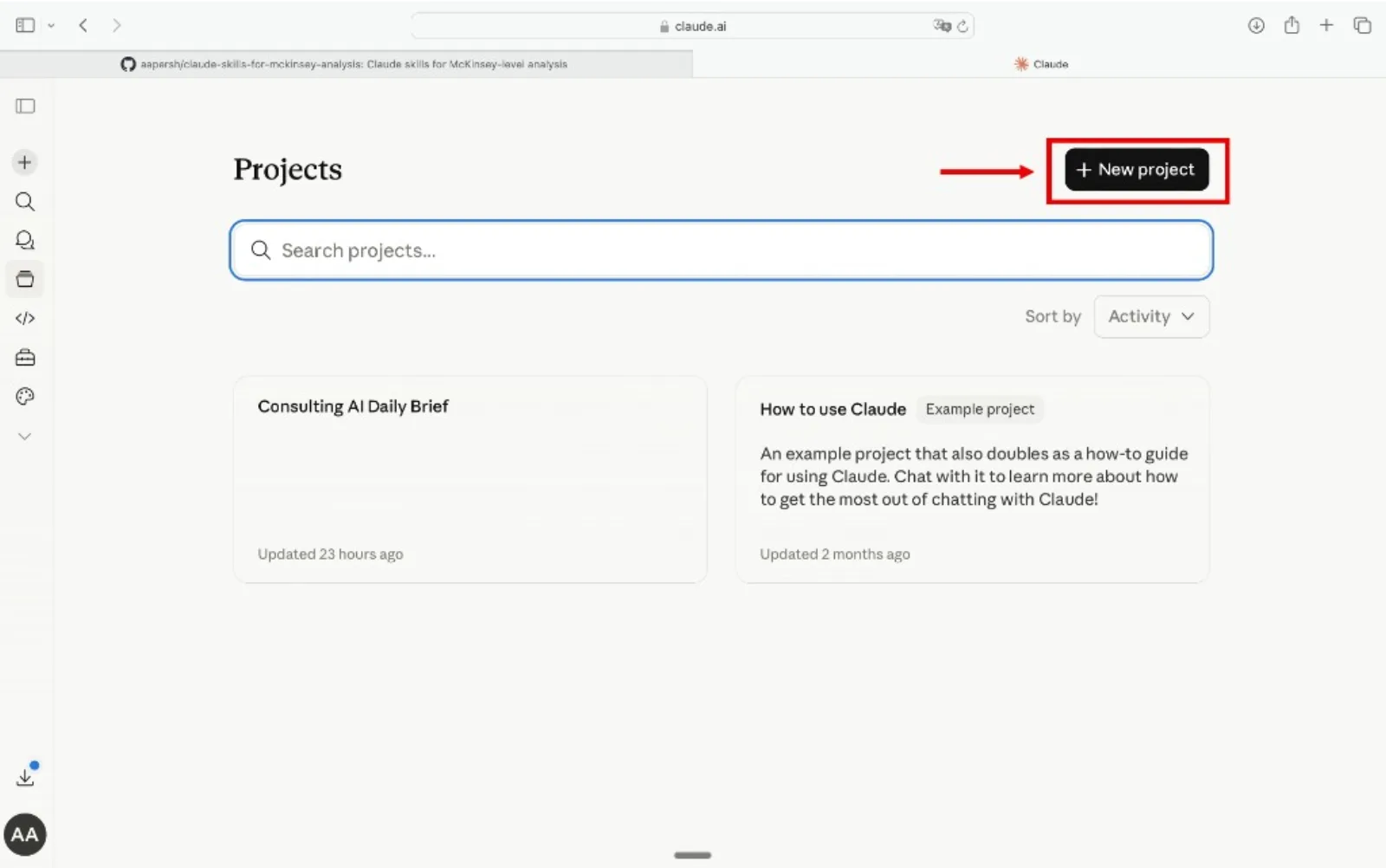
Go to claude.ai, open the left sidebar, click Projects, then Create Project. Name it something like "Strategy Assistant" so you can reuse it across engagements.
Add the skills as Project Knowledge
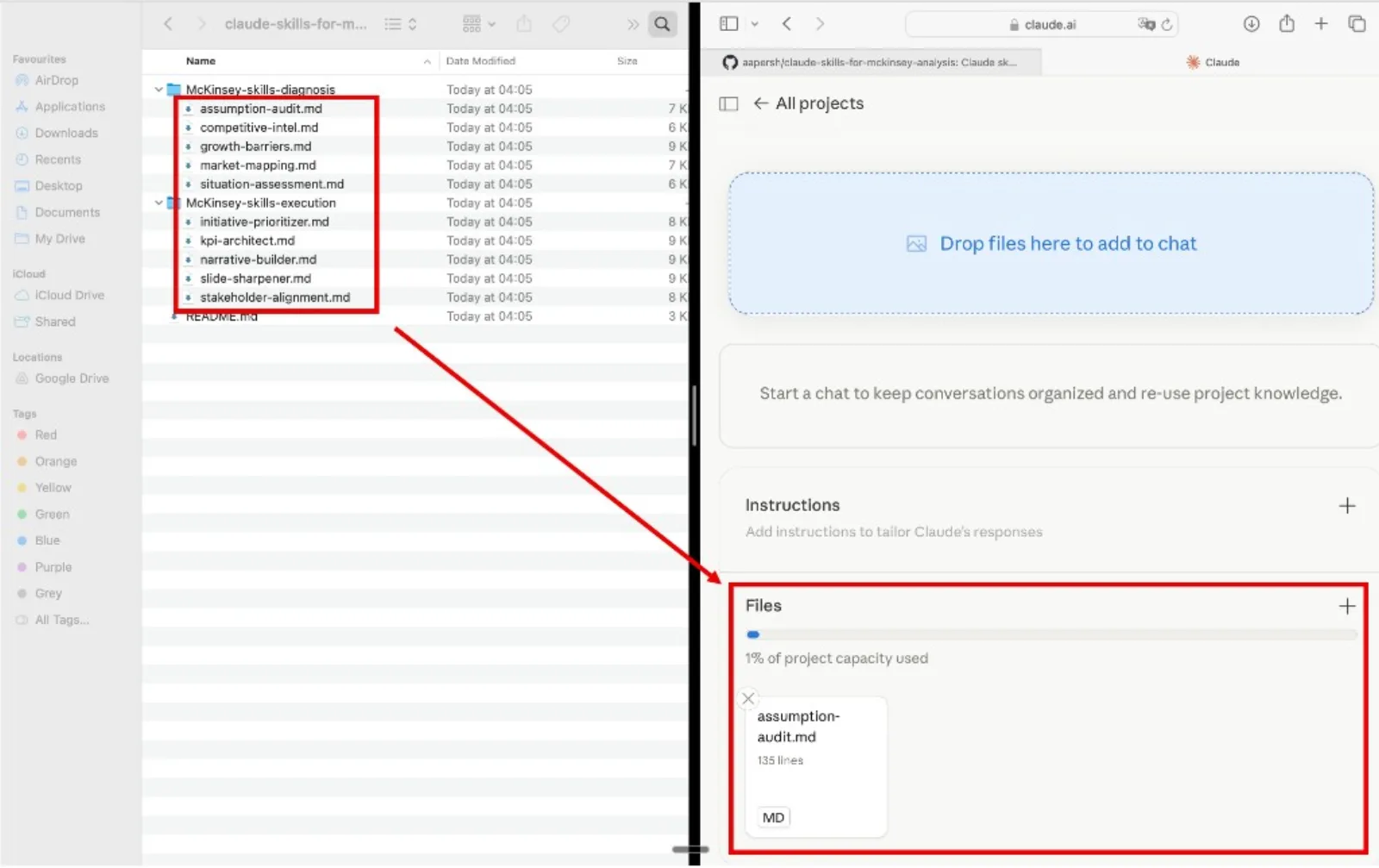
Inside your project, open Project Knowledge, click Add Content, and upload the .md files. Add one skill, an entire domain, or all 50; Claude references them automatically inside that project.
Start using the skills
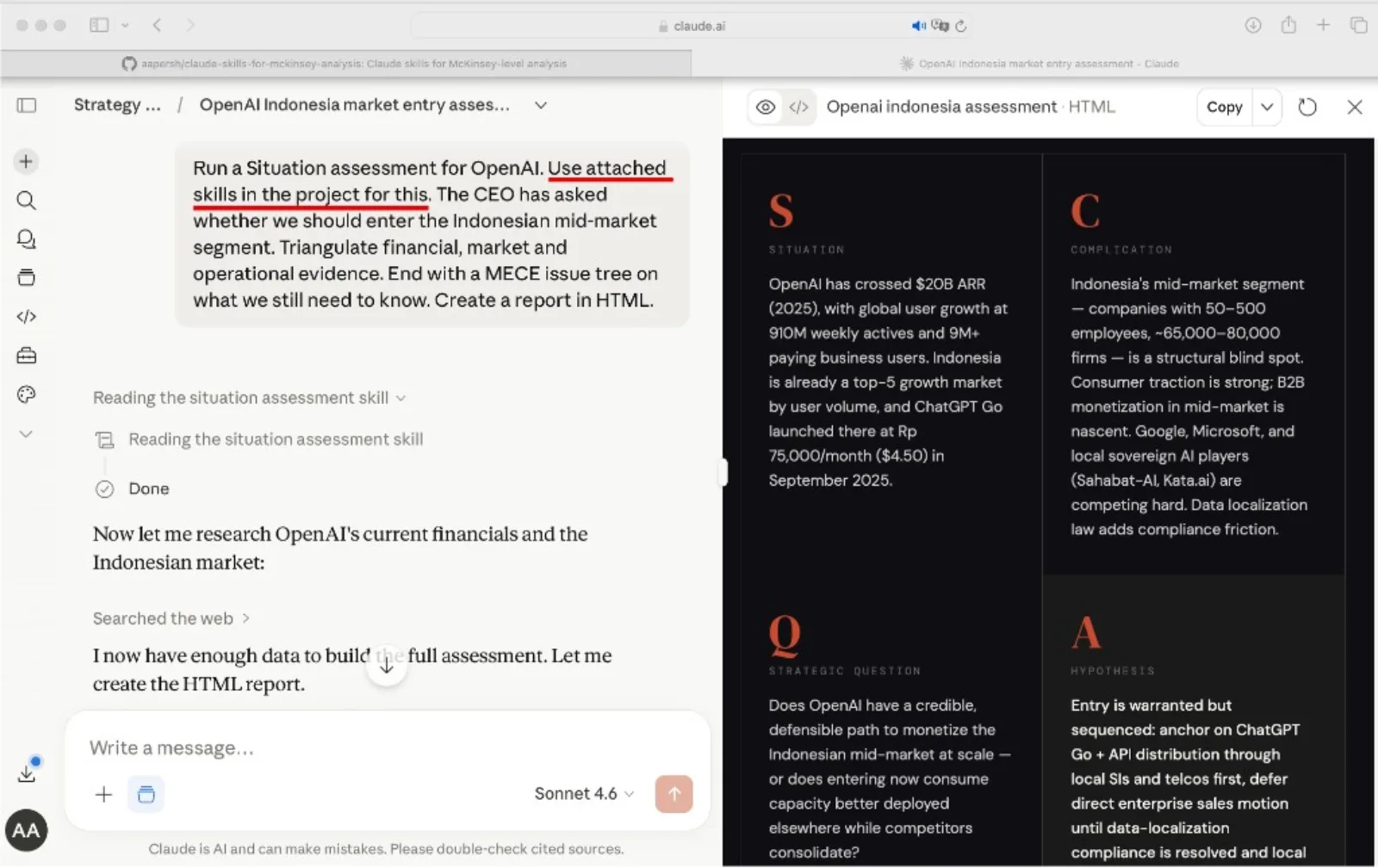
Open a new conversation inside the project, paste in your data, and name the skill you want Claude to run. Refer to it by name, phrases like "use the market-mapping skill" point Claude at the right framework instead of leaving it to guess.
Example prompts
- "Use the market-sizing skill to size the opportunity for a B2B payments product in Germany."
- "Use the assumption-audit skill to pressure-test our expansion strategy before the board meeting."
If This Isn't the Right Pack, Go Here
This page compares six ways to get strategy skills into Claude, and none of them is the answer for every reader. The table below routes the remaining cases by name.
Frequently Asked Questions
What makes a Claude skill “tier-one” instead of just a prompt?
A tier-one skill enforces the same structure every time: a stated method, a description specific enough that Claude routes to it correctly, and a documented case where it fails, tested against real inputs rather than a clean example. Anthropic's own skill-authoring guidance asks builders to write evaluations before shipping. A prompt saved in a document has none of that; it gets re-explained, and re-drifts, every time someone new opens the file.
Are the 50 Tier-1 strategy skills free?
Yes. The full pack downloads as one zip with no signup, one SKILL.md folder per skill, organized into six engagement domains. Install the whole set or pull out just the folders for the domain you need this week; each skill works standalone.
Do I need all 50 skills, or should I start smaller?
Start smaller if you only run one type of engagement. The 5-skill and 10-skill engagement packs on this site cover a single engagement sequence in a fraction of the setup time. Install the full 50 when your practice spans multiple domains, diagnosis, market work, execution, governance, so you are not hunting for a new pack every time the engagement type changes.
Do these skills work with ChatGPT instead of Claude?
No, a SKILL.md file is a Claude-specific format uploaded through Claude Settings. Teams working mainly in ChatGPT can run an equivalent backbone with the GPT-6 Astra strategy and finance skills instead, built for that platform and covering the same kind of engagement work.
Which Claude model should I run these skills on?
Claude Opus 5 for most of the fifty skills, moving up to Claude Fable 5.1 for a genuinely contested framing or an option set going to a board. The full model breakdown, including where Claude Sonnet 5 and Claude Haiku 4.5 fit, lives on the Claude strategy skills for consultants page, since it applies to every pack on this site, not just this one.
Can Claude turn the skill output into a finished slide deck?
Claude produces the structure and the written content; turning that into slides held to a corporate template is a separate step. Oria runs as a PowerPoint add-in and as a connector for Claude and ChatGPT over MCP, so a slide can be built from the same conversation without opening PowerPoint. For a highly visual deck, a pitch or a launch, a design-led tool will still outperform it.
How is this different from the smaller strategy skill packs on this site?
Scope. The 5-skill and 10-skill engagement packs cover one engagement sequence and read faster; the enterprise set trades single-user simplicity for rollout controls across many people; the skill factory builds a custom skill instead of shipping one. This pack is the only one that spans all six engagement domains in a single download, which is the right trade when your practice's next job is not the same shape as its last one.