

21 BCG-Style Strategy Skills for Claude
A BCG-style strategy operating system for Claude. 21 standalone skills across six engagement domains, diagnose, map markets, choose strategy, build execution, govern value, and communicate the recommendation.
Free skills and prompts for Claude and strategy work
Templates for Claude, ChatGPT and Perplexity — from diagnostics to board-ready decks.
What this is
21 standalone BCG-style strategy skills for Claude, grouped into six practical consulting domains. Each skill is a small, uploadable workflow that teaches Claude how to run one high-value strategy task with a repeatable, BCG-style method.
Where the method calls for it, the skills reach for the frameworks BCG made famous, the Growth-Share Matrix for the portfolio, the experience curve and the Advantage Matrix for cost position, the Strategy Palette for matching the strategy to its environment, Smart Simplicity for the operating model, and a total shareholder return lens on where value is created. The voice is BCG too: advantage-seeking, relentless about de-averaging the blended numbers, and anchored to a real decision rather than a tidy framework for its own sake.
Together they operate like a strategy operating system for a full engagement: diagnose the problem, map the market, choose a path, translate it into execution, govern the value, and communicate the recommendation. Prefer the McKinsey idiom? See the companion set of 21 McKinsey-style strategy skills for Claude.
Mechanically, each skill is one folder with a SKILL.md file, grouped by domain inside the zip. Install just the ones you need, or load the full set.
Download all 21 skills
One zip, one folder per skill. Free, no signup.
The 21 BCG-style skills you get
The collection is grouped into six consulting domains. They run in the order a real engagement does, diagnose first, communicate last, but every skill is also useful on its own.
The BCG-style strategy operating system
Domain 1 · 3 skills
Diagnosis & Framing
Use these when the team needs the real problem before choosing a move. An economics-led fact base, the strategic environment named with the Strategy Palette, de-averaged numbers, and the few load-bearing assumptions made explicit.
Situation Assessment
Use when: You need the real picture before choosing a direction
Output: Economics-led fact base, TSR read, issues list
Growth Barriers
Use when: Growth has stalled and the team is arguing about symptoms
Output: The single binding constraint and the proof
Assumption Audit
Use when: A strategy rests on beliefs that may be weak
Output: Assumption register, kill-shot test, pre-mortem
Domain 2 · 4 skills
Market & Competitive Intelligence
Use these when the answer depends on where value sits, how customers differ, where rivals hold the cost advantage, and where the attractive, under-served space really is.
Market Mapping
Use when: You need to size demand and find the white space
Output: Market map, triangulated size, where-to-play options
Competitive Intel
Use when: You need to read rivals and their most likely next move
Output: Advantage Matrix read and a pre-committed response
Customer Segmentation
Use when: You need sharper, decision-useful customer groups
Output: MECE segments and the wedge to attack first
Profit Pool Analysis
Use when: You need to know where the margin actually sits
Output: Profit pool map and the move toward the pool
Domain 3 · 4 skills
Strategic Choice & Economics
Use these when leaders need choices, trade-offs, economics, and allocation calls. The skills push Claude toward option-aware, TSR-anchored recommendations instead of single-answer advocacy.
Strategic Options
Use when: You need real alternatives before committing to a path
Output: Option set, weighted scorecard, conditional call
Pricing Strategy
Use when: Pricing power, discounting, or monetization is unclear
Output: Value-based pricing diagnosis and action plan
Business Case Builder
Use when: A decision needs economics, sensitivities, and risk
Output: Driver-based case with NPV, IRR, and a TSR view
Portfolio Review
Use when: You must reallocate capital across competing bets
Output: Growth-Share matrix and explicit reallocation calls
Domain 4 · 3 skills
Operating Model & Execution
Use these when strategy must become work: the few distinctive capabilities, a Smart Simplicity structure, clear decision rights, a prioritized roadmap, and a concrete first 90 days.
Operating Model Design
Use when: Strategy needs translating into how work actually runs
Output: Capabilities, Smart Simplicity design, decision rights
Initiative Prioritizer
Use when: Too many initiatives compete for the same attention
Output: Ranked roadmap and an explicit kill list
Transformation Roadmap
Use when: A plan must become sequenced, fundable execution
Output: Phased two-speed roadmap, owners, first 90 days
Domain 5 · 4 skills
Risk, Performance & Value Governance
Use these when the recommendation needs pressure-testing, resilience, measurement, and value capture. The bar is a board-ready governance view, not a generic risk list.
War Gaming
Use when: A strategy needs pressure-testing before launch
Output: Scenario stress test and response thresholds
Risk & Mitigation
Use when: Strategic risk needs owners and a real response
Output: Resilience-framed risk register and indicators
KPI Architect
Use when: Metrics are noisy, lagging, or quietly gamed
Output: North-star value-driver tree and thresholds
Value Realization
Use when: The value a strategy promised must be captured
Output: Value ledger and stage-gate governance
Domain 6 · 3 skills
Alignment & Executive Communication
Use these when the work must survive the room: pre-wire the stakeholders, lead with the value-creation so what, and turn the recommendation into a written decision.
Stakeholder Alignment
Use when: The recommendation needs pre-wiring before the meeting
Output: Stakeholder map and a sequenced engagement plan
Narrative Builder
Use when: The story must land in the first 30 seconds
Output: Pyramid story, four lengths, hostile-Q prep
Decision Memo
Use when: An executive needs the call in writing
Output: One-page, answer-first decision memo
Domains 1-2 sharpen the diagnosis and the market view. Domains 3-4 turn that view into a choice and a plan. Domains 5-6 govern delivery and land the recommendation with the people who matter.
Setup Guide
Download the skills pack
The zip contains all 21 skills, one folder per skill. Each skill is a single SKILL.md file. Unzip it anywhere. Keep the whole set, or pull out just the folders you need.
Create a Claude Project
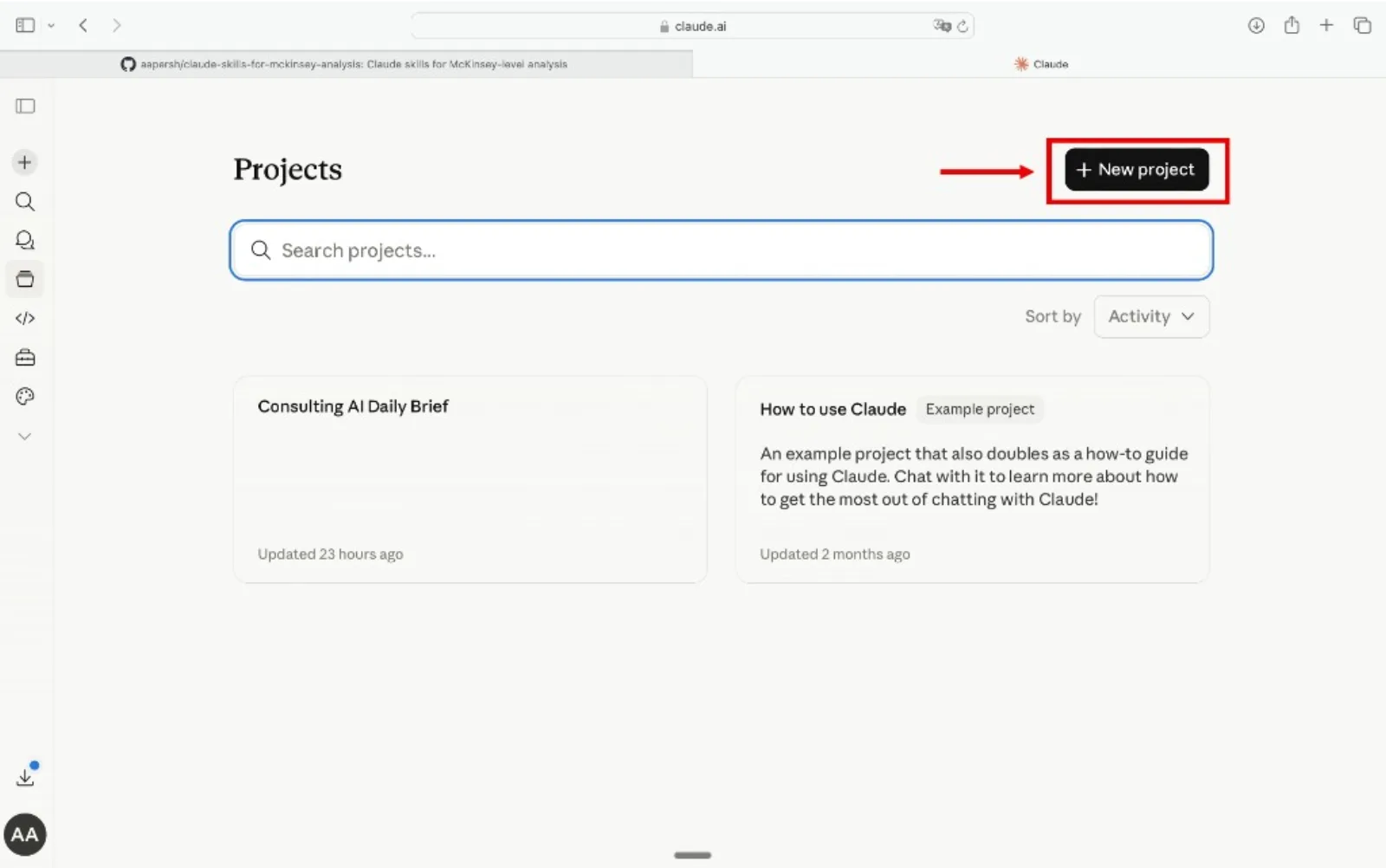
Go to claude.ai, open the left sidebar, click Projects, then Create Project. Name it something like "Strategy Assistant" or "BCG Co-pilot" so you can reuse it across engagements.
Add the skills as Project Knowledge
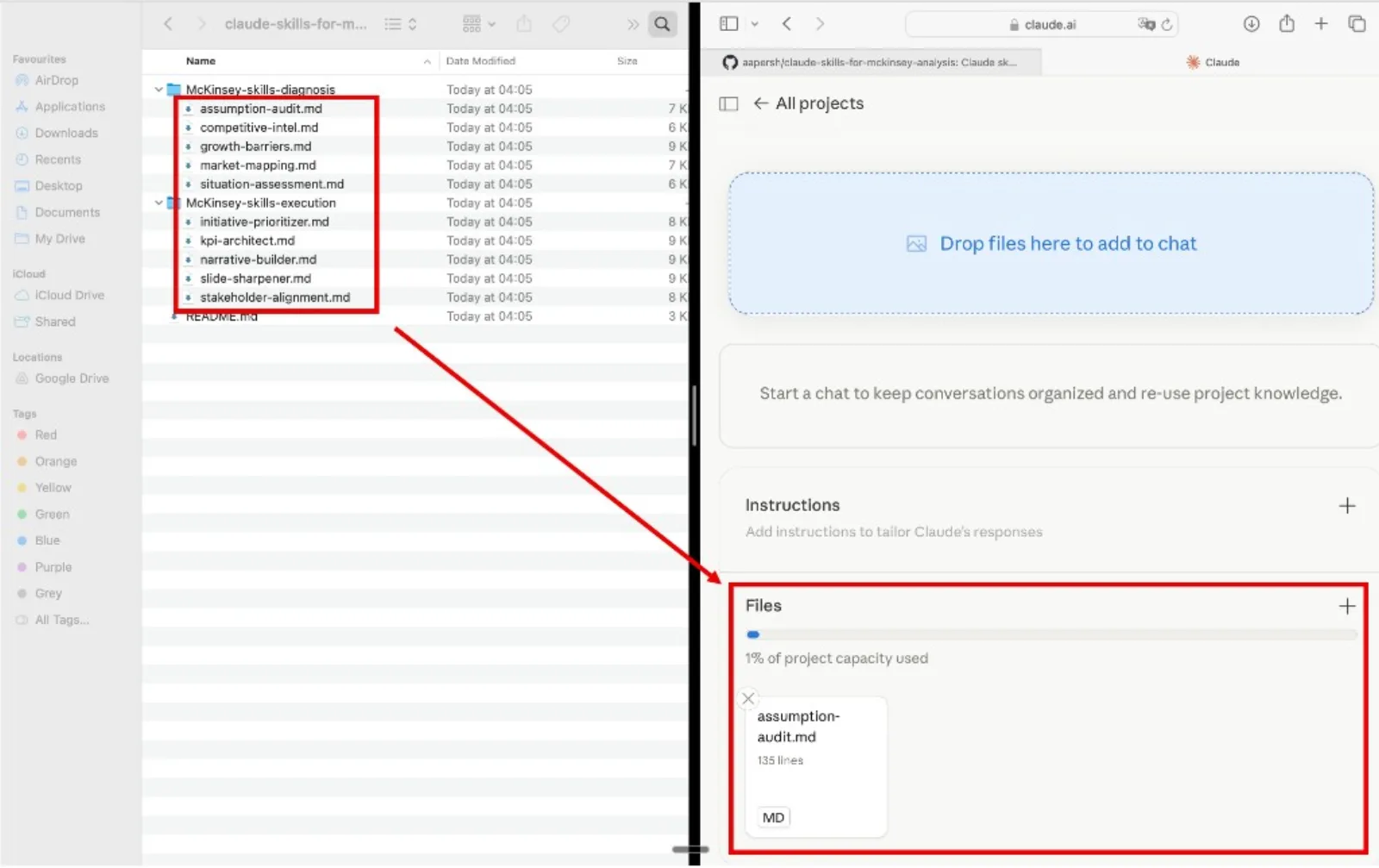
Inside your project, open Project Knowledge, click Add Content, and upload the .md files. Add as many as you want, one skill, an entire domain, or all 21. Claude will reference them automatically in every conversation inside that project.
Start using the skills
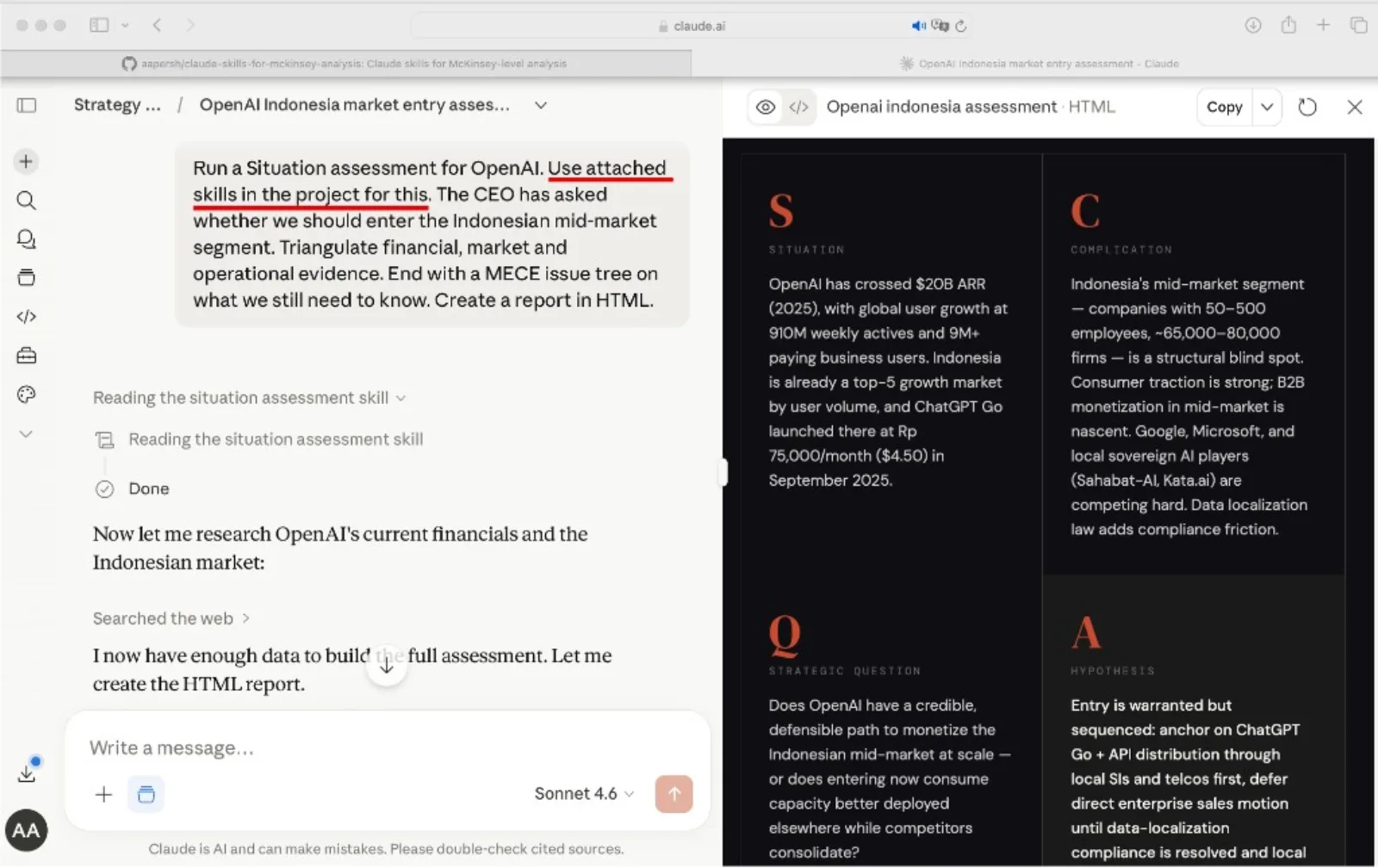
Open a new conversation inside the project, paste in your data, and name the skill you want Claude to run. Claude reads it from project knowledge and runs the analysis with the framework already loaded.
Tip
Refer to the skill by name in your prompt. Phrases like "Use the portfolio-review skill" or "Run the assumption-audit skill" point Claude at the right framework instead of leaving it to guess.
Example prompts
- "Use the portfolio-review skill to reallocate capital across these five business units."
- "Use the market-mapping skill to size the opportunity for a B2B payments product in Germany."
- "Use the assumption-audit skill to pressure-test our expansion plan before the board meeting."
- "Use the initiative-prioritizer skill to cut this list of 18 projects into the 3 that matter."
How to choose a BCG-style Claude skill
Skip the directory hunt. Each of these BCG-style Claude skills maps to a specific strategy need, so pick the row that matches your situation and use that skill. For a wider walkthrough of working this way, see our consultant's guide to Claude.
The quality bar
Every skill is designed to push Claude toward outputs that meet the same partner-grade quality bar, the standard a senior associate would hold each deliverable to before it leaves the room.