

Claude for Private Equity: Where a PE Firm Actually Deploys It
A stage-by-stage read on Claude across the whole deal cycle, from sourcing and screening through diligence, the IC memo, portfolio operations, LP reporting and exit. Plus 30 free Claude skills, one per job, and the places we would not use it.
Independent and unaffiliated. The skills, prompts, and frameworks referenced on this page are not created by, endorsed by, or affiliated with any consulting or financial-services firm whose methods may be referenced here. They are built on publicly available frameworks and ways of working, and are inspired by how such approaches are used to tackle complex business problems.
Claude for private equity, at firm level
Most private equity firms are past the question of whether to use Claude. The live question is narrower and harder: which part of the firm gets it first, what it is allowed to touch, and whose name is on the output when it turns out to be wrong.
A deal cycle is not one job. Sourcing is a ranking problem against a thesis. Diligence is an evidence problem against a data room. Portfolio operations is a cadence problem with a management team that does not report to you. Reporting to LPs is a consistency problem across quarters. Each of those has a different failure mode, and the tool that transforms one of them can quietly damage another.
So this page walks the whole cycle rather than one slice of it, and is specific about where Claude earns its place, where it needs a human in the loop for a reason we can name, and where it mostly makes unfinished work look finished. The 30 skills further down are the practical layer: one uploadable workflow per job, free, no signup.
If the question you actually came with is about the diligence process itself, the data room, quality of earnings and the workstream mechanics, read the companion piece on Claude skills for private equity due diligence instead. For a different professional context, see the consultant's guide to Claude and 21 consulting-style strategy skills for Claude.
Download all 30 skills
One zip, one folder per skill. Free, no signup.
Quick answer: what does a PE firm use Claude for?
Sort by the raw material, not by the job title. Where the input to a stage is already text that somebody wrote down, Claude changes how long that stage takes. Where the input is a judgement, a relationship, or a number that has to tie, it does not.
In private equity, Claude is strongest where the raw material is text and the answer is checkable against that text: tearing down a CIM, building the diligence question list, turning workstream findings into an investment committee memo, and writing the quarterly portfolio update. Use Claude for Excel, generally available on the Pro, Max, Team and Enterprise plans, when the work lives inside a model. Use a corporate deck tool such as Oria when the memo has to become a board pack. Use a design-led tool such as Gamma or Canva when the deliverable is a visual pitch. Keep the LBO itself in the workbook.
How we chose what goes on this page
The stage-by-stage verdicts below are not a feature list. Each one had to clear the same four questions, and several popular claims did not.
- Tested against deal documents, not demos. Every verdict was formed against real artefacts: a full CIM, a data room index, a board pack, a quarterly letter to LPs. Anything that only worked on a two-page teaser was cut.
- The output had to be checkable. If a VP cannot trace a claim back to a specific page or cell in about a minute, the stage is marked down however good the prose is. Unverifiable output is not a time saving, it is a transfer of risk.
- It had to survive an investment committee. The bar is a partner reading it cold and asking where a number came from. A draft that reads well and collapses under the first question does not count as work done.
- It had to work at firm level. One analyst with a clever prompt is not a deployment. The stage had to hold up when four people run it on the same deal and their outputs are expected to agree.
- What we ignored on purpose. Model benchmark scores, agentic deal-sourcing claims nobody could reproduce, anything needing a data-science team to stand up, and licence price, which is noise next to the cost of one diligence workstream.
Key takeaways
- Start where the raw material is already text. A data room, a CIM and a board pack are documents. A management team's candour and a lender's appetite are not. The stages whose inputs are documents are the stages where throughput actually changes.
- Checkability is the real constraint, not accuracy. If a VP cannot trace every claim back to a page in minutes, the time saved drafting is spent verifying instead. Prefer work where the source sits in the same window as the output.
- Someone still signs. Claude does not hold the pen on an IC recommendation, a covenant assumption or a statement to LPs. Decide whose signature it is before the workflow exists, or you find the accountability gap in committee.
- Every stage fails differently. Screening fails by false confidence, diligence by silent omission, value creation by plans nobody at the company agreed to, reporting by quiet inconsistency across quarters. The mitigations are not interchangeable.
- Deploy on the documentation-heavy stages first. Memo drafting, question-list generation and quarterly reporting pay back immediately. Sourcing and modelling need proprietary data and a model you already trust, so they are second wave.
The deal cycle, stage by stage
One row per stage, against the five rules above. Read the last column first. The pattern is not subtle: the stages that pay back immediately are the ones whose input is a document somebody already wrote, and the stages that need supervision are the ones where the input is a judgement or a number that has to tie.
| Stage | Raw material | Checkability | Who signs it | Failure mode | Deploy first? |
|---|---|---|---|---|---|
| Deal screening | Teasers, websites, patchy financials | Rubric scores are cheap to re-run | Deal partner | Confident scoring on thin evidence | Second wave |
| CIM teardown | The CIM itself, 60 to 120 pages | High: every claim cites a page | Deal lead | Omits whatever the CIM omits | Yes |
| Diligence architecture | Thesis plus the information gap log | The DDQ gets reviewed anyway | Workstream owners | Generic questions nobody asks | Yes |
| Commercial analysis | Expert calls, reports, raw billings | Only where sources are attached | Commercial workstream lead | Market sizes with no provenance | With sources attached |
| Financial scenario modelling | The model, not prose | The model checks itself | Deal team VP | Plausible numbers that do not tie | Inside the workbook only |
| IC memo drafting | Workstream outputs already written | Read straight against the findings | Sponsoring partner | Fluent memo over thin evidence | Yes |
| Portfolio value creation | Board packs, KPI exports, plans | Management contests it within days | Operating partner and the CEO | Plans nobody at the company agreed | Yes, with management |
| Exit preparation | VDD drafts and the equity story | The buyer checks it for you | Exit committee | Overclaiming the runway left | Second wave |
That unevenness is roughly what limited partners are bracing for. Coller Capital's Global Private Capital Barometer for Summer 2026, its 44th edition, surveyed 108 investors overseeing an aggregate $2.045 trillion, and found that around two thirds of them, 67%, expect AI adoption by GPs to widen the gap between the best performing funds and the laggards, against a third who think it will level the playing field. A tool that genuinely helps in five stages out of eight, deployed without reading the other three, is one way to end up on the wrong side of that gap.
How do PE firms use Claude for deal work?
PE firms use Claude for deal work in four places, and all four are places where the input is a document. First, reading: a 90-page CIM becomes a structured teardown, with the EBITDA bridge reconstructed and every management assertion logged as something a workstream will have to test. Second, asking: that teardown becomes a diligence question list and an information gap log, so the first management meeting is spent on what the CIM avoided. Third, writing: workstream findings become an investment committee memo with a risk matrix and a recommendation, in the house format. Fourth, reporting: board packs and KPI exports become the quarterly portfolio update and the letter to LPs.
What firms do not use it for is the price. The bid comes out of the model and the partners in the room. Limited partners read the technology the same modest way: in that Summer 2026 Coller Capital barometer, 70% expected GPs to use AI primarily to bring costs down, while just 22% believed it would become a source of alpha over the next five years.
The trade-off: all four uses move work from drafting to verification. The hours come back only if someone actually does the verifying, and a firm that skips that step is not faster, it is wrong earlier.
What does Claude do in deal sourcing and screening?
Screening is the stage most often oversold. The promise is that a model reads inbound teasers and ranks them against your thesis. The reality is that a teaser contains exactly what the banker chose to put in it, so a ranking built on teasers is a confident ordering of marketing copy.
What works is narrower and duller. Claude holds a written thesis with explicit must-be-true conditions and kill criteria well, and it will check a teaser against them and tell you which conditions the document simply does not address. That is a gap list rather than a score, and a gap list is honest about its own coverage. It is also useful for market mapping once you supply the universe: give it an ownership and EBITDA-band screen pulled from a data provider, and it will group targets by thesis fit rather than by who happens to be running a process. Anthropic's finance connectors matter here, since Claude reaching PitchBook or S&P Capital IQ directly is a different proposition from Claude reading a pasted list.
The trade-off: sourcing is the stage where proprietary data decides everything, so a firm with no differentiated pipeline data gets a faster version of the same undifferentiated pipeline.
Where does Claude fit in due diligence?
Diligence attracts the most enthusiasm and carries the sharpest edge. The raw material is close to ideal: a data room is thousands of pages of text, and most of what is asked of it is extraction and comparison. The danger is equally specific. A model summarising a contracts folder tells you what is in the folder. It cannot tell you what the seller left out of it, and in diligence the omission is usually the finding.
So the useful pattern is adversarial rather than summarising. Ask for the contradiction between the CIM narrative and the customer cohort data. Ask which management assertions logged at teardown are still unevidenced with a week of exclusivity left. Ask what a buyer looking for a reason to walk would point at. Those are questions a model answers well, because the answer is already sitting in the documents.
The diligence process has its own page here, because the workstream sequencing, the quality of earnings work, the issues log and the handoff into the IC memo deserve more room than a section: see Claude skills for private equity due diligence.
The trade-off: diligence is where a fluent wrong answer costs the most, so it carries the highest supervision ratio of any stage on this page. Treat every output as an associate's first draft, because that is what it is.
Can Claude write the investment committee memo?
Yes, and this is where the payback is clearest, for a structural reason. By the time anyone is writing the IC memo, every input is already written down. The commercial memo exists. The quality of earnings findings exist. The returns analysis exists. Drafting is an assembly and argumentation problem over text, which is the exact shape of problem a language model handles well.
What comes out is a full committee document: deal thesis, business quality, findings by workstream, a risk matrix pairing every material risk with a named mitigant and an owner, returns in bear, base and bull, and a direct recommendation. Asked properly it will also do the less pleasant half, which is to rank the questions the committee will actually ask and answer each one in writing before the meeting rather than during it.
Where it falls down is evidence density. A model writing a memo will produce a confident sentence in the place where the underlying workstream produced nothing, and that sentence reads exactly like the ones that are supported. The fix is mechanical: require a source for every claim and delete the claims that cannot produce one.
The trade-off: memo drafting is the best-returning use on this page and also the one where a fluent draft is most easily mistaken for a finished one.
How do PE firms use Claude in portfolio operations?
Post-close is where the arithmetic has changed most, because holding periods have. PE firms were sitting on 13,325 unsold US portfolio companies at the end of May 2026, up from 12,900 the previous October, according to PitchBook estimates reported by Yahoo Finance. Longer holds mean more quarters of operating work per dollar of carry, and operating work is documentation-heavy in a way diligence is not: 100-day plans, monthly operating reviews, board packs, add-on theses, and KPI definitions that have to mean the same thing in month 30 as in month 3.
That is a good fit. Claude decomposes an EBITDA bridge lever by lever, drafts a 100-day plan against a realistic read of management bandwidth, and writes KPI definitions precisely enough that nobody can argue later about what an active customer is. It is also useful for the unglamorous consistency job of checking this quarter's board pack against the last four for metrics that quietly changed definition.
Lúcia Soares, Partner, Chief Information Officer and Head of Technology Transformation at Carlyle, drew the line worth drawing in a firm piece on AI and business transformation: "Traditional AI speeds up the way things are done. Agentic AI rethinks what gets done." In portfolio operations the second is the prize, and the first is what most firms are currently buying.
The trade-off: a plan the portfolio company did not help write is a document, not a plan. Claude speeds up the drafting and changes nothing about the fact that the CEO has to own it.
What does Claude do for LP reporting and exit preparation?
These are the two stages closest to a publishing problem, and they reward opposite instincts. LP reporting rewards consistency: the same metric defined the same way, quarter after quarter, across a portfolio whose companies all report differently. That is a comparison job over text, and Claude does it well, including the awkward version where you hand it four quarters of your own letters and ask what changed definition without anyone flagging it.
Exit preparation rewards the opposite instinct: finding the thing a buyer will find first. Vendor diligence readiness, the buyer universe map, the equity story, and the runway you deliberately left unexploited so the next owner has something to underwrite. The useful instruction is not write the equity story. It is here is the equity story, now argue against it as the buyer's adviser.
Both stages run into the same constraint, and it is confidentiality rather than capability. A letter to LPs and a vendor diligence pack both contain material your agreements may restrict, and the plan you are on determines what happens to it. That is a procurement answer rather than a model answer, and it wants to be in writing before the first upload.
The trade-off: these are the two stages whose output is read by people outside your firm, so the review burden is highest and the tolerance for an invented number is zero.
Where does Oria fit for a private equity firm?
Oria is a slide generator built for corporate documents: board packs, steering committee decks, diligence exhibits, operating-model slides, dense frameworks held to an enforced template. In a PE firm the natural place for it is the last mile, after the argument is settled. The IC memo is written and someone now has to turn it into twenty committee slides in the house template. The quarterly update is drafted and it has to become a board pack.
It reaches you two ways. There is a PowerPoint add-in that lives in the task pane on Windows, macOS and PowerPoint for the web, and there is a connector for Claude and ChatGPT over MCP, so the slide can be built from the chat you are already in without opening PowerPoint at all. On security posture, stated plainly rather than argued: no training on customer content, Professional and Team do not persist presentation content after delivery, and Enterprise adds private cloud deployment and custom LLM integration.
Where it loses is visual work. It is built for the corporate environment only, so for founder fundraising decks, launch and campaign decks, marketing one-pagers and anything where visual impact is the point, a design-led tool such as Gamma, Canva, Pitch or Beautiful.ai will beat it and look better doing it.
The trade-off: Oria buys template compliance and density, not beauty. If the deck has to win a room on how it looks rather than survive one on what it says, use a design tool.
If you need X, go to Y
Plenty of people arriving on a Claude and private equity query want something other than a firm-level map. Find your row and leave.
| If you need | Go to | Why |
|---|---|---|
| The diligence process in depth: data room, quality of earnings, the IC handoff | The private equity diligence page | A dedicated page on the diligence workstreams, where this one deliberately stays at firm level. |
| Sell-side deal work: pitch books, teasers, comparable companies | Claude skills for investment banking | The advisory side of the same documents, written for a banking workflow rather than a sponsor one. |
| To interrogate the model itself, not write about it | Claude for Excel | Generally available on Pro, Max, Team and Enterprise. Claude reads, analyses, modifies and creates workbooks in a sidebar, with cell-level citations. |
| Portfolio monitoring and diligence data inside the chat | The Chronograph connector | Named in Anthropic's finance announcement as giving PE investors operational and financial information for monitoring and diligence. |
| A committee deck in an enforced house template | Oria, as an add-in or over MCP | Built for corporate documents: board packs, diligence exhibits and dense frameworks held to a template. |
| A fundraising, launch or campaign deck where the look is the point | Gamma, Canva, Pitch or Beautiful.ai | Design-led tools. A corporate deck generator loses to them on visual impact and looks worse doing it. |
| A firm already paying for Microsoft 365 Copilot | The Copilot comparison | Already licensed and already inside Office. Worth testing on your own documents before adding a second subscription. |
| Consulting-style strategy work rather than deal work | 21 strategy skills for Claude | Problem framing, options, war-gaming and the decision memo, written for an engagement rather than a deal. |
The 8 stages of the PE deal cycle, and the 30 skills
Everything above is the judgement. This is the practical layer. The 30 skills run in the order a real deal does, from first screening note through exit process, three or four to a stage: the lead skill for that phase plus the specialist work it demands. Each one is a small, uploadable workflow that teaches Claude a single named method, from quality of earnings analysis and LBO structuring to Porter's Five Forces, cohort retention testing and debt sizing. Each stage builds on the outputs of the one before it. Run them end to end across a deal, or load only the stages matching where you are.
The 8-stage private equity deal cycle
Deal Screening
Triage proprietary pipeline with a structured scoring rubric. Tests sector fit, scale fit, and return profile, then flags hard stops before any diligence resource is deployed.
Use when: An inbound teaser or proactive target needs a rapid go/no-go decision
Output: Screening note with thesis fit, TAM cross-check, quality scorecard, and recommended next action
4 skills in this stage
Deal Screening
deal-screening
Triages inbound and sourced opportunities against a scoring rubric, TAM logic, and sponsor-fit criteria, so pipeline is ranked before resource is committed.
Thesis Development
thesis-development
Turns a vague sector interest into a written thesis with a falsifiable core claim, must-be-true conditions, and kill criteria set before diligence starts.
Market Map and Sourcing
market-map-and-sourcing
Maps the sub-sector target universe by ownership status and EBITDA size band, then shortlists on thesis fit rather than on what happens to be available.
Proprietary Angle Assessment
proprietary-angle-assessment
Grades a claimed proprietary angle real, partial, or none against the evidence, and prices what it actually buys outside a broad auction.
CIM Teardown
Convert a 60-120 page marketing document into a structured analytical brief. Extracts deal thesis, reconstructs the EBITDA bridge, and builds a management assertions tracker as the backbone of the DDQ.
Use when: A CIM has arrived and the deal team needs a structured analytical brief before the first management meeting
Output: Teardown memo with thesis pillars, EBITDA bridge, management assertions tracker, and ordered diligence priority list
3 skills in this stage
CIM Teardown
cim-teardown
Extracts the deal thesis, reconstructs the EBITDA bridge, and logs every management assertion each diligence workstream will have to test.
Management Presentation Review
management-presentation-review
Reads the management presentation for what it omits: moved metric definitions, cohorts quietly dropped, and bridges that do not tie.
Information Gap Log
information-gap-log
Registers every assumption the price rests on but no evidence confirms, each with an owner, a need-by date, and the decision it blocks.
Diligence Architecture
Build the workplan that coordinates all diligence workstreams. Generates a tailored DDQ, a key-man risk checklist, and a live issues log that feeds directly into the IC memo.
Use when: The deal team needs a coordinated workplan across financial, commercial, legal, and technical workstreams
Output: Workplan with workstream owners and deliverables, DDQ by workstream, management risk checklist, and risk-ranked issues log
4 skills in this stage
Diligence Architecture
diligence-architecture
Builds the workplan with workstream owners, DDQ templates, a key-man risk checklist, and a risk-ranked issues log that feeds the IC memo.
Diligence Workstream Plan
diligence-workstream-plan
Sequences the commercial, financial, operational, legal, tax, and IT workstreams by dependency against the exclusivity clock.
Third-Party Advisor Brief
third-party-advisor-brief
Scopes an external provider: the questions to answer, the deliverable format, the materiality threshold, and the explicit exclusions.
Red Flag Register
red-flag-register
Grades every diligence finding by severity and classifies it priceable, fixable, or walk-away, with a named owner and a resolution status.
Commercial Analysis
Stress-test the growth thesis with rigorous market analysis. Applies top-down and bottom-up TAM sizing, Porter's Five Forces, customer concentration analysis, and growth driver decomposition.
Use when: The investment thesis depends on market growth, competitive positioning, or expansion into adjacent markets
Output: Commercial memo with TAM/SAM/SOM sizing, Porter's Five Forces conclusion, customer concentration analysis, and ranked commercial risks
4 skills in this stage
Commercial Analysis
commercial-analysis
Sizes TAM/SAM/SOM top-down and bottom-up, applies Porter's Five Forces, and tests customer concentration against the stated growth thesis.
Customer Cohort Analysis
customer-cohort-analysis
Rebuilds vintage-level NRR and gross retention from raw billings, to test whether blended churn is masking a deteriorating recent cohort.
Pricing Power Assessment
pricing-power-assessment
Builds the price/volume/mix bridge and pocket-price waterfall, and checks escalators and the last increase attempted before price-led EBITDA is underwritten.
Competitive Moat Review
competitive-moat-review
Tests the business against the named power structures, from scale economies to counter-positioning, to establish which moat it actually has.
Financial Scenario Modelling
Structure the LBO returns analysis with transparent scenario logic. Defines bear, base, and bull operating assumptions, computes MOIC and IRR, and stress-tests covenant headroom in the downside.
Use when: The deal team needs bear/base/bull returns analysis and a defensible bid ceiling before an indicative or final bid
Output: Sources and uses, operating assumptions by scenario, LBO returns (MOIC/IRR), sensitivity analysis, and covenant headroom assessment
4 skills in this stage
Financial Scenario Modelling
financial-scenario-modelling
Sets bear, base, and bull operating assumptions, computes MOIC and IRR, and stress-tests covenant headroom in the downside case.
LBO Structuring
lbo-structuring
Builds the sponsor base case: sources and uses that tie, leverage in turns, the cash sweep, a flat-multiple exit, and a value-creation bridge.
Debt Package Sizing
debt-package-sizing
Sizes the debt a lender will actually fund, in turns of the EBITDA credit will accept, with coverage tested at close and through a downturn.
Returns Sensitivity
returns-sensitivity
Isolates the two or three variables the return genuinely depends on, and states the entry price at which the base case stops clearing the hurdle.
IC Memo Drafting
Draft an IC memo that survives cross-examination. Structures the full committee document in institutional investment prose: deal thesis, diligence findings, risk matrix, returns, and a direct recommendation.
Use when: Diligence is substantially complete and the deal team needs to write the investment committee recommendation
Output: Full IC memo with executive summary, diligence findings by workstream, risk matrix, returns analysis, and recommendation
3 skills in this stage
IC Memo Drafting
ic-memo-drafting
Writes the committee document end to end: deal thesis, business quality, diligence findings, risk matrix, returns, and a direct recommendation.
Investment Committee Q&A
investment-committee-qa
Ranks the questions the committee will ask, answers each in writing, and drafts a conditions slate for the objections better met with a condition.
Risk and Mitigant Register
risk-and-mitigant-register
Pairs every material risk with a named mitigant, an owner, and a residual assessment, separating what is priced into the bid from what is simply accepted.
Portfolio Value Creation
Build the post-close operating framework. Structures the 100-day plan, decomposes the EBITDA bridge lever by lever, designs value creation workstreams with owners and KPIs, and builds the board monitoring dashboard.
Use when: The deal has closed and the deal team needs a 100-day plan, EBITDA bridge, and KPI dashboard to present to the board
Output: 100-day plan by category, EBITDA bridge with lever-by-lever contribution, value creation workstreams with owners and milestones, KPI dashboard structure
4 skills in this stage
Portfolio Value Creation
portfolio-value-creation
Structures the 100-day plan, decomposes the EBITDA bridge lever by lever, and designs value creation workstreams with owners and a KPI dashboard.
Hundred-Day Plan
hundred-day-plan
Budgets the first hundred days against management bandwidth, installs the reporting cadence in week one, and carries an explicit cut list.
Operating KPI Cadence
operating-kpi-cadence
Installs the monthly operating review: a short measure set defined precisely enough to be uncontestable, each with an escalation rule that fires automatically.
Add-On Acquisition Pipeline
add-on-acquisition-pipeline
Governs the buy-and-build programme: consolidation thesis, target criteria, multiple arbitrage arithmetic, integration capacity, and a stop rule.
Exit Preparation
Prepare for a premium exit. Identifies VDD gaps before the buyer does, maps the strategic and financial buyer universe, refines the equity story, and structures the management presentation and sale process timeline.
Use when: The fund is 12-18 months from a planned exit and needs to assess readiness and maximise sale value
Output: VDD readiness assessment, buyer universe map, equity story framework, management presentation structure, and process timeline
4 skills in this stage
Exit Preparation
exit-preparation
Assesses VDD readiness, maps the strategic and financial buyer universe, refines the equity story, and sets the management presentation and process timeline.
Exit Options Review
exit-options-review
Compares trade sale, sponsor-to-sponsor, IPO, continuation vehicle, and continued hold on achievable value, certainty, timing, and readiness cost.
Vendor Due Diligence
vendor-due-diligence
Commissions and controls sell-side diligence: scope, provider selection, reliance architecture, and the handling of adverse findings.
Buyer Narrative and Positioning
buyer-narrative-and-positioning
Builds the equity story the next owner will underwrite: a de-risking ledger, the runway deliberately left unexploited, and every claim graded by proof type.
Stages 1-3 cover opportunity identification and diligence planning. Stages 4-6 cover the analytical and documentation work that leads to an IC decision. Stages 7-8 cover the post-close period from 100-day plan through exit.
Setup Guide
- Step 1Download from GitHub
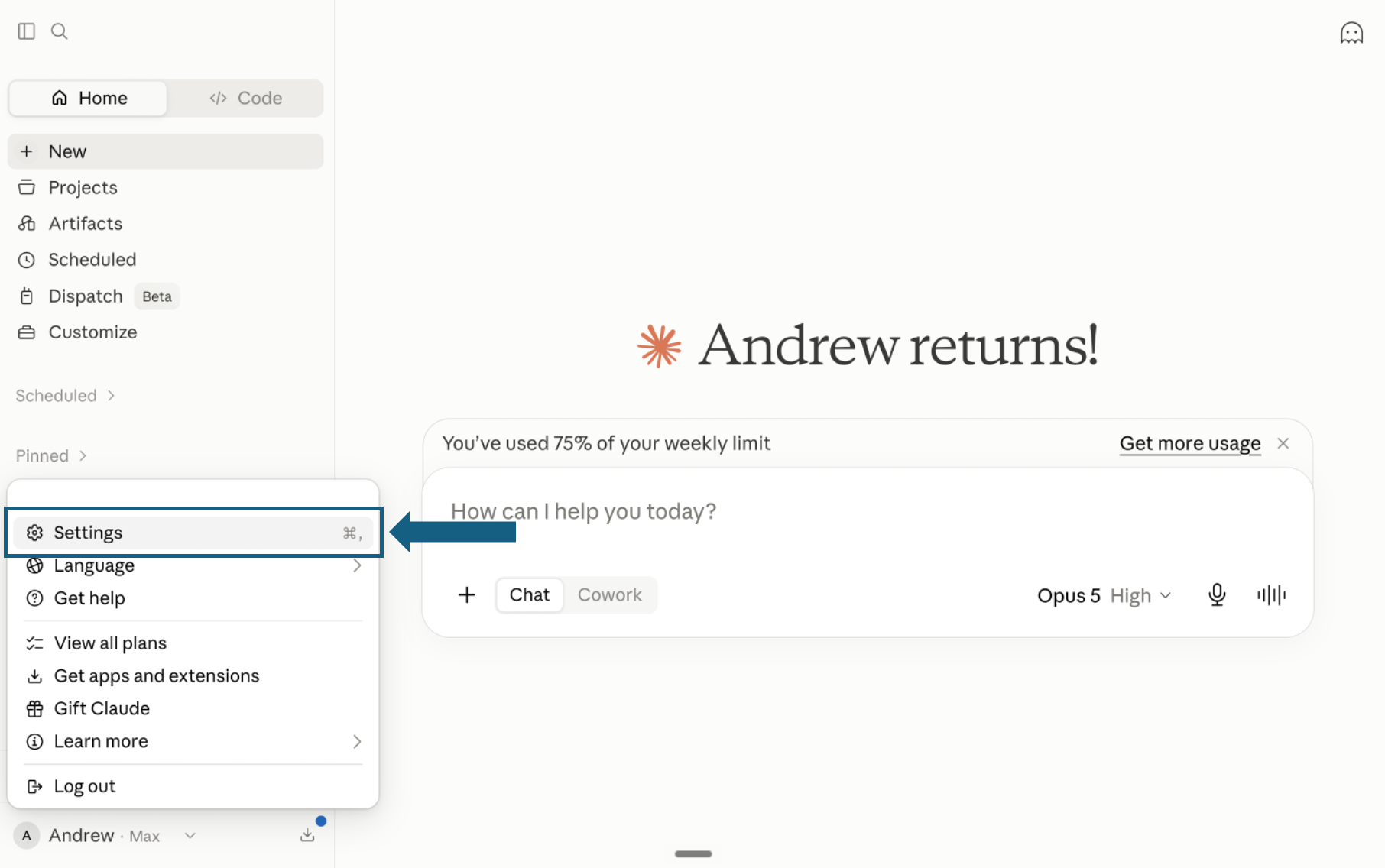
Download the pack and open Settings
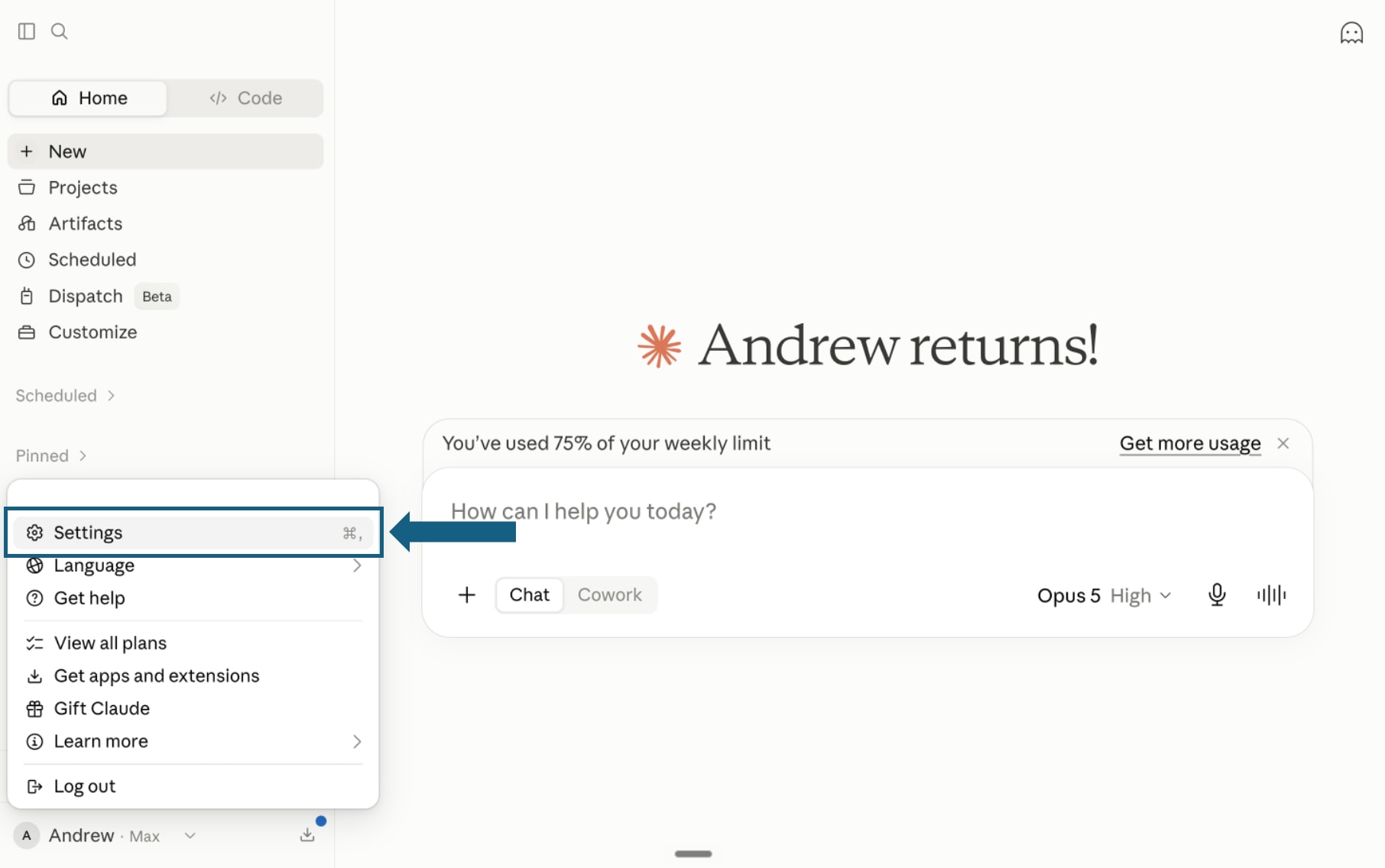
Download the pack and unzip it so each skill remains in its own folder with its SKILL.md file. In Claude, open your profile menu and select Settings.
Open the screenshot to view it full size. - Step 2
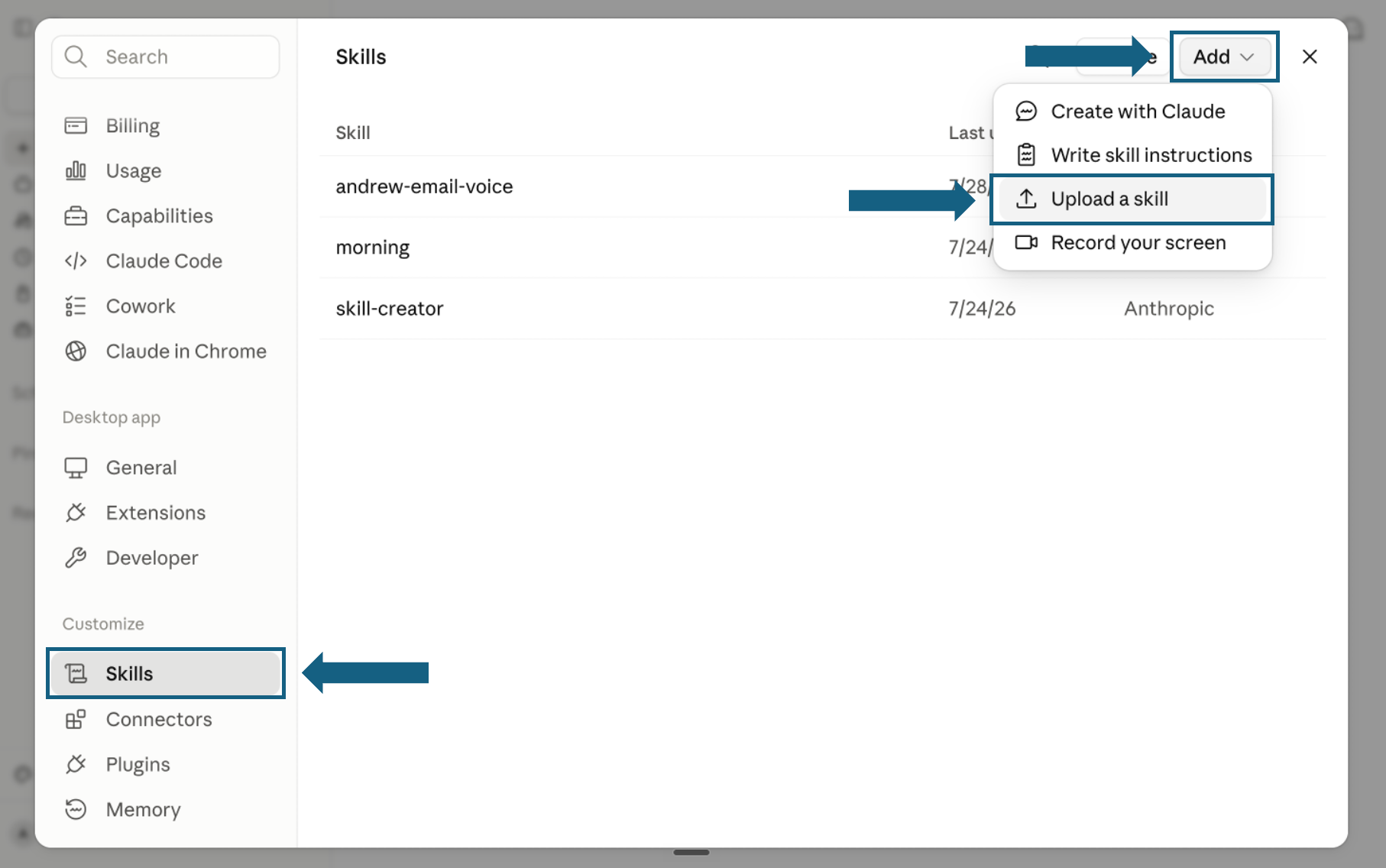
Open Skills and start an upload
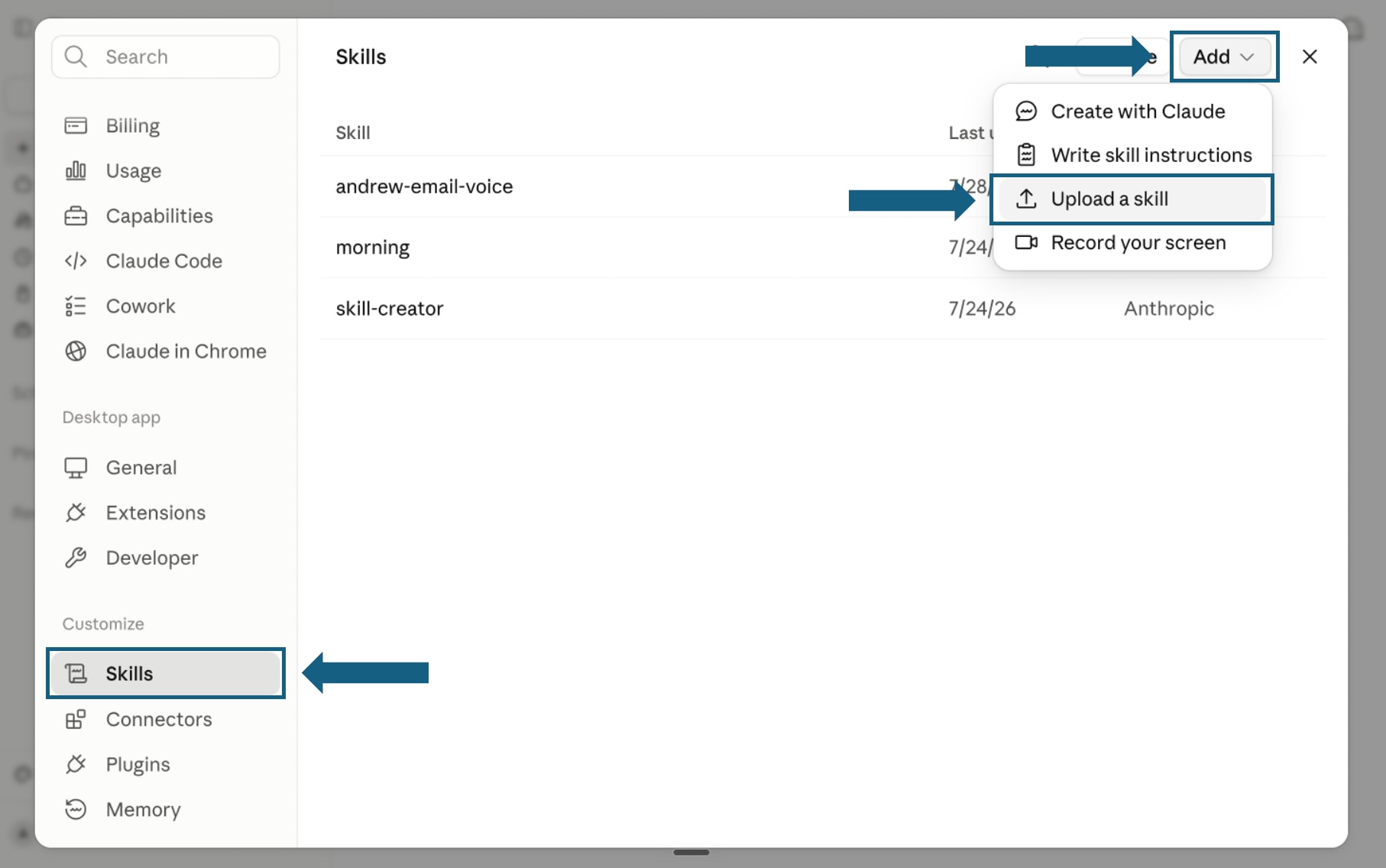
In Settings, select Skills under Customize. Open Add and choose Upload a skill.
Open the screenshot to view it full size. - Step 3
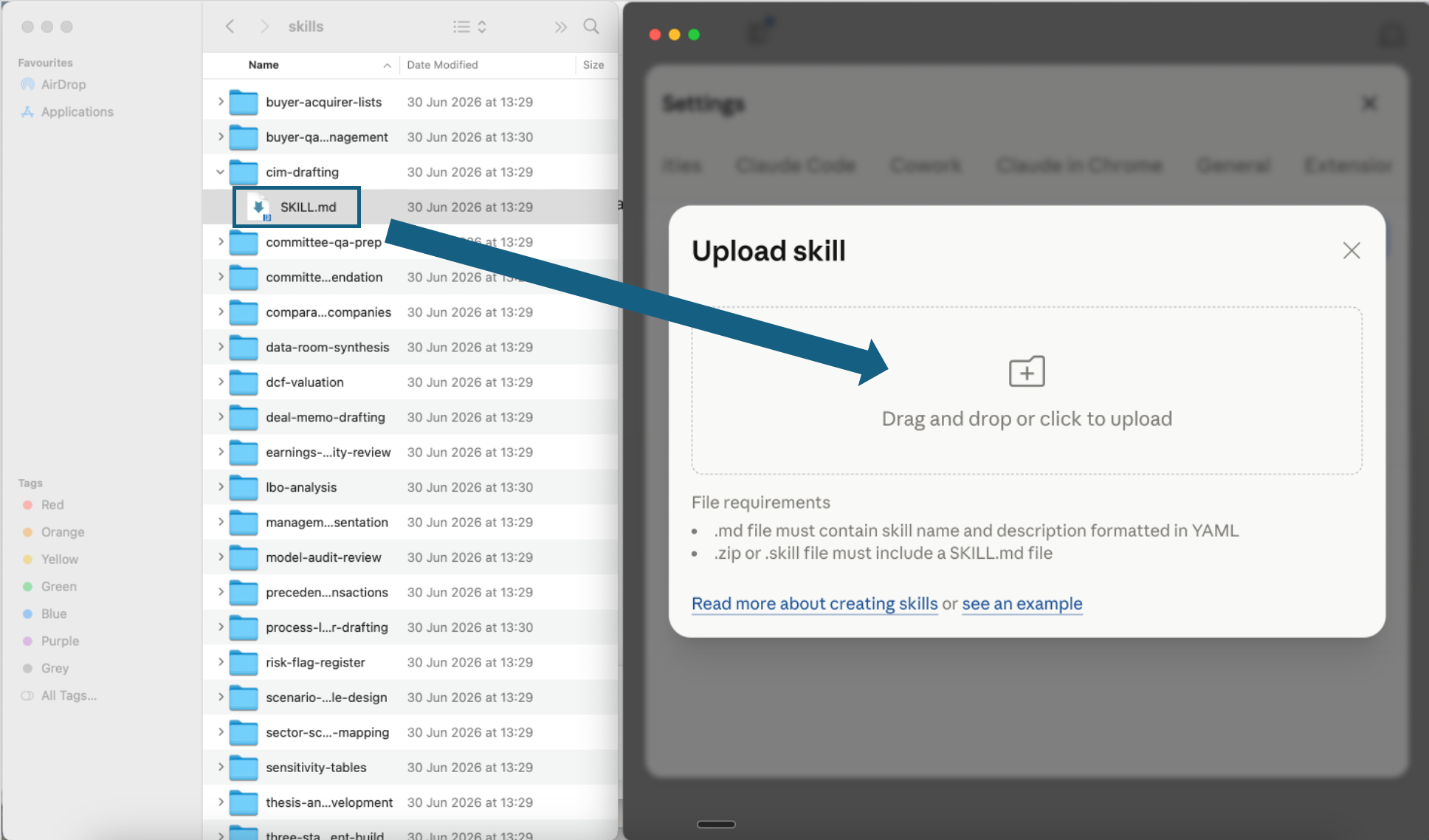
Upload one skill file
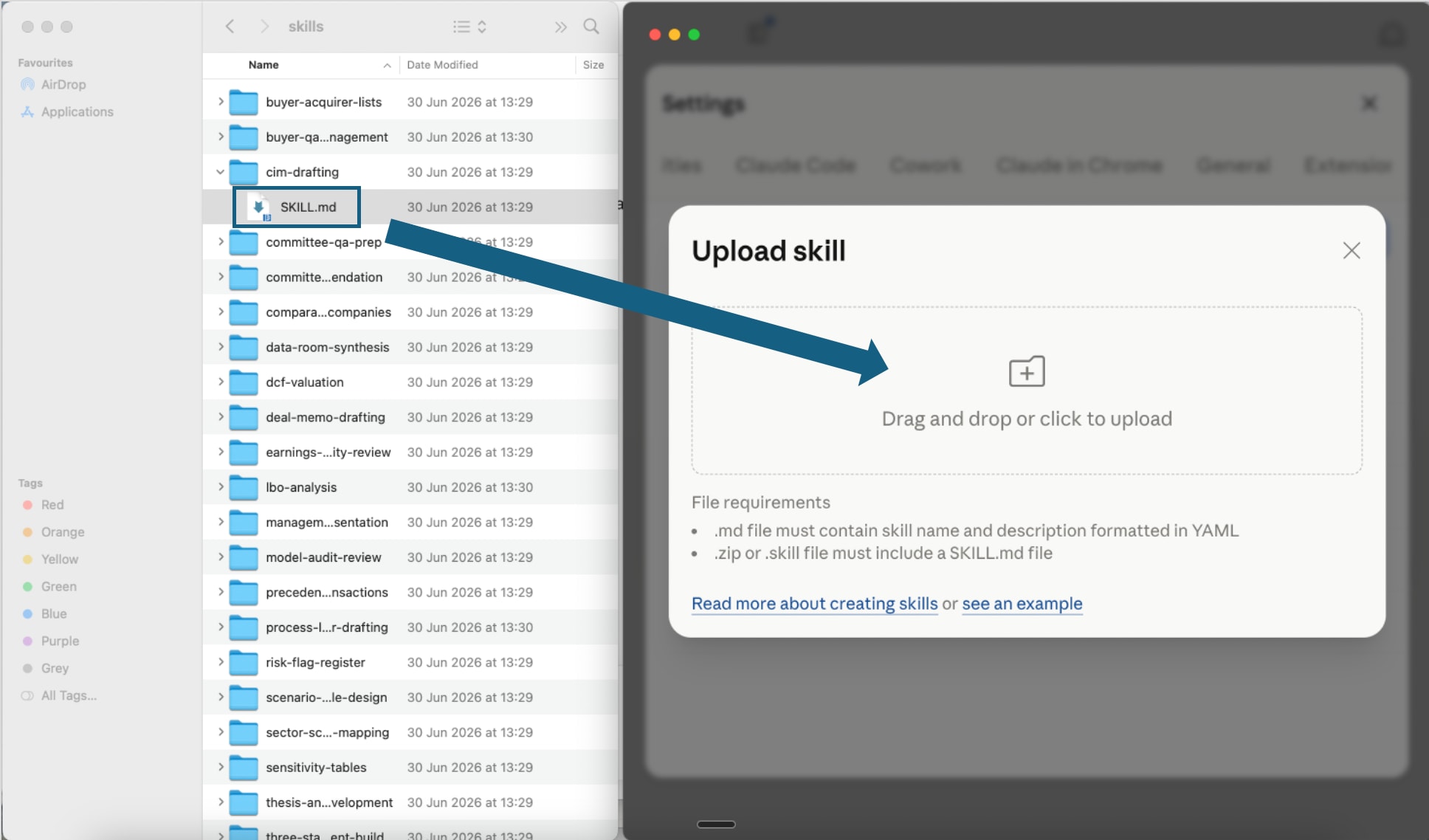
Open one extracted skill folder and drag its SKILL.md file into the upload window, or click the upload area to choose it. Repeat this step for any other skills you want to add.
Open the screenshot to view it full size. - Step 4
Confirm the skill was added
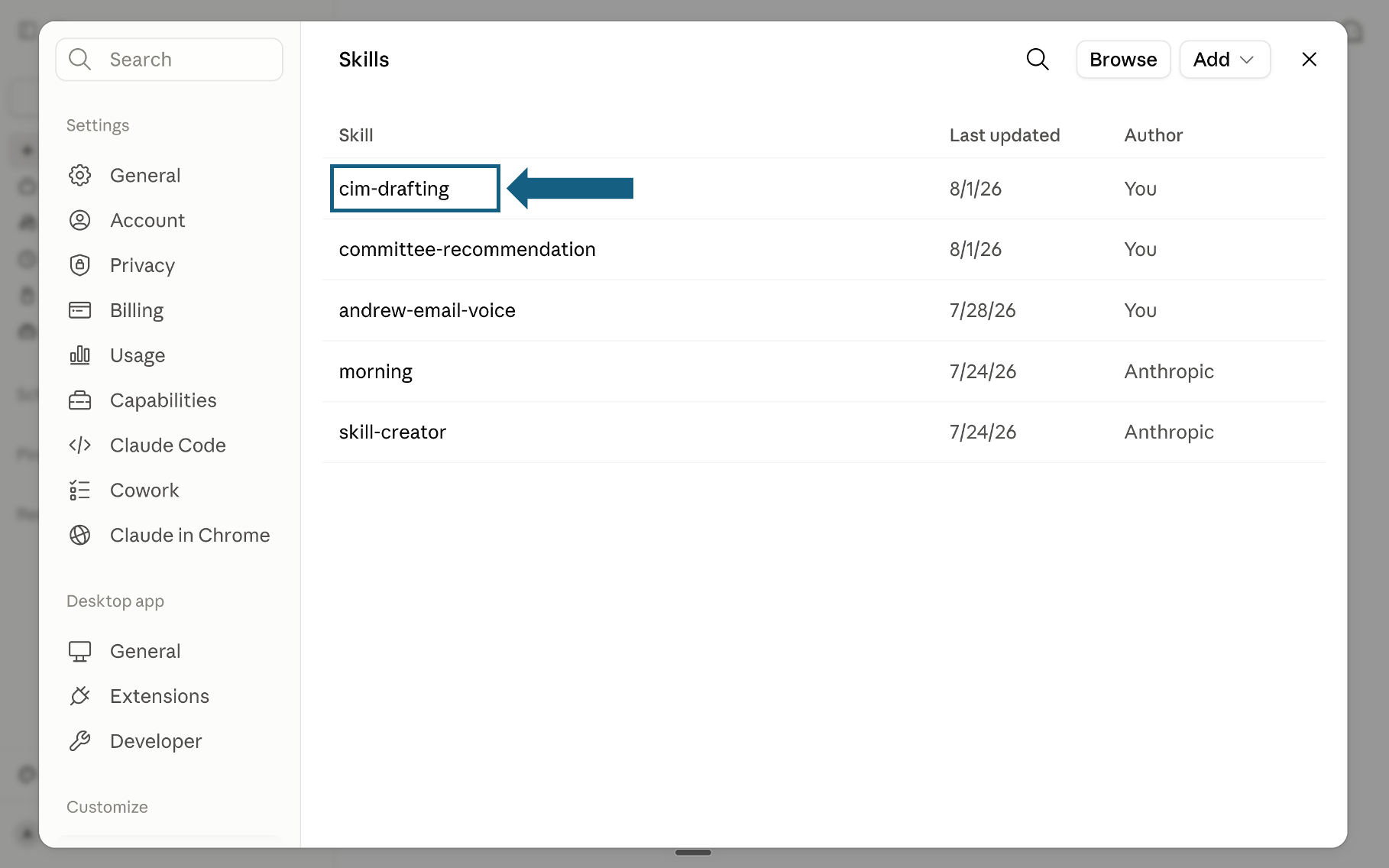
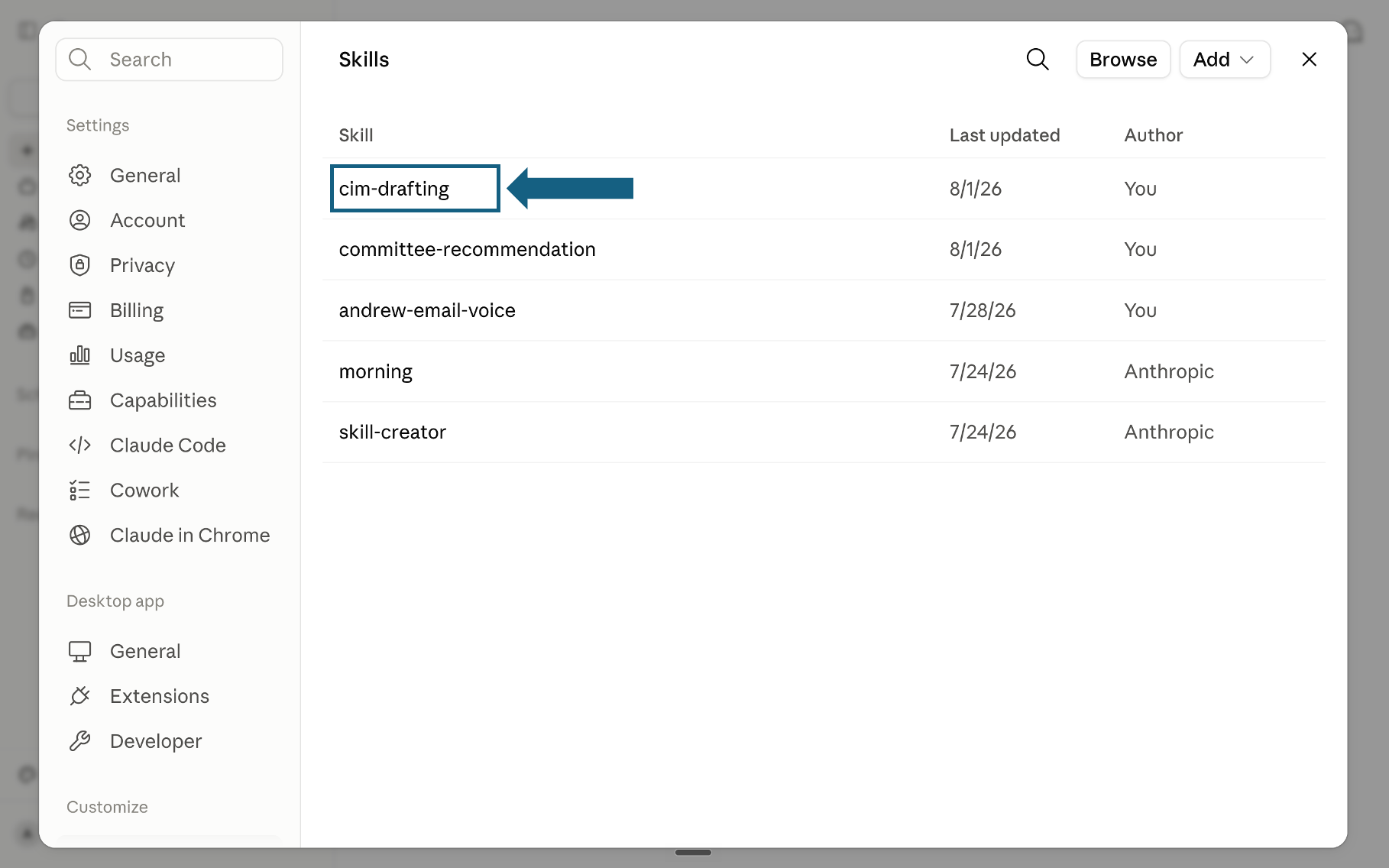
Return to the Skills list and check that the skill appears. Select its name to open it.
Open the screenshot to view it full size. - Step 5
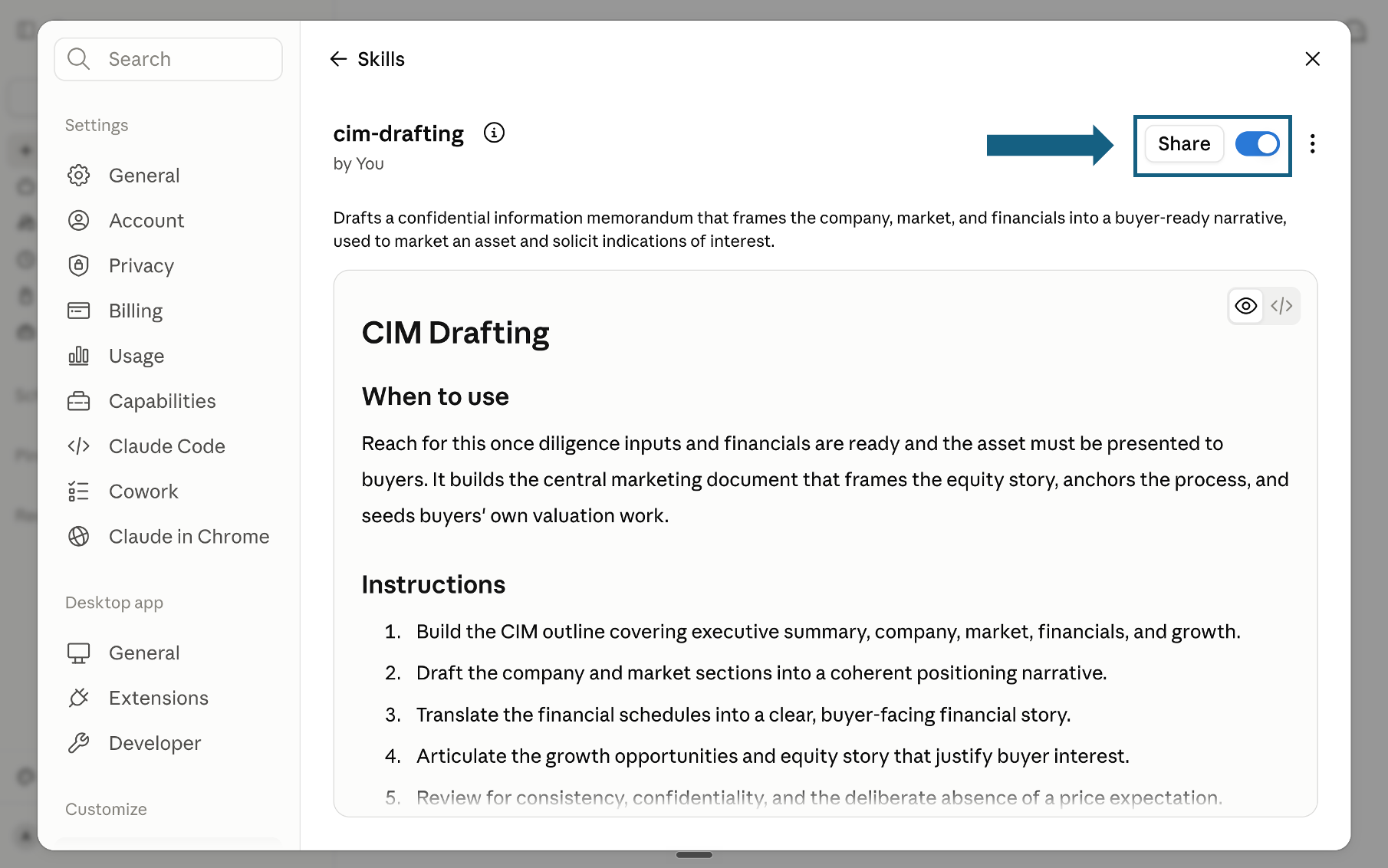
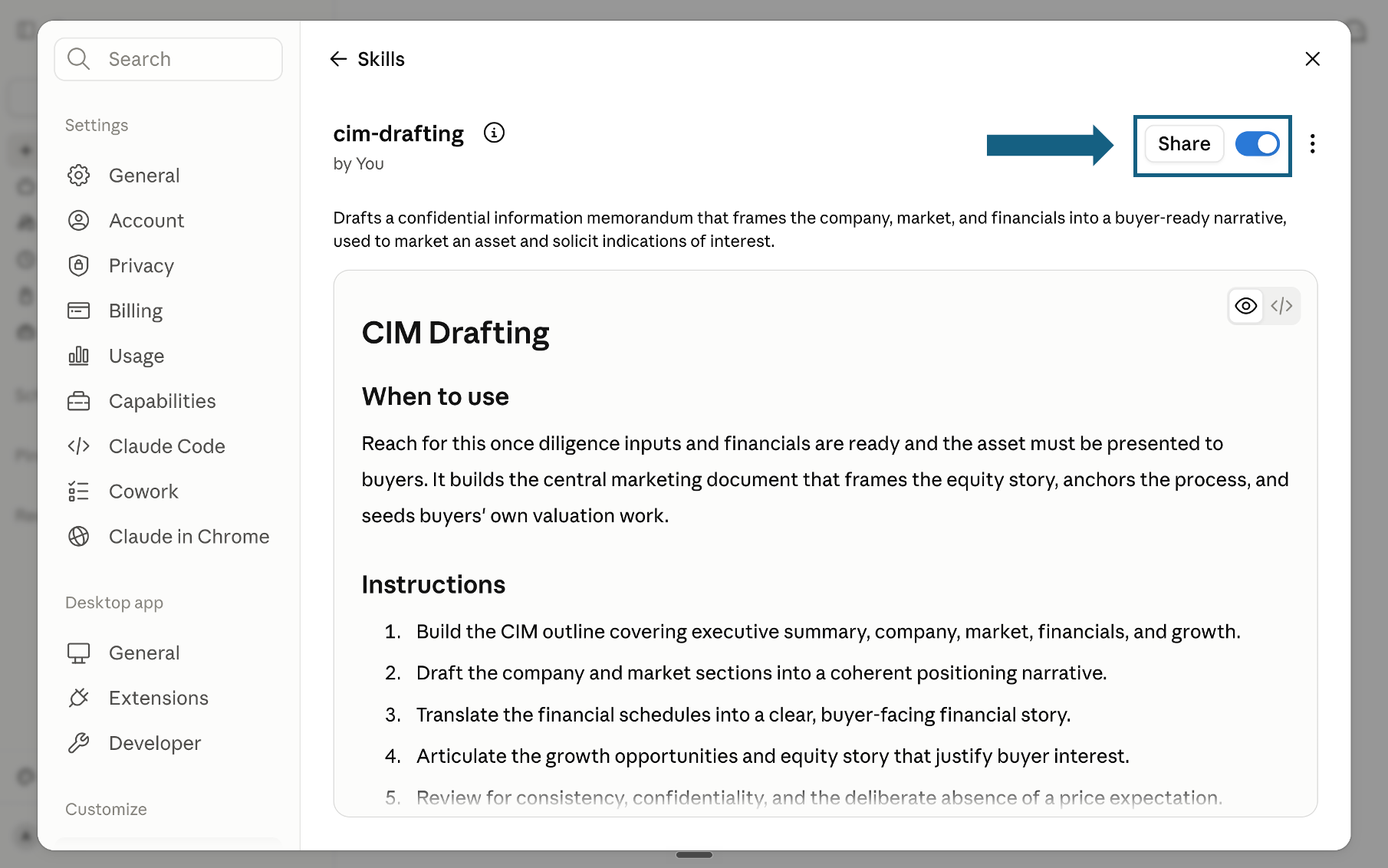
Review and turn on the skill
Review the skill's name, description, and instructions, then make sure the switch beside Share is on. A blue switch means the skill is turned on; sharing it is optional.
Open the screenshot to view it full size.
Try a skill
Tell Claude which skill to use and provide the relevant files or context. Review every output before sharing it.
- "Use the deal-screening skill to evaluate this inbound teaser: [paste teaser]."
- "Run the cim-teardown skill on this executive summary and identify the top 10 diligence priorities."
- "Use the financial-scenario-modelling skill with a 12x entry, $15M QoE EBITDA, and 5x leverage. Show bear/base/bull returns."
- "Run the ic-memo-drafting skill. Here are the QoE findings and commercial diligence conclusions: [paste]."
How to choose a skill
All 30 skills map to a specific deal phase need. Find the row that matches your situation and load that skill. For a broader view of using Claude for professional financial work, see our Claude skills for investment banking.
The quality bar
Every skill is designed to push Claude toward outputs that would pass scrutiny at an investment committee, not just produce a plausible-sounding analysis. The standard applied is the one a VP or principal would apply before sharing a memo with a partner.
Frequently asked questions
Can Claude do private equity work?
It does the documentation-heavy parts of private equity work well and the judgement parts badly. Reading a CIM, building a diligence question list, turning workstream findings into an investment committee memo and drafting a quarterly portfolio update are all tasks where the input is text and the output is checkable against that text. Pricing a deal, reading a management team and deciding what risk the fund will carry are not. Treat it as an analyst with total recall and no accountability.
Is Claude better than ChatGPT for private equity?
For long deal documents the honest answer is that both handle a CIM, and the difference that matters to a PE firm is the surrounding plumbing rather than the model. Anthropic has built out finance-specific connectors, including Chronograph for portfolio monitoring and diligence data, alongside PitchBook and S&P Capital IQ, and Claude for Excel puts the model in the workbook. Run your own side-by-side on one real CIM before standardising a firm on either.
Can Claude read a data room?
Not by connecting to it. Claude reads the documents you give it, so a data room becomes a batch of uploads, and most firms work folder by folder rather than all at once. That is a practical constraint rather than a fatal one: a contracts folder or a customer-contracts subset is usually the right unit of work anyway. Check your data room provider's terms and your NDA before anything leaves it.
Does Claude work with Excel models?
Claude for Excel is generally available on the Pro, Max, Team and Enterprise plans, working in a sidebar where Claude can read, analyse, modify and create workbooks, with cell-level citations back to the source cells. That makes it useful for interrogating a model, tracing a broken link or explaining someone else's tab. It does not make it the right place to build the LBO. Keep the structure in the workbook and use Claude to check it, not to author it.
Is it safe to put confidential deal information into Claude?
That is a procurement question and it is answered by your plan and your NDA, not by the model. Enterprise agreements, data retention settings and whether content is used for training all differ by tier, and an NDA with a seller will often say where their material may be processed. Get the answer in writing before the first CIM is uploaded, because the awkward version of this conversation happens after the upload.
Which Claude plan do private equity firms need?
Individual partners testing the water run Pro or Max. A firm putting deal material through it wants Team or Enterprise for the administrative controls, and the finance-specific connectors and the Excel add-in sit on the upper tiers. The cost is small next to a single diligence workstream, so the real gating item is usually the legal and compliance review rather than the licence.
Can Claude build the IC deck as well as the memo?
It drafts the argument well and builds the artefact poorly. Claude produces the memo text and the slide logic, but a committee deck held to a firm template, with an EBITDA bridge, a risk matrix and consistent typography, is a different job. That is what a slide generator such as Oria or the Microsoft 365 add-ins are for, and for a visually led pitch a design tool such as Gamma or Pitch beats both.