

Claude M&A Skills: 10 Investment Banking Skills for the Deal Execution Process
The question is not whether Claude can do investment banking work. It is which part of a live deal you are willing to hand to it, and at which stage. A skill that screens precedent transactions on a quiet Tuesday is doing something very different from one that drafts a page a managing director will put in front of a board. These ten skills are split along that line, and they map onto the deal execution process rather than onto a feature list: origination and the pitch, the valuation, the buyer universe, the CIM, the merger maths behind a bid, the management presentation, the data room, and the run from signing to closing. Some of those stages suit a model that reads fast and writes in a house register. At least one does not, and this page says which one.
Quick answer: which Claude M&A skill do you need?
Work backwards from the deal stage you are standing in, not from the document you have been asked to produce. The stage decides which inputs exist.
For M&A work in Claude, four skills carry most of the load. Company Teardown reverse-engineers a target's economics from filings before any model is built. Trading Comps Builder and Precedent Transaction Screener assemble the peer and precedent sets, and Valuation Triangulator reconciles them with a DCF and an LBO into a football field with a written view on weighting. CIM Red-Flag Reviewer reads a sell-side memorandum the way a sceptical buyer does and returns a risk register rather than a critique. For the workbook itself, use Claude for Excel. For a fairness opinion, use none of them: FINRA Rule 5150 requires a fairness committee that does not sit on the deal team.
Download all 10 skills
One zip, one folder per skill. Free, no signup.
How we chose these 10 M&A skills
Five rules decided what went in the pack and what was cut.
- Tested on real deal material. Each skill was run against public filings, a real sell-side memorandum and a live comparable set. A skill that only performs on a clean synthetic example fails on the first real carve-out.
- One deal stage each. A skill that claims to cover origination through closing is a prompt with ambitions. Every one of the ten names the stage it serves and refuses the work either side of it.
- The output had to be a working artefact. A risk register, a screened precedent set, a tiered buyer list, a page-by-page storyline. Anything that returned a well-written essay about the topic was cut.
- We ignored benchmark scores. No model-evaluation numbers appear anywhere in this pack. The only test that mattered was whether an associate could hand the output to a vice president without rewriting it first.
- We ignored anything needing a live data terminal. These are skills, not data subscriptions. They read what you give them. If your firm has a terminal, the skills work downstream of its exports rather than instead of them.
Key takeaways
- Match the skill to the deal stage, not the deliverable. The same target file supports a coverage pitch, an investment committee memo and a bid. Each stage needs a different skill even though the underlying company has not changed at all.
- A skill is only as good as what you feed it. Each of the ten expects specific primary material: filings, a peer set, a memorandum, a financing structure. Without that material you get a plausible-sounding template with no facts inside it.
- Expect a working artefact, not a finished document. What comes back is a register, a screened set, a storyline or a sensitivity table. That is the state an associate hands upward, not the state a client or a board ever sees.
- Know where judgement stays human. Valuation weighting, the price you advise, the fairness of consideration and anything disclosed under securities rules remain the responsibility of named people who sign their names to it.
- Check what is already covered before installing anything. Anthropic ships finance agent templates, Claude for Excel builds the workbook, and sibling packs cover pitch book pages and sponsor-side diligence in more depth than this one does.
The 10 Claude M&A skills compared
One row per skill, against the five rules above, in deal order. The last column is the honest one: where a sibling page, a Microsoft add-in or the vendor's own templates already do the job better, that is where you should go.
| Skill | Deal stage | What you feed it | What comes back | What it cannot decide | Covered better elsewhere? |
|---|---|---|---|---|---|
| Market and Sector Brief | Origination | Sector data, deal activity, your own read | A sector page with cycle and deal context | Whether the sector is investable now | Overlaps the vendor market researcher template |
| Company Teardown | Origination | Filings, accounts, disclosed KPIs | Revenue, cost, capital and concentration decomposition | Whether management is credible | No sibling covers this |
| Pitchbook Architect | The pitch | Client situation, valuation view, buyer angle | A page-by-page storyline plus a kill list | Whether you win the mandate | Page-level build: the pitch book pack |
| Trading Comps Builder | Valuation | Peer candidates and reported financials | Six to twelve normalized peers with written rationale | Which multiple the market will pay | Workbook build: the Excel pack |
| Precedent Transaction Screener | Valuation | Deal list, dates, structures, consideration mix | A cycle-adjusted, tiered precedent set | Whether a precedent still applies | Workbook build: the Excel pack |
| Valuation Triangulator | Valuation | DCF, comps, precedent and LBO outputs | A football field and a weighting argument | The number you advise | Chart build: the football field guide |
| Buyer Universe Builder | Marketing the deal | Strategic and sponsor candidates, capacity data | A tiered list with a thesis per name | Who will actually bid | No sibling covers this |
| CIM Red-Flag Reviewer | Diligence | The teaser or CIM, plus data room extracts | A quality-of-earnings risk register | Whether to bid, and at what price | Sponsor-side depth: the PE diligence pack |
| Accretion / Dilution Tester | Bid and structure | Purchase price, financing mix, synergy plan | An EPS bridge and a sensitivity table | Whether the synergies are real | Workbook build: the Excel pack |
| Deal Process Manager | Signing to closing | Workstreams, milestones, committee dates | A critical path and a weekly risk register | Regulatory outcome and timing | Agent orchestration: the deal engine |
Skills 1 to 6 build the fact base and the valuation before market. Skills 7 to 10 carry the deal from launch through process to close.
Which Claude M&A skills do you use to originate a deal and win the pitch?
Three of them, in sequence. Market and Sector Brief builds the sector page the pitch rests on: growth, cyclicality, where the deal activity actually is, and what the capital markets backdrop does to a process launched this quarter. Company Teardown then decomposes the target, revenue by segment and customer, cost structure, capital intensity, working capital, and the concentration facts that decide whether a buyer gets comfortable. Pitchbook Architect lays out the storyline page by page, subordinating credentials to the client's situation and naming the pages that should be cut.
The market context matters more than usual right now. Global M&A reached USD 3.16 trillion in the first half of 2026, a 44 percent jump on the year before, but across 21,340 deals against 21,978 in the same period of 2025, according to Mergermarket data published by ION Analytics. More value on fewer transactions. Forty-eight megadeals of USD 10 billion or more made up 42 percent of total volume. Lucinda Guthrie, Head of Mergermarket, put it this way: "The quest for scale has pushed M&A into gigadeal territory. These bets are often responding to the race for AI dominance and mask an overall market fragility caused by geopolitical and macro volatility." A sector page that misses that split reads as last year's.
The trade-off: Pitchbook Architect produces a storyline, not pages. If you want the individual exhibits built, the 16-skill pitch book pack goes one level deeper and covers league tables, management profiles and the deal rationale page.
How do you build an M&A valuation in Claude: comps, precedents and the football field?
In three passes, and the order is not negotiable. Trading Comps Builder first: six to twelve genuine peers, calendarized to a common year end, EBITDA adjusted consistently, outliers treated rather than deleted, and a written rationale for every name considered and rejected. That rejection log is the part that survives counterparty review. Precedent Transaction Screener next, which is a harder screen than most people run, because a transaction priced into a different rate environment or a different consideration mix is not a comparable at all. It tiers by deal type, adjusts for cycle and structure, and calibrates the synergy assumption baked into each premium.
Valuation Triangulator then reconciles those two with a DCF and an LBO, walks the enterprise-to-equity bridge properly, and writes the argument for which method should carry the most weight in this specific situation. That last sentence is the output. A football field with five bars and no view attached is a picture, not an opinion. The football field slide guide covers the exhibit once the range exists.
The trade-off: none of this builds a workbook. The DCF and the LBO have to exist before Triangulator has anything to reconcile, and for that you want the Excel modelling skills or the Claude for Excel add-in and its real limits.
Which Claude skill screens the buyer universe for an M&A process?
Buyer Universe Builder, and its discipline is one thesis per name. A list of forty logos is not a buyer universe. What the skill produces is a segmented set: strategics grouped by acquisition rationale, sponsors grouped by fund stage, mandate fit and dry powder, each with a stated reason this buyer would pay more for this asset than the next one would. It then diligences capacity to pay against balance sheet headroom and recent behaviour, and sorts the result into process tiers, so you can argue for a broad auction, a limited process or targeted outreach with something other than instinct.
The tiering is where the value sits. A broad auction run against buyers who cannot fund the deal burns the asset and tells the market it was shopped. A targeted approach to three names that each have a distinct angle is a different conversation. The skill forces you to write the angle down before the name goes on the list, which is exactly the step that gets skipped when a list is assembled from a screen the night before a client call.
The trade-off: it knows nothing your inputs do not contain. It cannot see who is quietly in a process already, who just lost an auction and is motivated, or which strategic has an internal moratorium. That intelligence comes from coverage bankers, and no skill substitutes for it.
Can Claude read a CIM and flag the quality-of-earnings risks?
This is the skill people come back to. CIM Red-Flag Reviewer reads a sell-side memorandum the way a sceptical buyer's managing director reads it, and it is looking for a specific list: adjustments to EBITDA that are really run-rate hopes, customer and supplier concentration buried in an appendix, margin expansion with no mechanism behind it, working capital and capex assumptions that do not reconcile to the growth case, and the gaps between what the narrative claims and what the exhibits actually evidence.
What comes back is a risk register rather than a critique, which matters on both sides of the table. A buy-side team uses it to frame the indication of interest and to write the diligence request list. A sell-side team runs it on its own CIM before launch and closes the gaps while there is still time. Sponsor-side readers who want the full diligence workflow rather than the memorandum read should start from the private equity due diligence skills instead.
The trade-off: a CIM is confidential and usually covered by an NDA that names permitted recipients. Whether you may put it into any hosted model at all is a question for your compliance function, and the answer depends on your firm's tenant and its agreement, not on this page. It is also not a quality-of-earnings report and does not replace one.
How do you run accretion and dilution on a bid in Claude?
Accretion / Dilution Tester takes the purchase price mechanics, a financing mix priced at something resembling today's market, a synergy plan with timing attached, and the intangible amortization and tax shield effects that people leave out and then cannot explain in the meeting. It returns an EPS bridge and a sensitivity table, and the table is deliberately built to run in the other direction: not "here is what we believe" but "here is what would have to be true" for this deal to be accretive in year two.
That reversal is not a stylistic preference. Writing in the Harvard Business Review, Clayton Christensen, Richard Alton, Curtis Rising and Andrew Waldeck put the acquisition failure rate at between 70 and 90 percent, and argued that what was missing was not more analysis but a theory of why deals succeed or fail. A sensitivity table that names the synergy realisation rate, the integration cost and the financing spread at which the maths stops working is a small contribution to that, and it is the page a board actually interrogates.
The trade-off: the skill tests the arithmetic of a synergy plan, not the plan itself. Whether 180 million of cost synergies is achievable in eighteen months is an operating judgement that belongs to the people who will have to deliver it.
Which tool turns the analysis into the management presentation?
None of the ten skills do. They stop at the analysis, and somebody still builds the pages. Oria is our own product, so weigh this accordingly. It reaches you two ways: as a PowerPoint add-in in the task pane on Windows, macOS and PowerPoint for the web, and as a connector for Claude and ChatGPT over MCP, so a slide can be built from the conversation you are already in.
What it is built for is narrow and deliberate: corporate and consulting documents. Board packs, steering committee decks, diligence exhibits, operating model pages, dense frameworks held to an enforced corporate template. A management presentation is that shape. On data posture, stated plainly: no training on customer content, Professional and Team do not persist presentation content after delivery, and Enterprise adds private cloud deployment and custom LLM integration.
Where it loses, equally plainly. Oria is built for the corporate environment only, so on highly visual work it is beaten and looks worse losing: founder fundraising and pitch decks, launch and campaign decks, student presentations, marketing one-pagers. Where the job is visual impact, a design-led tool such as Gamma, Canva, Pitch or Beautiful.ai is the right answer, and our own comparison against Gamma says so.
The trade-off: a second subscription from $19 a month, justified only when your exhibits are genuinely complex and your template is genuinely enforced. If the deliverable is twelve pages of text and two charts, the free skills plus whatever your firm already licenses are the honest answer.
Can Claude write a fairness opinion?
No, and this is the stage of the deal execution process where the answer is a flat one. A fairness opinion is a regulated product of a member firm, not a document. FINRA Rule 5150 requires the firm to disclose, inside the opinion itself, whether it acted as financial advisor to a party to the transaction and will be paid contingent on completion, any other significant contingent compensation, material relationships with the parties over the preceding two years, whether company-supplied information was independently verified, and whether a fairness committee approved the opinion.
The procedural requirement is the part no software touches. The rule requires written procedures for a balanced review by that committee, which must include "the review and approval by persons who do not serve on the deal team". On the disclosure side, Item 1015 of Regulation M-A pulls the financial advisor's materials, including board books and draft opinions, into the proxy disclosure. A model can help assemble the underlying analysis. It cannot be the independent reviewer, and it cannot be the signatory.
The trade-off: there is no trade-off to weigh here, which is the point of including the stage. Valuation Triangulator can produce the methodology view that supports an opinion. Everything that makes it an opinion is governed by rules written for people.
What holds an M&A deal together from signing to closing?
Deal Process Manager, which is the least glamorous skill in the pack and the one that saves the most hours. It builds the workstream architecture, the critical path, the committee and investment committee cadence, and a weekly risk register aimed at the three things that actually break processes: missed milestones, diligence findings that arrive too late to reprice, and sign-to-close drift while everyone assumes somebody else is chasing the condition precedent.
Drift is measurable. Dechert's DAMITT report found that significant US merger investigations concluded in the first half of 2026 averaged 9.9 months, and that in the European Union two Phase I remedy cases closed roughly 7.8 months from announcement to decision against a 2025 average of 11.9 months. Timelines improved, but a deal signed with a nine or ten month gap to closing needs a governance rhythm, not a shared inbox. That is what the skill lays out, and it is also where the data room, the Q&A log and the process letter hang off the same critical path.
The trade-off: a single-turn skill produces a plan, then forgets it. If you want something that maintains state across a live process, the 21-agent deal engine and the 60-agent deal flow set are built as agents with handoffs rather than procedures.
How do you install a Claude skill for investment banking?
Five steps, once. Each skill is an exact, source-verified markdown workflow packaged as one folder with a SKILL.md file inside it. Upload the file through Claude's Skills settings, then name the skill in your prompt and give it the deal material.
- Step 1Download all 10 skills (.zip)
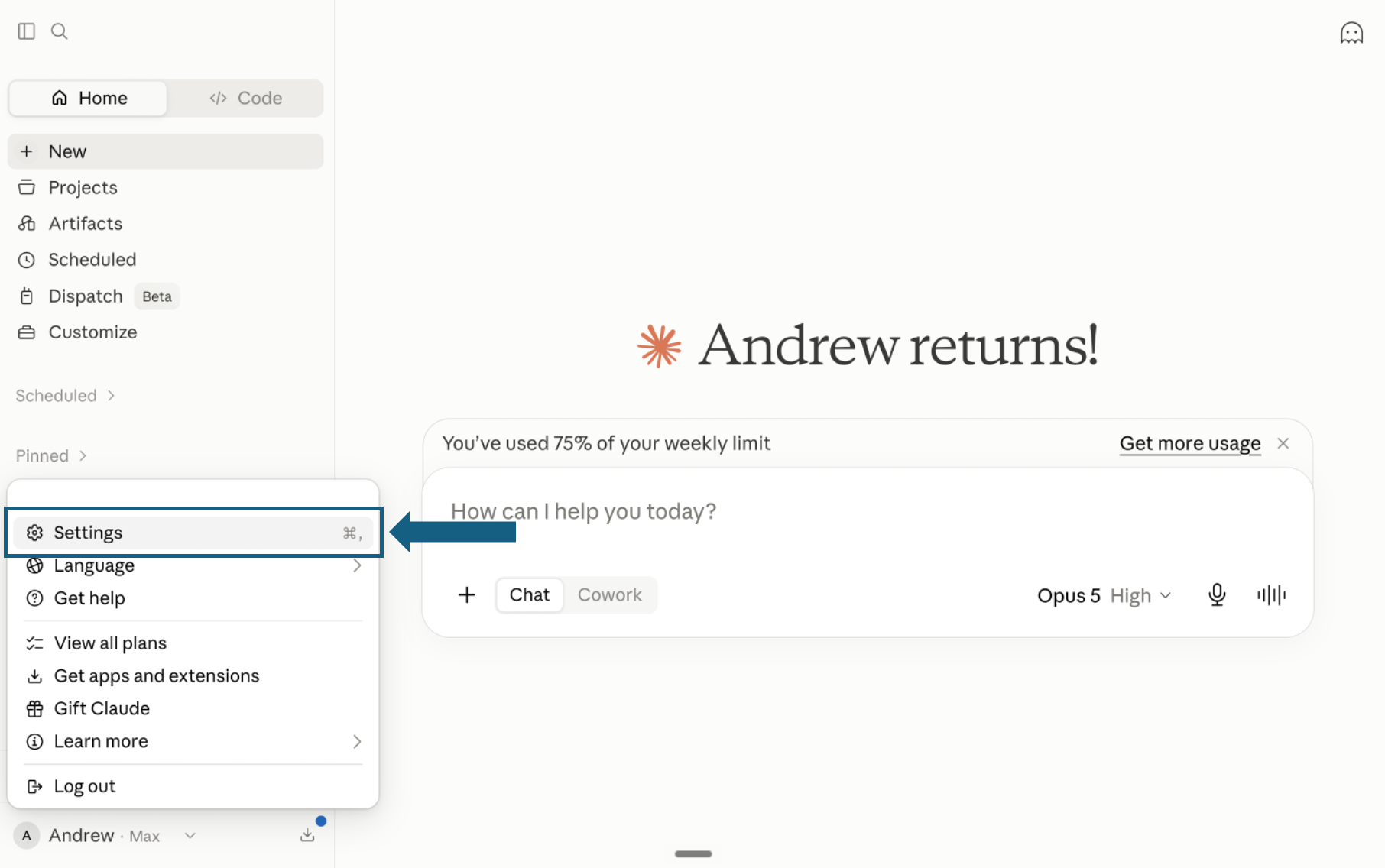
Download the pack and open Settings
Download and unzip the pack so every skill remains in its own folder with a SKILL.md file. In Claude, open your profile menu and select Settings.
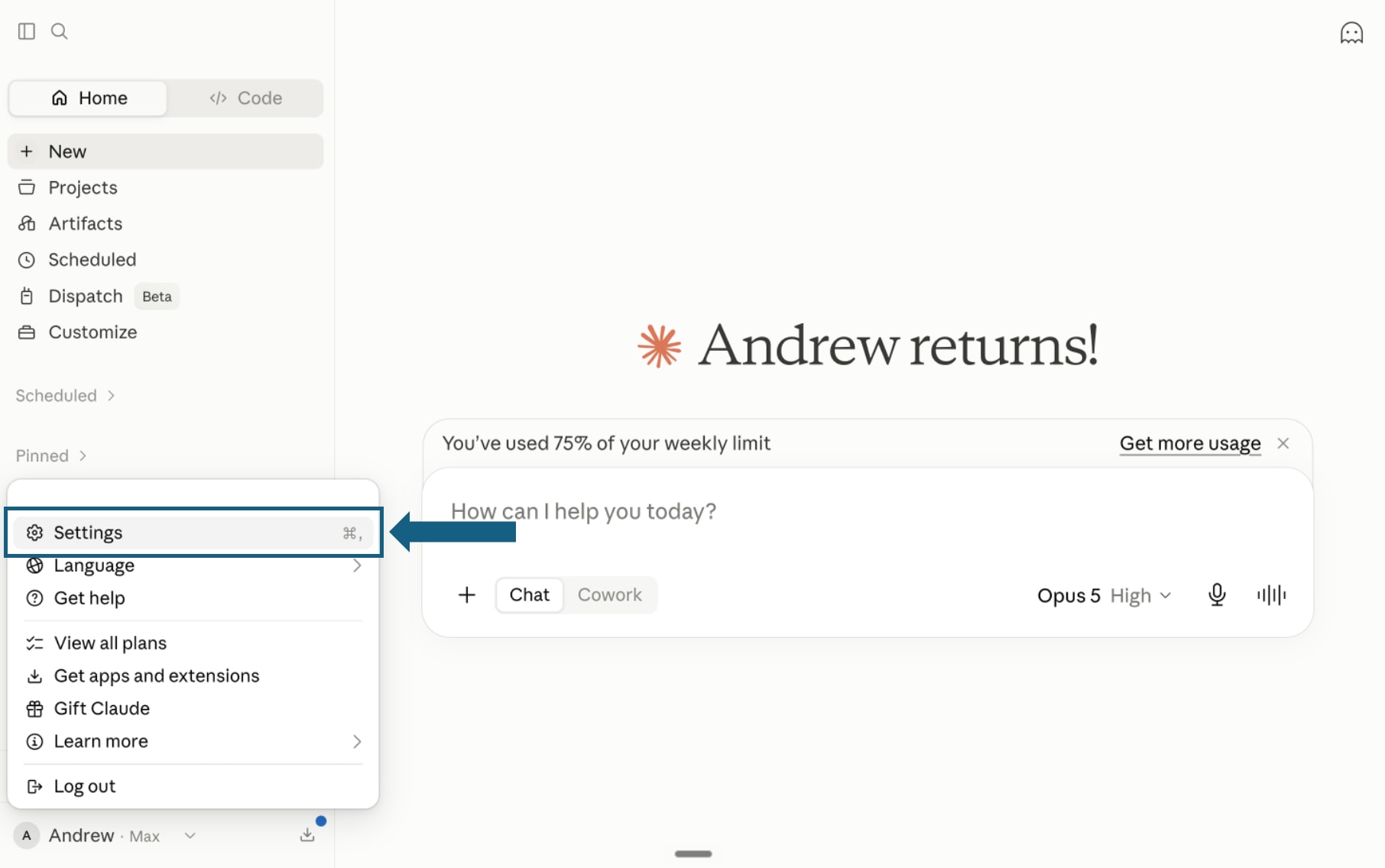
Open the screenshot to view it full size. - Step 2
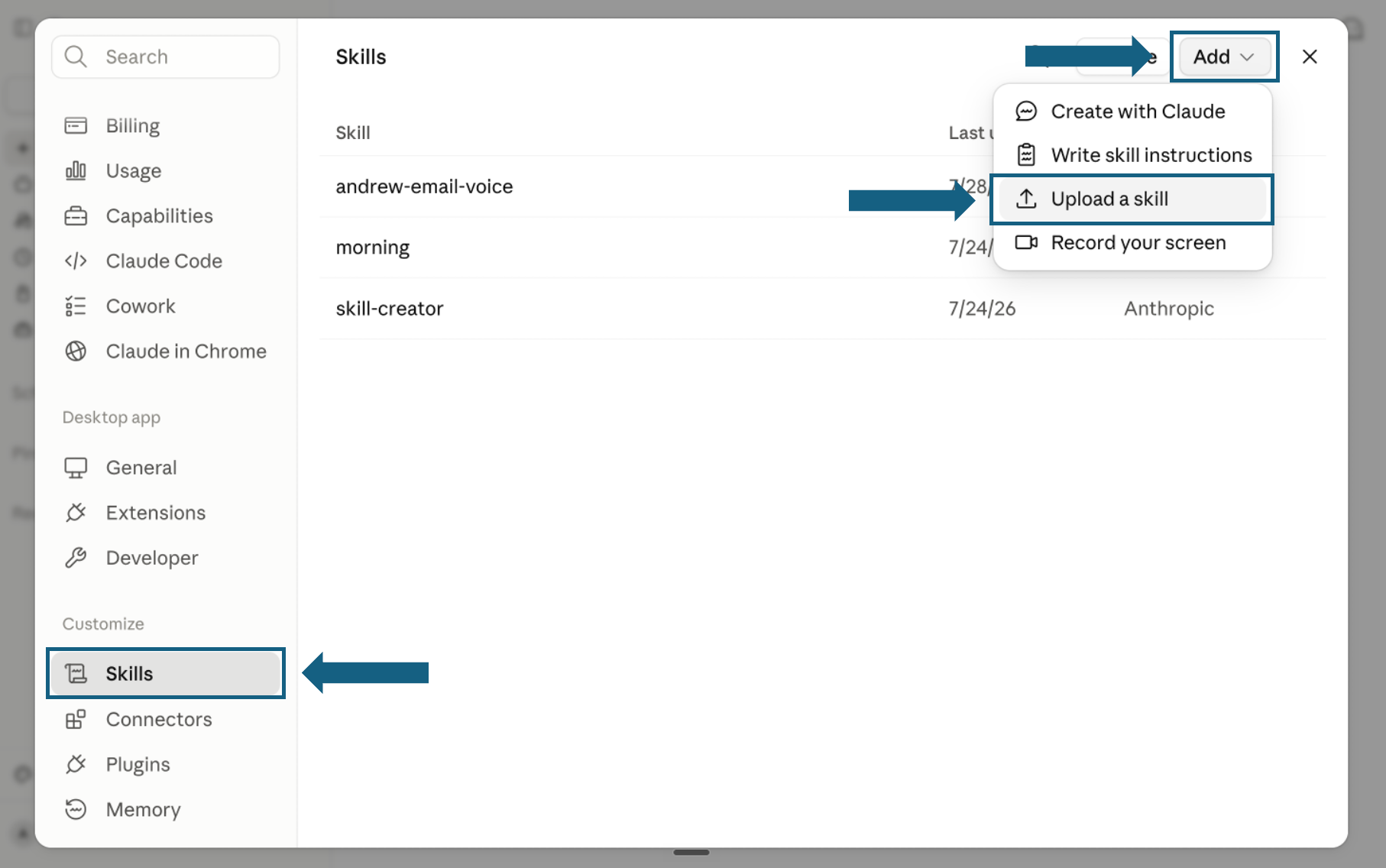
Open Skills and start an upload
In Settings, select Skills under Customize. Open Add and choose Upload a skill.
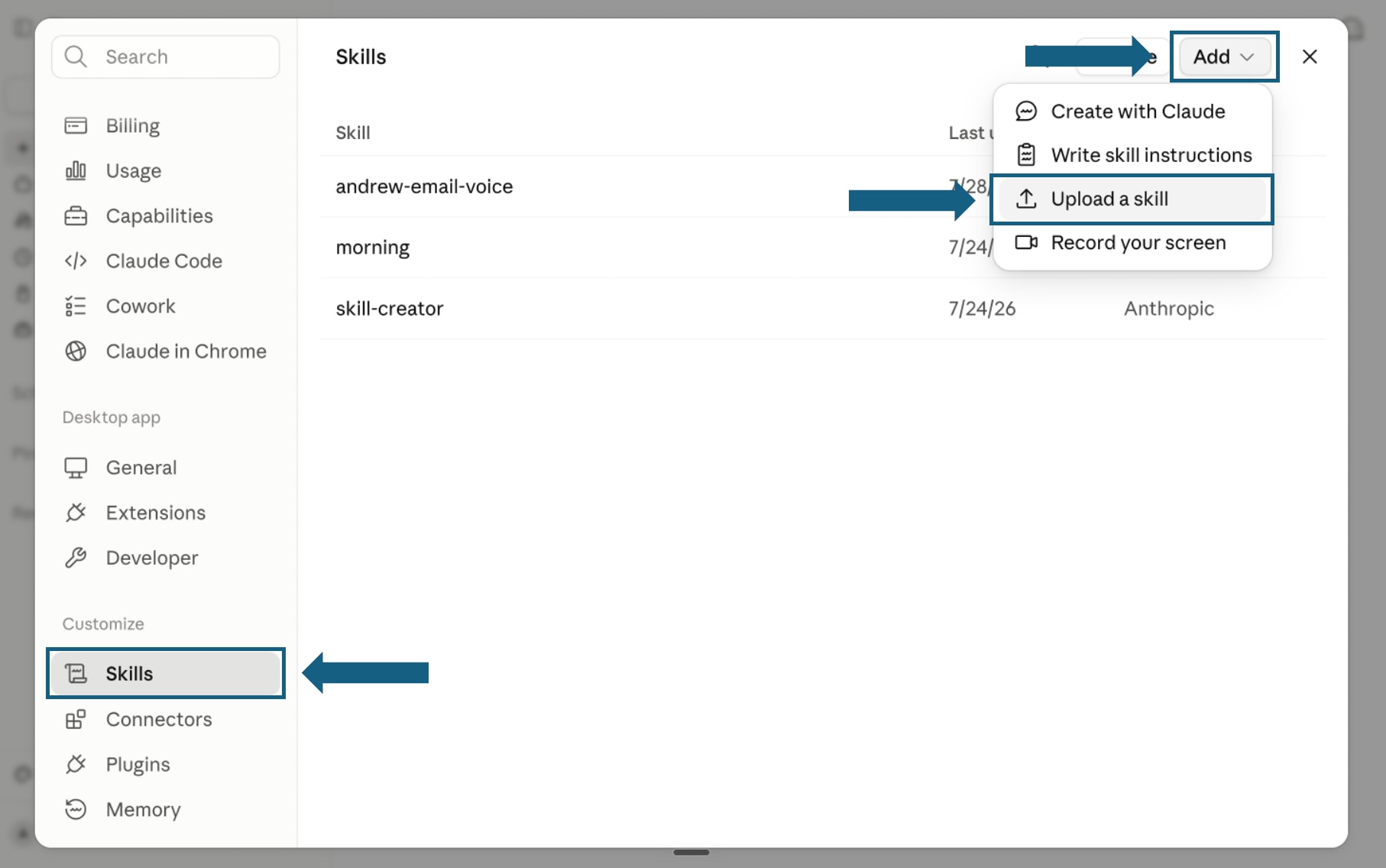
Open the screenshot to view it full size. - Step 3
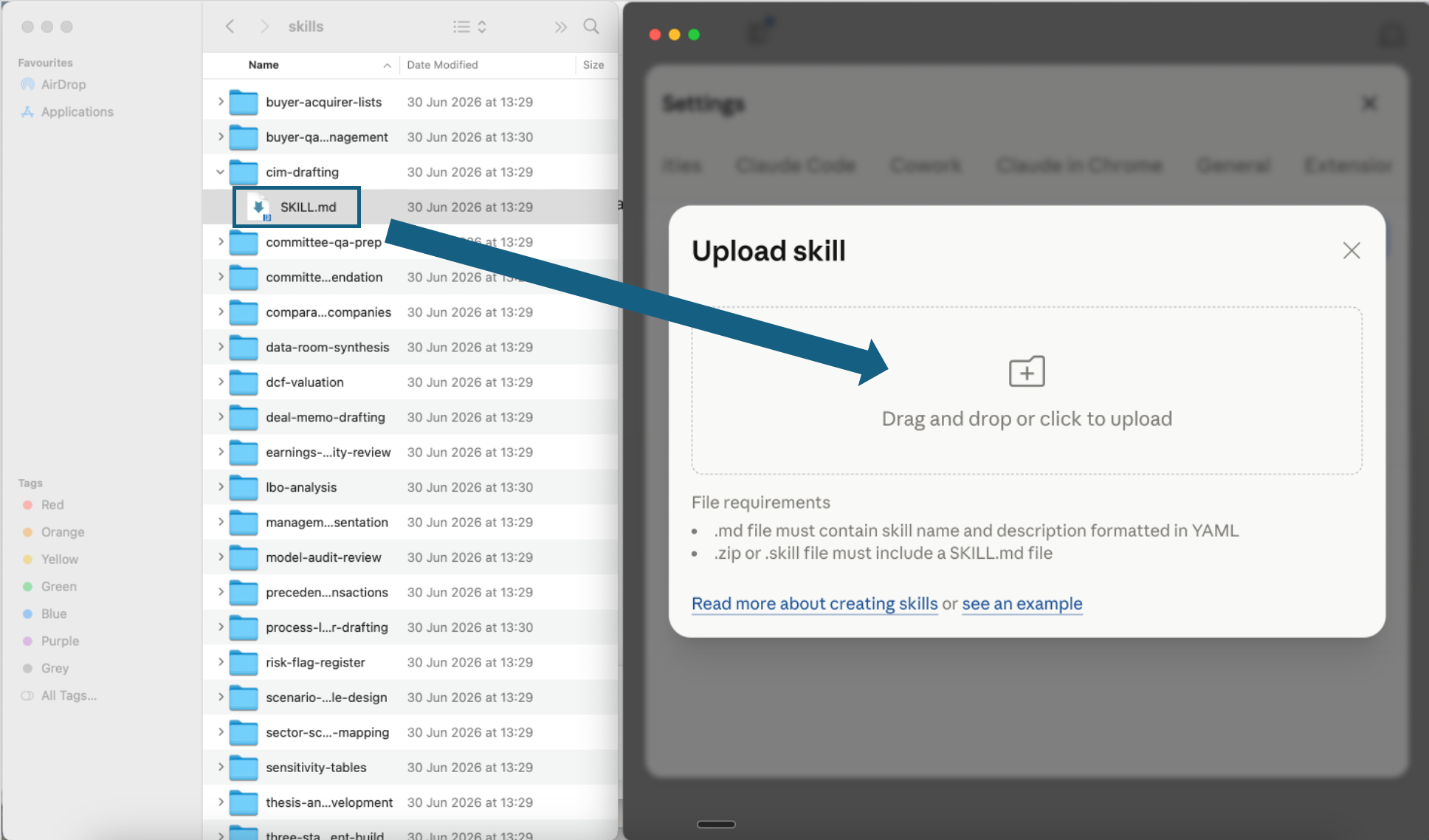
Upload one skill file
Open one extracted skill folder and drag its SKILL.md file into the upload window, or use the file picker. Repeat for every skill you want.
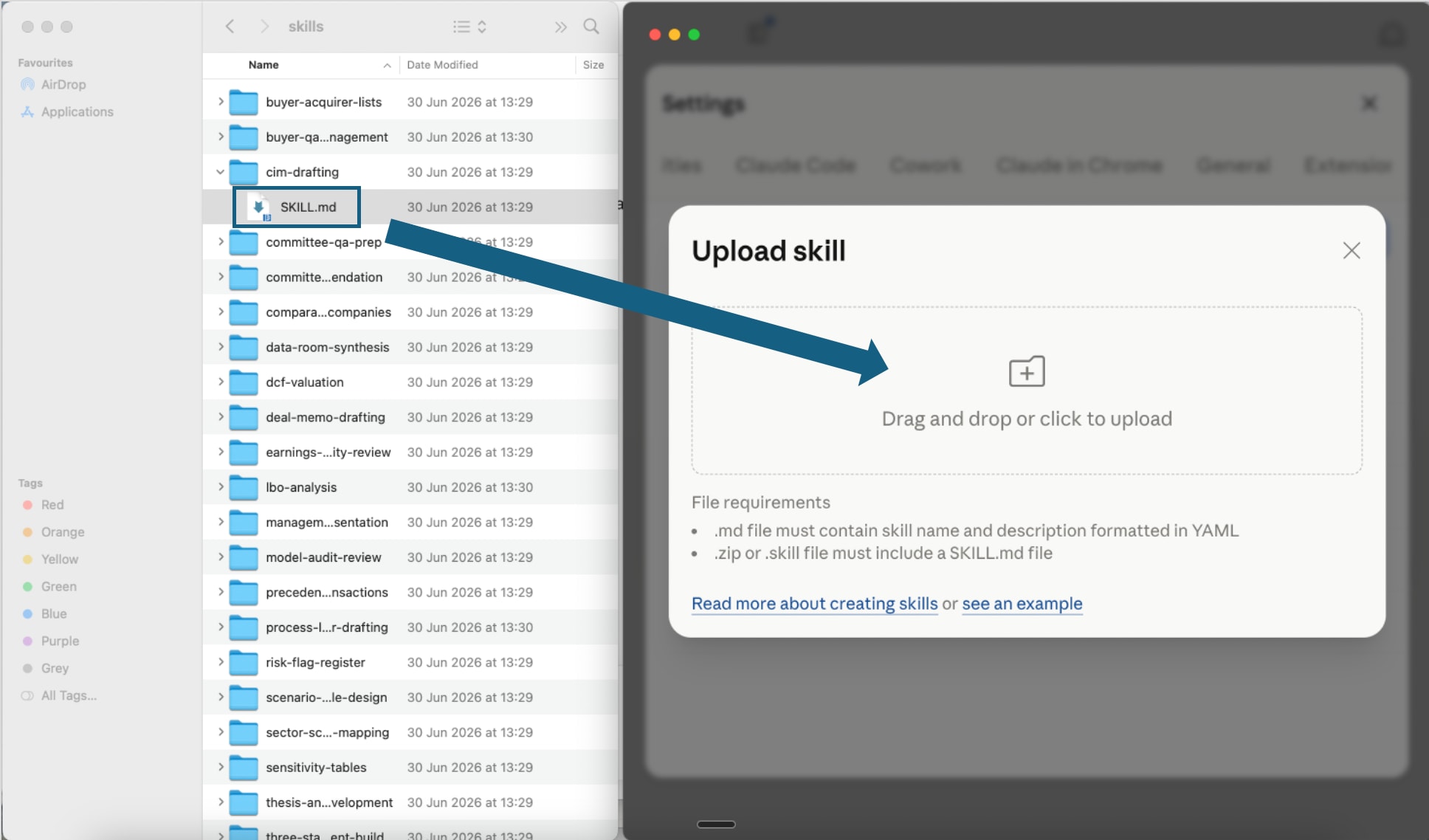
Open the screenshot to view it full size. - Step 4
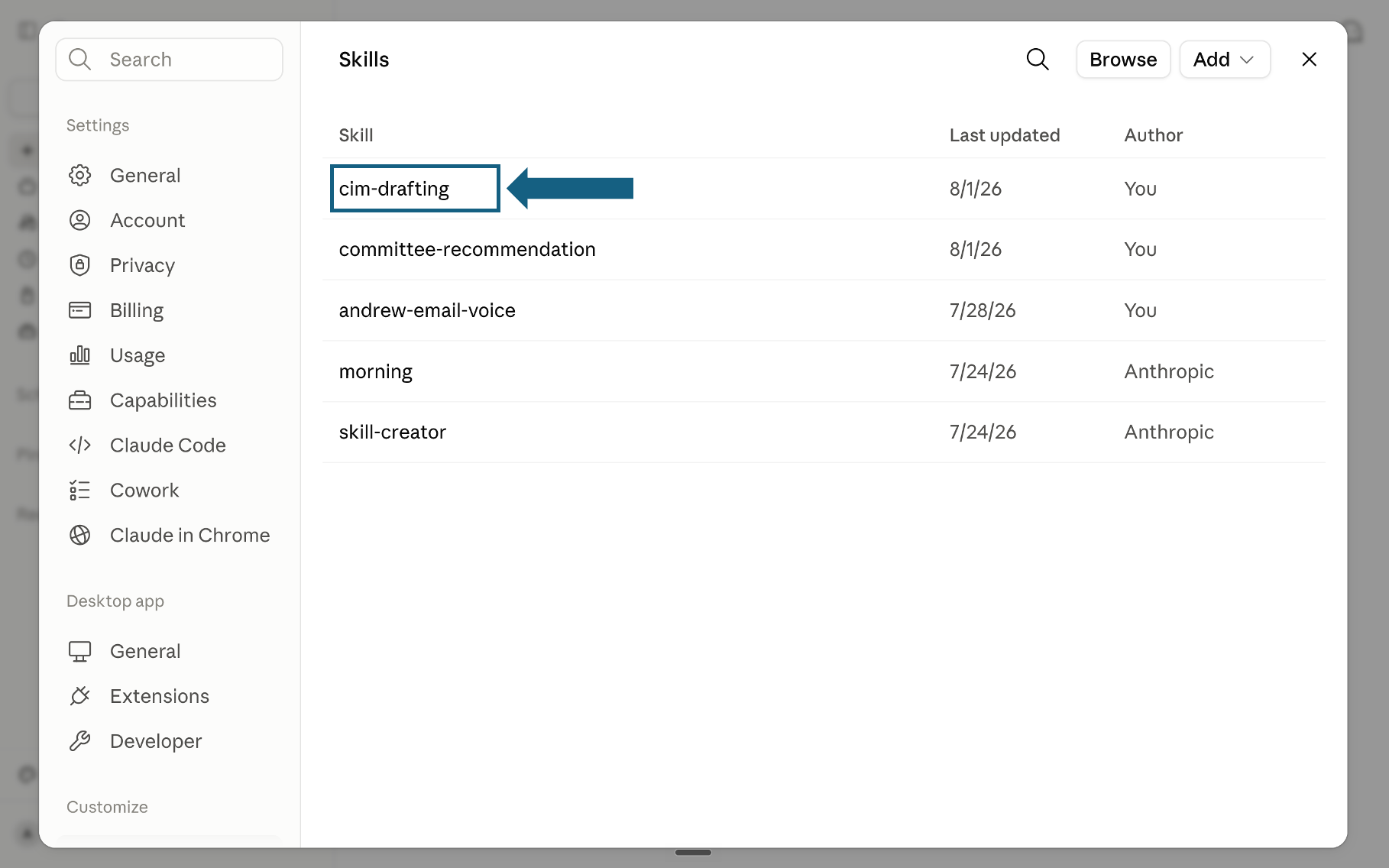
Confirm the skill was added
Return to the Skills list and check that the skill appears. Select its name to open it.
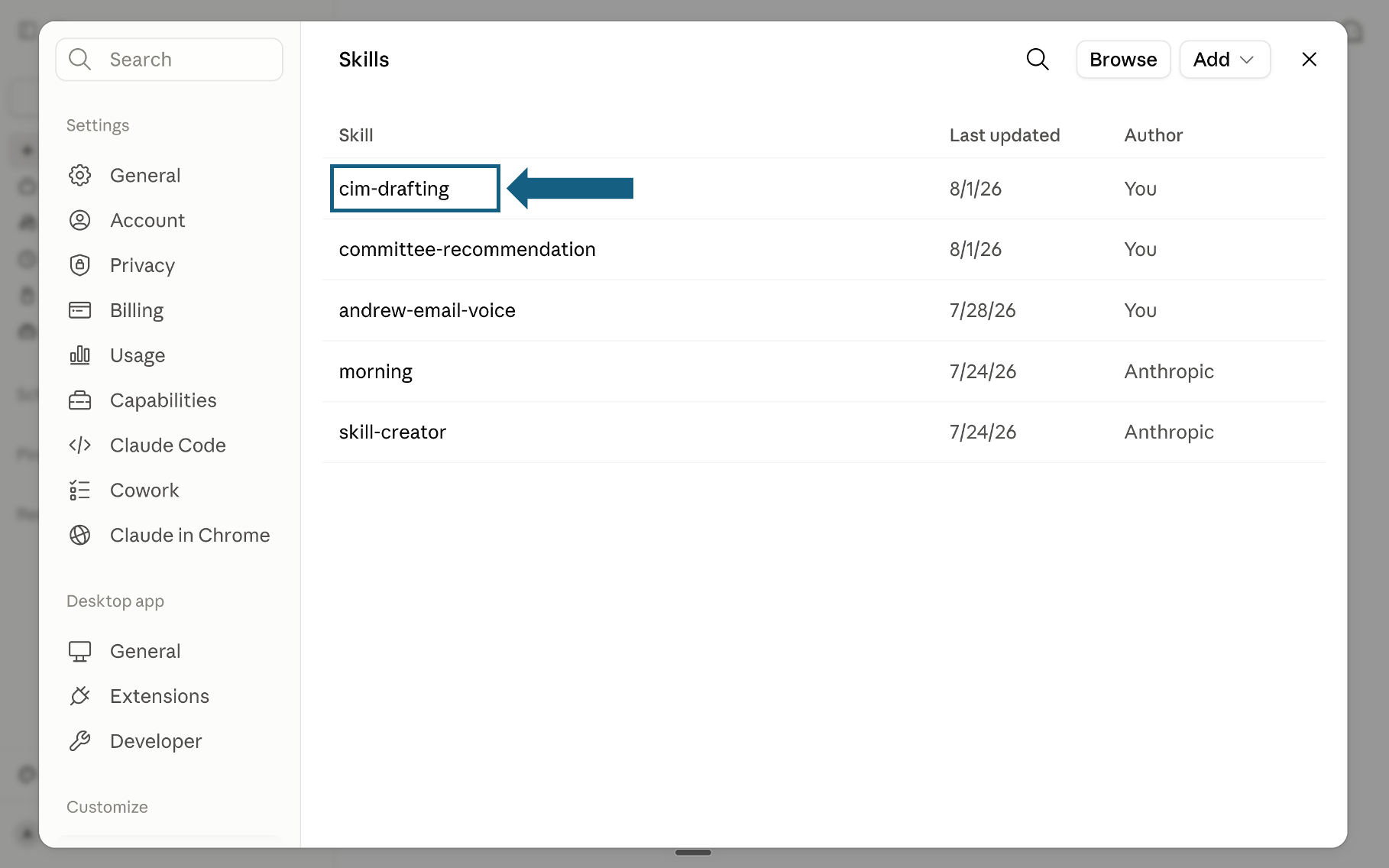
Open the screenshot to view it full size. - Step 5
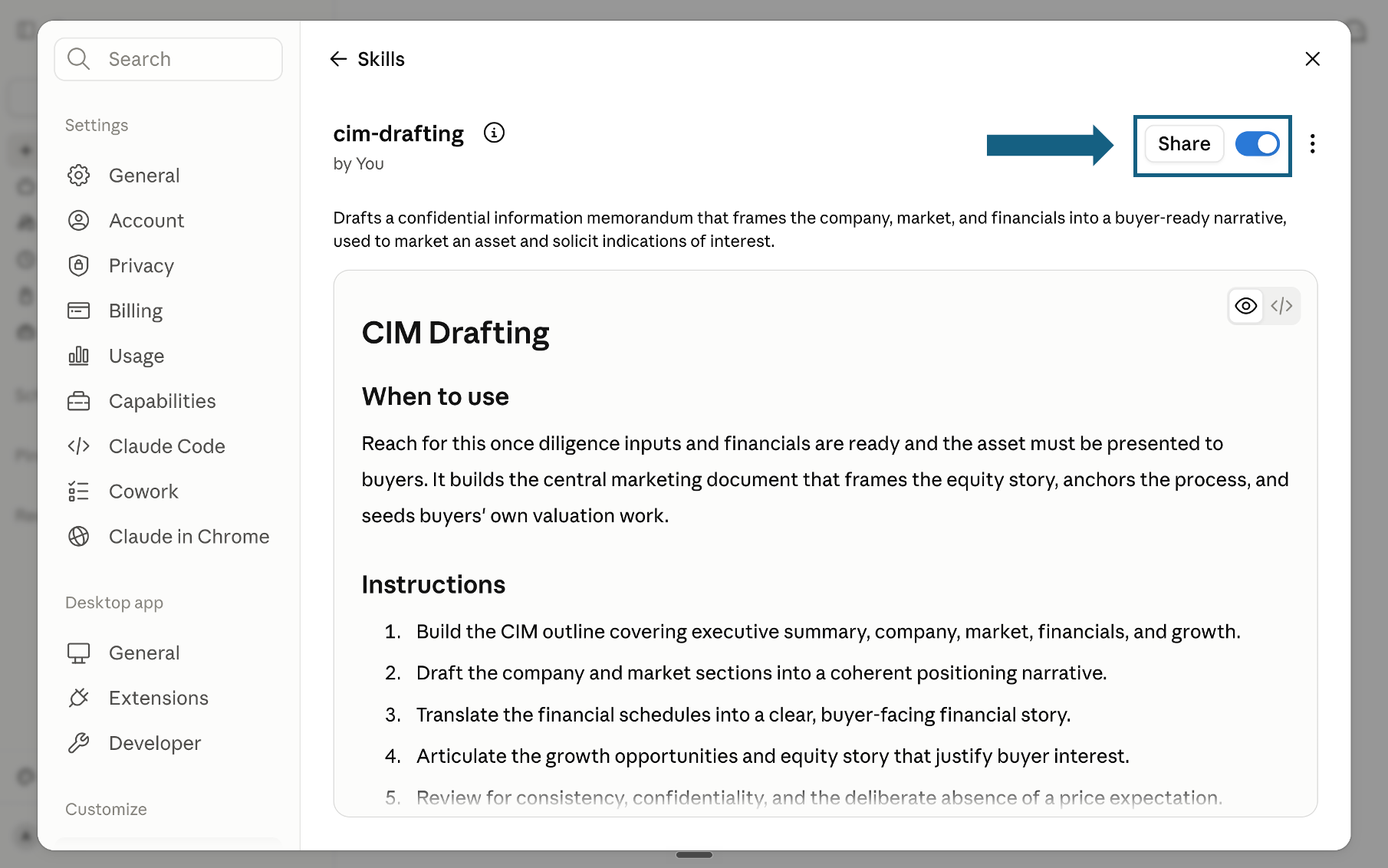
Review and turn on the skill
Review the skill's name, description, and instructions, then make sure the switch beside Share is on. A blue switch means the skill is turned on; sharing it is optional.
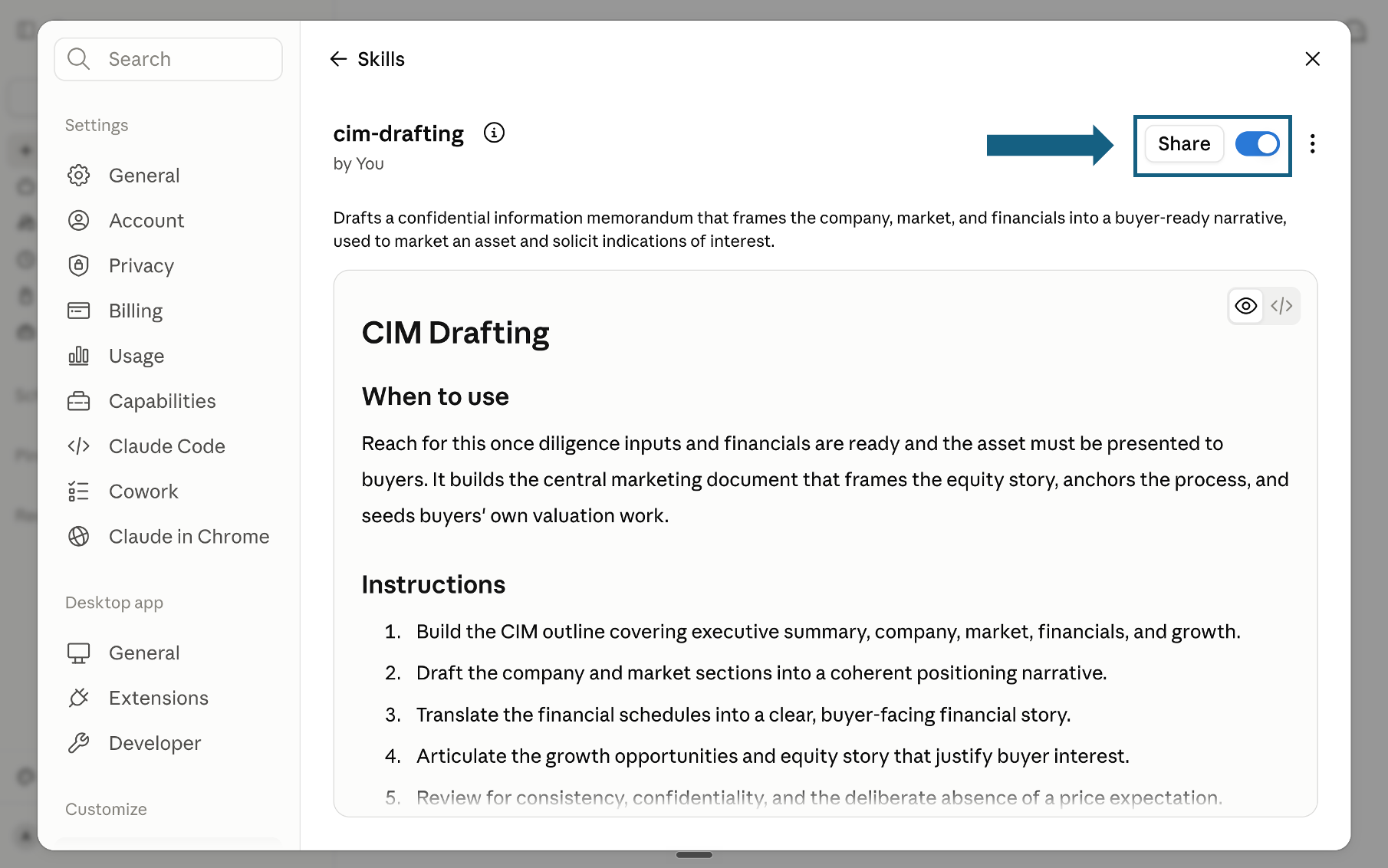
Open the screenshot to view it full size.
Try a skill
Name the skill and provide the relevant financials, filings, CIM, buyer list, or process context. Review every output before sharing it.
- "Use the valuation-triangulator skill to reconcile this DCF, trading comps, and precedent set into a defensible valuation range."
- "Use the company-teardown skill to build the fact base and risk profile from these filings."
- "Use the buyer-universe-builder skill to segment these buyers by rationale, capacity to pay, and process fit."
- "Use the deal-process-manager skill to build the workstream plan and identify the critical path to signing."
If you need X, go to Y
Plenty of people arriving on a Claude M&A skills query do not want a skill pack at all. Anthropic now ships its own finance agent templates, including a pitch builder that "creates target lists, runs comparables, and drafts pitchbooks for client meetings", a model builder and a valuation reviewer, running as plugins in Claude Cowork and Claude Code. If your firm has a vendor relationship and a data integration, start there rather than here.
| If you need | Go to | Why |
|---|---|---|
| The workbook itself: DCF, LBO, three-statement | Claude for Excel, plus the 25-skill Excel modelling pack | These skills reason about a model. They do not build one in cells. |
| Individual pitch book pages | The 16-skill pitch book pack | Page-level build instructions, one per exhibit, including league tables. |
| Agents that run the whole flow with handoffs | The 21-agent deal engine, or the 60-agent set | Bounded workers across many turns, not single-turn procedures. |
| Buy-side diligence on a sponsor deal | The 6-skill private equity diligence pack | Written for a sponsor investment committee, not a sell-side process. |
| Vendor-supported templates with market data wired in | Anthropic's own finance agent templates | Ship with Microsoft 365 and market data connectors behind them. |
| A corporate or consulting deck held to an enforced template | Oria | Our own product. Built for dense corporate documents and nothing else. |
| A visually striking fundraising or launch deck | Gamma, Canva, Pitch, Beautiful.ai | Design-led tools win outright where the job is visual impact. |
| Drafting inside Word and Outlook on a managed tenant | Microsoft 365 Copilot | Lives inside the compliance boundary your firm already runs. |
| Live Excel-linked waterfalls, Mekkos and Gantts | think-cell | A charting add-in with data links, not a writing tool. |
For the broader picture across finance rather than M&A specifically, the 20-skill finance set covers valuation and financial planning work, and the full skills library lists every pack on this site.
What methodologies do these Claude M&A skills use?
Every skill names the methodology it runs, the steps it follows, the assumptions it pressure-tests before it reports, and the failure modes it watches for. Nothing here is proprietary. It is the standard toolkit, written down precisely enough that a model applies it the same way twice.
Frequently asked questions
What are Claude M&A skills?
A Claude skill is a folder containing a SKILL.md file that tells Claude how to run one specific procedure. An M&A skill encodes a deal workflow: how to screen precedent transactions, how to read a CIM for quality-of-earnings risk, how to reconcile five valuation methods into one range. You upload it once, then name it in a prompt and hand it the deal material. The skill supplies the method. You supply the facts.
What is the deal execution process in investment banking?
Deal execution is the run from mandate to close. On a sell-side M&A process it moves through preparation and positioning, the teaser and the confidential information memorandum, first-round indications, management presentations, the data room and confirmatory diligence, final bids, negotiation, signing, regulatory clearance, and closing. Origination and the pitch sit in front of it. Integration sits behind it. Each stage has a different document and a different audience, which is why these skills are split by stage rather than by deliverable.
Are these Claude investment banking skills free?
Yes. The pack downloads as a single zip, one folder per skill, no signup and no licence key. You need a Claude account to run them, and the upload route runs through Settings. Nothing in the files phones home. You can open every SKILL.md in a text editor and read exactly what it instructs Claude to do before you point it at anything confidential, which is the sensible order.
Can Claude build a DCF or an LBO model?
It can, through the Claude for Excel add-in, but these ten skills are not the tool for it. They reason about a model rather than construct one. Valuation Triangulator reconciles outputs that already exist, and Trading Comps Builder assembles a peer set you then calendarize yourself. For the workbook itself, the Excel modelling pack covers the three-statement build, the debt schedule, the LBO and the returns waterfall.
Is it safe to upload a CIM or data room documents to Claude?
That is a question for your compliance function and your NDA, not for a download page. Two things are worth checking before you paste anything: what your firm's agreement with the vendor says about training and retention, and whether the material is under an NDA that names permitted recipients. Many banks run Claude inside an enterprise tenant precisely so this question has a documented answer. If you do not know your firm's position, assume it is no.
Can Claude replace an investment banking analyst?
No, and the skills are not written as though it could. What they compress is first-draft work: assembling a peer set, decomposing a target's revenue, laying out a pitch storyline, building a risk register from a memorandum. What they do not do is carry responsibility. The valuation you advise, the price you recommend and anything disclosed to shareholders belong to named people who sign their names to it.
What is the difference between a Claude skill and a Claude agent?
A skill is a reusable procedure in a SKILL.md file: single purpose, invoked by name, no autonomy. An agent is a bounded worker that can apply procedures, call tools and hand off to other agents across many turns. Ten skills suit a banker who wants a specific method applied to specific material. An orchestrated agent stack suits someone building a pipeline, which is a different page on this site.