

Claude Skills for Private Equity Due Diligence
Two different questions bring people to a page like this. One is which Claude skills genuinely help on a live deal. The other is what a private equity due diligence professional has to be good at to get hired and promoted. This page answers both, because the second question decides how much of the first you should ever hand over. Six free skills, the human capabilities they sit next to, and a plain account of where an assistant stops being useful.
Independent and unaffiliated. The skills, prompts, and frameworks referenced on this page are not created by, endorsed by, or affiliated with any consulting or financial-services firm whose methods may be referenced here. They are built on publicly available frameworks and ways of working, and are inspired by how such approaches are used to tackle complex business problems.
Claude skills for private equity due diligence
6 standalone Claude skills, one per diligence workstream. Each is a small uploadable file that teaches Claude to run one task with a named, repeatable method: sector mapping, CIM risk scoring, commercial market sizing, quality of earnings review, management evaluation, and legal risk register construction. They run independently, so you can load one for the phase you are in rather than all six.
The decision this page is really about is not which skill to download. It is which parts of a diligence file you are willing to delegate. Confirmatory diligence typically runs four to eight weeks from NDA to binding offer, and in that window somebody has to read several hundred documents, form a view and defend it. The skills take the reading and the structuring. The view stays with you.
This page covers diligence only. For Claude across the wider deal cycle, the companion private equity Claude skill set is the broader page. For sell-side and advisory workflows, see Claude skills for investment banking.
Download all 6 skills
One zip, one folder per skill. Free, no signup.
Quick answer: which due diligence skill should you load first?
Sort by the decision in front of you this week, not by the order of a textbook process. Most teams use two of these heavily and the other four occasionally.
For private equity due diligence, the six free Claude skills on this page cover the workstreams that recur on almost every deal: CIM Rapid Screen for the first go or no-go call, Commercial Diligence for market and customer claims, Quality of Earnings for the adjusted EBITDA bridge, Deal Sourcing Analysis for pipeline work, Management Assessment for key-person risk, and Legal and Compliance Review for the contract and regulatory register. Load CIM Rapid Screen first: it governs the cheapest decision in the process and the one most often made on instinct. The signed financial opinion still comes from a transaction advisory firm, and the customer calls still come from people.
What are the most sought-after skills for PE due diligence roles?
Ask a deal partner what they look for in a diligence hire and you almost never hear a software name. You hear a list of judgements. The work is compressed into a few weeks, the material is incomplete by design, and somebody has to stand in front of an investment committee and recommend deploying capital. The capabilities that get people hired, and the different ones that get them promoted, are the ones that survive that compression.
- Commercial judgement. Forming a view on whether a business will still be compounding in five years, and saying why in one sentence. Describing a market is an analyst task. Separating structural growth from a restock, a pricing window or one large customer renewing early is the part that gets people promoted.
- Quality-of-earnings literacy. Reading an EBITDA bridge line by line and knowing which add-backs a lender will fund and which get argued away at signing. This is where deals now break. In the 2025 Axial Dead Deal Report data, quality-of-earnings discrepancies roughly doubled as a cause of post-LOI failure, from 10.6% in 2023 to 21.3% in 2025.
- Modelling that holds under a live structure. LBO mechanics, sources and uses, the working capital peg, and the discipline to rebuild at short notice when a diligence finding moves an assumption. Funds screen candidates on the model and hire on whether the candidate understood what the model was arguing.
- Data-room discipline. Knowing what to request first, tracking open items, and being able to tell a partner on a Friday exactly what is still missing and who owes it. Scope is expanding: in a Q4 2025 survey of 150 senior dealmakers published by SRS Acquiom, 73% expected diligence to become more complex and 84% expected more scrutiny of cybersecurity diligence within one to two years.
- Synthesis under time pressure. Turning four hundred files into one page that says proceed, walk, or re-trade, with the three reasons ranked and the evidence behind each. Most diligence analysis is not wrong so much as never concluded, and an unconcluded workstream is indistinguishable from work nobody did.
- Management-meeting craft. Asking the question that exposes the gap between the plan and the org chart, running off-list references, and reading a team you may own for five years. It is the least teachable item on this list, the hardest to evidence in an interview, and the one with the longest tail of consequences.
Notice that none of the six is a tool skill, and that the market prices them directly. GF Data analysed 360 transactions completed since the third quarter of 2024 and found that sellers who commissioned a sell-side quality of earnings review saw average enterprise value to EBITDA multiples of 7.4x, against 7.0x for those who did not, with the effect concentrated above 50 million dollars of enterprise value. Michael Vaccarella, partner at Wipfli and leader of its Private Equity and Transaction Advisory Services team, described the mechanism to Middle Market Growth: "The sell-side QoE is supposed to bolster your adjusted EBITDA. That's what everybody hopes for, and that's where the valuation uptick comes in."
Roughly half a turn of EBITDA is what earnings-quality literacy is worth on one transaction, which is also why the conclusion never gets handed to a model. Scott Linch, managing partner of Forvis Mazars Capital Advisors and the national sector leader of its private equity practice, told the same publication that sellers "don't want to go to market with an EBITDA number that can't hold up through diligence." That sentence is the whole job description. Everything below is about which parts of holding a number up can be delegated and which cannot.
Which of those diligence skills can Claude actually carry?
Diligence is already the function where private equity has put the most AI, and the industry is candid about how far that goes. In S&P Global Market Intelligence's 2026 Private Equity Survey, fielded in February 2026, 31% of respondents said they had somewhat or fully integrated AI into due diligence, the highest share of any activity measured, while 64% rated AI ineffective for deal sourcing and 75% rated it ineffective for portfolio monitoring. The same survey named the obstacles: a lack of in-house expertise (49%), data privacy concerns (43%) and doubts about model accuracy (38%).
That split is the right way to read these skills. Diligence is document-dense and framework-driven, which is the shape of work a language model handles well. Sourcing and monitoring run on relationships and on data the model never sees.
What it carries well: first-pass extraction from a long CIM, imposing a consistent structure on a messy workstream, completeness checks against a named framework, rebuilding an EBITDA bridge from a schedule you supply, classifying add-backs into accepted, rejected and contested, and writing the open questions list you take into the next management session.
What it cannot carry: the view, the customer call, the reference through a mutual contact, the signed opinion, the negotiation, and accountability. It cannot see anything outside what you paste, so a skill is only as good as the data-room discipline of whoever runs it. Treat every output as a draft written by a diligent first-year who has never met the management team.
How we chose these 6 skills
The pack is deliberately narrow. A skill had to earn its place against the way a deal runs, not against a list of diligence topics.
- It had to change a decision, not describe a process. A skill earned a place only if its output altered what the deal team did next. Anything that produced a tidy summary of material the team had already read was cut.
- It had to name its method out loud. Each skill states the framework it applies: an EBITDA bridge, a DDQ structure, a top-down and bottom-up sizing cross-check, a severity-ranked risk register. A model that improvises a framework improvises the conclusion too.
- It had to survive an IC read. Outputs were tested against the standard a VP applies before a memo reaches a partner: stated assumptions, a range rather than a point estimate, and every number traceable to a source document.
- It had to refuse to invent. Skills that filled gaps with plausible market figures were rewritten until they returned an open-questions list instead. On a diligence file, a confident fabricated number is the most expensive failure mode there is.
- What we ignored on purpose. Valuation output, LBO model construction, exit planning and portfolio monitoring. Those sit outside diligence and belong on the broader private equity skill set page rather than being half-covered here.
Key takeaways
- Start from the call, not the document. Each workstream exists to make one decision. If you cannot write that decision down before you open the data room, you will produce a summary of the CIM rather than a view on the company.
- The input sets the ceiling. A skill handed a CIM and nothing else returns a reading of the CIM. Give it the mandate, the rejection screens and the management plan, and it starts testing claims rather than restating them.
- Judgement does not delegate. The screen, the bridge and the risk register are drafts. The no, the reference call, the signed opinion and the price you pay stay with people who carry accountability for them.
- Confidentiality decides what you can paste. Work out where your clean-team line sits before the first upload. Aggregated financials and contract summaries are a different category from payroll files and executed agreements.
- Every workstream has a breaking point worth knowing in advance. Thin teasers, cash-basis ledgers, genuinely new categories and anything that needs presence in a room are where these skills stop earning their keep.
The 6 due diligence Claude skills, compared
One row per skill, against the five rules above. Read the third and fifth columns first: they decide whether the output reaches an investment committee or stops at your desk.
6 Claude skills for private equity due diligence
| Workstream | The call it makes | What you have to feed it | What stays human | What you can safely paste | Where it breaks |
|---|---|---|---|---|---|
| Deal Sourcing Analysis | Which corner of a sector deserves a proprietary approach, and which names go on the pipeline | The mandate: cheque size, EBITDA band, geography, hold period, the platform you already own | Whether the thesis is investable at today's entry multiple, and who calls the owner | Nothing confidential. Sourcing runs on public and market information only | Fragmented markets with no published operator list. It finds the obvious consolidators and misses the founder-owned tail |
| CIM Rapid Screen | Whether an inbound teaser or CIM justifies spending a team on it at all | The CIM, plus the two or three screens your fund actually rejects deals on | The no. It ranks the case both ways; a partner decides what gets resourced | Post-NDA material, inside a workspace your fund has approved | A thin teaser with no financial history. Three numbers and a logo page cannot be scored |
| Commercial Diligence | Whether the growth story is structural, cyclical, or a pricing window that has closed | Revenue by customer and cohort, the management plan, the market reports you already bought | The customer calls. A model cannot hear hesitation in a reference | Aggregated revenue data. Named customer contracts are usually clean-team material | Genuinely new categories. Sizing a market with no comparable is arithmetic dressed as evidence |
| Quality of Earnings | What sustainable EBITDA actually is, and which add-backs survive contact with a lender | Monthly management accounts, the add-back schedule, the working capital history behind them | The signed opinion. A transaction advisory firm carries that liability | Financial detail your NDA covers. Payroll and customer-level margin are restricted | Poor underlying books. A bridge rebuilt from a cash-basis ledger is confident and wrong |
| Management Assessment | Whether this team can deliver the value creation plan, and who is replaced or retained | Bios, org chart, tenure and comp structure, and the plan you intend to underwrite | Everything that matters. The meeting, the references, the retention conversation | Role-level structure. Individual performance and comp data stay restricted | Anything needing presence in a room. It reads a CV; it does not read a person |
| Legal and Compliance Review | Where the legal exposure sits, and what the counsel budget should be pointed at first | Contract list, litigation schedule, licences and permits, and the structure you plan to use | The legal advice. This instructs counsel; it does not substitute for counsel | Contract summaries and schedules. Executed agreements stay with counsel | Jurisdiction-specific regulation and anything litigated. Read it as a question list |
Both rows also map onto a finished deliverable. The commercial due diligence report template sets out the section-by-section structure, and the investment memo template is where all six workstreams have to fit on a few pages.
Deal Sourcing Analysis: who is it built for?
Built for the associate or principal told to own a sector with three weeks to come back with something proprietary. It maps the opportunity universe across five segments, applies a screen built from your own mandate, and returns a ranked pipeline with a one-line thesis per name, an adjacency map for bolt-ons and a 90-day outreach plan.
It is the only skill in the pack that runs entirely on public information, which makes it the safest to try first. Feed it the cheque size, the EBITDA band, the geography and the platform you already own, or it hands you the same names every other fund is calling.
The trade-off: it is good at the visible middle of a market and blind to the founder-owned tail, which is where proprietary deals actually come from. Use it to structure the search, not to finish it.
CIM Rapid Screen: who is it built for?
Built for whoever opens the inbox. A banker sends a CIM, the team has four other live processes, and the question is whether this one deserves a week of anyone's time. The skill applies a structured risk scorecard across six categories, scores financial quality, market attractiveness and risk one-to-five, and closes with the open questions that belong in the DDQ.
Its real value is consistency. Screening calls are the most frequent and least documented judgements a fund makes, and they drift with whoever is tired that week. A written scorecard on every inbound gives you something to look back at when a name you passed on trades a year later.
The trade-off: a CIM is a marketing document, and a screen of a marketing document inherits its framing. The skill is good at finding what a CIM avoids saying; it cannot tell you what the seller never wrote down.
Commercial Diligence: who is it built for?
Built for the deal team that has to test whether the growth story holds before the investment committee tests it for them. It structures top-down and bottom-up sizing with a stated methodology and a cross-check between the two, decomposes growth into volume, price and mix, analyses customer concentration and cohort retention, and ends with the top three commercial risks.
Used properly it is a targeting tool. Commercial diligence changes prices through primary research, and primary research is rationed by the calendar. Its most valuable output is a shortlist of the customers and former employees whose answers would actually move your underwriting.
The trade-off: it cannot make the calls, and in a genuinely new category its top-down sizing is arithmetic dressed as evidence. If the market has no honest comparable, treat the number as a hypothesis and go and test it.
Quality of Earnings: who is it built for?
Built for the person who has to form a private view on adjusted EBITDA before, and alongside, the formal report. It rebuilds the bridge from the schedule you supply, classifies every add-back as accepted, rejected or contested with a reason attached, assesses revenue quality, cash conversion and working capital, and returns a clean EBITDA range with the assumptions stated.
This is the highest-stakes workstream in the pack and the one where the evidence is clearest. In Christoph Totter's 2026 study of post-LOI failure, which works from the 2025 Axial Dead Deal Report, diligence-driven terminations accounted for 46.6% of failures in 2025 while financing-driven failures fell from 21.3% to 10.7% over the same window. Diligence, not the debt market, is now what kills a signed letter of intent. A contested add-back found in week two is a negotiation; the same add-back found in week seven is a dead deal.
The trade-off: it produces an opinion nobody is liable for. Lenders and investment committees want a signed report from a transaction advisory firm, and this does not replace one. Use it to arrive at the meeting already knowing which three add-backs you will argue about.
Management Assessment: who is it built for?
Built for the partner preparing management meetings and the operating team sizing the post-close plan. It profiles leaders across three tiers, assesses track record, functional depth, tenure risk and fit against the plan you intend to underwrite, builds a key-person dependency register and maps succession depth for the three most critical roles.
Its honest use is preparation, not assessment. The output is a question list: which roles have no successor, where the plan assumes a capability the org chart does not contain, and which incentive structures expire at close. Walking into a management session with those written down is worth more than any scoring grid.
The trade-off: it reads a CV, not a person. Every judgement that matters here comes from a room, a reference or a backchannel, and none of those are inputs it can have.
Legal and Compliance Review: who is it built for?
Built for the deal team instructing external counsel and trying to spend that budget in the right order. It maps regulatory exposure, flags change-of-control provisions in material contracts, classifies litigation by financial exposure, and produces a severity-ranked legal risk register you can hand an adviser as a scope.
Scope is the point. Legal budgets run over because everything looks equally urgent in week one, and the surface keeps widening: 84% of the dealmakers surveyed by SRS Acquiom in late 2025 expected more scrutiny of cybersecurity diligence within one to two years, on top of the existing list.
The trade-off: it is not legal advice and should never be quoted as if it were. Jurisdiction-specific regulation and anything already in litigation are exactly where a confident wrong answer costs the most. Treat the register as a question list for counsel.
Oria: who is it built for?
None of the six skills produces a slide, and a finding that never reaches the committee pack has not really landed. Oria is the layer that turns written output into the exhibit. It is built for corporate documents and consulting presentations: board packs, steering committee decks, diligence exhibits, operating-model slides and dense frameworks held to an enforced corporate template. That is the whole design, and it is the output a tier-one consulting firm produces.
It reaches you two ways: a PowerPoint add-in that runs in a task pane on Windows, macOS and PowerPoint for the web, and a connector for Claude and ChatGPT over MCP, so an exhibit can be built from the chat you are already in. On security, for the record: customer content is not used for training, Professional and Team do not persist presentation content after delivery, and Enterprise adds private cloud deployment and custom LLM integration.
The trade-off: it is built for the corporate environment only, so it loses on highly visual work. Founder fundraising and pitch decks, launch and campaign decks, student presentations and marketing one-pagers are all jobs where visual impact beats defensible content, and a design-led tool such as Gamma, Canva, Pitch or Beautiful.ai will beat it and look better doing it. If that is the deck you are making, go there instead.
How do you install these Claude skills?
- Step 1Download from GitHub
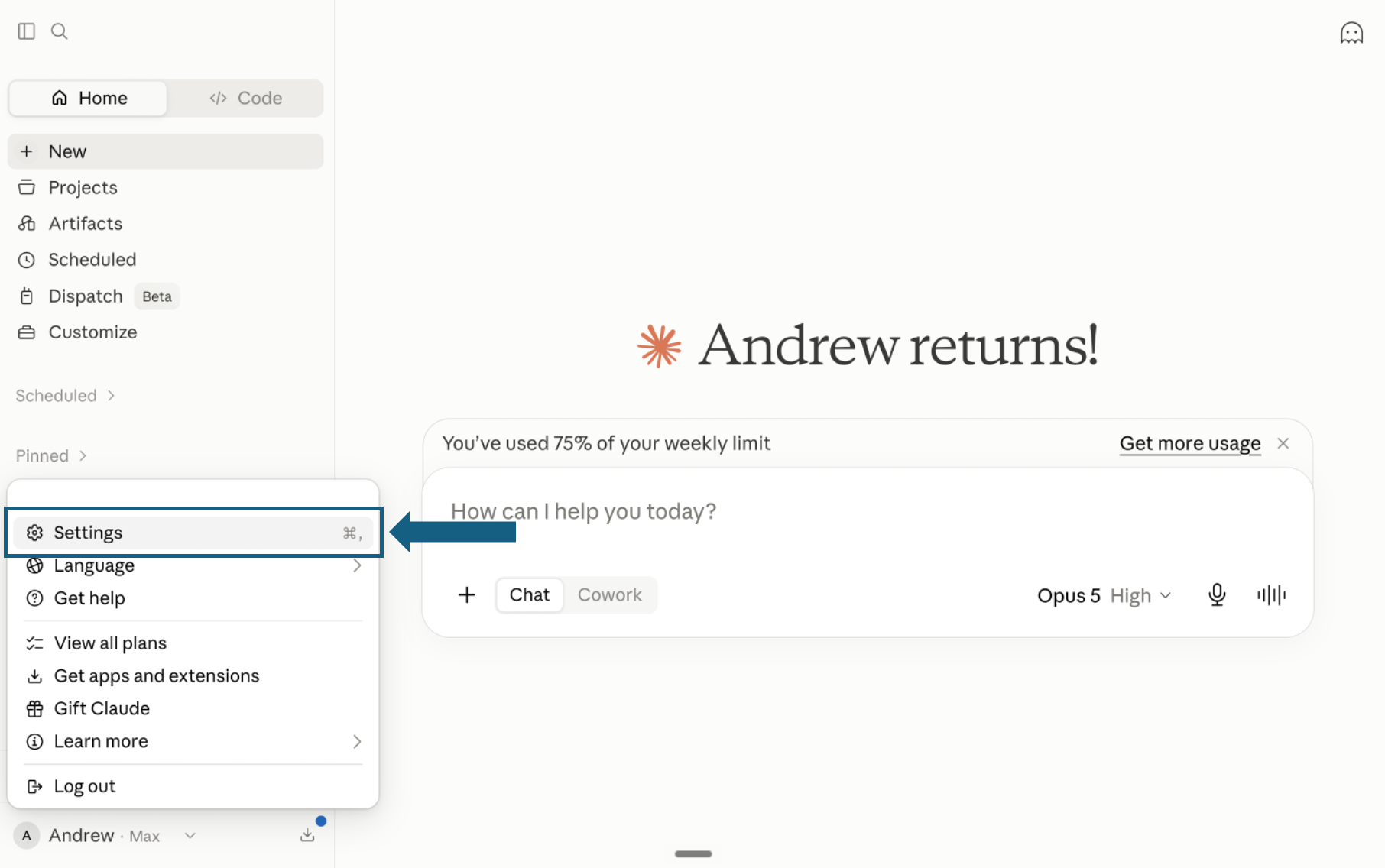
Download the pack and open Settings
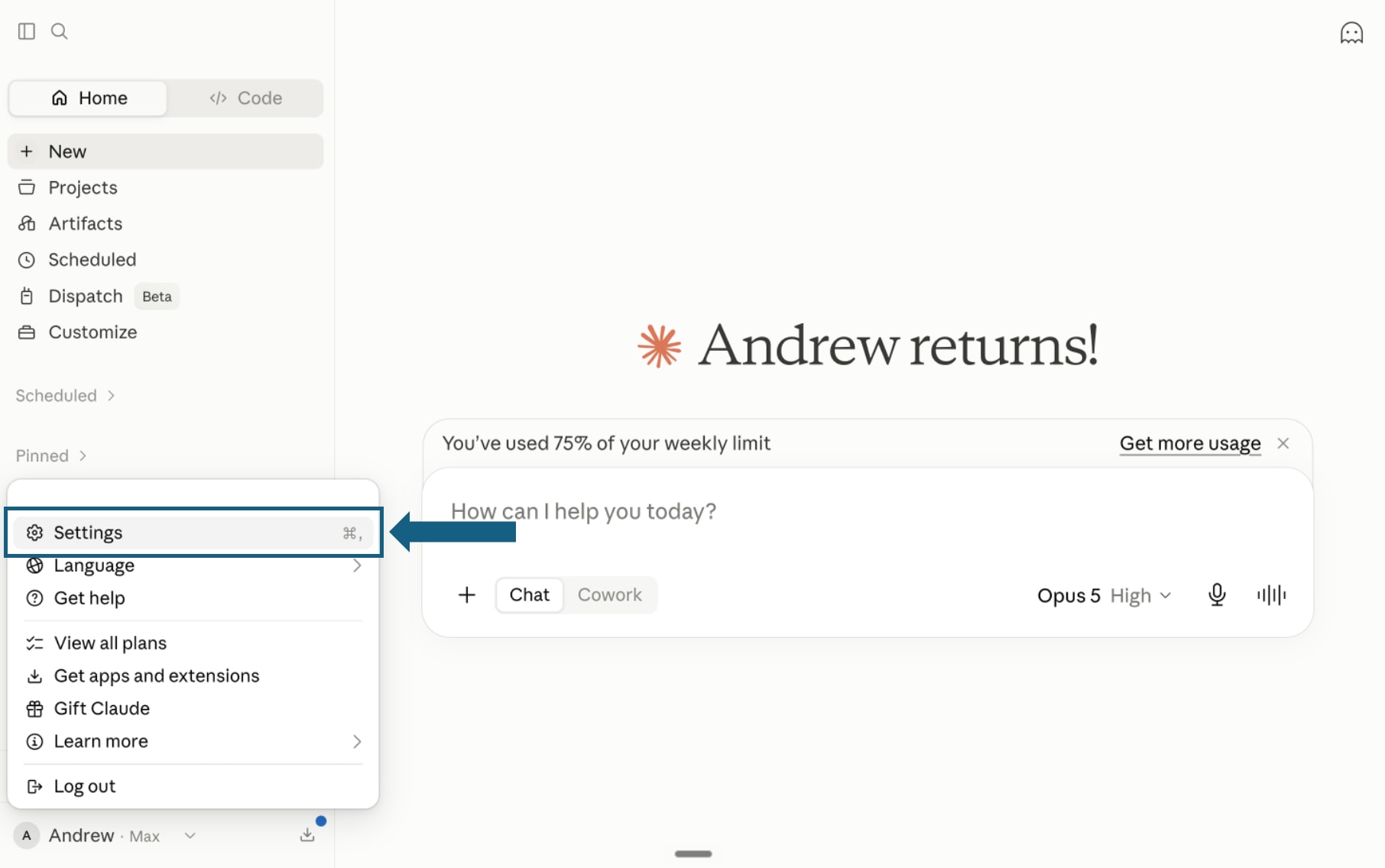
Download the pack and unzip it so each skill remains in its own folder with its SKILL.md file. In Claude, open your profile menu and select Settings.
Open the screenshot to view it full size. - Step 2
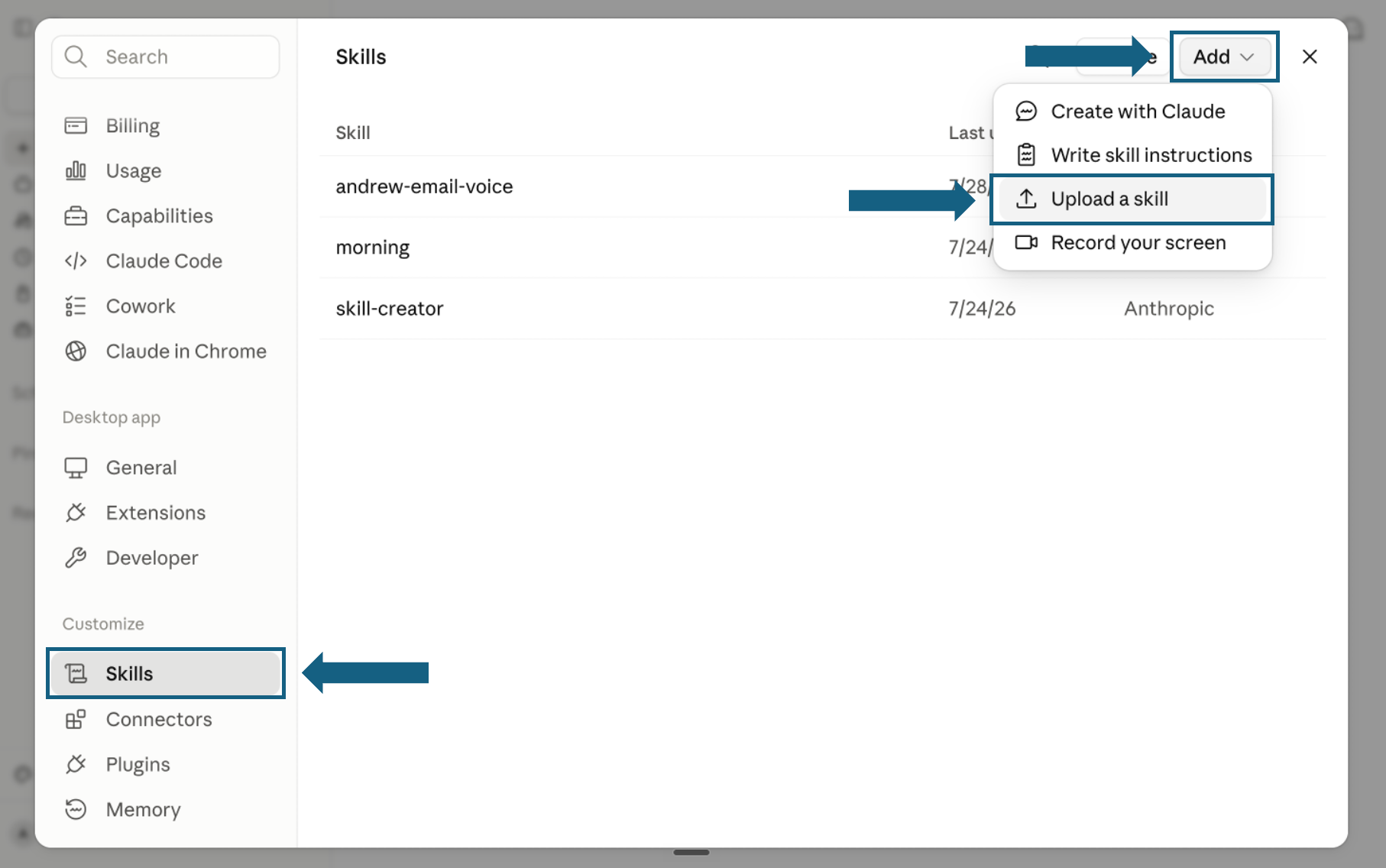
Open Skills and start an upload
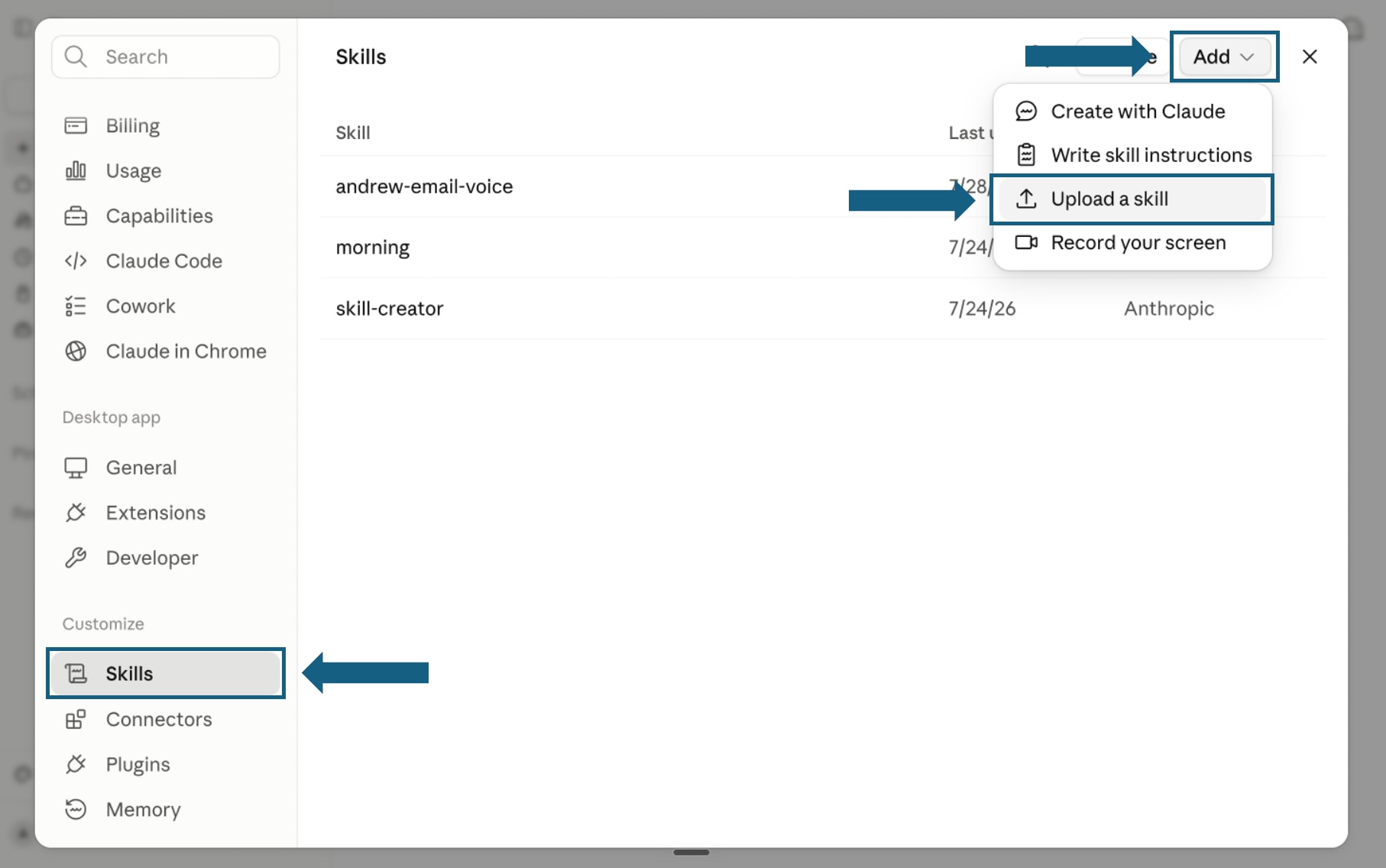
In Settings, select Skills under Customize. Open Add and choose Upload a skill.
Open the screenshot to view it full size. - Step 3
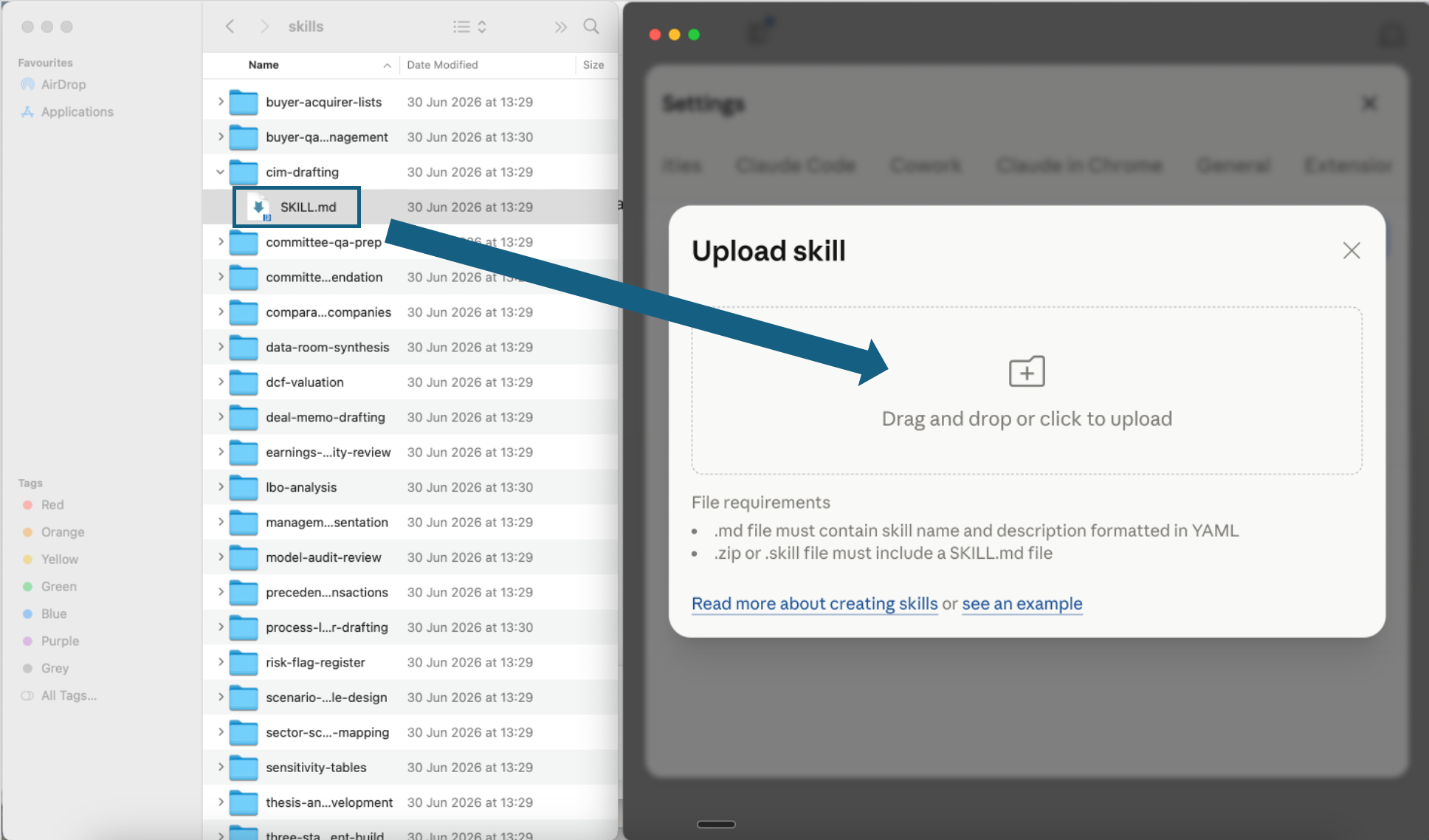
Upload one skill file
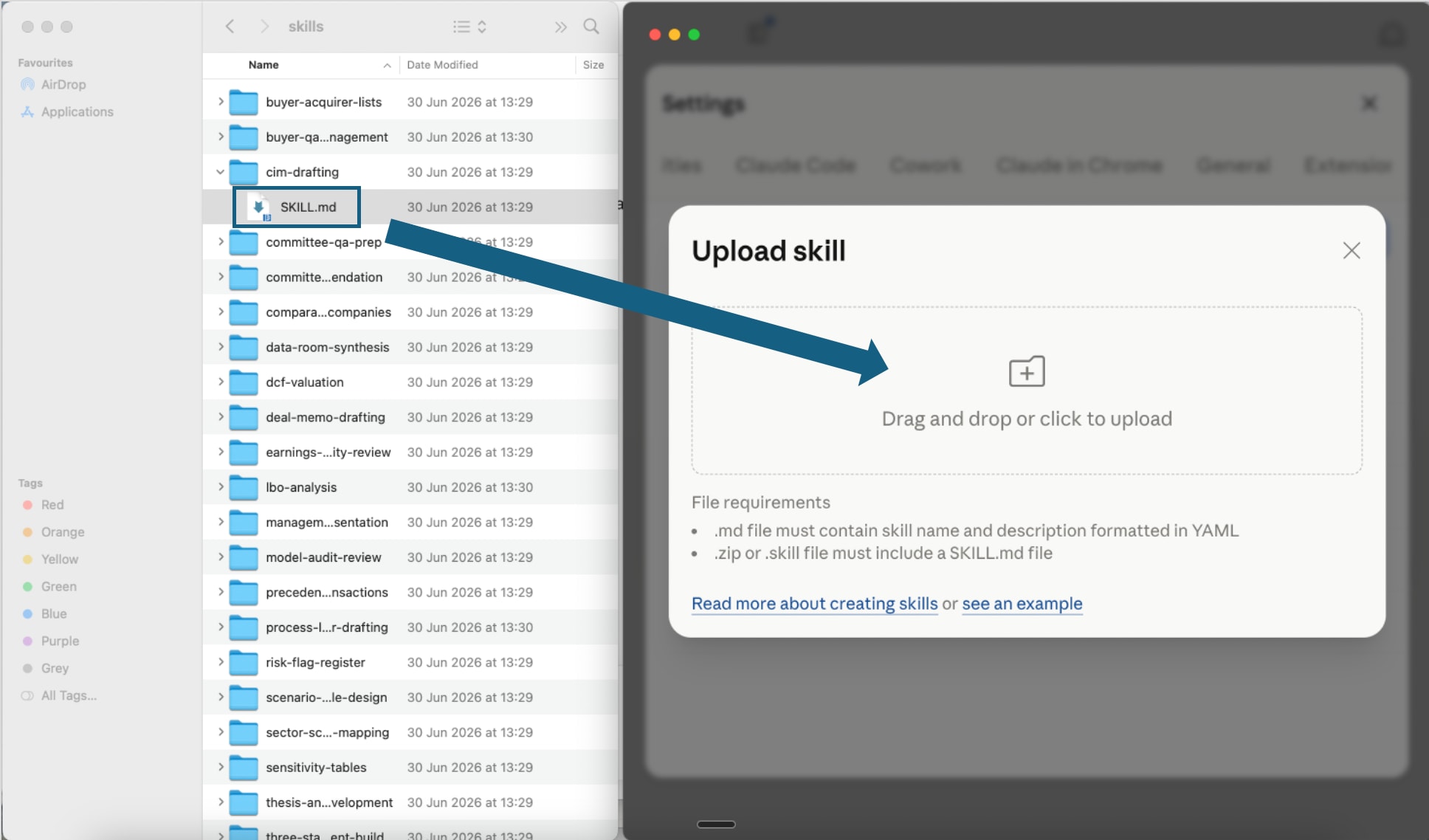
Open one extracted skill folder and drag its SKILL.md file into the upload window, or click the upload area to choose it. Repeat this step for any other skills you want to add.
Open the screenshot to view it full size. - Step 4
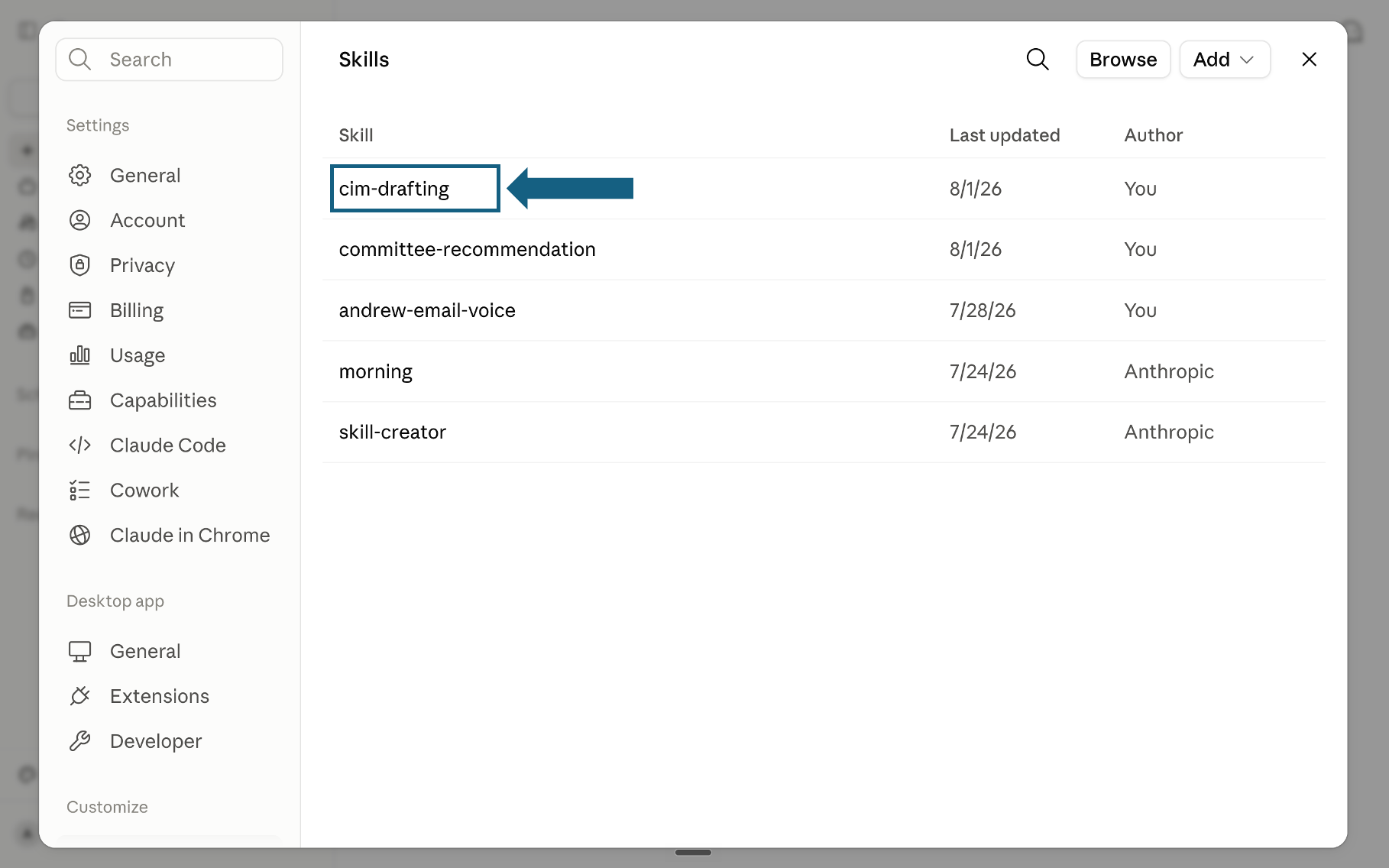
Confirm the skill was added
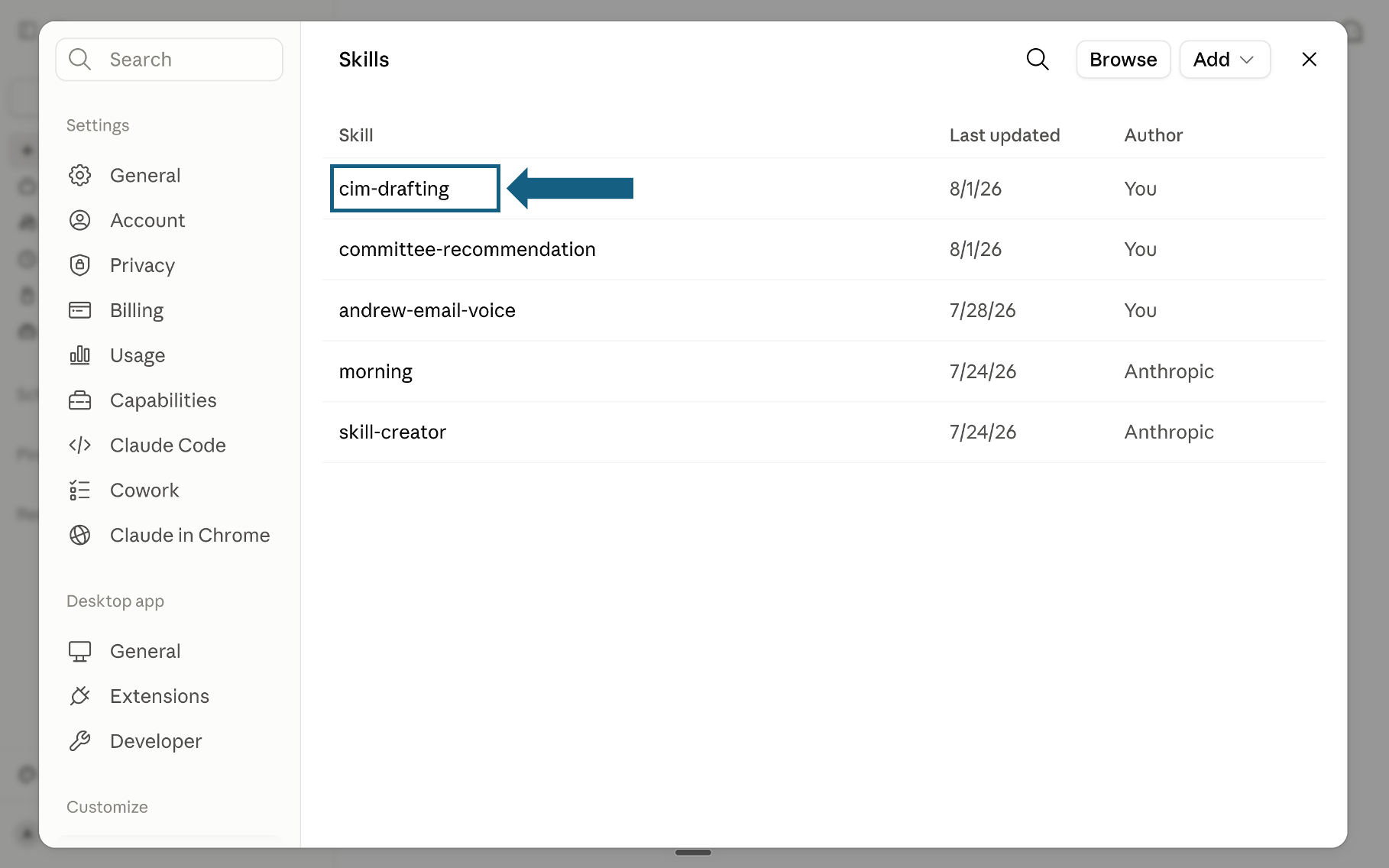
Return to the Skills list and check that the skill appears. Select its name to open it.
Open the screenshot to view it full size. - Step 5
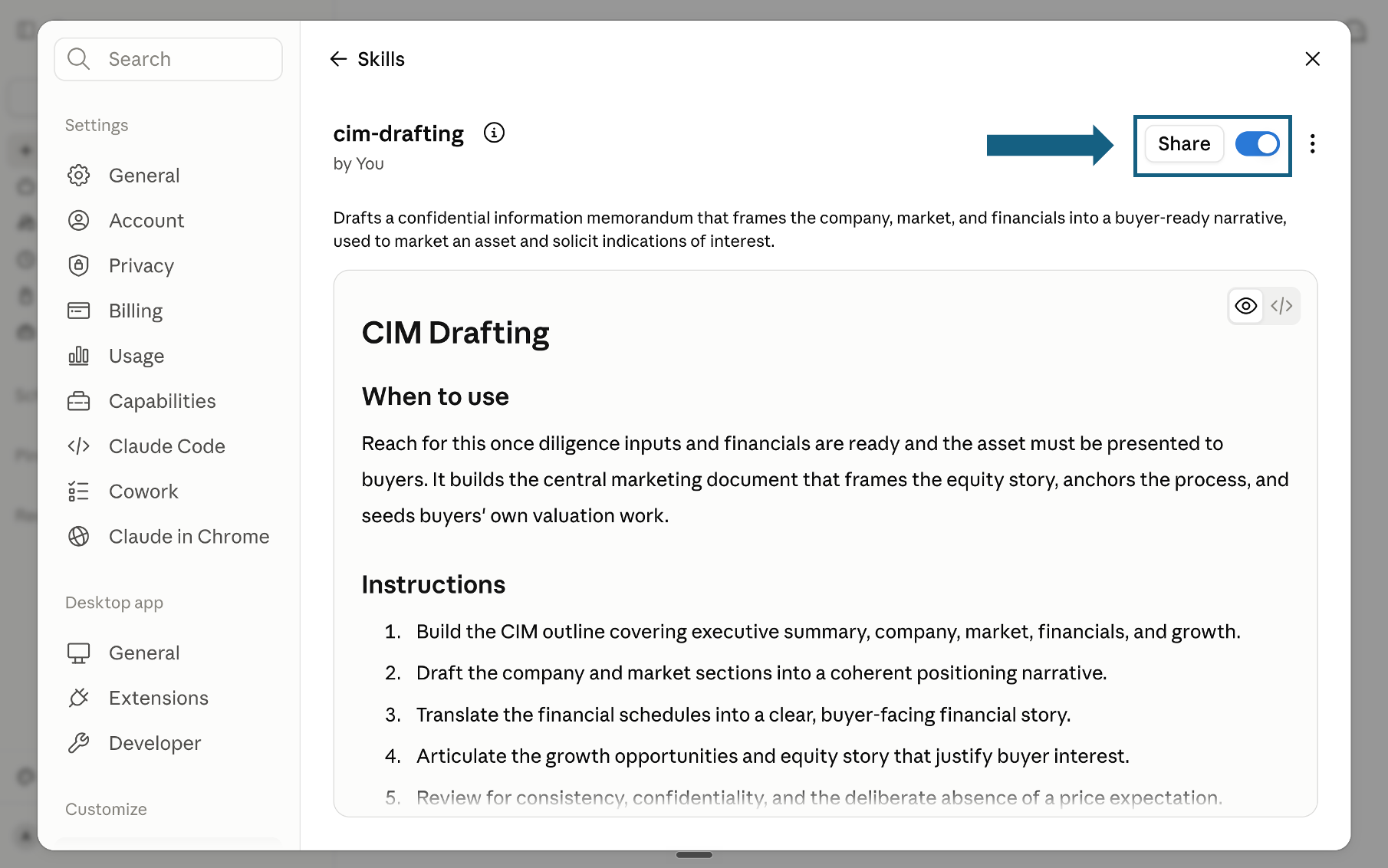
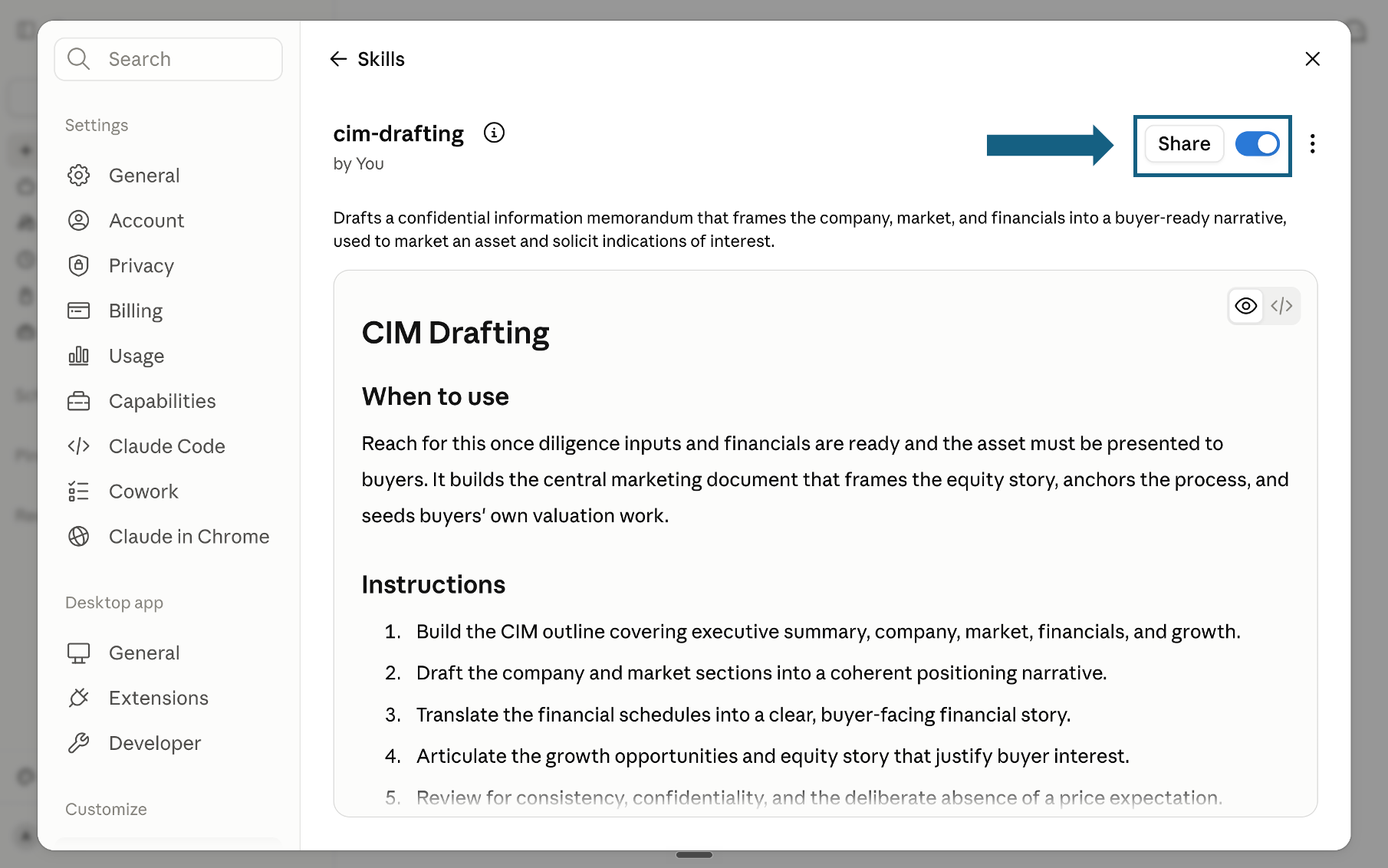
Review and turn on the skill
Review the skill's name, description, and instructions, then make sure the switch beside Share is on. A blue switch means the skill is turned on; sharing it is optional. Confirm your NDA covers the workspace before you upload any deal material into it.
Open the screenshot to view it full size.
Try a skill
Name the skill and give Claude the relevant files. Review every output before sharing it.
- "Use the deal-sourcing-analysis skill to map the UK veterinary care sector and generate a target list in the £5M-£30M EBITDA range."
- "Run the cim-rapid-screen skill on this executive summary and flag the top five diligence concerns: [paste text]."
- "Use the quality-of-earnings skill to review this EBITDA bridge and validate the add-backs: [paste financials]."
- "Run the management-assessment skill on these leadership bios and flag key-person risks before we structure retention packages."
What should you use instead of these skills?
Most of a diligence file is not a job for a chat assistant, and the honest routing is worth more than another paragraph about what these skills do. If your need is on the left, go to the right.
| If you need | Go to | Why |
|---|---|---|
| A quality of earnings opinion someone is liable for | A transaction advisory firm | Lenders and investment committees want a signed report. No AI tool carries professional liability for a number. |
| Primary customer and expert research | An expert network such as Third Bridge or AlphaSights | Commercial diligence changes prices through calls, and a reference programme takes weeks to schedule. |
| The broader private equity skill set | The private equity Claude skill set | This page stops at diligence. LBO structuring, value creation and exit live on the wider page. |
| Document hosting, redaction and an audit trail | A virtual data room such as Datasite or Intralinks | Permissions, versioning and who-opened-what are the real infrastructure. A chat window is not a data room. |
| Model building and live spreadsheet work | Claude skills for Excel modelling | A bridge you re-run when the peg moves belongs in a spreadsheet, not in prose. |
| Turning diligence findings into committee slides | Oria | Built for corporate output held to an enforced template. Weakest where the job is visual impact. |
| A founder fundraising or launch deck | Gamma, Canva, Pitch or Beautiful.ai | Design-led tools win where the deck has to look striking. Oria loses that comparison. |
| The written structure of the memo itself | The PE investment memo template | Six workstreams compress into a handful of pages. Structure is a separate problem from analysis. |
The quality bar
Every skill is written to push Claude toward output that survives scrutiny rather than output that sounds plausible. The standard applied is the one a VP applies before a diligence memo reaches a partner.
Frequently asked questions
What are the most sought-after skills for PE due diligence roles?
Deal teams hire and promote on six capabilities: commercial judgement, quality-of-earnings literacy, modelling that holds up when an assumption moves, data-room discipline, synthesis under time pressure, and management-meeting craft. None of them is a software skill. Firms screen candidates on the model and the CV, then promote on whether the person can reach a defensible conclusion in four to eight weeks and argue it at an investment committee.
Which Claude skills work for private equity due diligence?
Six skills cover the recurring diligence workstreams: Deal Sourcing Analysis, CIM Rapid Screen, Commercial Diligence, Quality of Earnings, Management Assessment, and Legal and Compliance Review. Each is a standalone SKILL.md file you can upload on its own, so a deal team can load only the workstream it is in, or all six across a full engagement. They are drafting and structuring tools, not sign-off tools.
Can Claude run a commercial due diligence?
It can run the desk half. The Commercial Diligence skill structures top-down and bottom-up market sizing with a stated methodology, decomposes revenue growth, analyses customer concentration and closes with the top three commercial risks. It cannot run the primary research, and primary research is where commercial diligence usually changes a price. Use the skill to decide which customers and experts are worth calling.
Can Claude screen a CIM?
Yes. The CIM Rapid Screen skill applies a structured risk scorecard to a CIM or executive summary and returns a go or no-go case in minutes, with red flags across six categories, one-to-five scores on financial quality, market attractiveness and risk, and a list of open questions for the DDQ. Check your NDA covers the workspace before you upload the document.
Do these skills work for real estate or hospitality acquisition due diligence?
Partly. The frameworks are sector-agnostic, so management assessment, legal review and the CIM screen transfer directly to a real estate or hospitality acquisition. The financial and commercial skills do not know about rent rolls, lease maturity ladders, RevPAR, ADR or franchise agreements, so you have to supply those definitions as context or the analysis drifts to generic corporate metrics. Property-level underwriting still belongs in a dedicated model.
Is it safe to put data room documents into Claude?
That depends on your NDA and your fund's policy, not on the tool. Decide where your clean-team line sits before the first upload. Aggregated financials and contract summaries are usually fine inside an approved workspace; payroll files, customer-level margin, executed agreements and anything the seller has marked restricted are usually not. Ask compliance once, in writing, rather than per document.
Are these private equity Claude skills free?
Yes. All six download as a single zip with no signup, no email capture and no cost, one folder per skill with its SKILL.md file inside. Upload the ones your deal team needs in Claude Settings and turn them on. Nothing on this page is gated, the pack does not expire or phone home, and there is no paid tier of the skills themselves.