

Canva Alternatives for Professional Decks: 7 Tools Compared
You know Canva and you are deciding whether a board pack, a client deliverable or a steering committee deck should still be built there. This is a fair field guide to the Canva alternatives for professional decks, with a clear pick for each kind of reader.
Canva is a very good tool, and that is why the question is hard. It is a design-first editor with a huge template library, and the people who leave it for professional decks rarely leave because it looks bad. They leave because of what happens after the design is done: the deck is edited by five people, held to a corporate template, and marked up in PowerPoint.
The scale of the incumbent explains why Canva alternatives is such a large search. Canva reported more than 265 million monthly active users and more than 31 million paying users at the end of 2025, as covered by Music Ally in February 2026, with annual recurring revenue of about US$4 billion. Most people building a deck have already tried it. The useful question is which tool fits the deck you are building now.
Quick answer: the best Canva alternative
There is no single winner, because Canva alternatives split into two camps. Design-led tools (Gamma, Beautiful.ai, Pitch) keep the visual, web-first workflow. Native PowerPoint tools (PowerPoint with Copilot, Plus AI, Oria) keep the deck in the file format your reviewers already use.
For professional decks, meaning board packs, client deliverables and diligence exhibits held to a corporate template, our pick is a native PowerPoint tool. Choose PowerPoint with Copilot if you want drafting help in the app you already pay for, and choose Oria if the slides are dense, framework-heavy and template-bound. If the deck is a fundraising pitch, a launch or a student project, stay with Canva, Gamma or Pitch, which will look better.
How we chose these Canva alternatives
We scored each tool against five rules, and we say what we ignored. Facts about Oria come from its product documentation. Other tools are described by the category they belong to, without invented pricing or features.
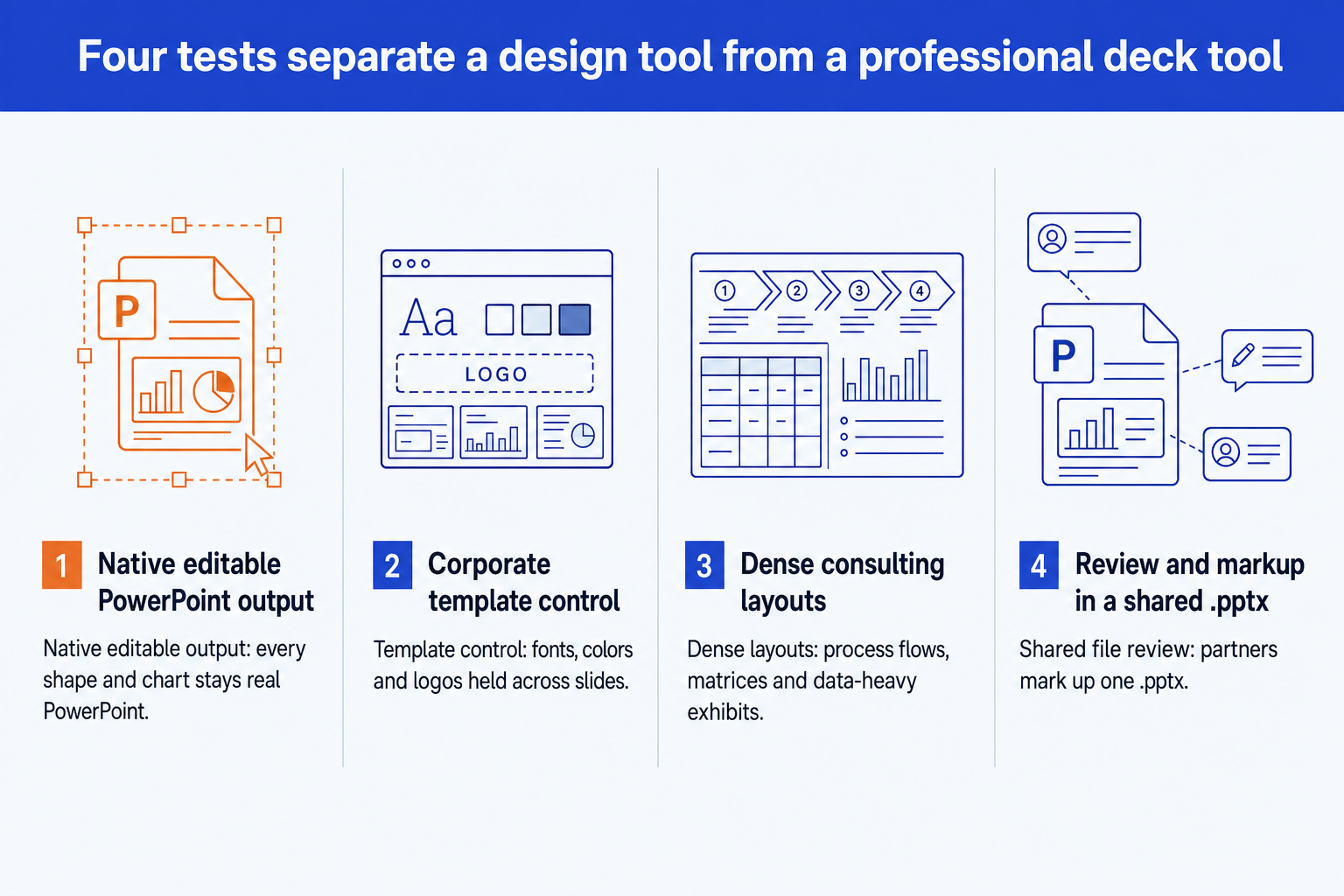
Native, editable output. Every shape, text box, icon and chart is real PowerPoint that a colleague can retype and restyle. A flattened image or a locked block fails this test.
Corporate template control. Fonts, colors, logos and layout rules hold across every slide, so the deck passes a brand-compliance check without a reformatting pass.
Dense, bespoke layouts. Process flows, matrices, customer journeys and data-heavy exhibits, not only clean one-idea slides with a photo.
Review in a shared file. Partners and clients mark up, merge and circulate one .pptx. A tool that lives in its own web editor adds an export step to every review round.
What we ignored. Template counts, stock-image libraries and animation effects. They matter for marketing decks and barely move a board pack. We also did not score price, because plans change often.
Key takeaways for choosing
- Editability decides more than looks. A deck that looks polished but cannot be changed by the next person in the review chain costs time at exactly the wrong moment. Test the exported file, not the web preview.
- Template control is the quiet dividing line. Design-led tools apply their own themes well. A strict corporate master with fixed fonts, colors and layouts is easier to hold inside PowerPoint itself.
- Density is where generators diverge. Most tools handle a clean narrative slide. The gap opens on a seven-step flow with a summary column, so ask each tool for the hardest slide you actually make.
- The shared file is the review surface. If your deck is merged into a bigger file and marked up by others, favor tools that produce native PowerPoint over tools that export it as a last step.
- Visual impact is a different job. For pitches, launches and student work, a design-led tool can beat every option here on looks. Pick by the job, not by a single winner.
Canva alternatives compared at a glance
One row per option, with columns that follow the takeaways above. Canva itself is the benchmark, and the category leader for visual design: if visual polish is your only criterion, none of these rows beats it.
| Tool | Where it runs | Output and editability | Template control | Best fit |
|---|---|---|---|---|
| Gamma | Web app, AI generated | Web-first, PowerPoint export step | Theme based | Fast visual decks, web-style pages |
| Beautiful.ai | Web app, smart templates | Web-first, PowerPoint export step | Template led | Clean, on-message narrative decks |
| Pitch | Web app, collaborative | Web-first, PowerPoint export step | Templates and brand kits | Startup and go-to-market teams |
| Oria | PowerPoint add-in, plus Claude and ChatGPT connector | Native PowerPoint, fully editable | Holds an uploaded corporate template | Dense consulting decks and board packs |
| PowerPoint with Copilot | Built into PowerPoint | Native PowerPoint | Uses your own slide master | Microsoft 365 teams that want drafting help in the app |
| Plus AI | Add-in for PowerPoint and Google Slides | Native, editable in the host app | Works in your existing file | Prompt-to-slide drafting on standard structures |
| Google Slides | Web app, real-time collaboration | Google Slides file, .pptx export | Manual master control | Shared, lightweight decks in a Google workspace |
The Canva alternatives in depth
Each option below closes with its trade-off, including ours.
Is Gamma a good Canva alternative for professional decks?
Gamma generates a deck, document or web page from a prompt and is one of the fastest routes from an idea to something that looks finished. It sits in the same design-led category as Canva, so it is an alternative in workflow more than in kind.
It is strong for pitches, internal updates and web-style narratives shared by link. Where consulting work strains it is the file: the deck is built in a web editor, and a .pptx appears through export, which is the moment a strict corporate master and dense layouts get tested.
The trade-off: Gamma is web-first, so a firm-template deck that gets marked up in PowerPoint adds an export and a cleanup step.
Is Beautiful.ai better than Canva for business presentations?
Beautiful.ai is built around smart templates that rearrange themselves as content is added, which keeps a deck tidy without manual alignment. For a clean, on-message business presentation, that discipline is a genuine advantage over a free-form canvas.
It is still a standalone web app, and styling is template led. We compare it head to head with a native PowerPoint tool in our Oria vs Beautiful.ai breakdown.
Related reading: Oria vs Beautiful.ai.
The trade-off: Smart templates protect layout but limit bespoke, dense slides and strict corporate masters.
Is Pitch a good Canva alternative for team decks?
Pitch is a browser-based presentation tool with polished templates and a collaborative workflow aimed at startup and go-to-market teams. Comments, shared workspaces and brand kits make it a practical place to build and review a deck together.
For decks that end up merged into a larger PowerPoint file, edited in a document-management system or marked up line by line, the browser-first workflow is one step removed from the file everyone else circulates.
The trade-off: Strong collaboration inside Pitch, weaker fit when the final artifact must live as a native PowerPoint file.
What is the best Canva alternative for consulting and board decks?
Oria is an AI tool for complex professional slides, and it reaches users on two surfaces: an add-in in the PowerPoint task pane (Windows, macOS and PowerPoint for the web), and a connector for Claude and ChatGPT over MCP, so a deck can be built from the chat you are already in. Output is native, fully editable PowerPoint that holds an uploaded corporate template.
Its strength is the dense, template-bound work a tier-one consulting team produces: board packs, steering committee decks, diligence exhibits and operating-model slides. Oria does not claim the visual-first ground.
Related reading: install Oria in Claude and ChatGPT.
The trade-off: Oria is built for the corporate environment only, so it loses on highly visual work such as fundraising decks, launch decks and student presentations, where a design-led tool looks better.
Is PowerPoint with Copilot a good Canva alternative?
PowerPoint is the default answer for professional decks for a reason: it is the file format the rest of the business already uses. Microsoft reported more than 450 million paid Microsoft 365 commercial seats in its fiscal 2026 second-quarter results, so a native file is also the format your reviewers already have open.
Designer and Copilot add drafting and layout suggestions inside the app, and everything stays native. Both are broad tools for general business use, so the densest framework slides and strict template enforcement still take hands-on work. Our roundup of the best AI for PowerPoint scores them more closely.
Related reading: best AI for PowerPoint.
The trade-off: Native and familiar, but you still do most of the layout work on complex slides.
Is Plus AI a good Canva alternative inside PowerPoint?
Plus AI installs as an add-in for PowerPoint and Google Slides and generates slides inside the editor you already use. Because the work happens in the host app, the output stays editable there, which removes the export step that web-first tools carry.
It leans toward standard slide structures. For the most bespoke layouts and rigid template control, expect hands-on work. The Oria vs Plus AI comparison walks through the two in detail.
Related reading: Oria vs Plus AI.
The trade-off: Good drafting inside your own editor, lighter on dense custom layouts.
Is Google Slides a good Canva alternative for professional decks?
Google Slides is free with a Google account, collaborative in real time and easy to share. For teams working in a Google workspace, it is the lowest-friction way to build a plain, shared deck.
It exports to .pptx, but fidelity on complex layouts and custom fonts is the usual pinch point, and it offers less design automation than the AI-led tools above.
The trade-off: Excellent for shared, lightweight decks, and limited when a strict template and dense exhibits are required.
Which Canva alternative we would pick
Our recommendation: for professional decks, pick a native PowerPoint tool, and start with PowerPoint plus Copilot if your decks are standard. Move to Oria when the slides get dense and the template is strict. For a visual deck, stay with Canva or move to Gamma. That is the honest split, and it comes from the job, not from a ranking.
If you are still choosing between the wider field, our tested roundup of PowerPoint add-ins and our Gamma alternatives for consulting decks apply the same criteria to more tools.
If you need X, go to Y
Frequently asked questions
What is the best Canva alternative for professional presentations?
It depends on the job. For dense, template-bound corporate decks that must stay editable in PowerPoint, an in-PowerPoint AI tool such as Oria or a Copilot-assisted PowerPoint file fits best. For visual pitches and marketing decks, Gamma, Beautiful.ai or Pitch are closer to what Canva does. No single tool wins every deck, and the honest pick follows the audience and the review process.
Is there a free alternative to Canva for presentations?
Yes. Google Slides is free with a Google account, and PowerPoint for the web offers a free tier with a Microsoft account. Oria has a free plan with test tokens and no credit card. Free tiers change often, so check each vendor's pricing page before you commit a team to one.
Can I use Canva for consulting or board presentations?
You can, and many people do. Canva is a capable design tool with a very large user base. The friction shows up when a deck must hold a strict corporate template, stay fully editable by others, and be marked up as a shared .pptx. Canva exports to PowerPoint, but complex designs can shift fonts and layout on export, so test a real slide first.
Does Canva export to PowerPoint?
Yes, Canva can download a design as a .pptx file. Text boxes, basic shapes and images generally carry over, while animations do not translate and fonts or spacing can shift on complex layouts. Open the exported file in PowerPoint and check the slide you care most about before relying on it.
What is the best AI presentation maker for PowerPoint?
Tools that run inside PowerPoint keep the output native, which is the deciding factor for most professional decks. Oria, Plus AI and Microsoft Copilot all work in the app, with different strengths on density and template control. Our guide to the best AI for PowerPoint scores them side by side.
Is Oria a Canva replacement?
No, and it does not try to be. Oria is built for corporate documents and consulting-grade presentations, so it loses on highly visual work such as fundraising decks, launches and student presentations. If your deck is judged on visual impact, a design-led tool will look better. If it is judged on defensible content held to a corporate template, Oria is built for that.
Sources: Canva user and revenue figures as reported by Music Ally (February 2026). Microsoft 365 seat count from Microsoft's fiscal 2026 second-quarter results (January 2026).