

16 Claude Skills for Investment-Banking Pitch Books
A pitch book runs a dozen-plus pages, each one a different discipline: valuation, financing math, market and company context, mandate narrative. The real question is not whether Claude can help build one, it is which of the 16 page types to hand to it, and where a banker still has to check the number before it reaches a client.
Global M&A activity reached $4.6 trillion in 2025, the second-highest total in the more than 40 years LSEG has tracked deals, even as the number of transactions fell to its lowest level since 2016, according to LSEG's Deals Intelligence data. Every one of those deals produced a book, and the people who build the pages inside it are stretched thin: Wall Street Oasis's 2022 Investment Banking Work Conditions Survey of 485 bankers found 14% working 91 or more hours a week, at an industry average of 78 hours, itself down from 82 a year earlier.
This pack is 16 Claude skills, one per page type: comps, precedent transactions, the DCF, the football field, sources and uses, accretion or dilution, league tables, the buyer landscape, and the executive summary that leads the book. Each is one folder with a SKILL.md file, grouped into four sections inside the zip. Install just the pages you need, or load the full set. Nothing here invents a figure, a firm name, or a source you have not supplied.
For deal execution beyond the pitch itself, meaning origination, financing, negotiation and closing, see our 21-agent deal engine. This page stays inside the book itself.
Download all 16 skills
One zip, one folder per skill. Free, no signup.
Quick answer: which Claude skills do you need for a pitch book?
Work backwards from the page you have been asked to build, not from the domain it sits in. A comps page and a management-profile page share nothing except the folder they ship in, so the skill that matters is the one that matches today's deliverable, not the one with the most impressive name.
For pitch book pages built with Claude, the sixteen-skill pack groups into four jobs: Comparable Company Analysis, Precedent Transactions, DCF Summary and WACC Build value the asset; Football-Field Valuation, Capital Structure / Sources and Uses, Accretion / Dilution Summary and Trading Multiples structure the deal; Company Profile, Management Profiles, Sector Overview and Market Update build the context pages; and League Tables, Buyer / Target Landscape, Transaction Process Timeline and Executive Summary / Deal Rationale win the mandate and lead the book. Start with whichever group matches the page due first.
How we chose the 16 skills
Five rules decided what went into the pack and what got left out.
- One page per skill. Anything that tried to cover two page types at once was cut and split. Comps and precedents look similar; they use different universes, different adjustments and different multiples, so they ship as two skills, not one.
- Real method, not a persuasive paragraph. Every skill runs the actual banking procedure, peer screening tests, calendarization, the EV-to-equity bridge, rather than describing a result and asking Claude to sound confident about it.
- Nothing invents a missing input. A skill that will accept a placeholder peer set or a guessed WACC produces a page that looks finished and is not. Every one of the sixteen stops and asks rather than filling the gap.
- We ignored the model leaderboard, except once. Model version numbers change every few months; a banking method should not. The one number that did change the design: FinanceBench, built by researchers at Patronus AI, Contextual AI and Stanford University and published as arXiv:2311.11944, found that GPT-4-Turbo used with a retrieval system incorrectly answered or refused to answer 81% of questions in its reviewed sample. That is why every skill here separates a reported fact from a calculation from an assumption, instead of returning one confident number.
- We ignored deal execution. Origination, financing, negotiation, regulatory review and post-close mechanics are real jobs, and they are not pitch book pages. A separate pack covers that stretch of the process, which let this one go deeper on the sixteen pages it actually ships.
Key takeaways
- Match the skill to the page, not the domain label. Comps and precedents both value the asset but need different universes and different adjustments. Pick the skill named after the page you have been asked to build, not the section it happens to sit in.
- Every skill demands real inputs, not vibes. A peer set, a deal set, a capital structure, disclosed company facts: none of the sixteen will invent a number to fill a gap, so the analyst still gathers what a banker would gather before any page gets built.
- Expect a page draft, not a finished exhibit. Each skill returns the structured content of one page: a peer table, a sensitivity grid, a page brief with a headline. That is the draft that used to take an afternoon, not the polished slide a client sees.
- The mandate and the number both need a name attached. Peer inclusion, WACC inputs, synergy assumptions and the final recommendation are judgment calls a named banker has to own before a page leaves the building. A skill can build the range; it cannot sign for it.
- Know when the ask is bigger or smaller than a page. A single method run once is a skill question. A live, end-to-end deal with review gates is an agent question. The workbook built cell by cell is an Excel question. This pack answers only the middle size: the pitch book page itself.
The four skill groups compared
The four sections against the same five questions: what a group needs, what it returns, where it has to stop, when to run it in the sequence, and where a deeper or narrower pack takes over.
| Section | What you feed it | What comes back | Where it has to stop | Best run | Covered better elsewhere |
|---|---|---|---|---|---|
| Valuation Engine | Subject financials, a peer set or a deal comp set, a capital structure for the discount rate | A comps range, a precedent range, a DCF range, and the WACC that supports it | Peer inclusion and the discount rate build need a banker's sign-off before the range is quoted | First, before Financial Structuring needs a range to consolidate | Claude skills for Excel modelling |
| Financial Structuring | The valuation ranges above, sources and uses inputs, share count and EPS data | A football field, a balanced sources and uses, an accretion or dilution read, a trading multiples view | Leverage and synergy assumptions need the deal lead's sign-off before they reach a committee | Second, right after the valuation engine has a range | The 21-agent deal engine |
| Company & Market | Company facts, management bios, sector data, current market levels | A company one-pager, management profiles, a sector overview, a market update | Every fact still needs a source check, though none of the four carry the recommendation | Any time, independent of where the valuation stands | The private equity diligence pack |
| Process & Narrative | Track record, buyer or target criteria, process constraints, the approved numbers | League tables, a buyer or target landscape, a process timeline, the executive summary | Credentials claims and the recommendation need the deal captain's sign-off before release | Last, since the executive summary draws on every section before it | The 60-agent deal flow set |
The collection is grouped into four sections that map to how a book is built: value the asset, structure the deal, profile the company and market, then pitch it. Every skill is also useful on its own.
How a pitch book comes together
Which Claude skills value the deal for a pitch book?
Four skills carry the valuation section: Comparable Company Analysis, Precedent Transactions, DCF Summary and WACC Build. Each runs the method the way an analyst actually builds it rather than describing the output: a defensible peer screen with an inclusion test stated in one sentence, deal screening adjusted for cycle and structure, a forecast with a stated terminal assumption, and a WACC built from CAPM equity and after-tax debt rather than a round number pulled from memory.
Comps and precedents both stand on the same discipline: choosing a defensible comparison set and being honest about where it strains. Aswath Damodaran of NYU Stern put the trap plainly in his work on relative valuation: "While multiples are easy to use and intuitive, they are also easy to misuse." The skill will not fix a bad peer set; it will build a clean page from whichever peer set the analyst hands it, which is exactly why the inclusion test has to be written down before the page is built, not after.
The trade-off: these four skills reason about the valuation and write the page; they do not build or audit the underlying workbook. If the WACC, the DCF or the comps need to live in a live, checkable spreadsheet, that is a construction problem the Claude skills for Excel modelling are written for, not this one.
Section 1 · 4 skills
Comparable Company Analysis
Use when: You need a public-market read on value
Output: Peer set, multiples, implied range
Precedent Transactions
Use when: You need an M&A, control-inclusive read on value
Output: Screened deals and a control range
DCF Summary
Use when: You need an intrinsic, standalone value
Output: Forecast, terminal, EV, sensitivity grid
WACC Build
Use when: The DCF needs a discount rate you can defend
Output: CAPM equity, after-tax debt, weighted WACC
Which Claude skills turn a valuation into a deal structure?
Once the valuation range exists, four skills turn it into a deal: Football-Field Valuation consolidates every method onto one page with a recommended zone; Capital Structure / Sources and Uses shows how the transaction is actually funded and what it does to pro forma leverage; Accretion / Dilution Summary tests the EPS impact a corporate buyer cares about, with a sensitivity table rather than one headline number; and Trading Multiples explains where the subject trades today and what would re-rate it.
None of the four will pick a weighting across methods or size a synergy number on their own. Sources and uses balances to the last dollar whatever leverage figure it is given, and if that figure is optimistic the page will look every bit as clean as one built on a conservative case. The judgment stays with the deal lead; the skill only guarantees the arithmetic behind it is consistent.
The trade-off: for the financing, negotiation and closing stages beyond these four pages, meaning debt sourcing, term sheets and regulatory review, that is deal execution rather than pitch book construction, and the 21-agent deal engine is built for that stretch of the process.
Section 2 · 4 skills
Football-Field Valuation
Use when: You need to consolidate every method on one page
Output: Range bars and a recommended value zone
Capital Structure / Sources and Uses
Use when: You need to show how a transaction is funded
Output: Balanced S&U, pro forma leverage, credit metrics
Accretion / Dilution Summary
Use when: A corporate buyer cares about EPS impact
Output: Pro forma EPS, breakeven synergies, sensitivity
Trading Multiples
Use when: You need to explain where the subject trades and why
Output: Benchmarking read and re-rating drivers
Which Claude skills build the company and market context pages?
Four skills build the pages the rest of the book leans on: Company Profile turns disclosed facts into a clean one-pager on a target or a comparable; Management Profiles present the leadership team mapped to the transaction thesis rather than a generic bio; Sector Overview frames the structure, growth and M&A backdrop of the industry; and Market Update reads current equity, credit and M&A conditions into a timing call.
These four carry less judgment risk than the valuation or process pages, because a company fact or a market level is either right or it is not. That does not make them optional. A sector overview built on stale data will read exactly as confident as one built on this morning's numbers, and the page gives no visual cue for which one it is.
The trade-off: a one-pager is not a diligence file. Sponsor-side underwriting that has to survive an investment committee, not just a pitch, needs the depth of the private equity diligence pack, which reads a data room rather than a public filing.
Section 3 · 4 skills
Company Profile
Use when: You need a clean one-pager on a target or comparable
Output: Business, financials, ownership, developments
Management Profiles
Use when: You need to present the leadership team
Output: Profiles mapped to the transaction thesis
Sector Overview
Use when: The book needs deal-relevant industry context
Output: Structure, growth, cyclicality, M&A backdrop
Market Update
Use when: You need to justify timing with market conditions
Output: Equity, credit, and M&A read with a window call
Which Claude skills win the mandate and lead the book?
Four skills carry the pitch itself: League Tables give the why-us section credentials in the relevant, honestly framed cut; Buyer / Target Landscape segments the universe of who could buy or be acquired with a thesis attached to each name; Transaction Process Timeline lays out phases, workstreams and the critical path; and Executive Summary / Deal Rationale leads the book with the recommendation first and the support behind it.
The executive summary is the page most likely to be read on its own, forwarded ahead of the rest of the book, which is exactly why it runs last in the sequence: it can only lead with a recommendation once the valuation, the structure and the context pages behind it have already been built and checked.
The trade-off: these four pitch the mandate; they do not run it. For the origination-through-close process these pages sit inside, including outreach, buyer targeting at a live-deal level and the workstreams that follow a signed engagement, see the 60-agent deal flow set or, for one method run once instead of a stack of agents, the 10 Claude M&A skills.
Section 4 · 4 skills
League Tables
Use when: The why-us section needs credentials
Output: Ranking in the relevant cut, honestly framed
Buyer / Target Landscape
Use when: You need to show who could buy or be acquired
Output: Segmented universe with a thesis per name
Transaction Process Timeline
Use when: You need to show how the deal will run
Output: Phases, workstreams, milestones, critical path
Executive Summary / Deal Rationale
Use when: The book needs a lead page that carries the argument
Output: Recommendation first, then the support
Sections 1 and 2 build the numbers, the value, and the structure. Sections 3 and 4 build the context, target the counterparties, and lead the book with a recommendation.
Quick reference: which skill for which need
Skip the directory hunt. Pick the row that matches the page you need and use that skill. For the slides that often need their own page, see our guides to the football-field valuation slide and the competitive landscape slide.
Setup Guide
Download the skills pack
The zip contains all 16 skills, one folder per skill. Each skill is a single SKILL.md file. Unzip it anywhere. Keep the whole set, or pull out just the folders you need.
Create a Claude Project
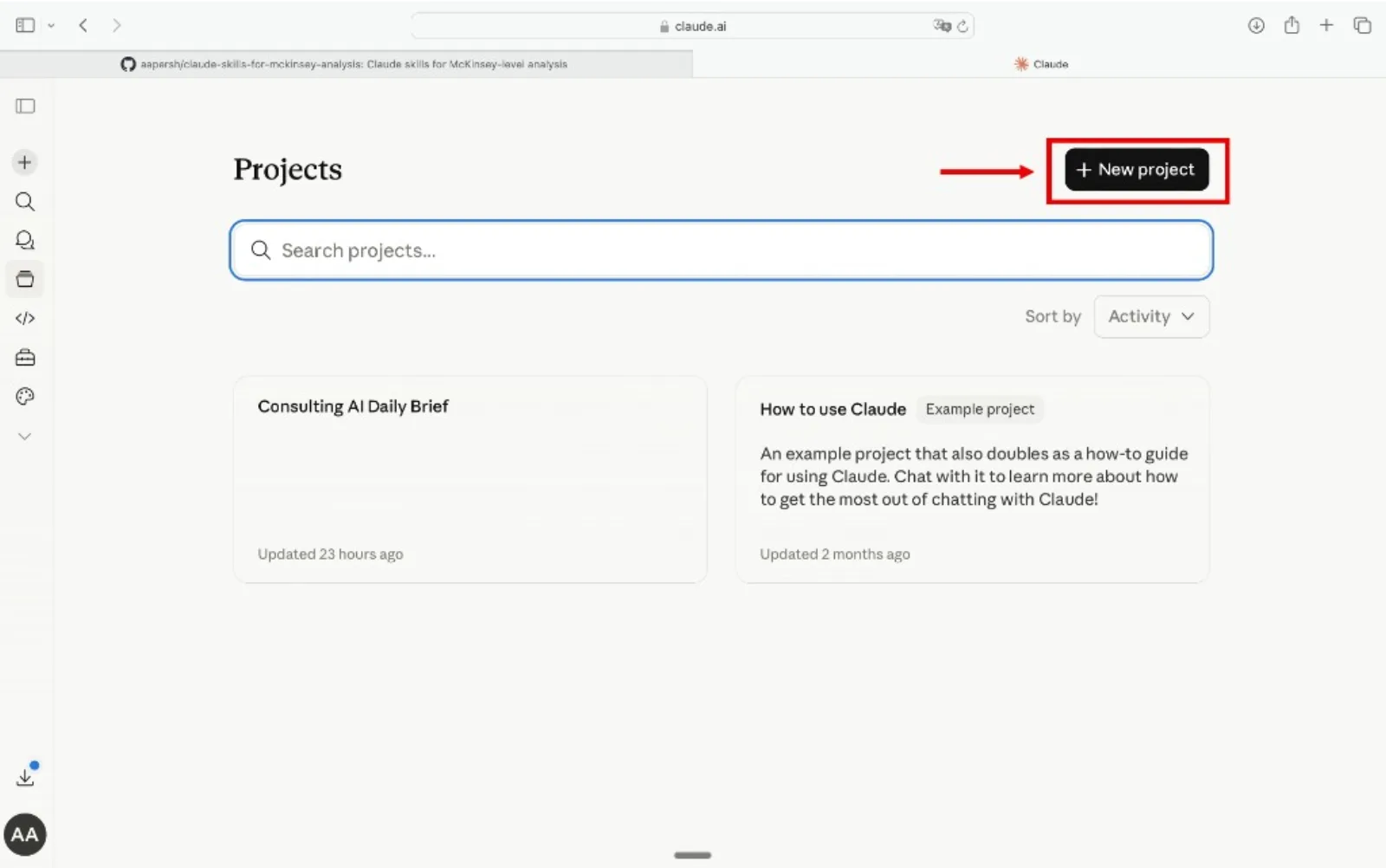
Go to claude.ai, open the left sidebar, click Projects, then Create Project. Name it something like "Pitch Book Builder" or "Deal Materials" so you can reuse it across mandates.
Add the skills as Project Knowledge
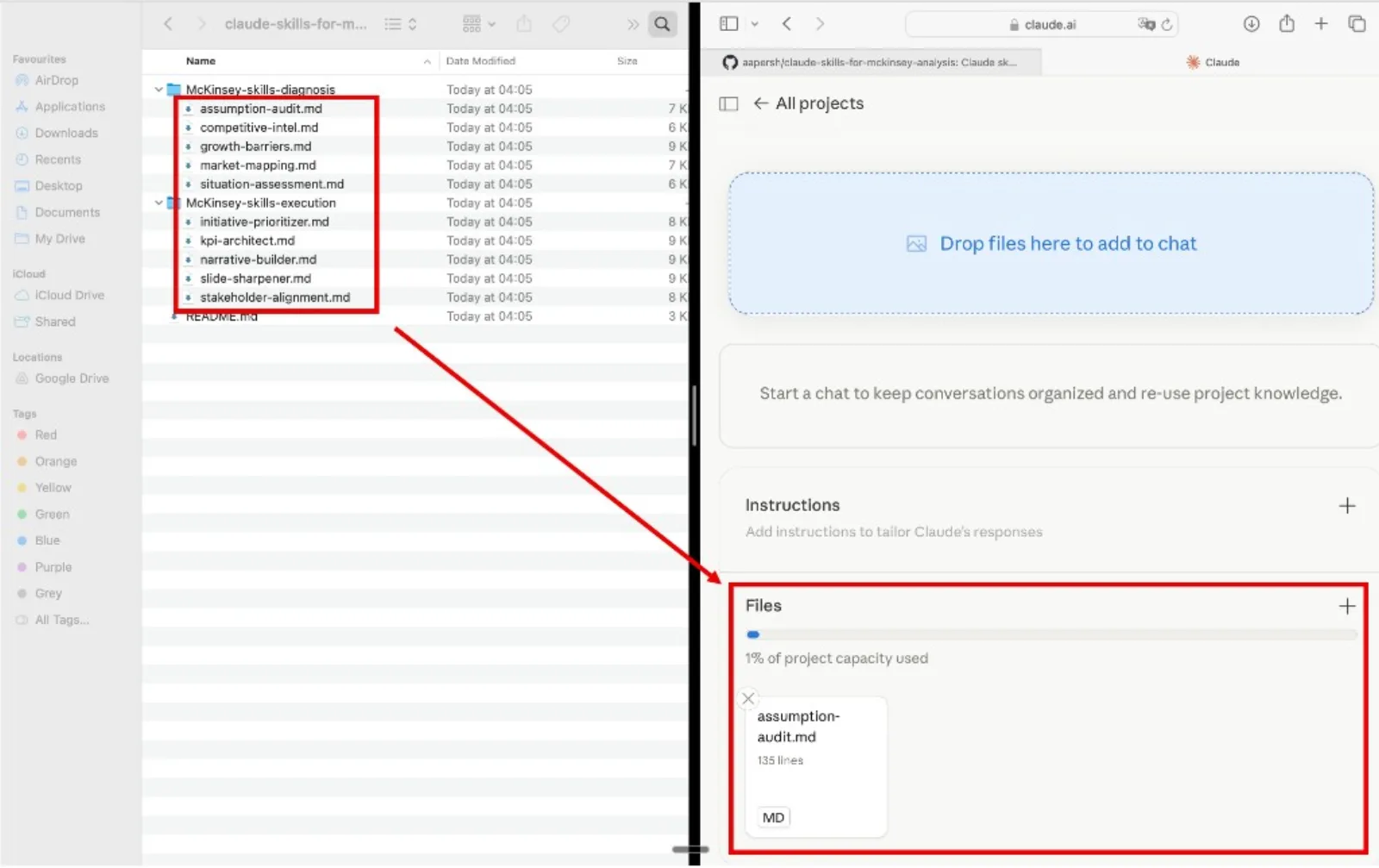
Inside your project, open Project Knowledge, click Add Content, and upload the .md files. Add as many as you want, one skill, one section, or all 16. Claude will reference them automatically in every conversation inside that project.
Start building pages
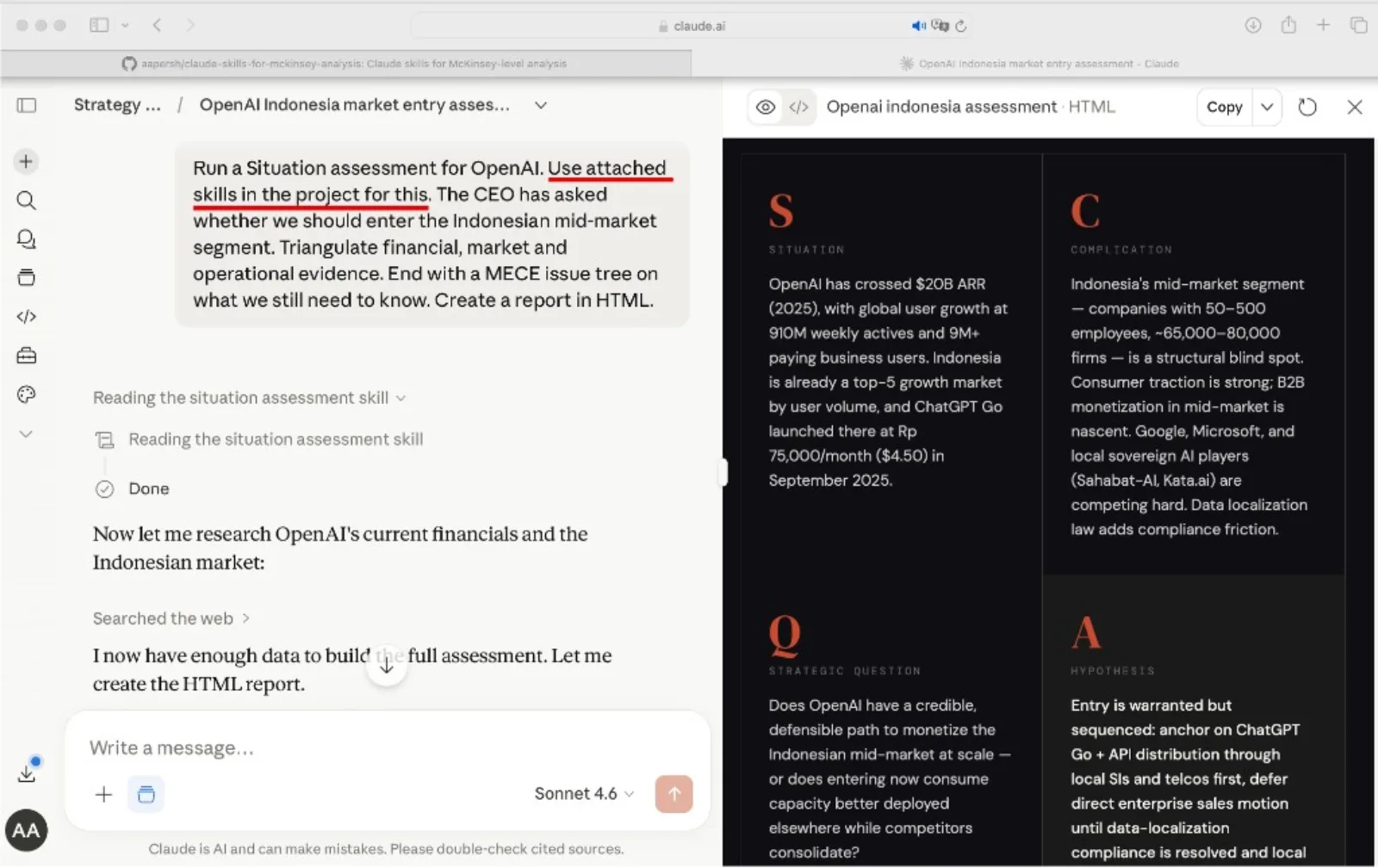
Open a new conversation inside the project, paste in your data, financials, a peer list, a precedent set, and name the skill you want Claude to run. Claude reads it from project knowledge and builds the page with the method already loaded.
Tip
Chain the skills the way a book is built. Phrases like "Run wacc-build, then dcf-summary" or "Use comps and precedents, then the football-field skill" point Claude at the right sequence instead of leaving it to guess.
Example prompts
- "Use the comparable-company-analysis skill to build a trading comps page from this peer set."
- "Run wacc-build then dcf-summary on these financials."
- "Use the football-field-valuation skill to consolidate the comps, precedents, and DCF ranges."
- "Use the executive-summary-deal-rationale skill to write the lead page for this sell-side book."
If you need X, go to Y
This page owns the pitch book itself, the document, its sections and the skills that build them. Plenty of related jobs are served better elsewhere, including by tools that are not ours, and it is quicker to say so than to let a mismatched pack slow down a live deal.
| If you need | Go to | Why |
|---|---|---|
| The full deal process, not just the pitch | The 21-agent deal engine | Origination through closing with review gates built in; these sixteen go deep only on the pitch book pages themselves. |
| Breadth past M&A: capital raising, negotiation, post-close | The 60-agent deal flow set | Reaches IPO readiness, syndication, earnouts and antitrust review. These sixteen do not. |
| A single method applied once, not sixteen page builders | The 10 Claude M&A skills | One method, no page architecture, and far less to install if you only need one page type. |
| Sponsor-side diligence on a buyout | The private equity diligence pack | Written from the buyer's side, where the diligence question is the investment question. |
| A dense corporate deck built from the approved pages | Oria | Our own product, and only after the numbers are reviewed. It does not train on customer content, and Enterprise adds private cloud deployment. Reaches you as a PowerPoint add-in or a connector for Claude and ChatGPT over MCP. |
| Recurring valuation and FP&A work outside a live deal | The 20-skill finance playbook | Written for a monthly or quarterly cadence, not a mandate with a closing date. |
| The workbook itself, built and audited in Excel | Claude skills for Excel modelling | These sixteen reason about a model and write the page. They do not construct one cell by cell. |
| A visually striking deck for a fundraise, launch or campaign | Gamma, Canva, Pitch or Beautiful.ai | Design-led tools win outright where the job is visual impact rather than defensible content, and they will look better doing it. |
| Vendor-integrated finance agent templates with market data behind them | Anthropic's finance agent templates | If your firm already has that vendor relationship and the data integration, start there instead. |
Whichever pack fits, the discipline should not change: a defensible peer set, a stated inclusion test, a WACC you can defend line by line, and a named person who checks the range before it reaches a client. A skill that skips any of those has saved you time by moving the risk downstream.
The quality bar
Every skill is designed to push Claude toward pages that meet the same bar a senior associate would hold each page to before it goes in front of an MD or a board. That bar exists because the alternative is not hypothetical: Claude Opus 5 leads the Vals AI Finance Agent v2 benchmark of expert-reviewed finance questions at 58.63% as of September 2026, a genuinely strong score that still means well over a third of entry-level analyst questions come back wrong. A skill does not change that hit rate. What it changes is whether a wrong number arrives labeled as a calculation you can check, rather than buried inside a confident paragraph.
Frequently asked questions
What are Claude skills for pitch books?
A Claude skill for pitch books is a written method inside a SKILL.md file that tells Claude how to build one specific page the way a banker would: a comps page, a DCF, a football field, a league table. The free pack on this page bundles sixteen such methods, four per section of a live pitch book, as plain Markdown you can read before you run it.
How many Claude skills are in the pitch book pack?
Sixteen, four per section: Valuation Engine, Financial Structuring, Company and Market, and Process and Narrative. Each is a standalone SKILL.md file, so you can install one, a section, or the full set, and a single download covers the whole book rather than one page at a time.
Are the Claude skills for pitch books free?
Yes. The zip on this page is free, with no signup, and every file inside it is plain Markdown you can open and read before you run it. Nothing in the pack calls an external service or requires a paid Claude plan beyond whatever plan already runs Claude Skills or Projects.
Can Claude build an entire pitch book on its own?
Not responsibly, and the skills are written to say so. Peer inclusion, the discount rate, synergy assumptions and the final recommendation are judgment calls a named banker has to own. What the sixteen skills remove is the blank-page assembly time on each page, not the sign-off at the end of it.
What is the difference between these skills and the 60-agent investment banking pack?
Depth versus breadth. These sixteen go deep on one artifact, the pitch book, and its pages specifically. The 60-agent set reaches the whole transaction, research through post-close, including capital raising, negotiation and antitrust review that a pitch book never touches. Use this page when the pitch book is the job; use the 60-agent set when the job is the deal.
How do you install the Claude skills for pitch books?
Download the zip, unzip it, and add the SKILL.md files as Project Knowledge in a Claude Project, or drop them into a Claude Code skills directory. Claude loads the relevant one automatically once its description matches your request, or you can name a skill directly: run football-field-valuation on these three ranges.
Do the Claude skills for pitch books work in ChatGPT too?
No. They are written specifically for Claude's Skills and Projects mechanics, and their instructions assume Claude's tool conventions. If your team is on ChatGPT, treat the SKILL.md files as a written method to paste into a custom instruction rather than a file Claude loads on its own.