

Past the CIM: 6 Claude Skills for PE Due Diligence
The seller writes the CIM. The diligence team races a clock to find what the story leaves out. These six Claude skills target the five risks that well-crafted information memorandums routinely obscure: inflated add-backs, buried customer concentration, unsupported growth claims, key-person dependencies, and change-of-control clauses that reprice the whole thesis.
Claude skills for PE due diligence
6 Claude skills focused on the risks a well-written CIM routinely obscures. Each skill encodes a specific analytical method that deal teams use to pressure-test what the information memorandum presents as fact: the add-back that inflates EBITDA, the customer concentration buried three exhibits deep, the growth narrative no market data supports, the key-person risk dressed up as a strong management team, and the change-of-control clause that reprices the whole thesis.
The sixth skill ties the findings together into a structured investment committee memo. Load all six for a full diligence engagement, or pull individual skills for the workstream you are currently running.
For the broader deal lifecycle including LBO modelling and deal sourcing, see the full private equity due diligence skills pack. For investment banking workflows, see Claude skills for investment banking.
Download all 6 skills
One zip, one folder per skill. Free, no signup.
The 6 Claude due diligence skills
Each skill targets one of the risks that a well-constructed CIM is most likely to downplay. The first five cover specific workstreams. The sixth synthesizes all findings into the IC memo format.
6 Claude skills for private equity due diligence
EBITDA Add-Back Scrutiny
Deconstructs the EBITDA bridge and applies the STAR test to every add-back: Specific, Terminated, Arm's-length, Recurring-free. Classifies each as Accepted, Contested, or Rejected and rebuilds clean EBITDA in three scenarios.
Use when: A CIM or data room model presents an adjusted EBITDA figure and the deal team needs to validate whether each add-back is legitimate, before committing to a valuation range
Output: EBITDA bridge with line-by-line classification, STAR test result per item, clean EBITDA in bear/base/bull scenarios, priority data room requests
Customer Concentration Forensics
Maps revenue concentration by customer tier, runs a cohort retention test across the top accounts, and applies a walk-away simulation to stress-test the deal thesis. Flags hidden churn signals buried in aggregate growth figures.
Use when: The CIM presents revenue data and the deal team needs to assess concentration risk across the customer base before the IC
Output: Concentration pyramid by customer tier, cohort retention table, growth source decomposition, walk-away simulation, three priority concentration risks with evidence
Growth Narrative Validation
Inventories every growth claim in the CIM, classifies each as Primary, Secondary, or Asserted evidence, and builds the diligence question list to resolve asserted claims. Runs a base-rate test and produces a haircut scenario range for IC presentation.
Use when: The CIM presents a bullish market or revenue growth story and the deal team needs to separate evidenced claims from asserted ones before management Q&A
Output: Growth claim inventory with evidence quality classification, diligence question list, base-rate comparison, bear/base/bull revenue range in year 3, three highest-priority unsupported assumptions
Key-Person Dependency Map
Maps every named leader across Revenue, Operational, and Knowledge dependency dimensions. Applies the bus-factor test to identify the minimum departure that triggers disruption. Rates succession depth per executive role and surfaces the risks the CIM's leadership narrative downplays.
Use when: The deal team is assessing management quality and succession risk, either before management meetings or when structuring retention packages
Output: Leadership map with dependency ratings across three dimensions, bus-factor assessment, succession depth per executive role, top three single-point risks with recommended actions
Change-of-Control Contract Review
Reviews material contracts for change-of-control clauses, assignment restrictions, and repricing provisions. Classifies each trigger as Red, Amber, or Green and calculates the total revenue at risk and cost exposure if Red and Amber contracts are terminated or repriced.
Use when: The deal team is beginning the contract workstream and needs to identify which agreements could be triggered, terminated, or repriced at close
Output: Material contract inventory by category, trigger classification (Red/Amber/Green) per contract, revenue and cost impact for triggered contracts, three highest-impact risks with clause evidence and recommended actions
IC Diligence Memo
Structures the IC memo across five workstream sections (Commercial, Financial, Operational, Legal, Thesis Check), builds the risk register with High/High mitigations, and ends with three questions designed to pressure-test the deal before approval.
Use when: The deal team has completed the primary diligence workstreams and needs to consolidate findings into a structured memo ready for the investment committee
Output: Executive summary, five-section deal assessment with evidence citations, risk register with severity and probability ratings, recommended action with conditions, three IC pressure-test questions
Setup Guide
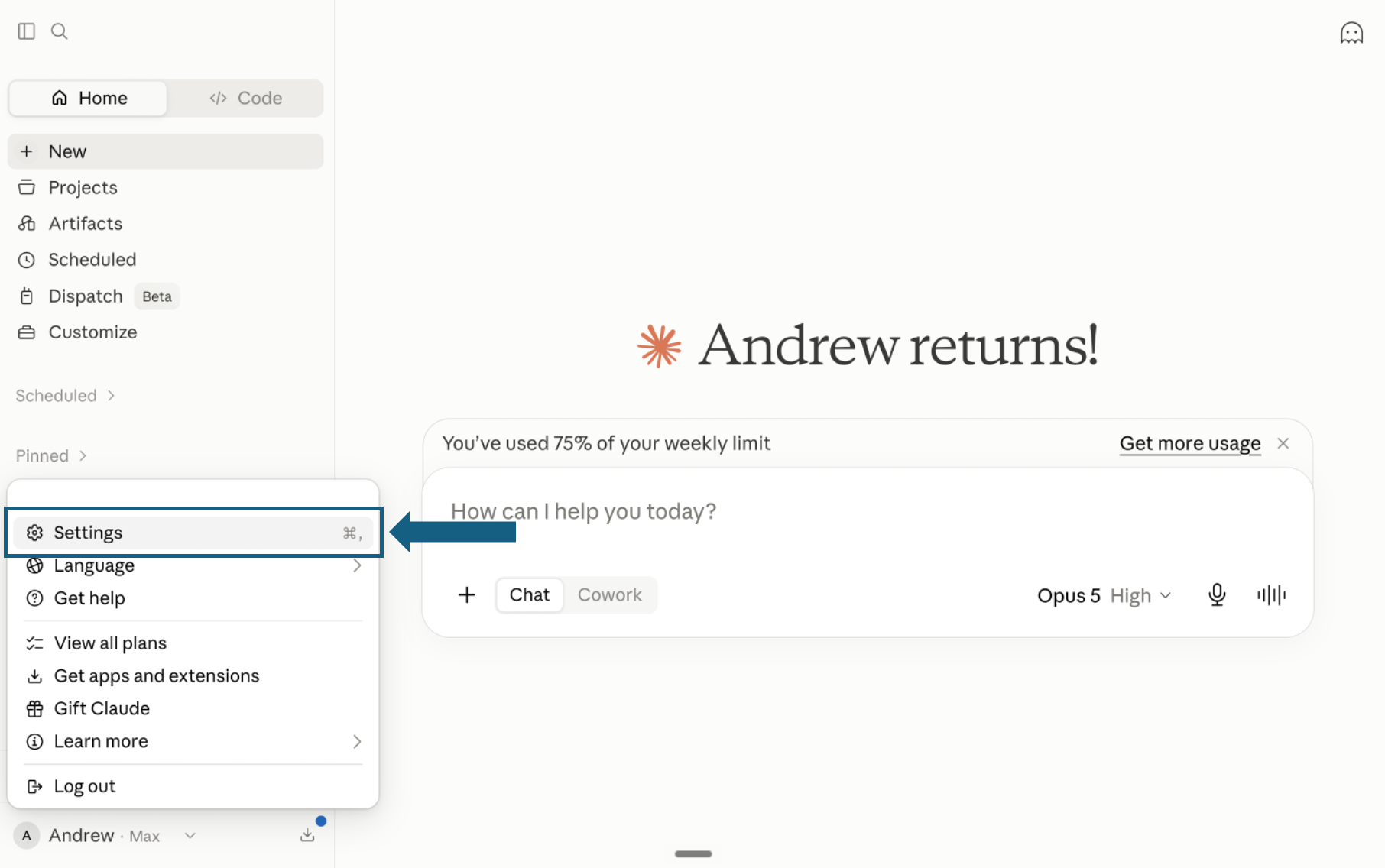
- Step 1Download all 6 skills (.zip)
Download the pack and open Settings
Download the pack and unzip it so each skill remains in its own folder with its SKILL.md file. In Claude, open your profile menu and select Settings.
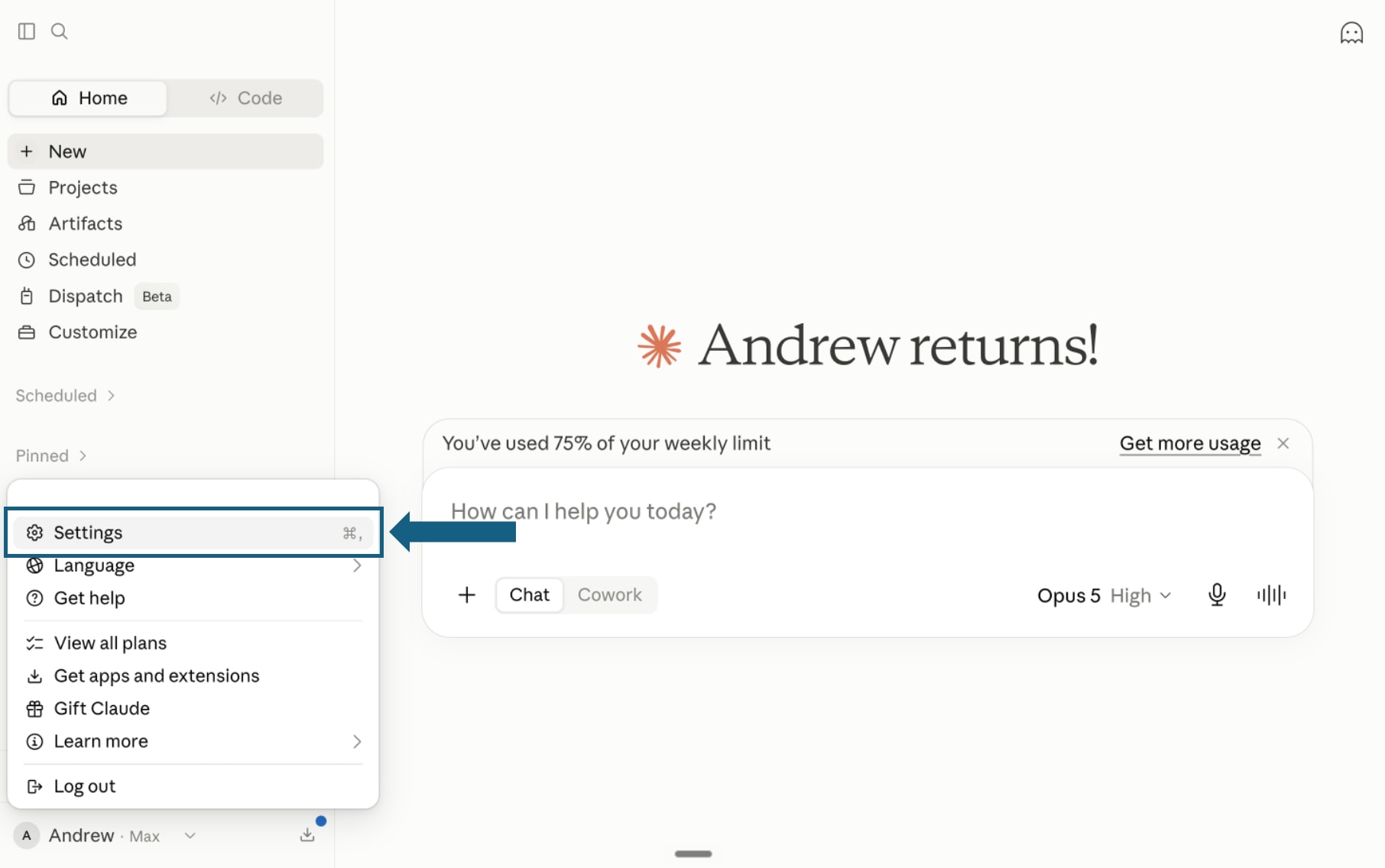
Open the screenshot to view it full size. - Step 2
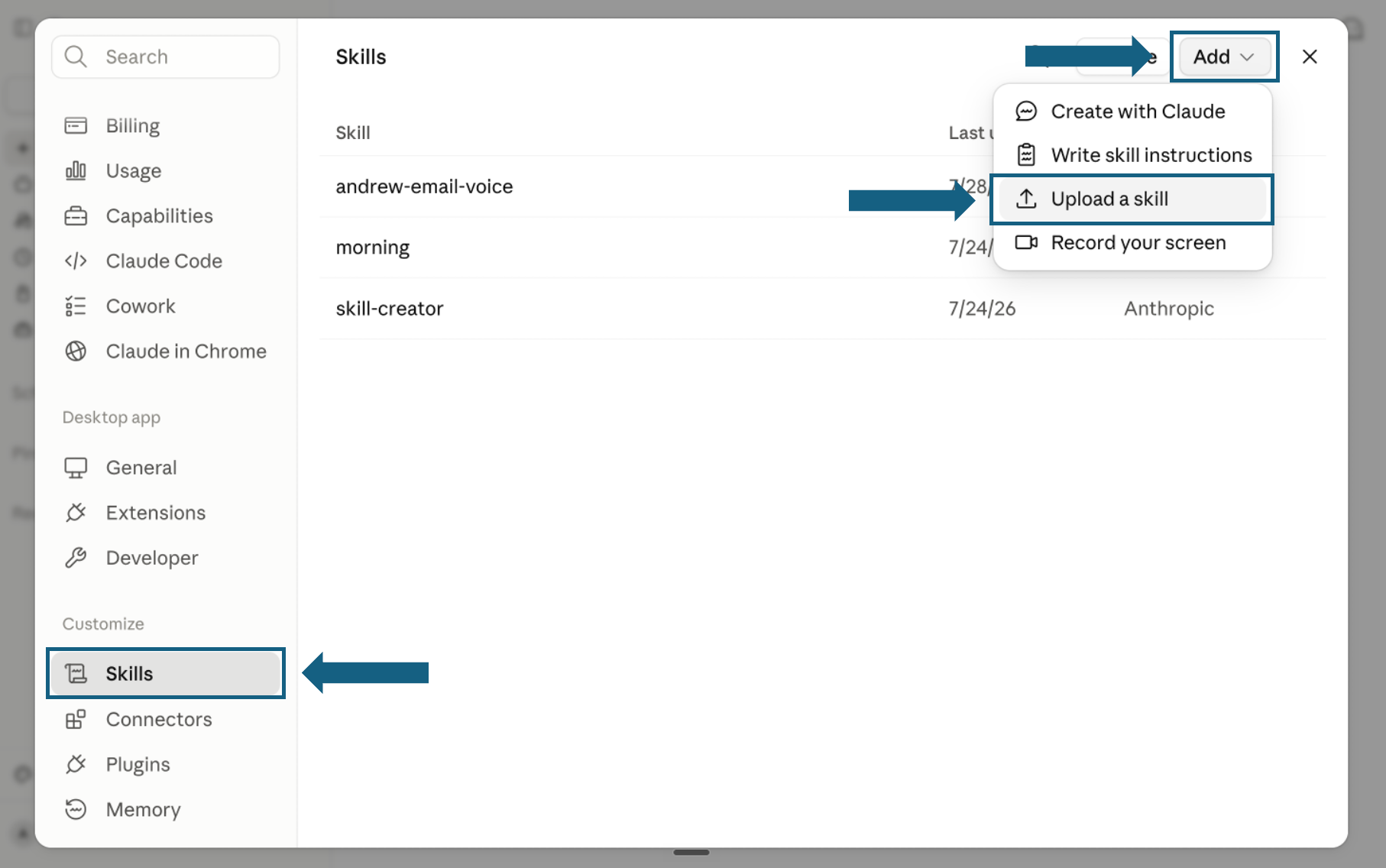
Open Skills and start an upload
In Settings, select Skills under Customize. Open Add and choose Upload a skill.
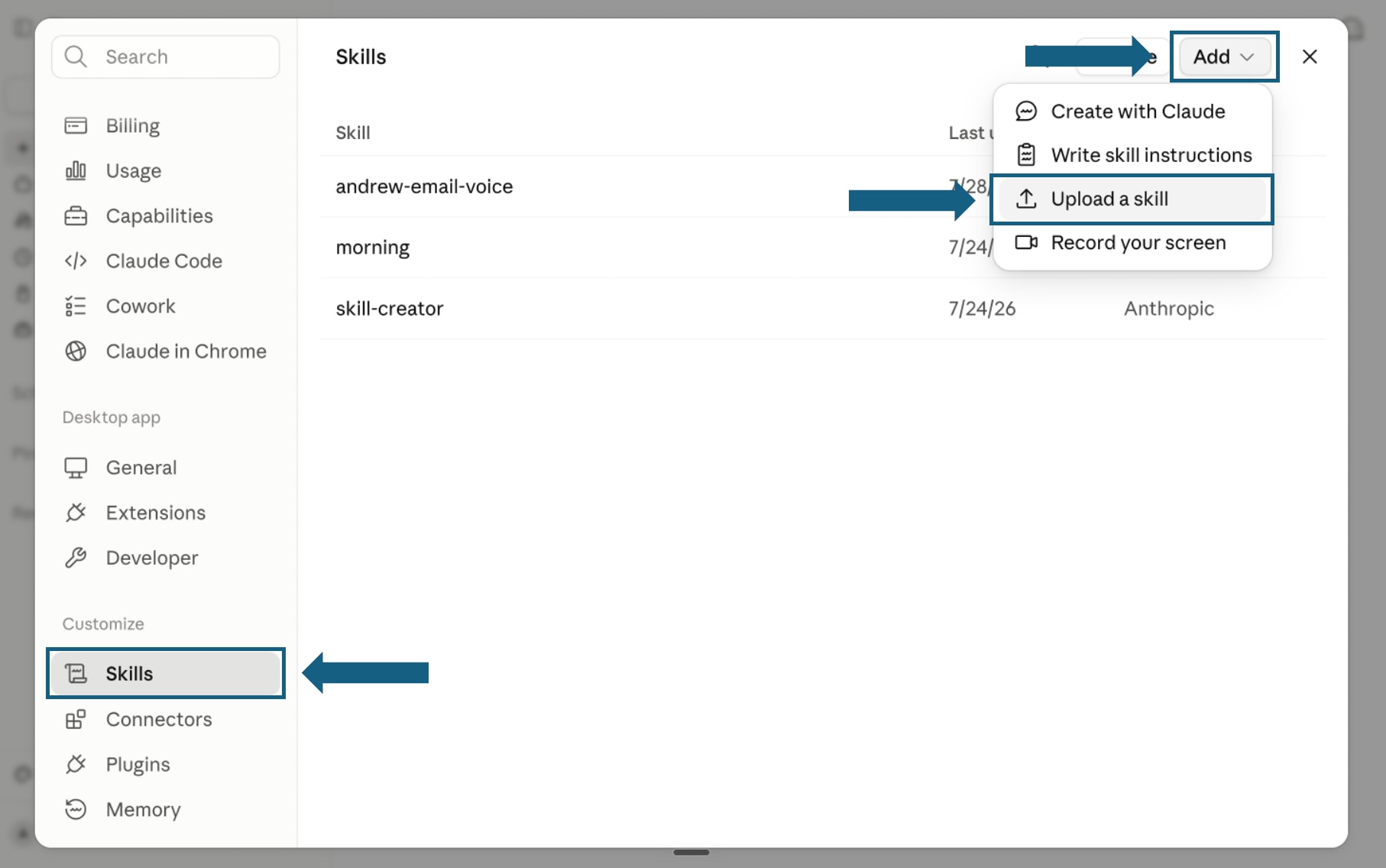
Open the screenshot to view it full size. - Step 3
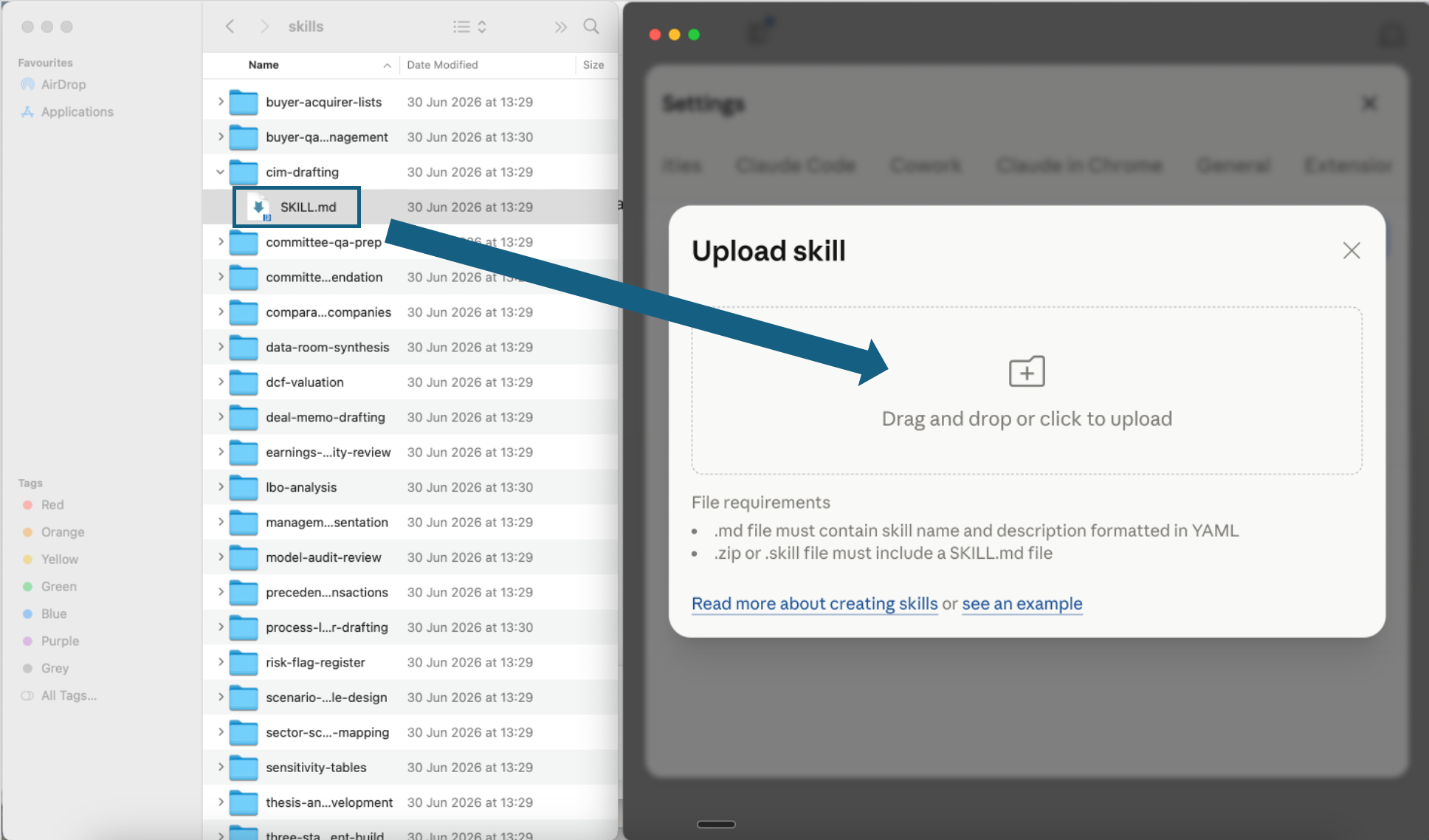
Upload one skill file
Open one extracted skill folder and drag its SKILL.md file into the upload window, or click the upload area to choose it. Repeat this step for any other skills you want to add.
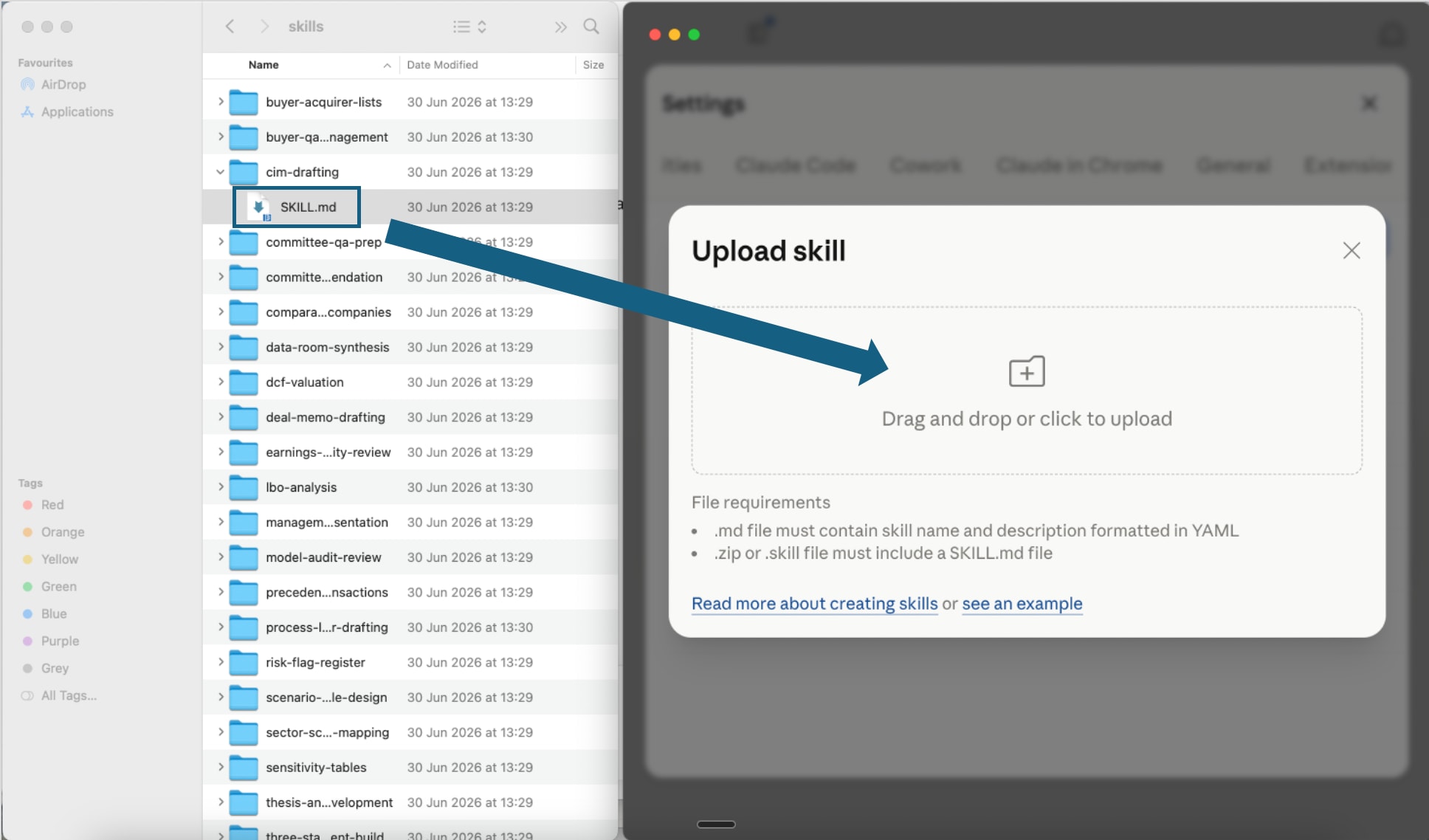
Open the screenshot to view it full size. - Step 4
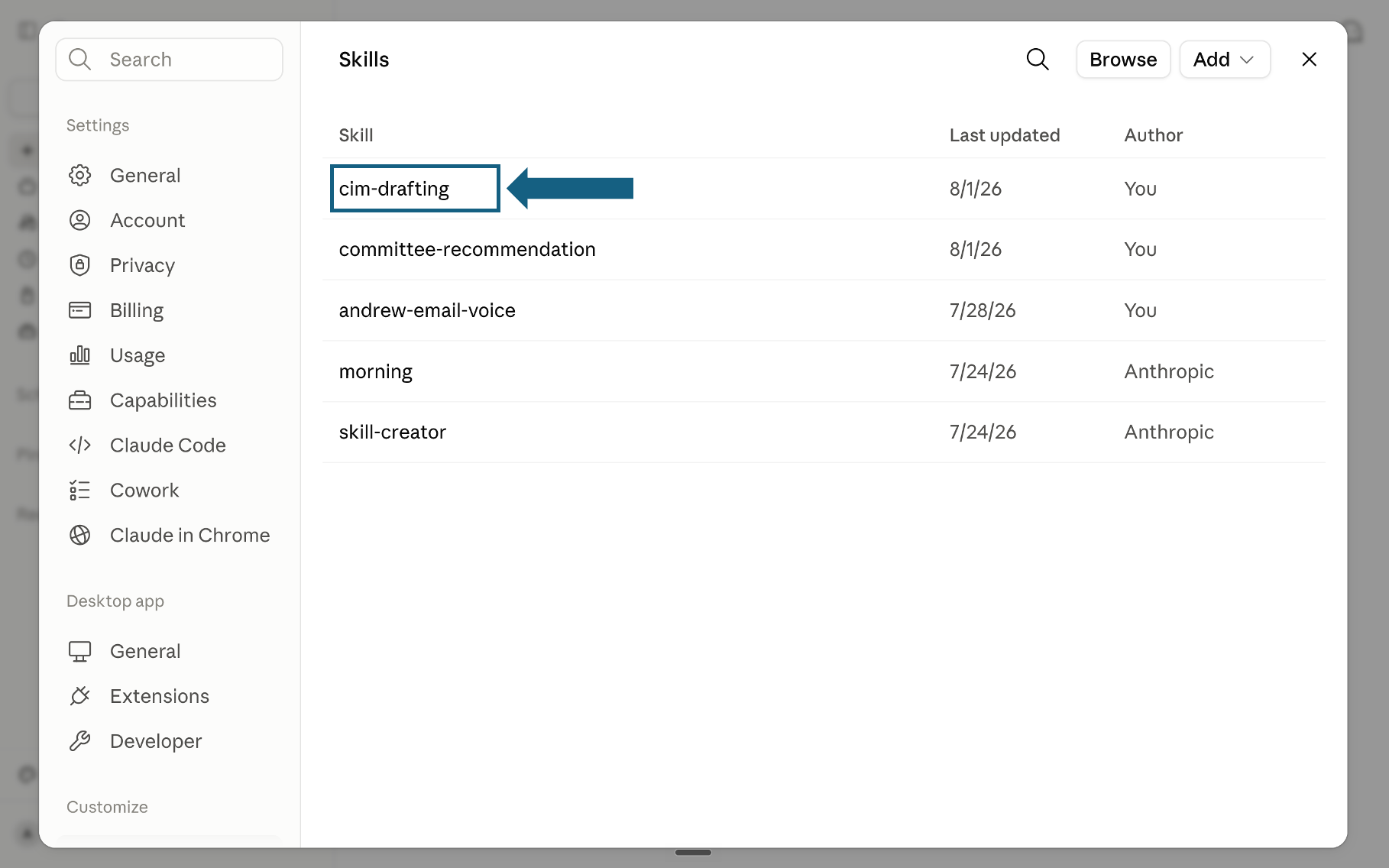
Confirm the skill was added
Return to the Skills list and check that the skill appears. Select its name to open it.
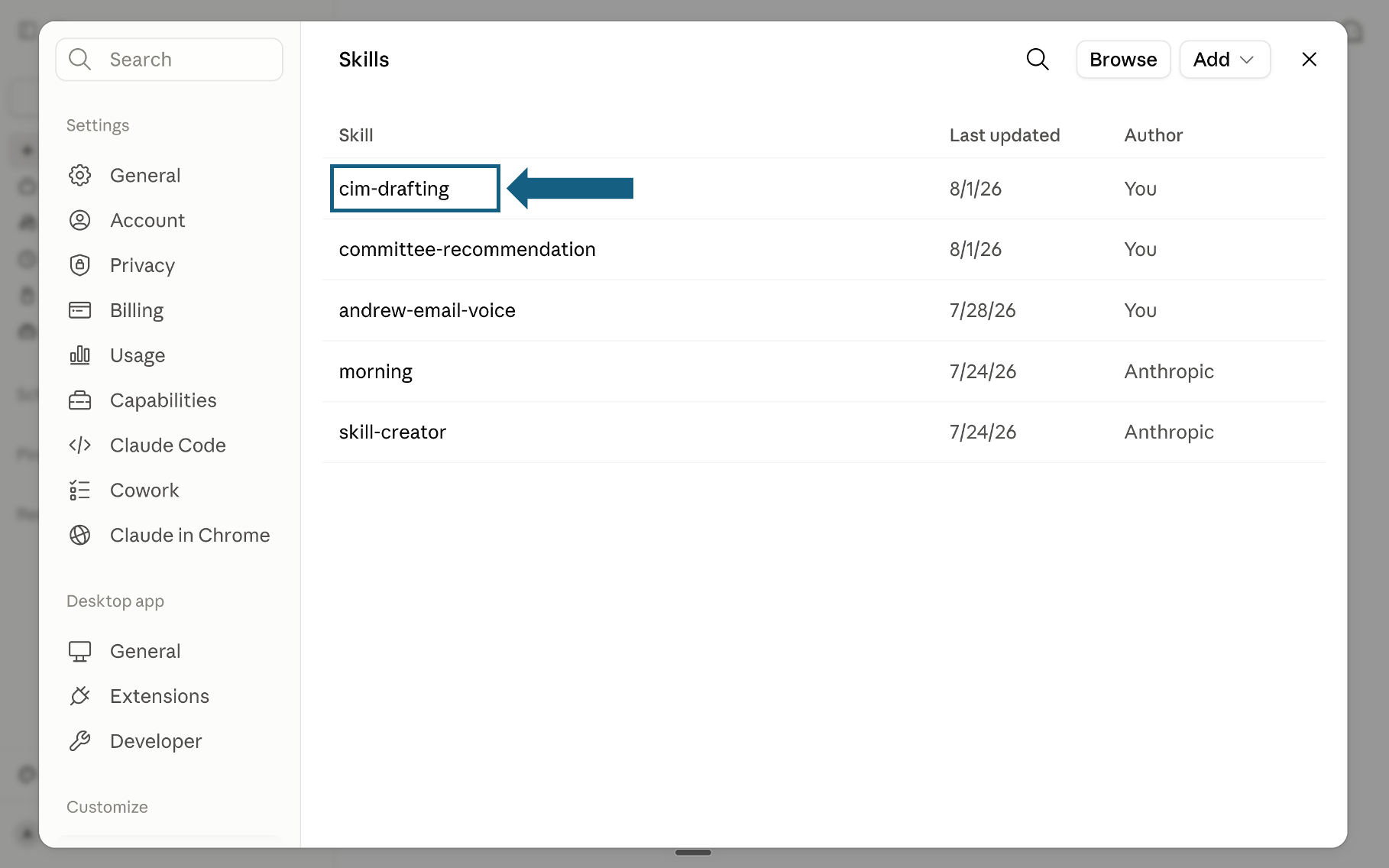
Open the screenshot to view it full size. - Step 5
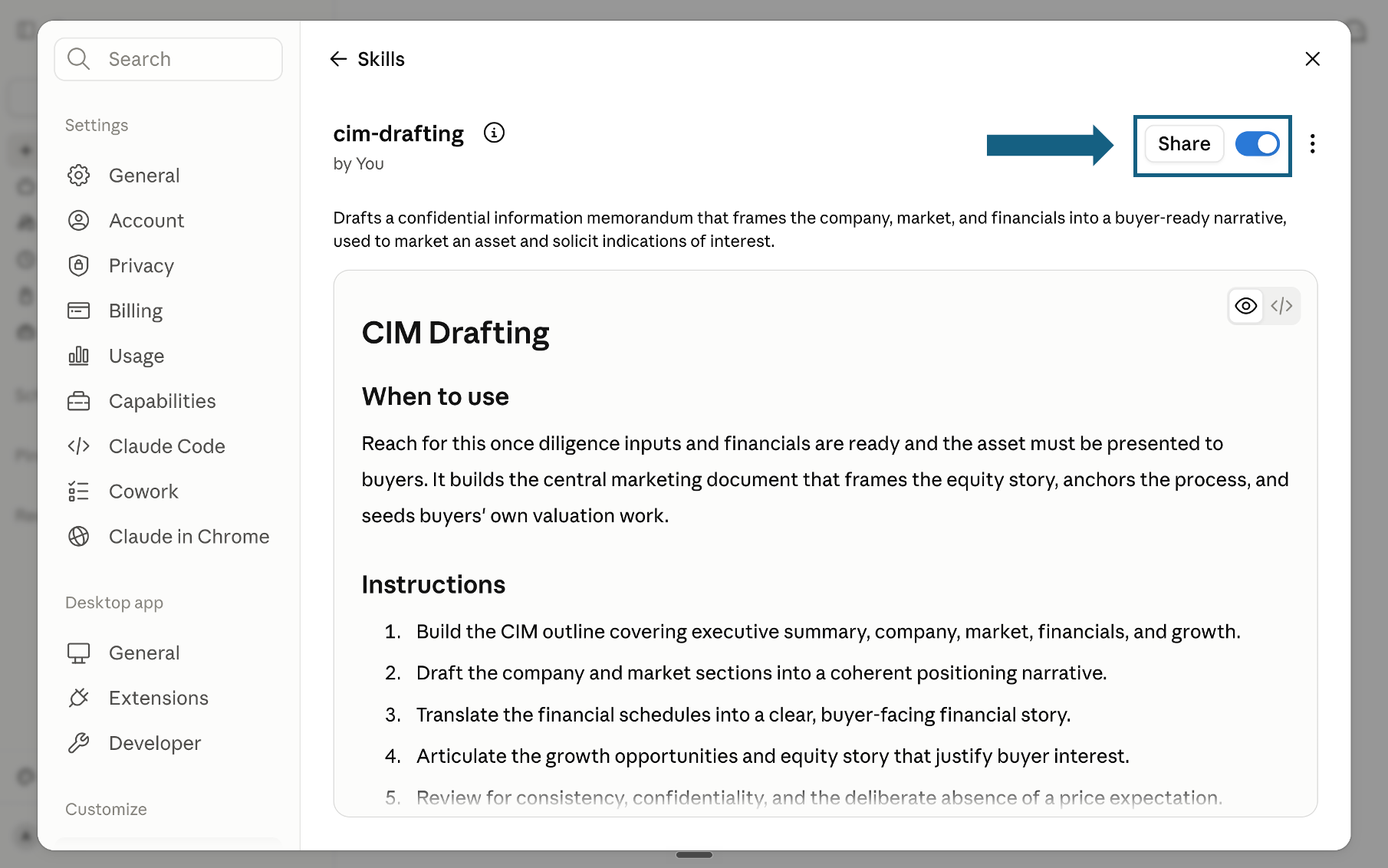
Review and turn on the skill
Review the skill's name, description, and instructions, then make sure the switch beside Share is on. A blue switch means the skill is turned on; sharing it is optional.
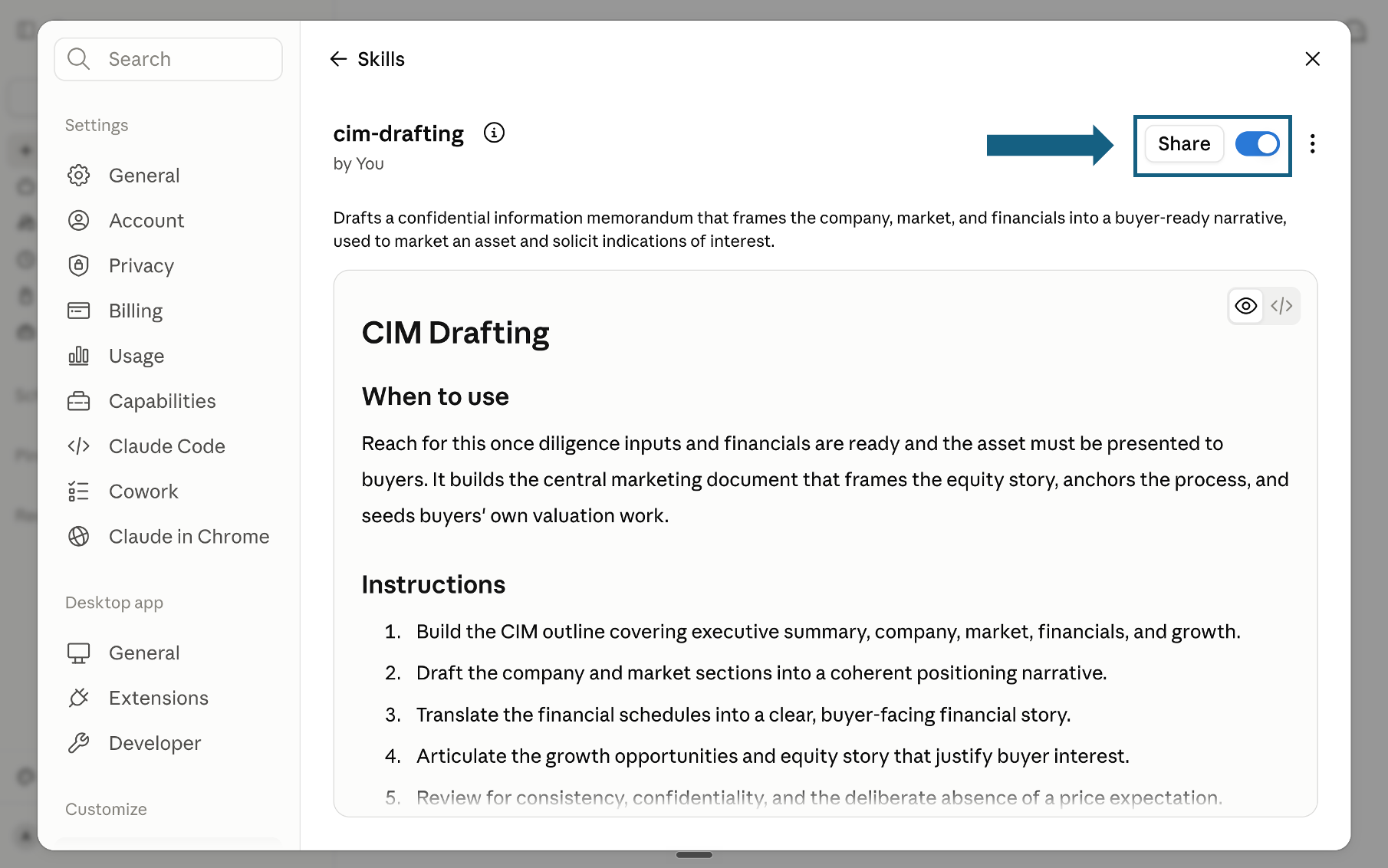
Open the screenshot to view it full size.
Try a skill
Tell Claude which skill to use and provide the relevant files or context. Review every output before sharing it.
- "Use the ebitda-add-back-scrutiny skill to review this EBITDA bridge and classify each add-back as Accepted, Contested, or Rejected: [paste financials]"
- "Run the customer-concentration-forensics skill on this revenue data and apply the walk-away simulation for the top 3 accounts: [paste data]"
- "Use the growth-narrative-validation skill to classify the market and revenue claims in this CIM section as Primary, Secondary, or Asserted: [paste section]"
- "Run the ic-diligence-memo skill to structure the IC memo from these workstream findings and build the risk register: [paste summaries]"
How to choose a skill
Each skill maps to a specific diligence question. Match your immediate need to the right skill and add that one in Claude Skills.
The quality bar
Every skill is designed to push Claude toward outputs that would pass scrutiny at an investment committee, not just produce a plausible-sounding analysis. The standard is the one a senior associate would apply before sharing a diligence memo with a deal partner.