

Storylining a Consulting Deck: Top-Down Communication That Lands
Storylining a consulting deck means sequencing every section so it reads as one top-down argument, the recommendation first, then the reasoning a partner needs to trust it. This guide walks the method step by step and shows a full before-and-after example, from a bottom-up data dump to a deck that lands in the first three slides.
What Storylining a Consulting Deck Means
Storylining a consulting deck means sequencing every section so it reads as one top-down argument instead of a set of loosely related topics. The recommendation comes first, the reasoning behind it comes next, and the supporting data sits at the back where a reader can check it without wading through it first.
A single slide already has a top-down shape when it follows the pyramid principle: a governing thought as the headline, three or four supporting arguments in the body. Storylining applies the same logic one level up. Each section of the deck is a governing thought of its own, and the sections sit in the order that makes the deck's overall argument, not the order the analysis happened to get done.
Every section is a mini pyramid
Each section header states an assertion, backed by a short layer of supporting argument underneath it, the same shape as a single slide.
Order matches logic, not workflow
Sections run in the order a reader needs the argument, not the order the workstreams delivered their findings.
How to Storyline a Deck, Step by Step
Six steps take a set of findings and turn them into a storyline a reader can follow from the first slide to the last without losing the thread.
Write the governing thought for the whole deck first
State the overall recommendation in one sentence before you open a slide template. That sentence becomes the executive summary headline and the test every later section has to support.
Draft the situation, complication, and resolution
Open with the situation the reader already agrees with, the complication forcing a decision now, and the resolution, which restates the governing thought. Three or four sentences is enough.
Turn every section header into a governing thought
Replace topic labels like "Market Overview" with an assertion like "The addressable market has widened since the last review." A reader should learn something from the header alone.
Sequence sections in the order of the key line
Lay sections out in the same order you would list the key line arguments out loud. If one argument depends on an earlier one being true, put the earlier one first.
Write a transition sentence between sections
Close each section with a line stating how it leads to the next one, so the deck reads as one continuous argument instead of a stack of separate topics.
Move detail and back-up data to the appendix
Keep the main flow to the sections a partner needs to approve the recommendation. Send supporting exhibits, full data tables, and methodology notes to the appendix.
Step three is really a MECE test applied to the section headers themselves: no two sections should overlap, and nothing relevant should be left uncovered. For the full test and worked examples, see our guide to the MECE principle.
Before and After: Turning a Data Dump Into a Storyline
Take a team asked to recommend how to reduce customer churn. Both versions below use the same underlying analysis. Only the sequencing changes, and that sequencing is the entire difference between a deck that lands and one that gets read out of order.
Before: bottom-up
- Company background and org chart
- Full data set, segment by segment
- Competitor benchmarks
- Survey and interview findings
- Root cause analysis
- Recommendation, on one of the last slides
After: top-down storyline
- Executive summary stating the recommendation
- Situation: what has been true and stable
- Complication: what is forcing a decision now
- Resolution: the recommendation, restated with its three supporting arguments
- One section per supporting argument, each with its own governing thought
- Appendix: full data set, benchmarks, and methodology
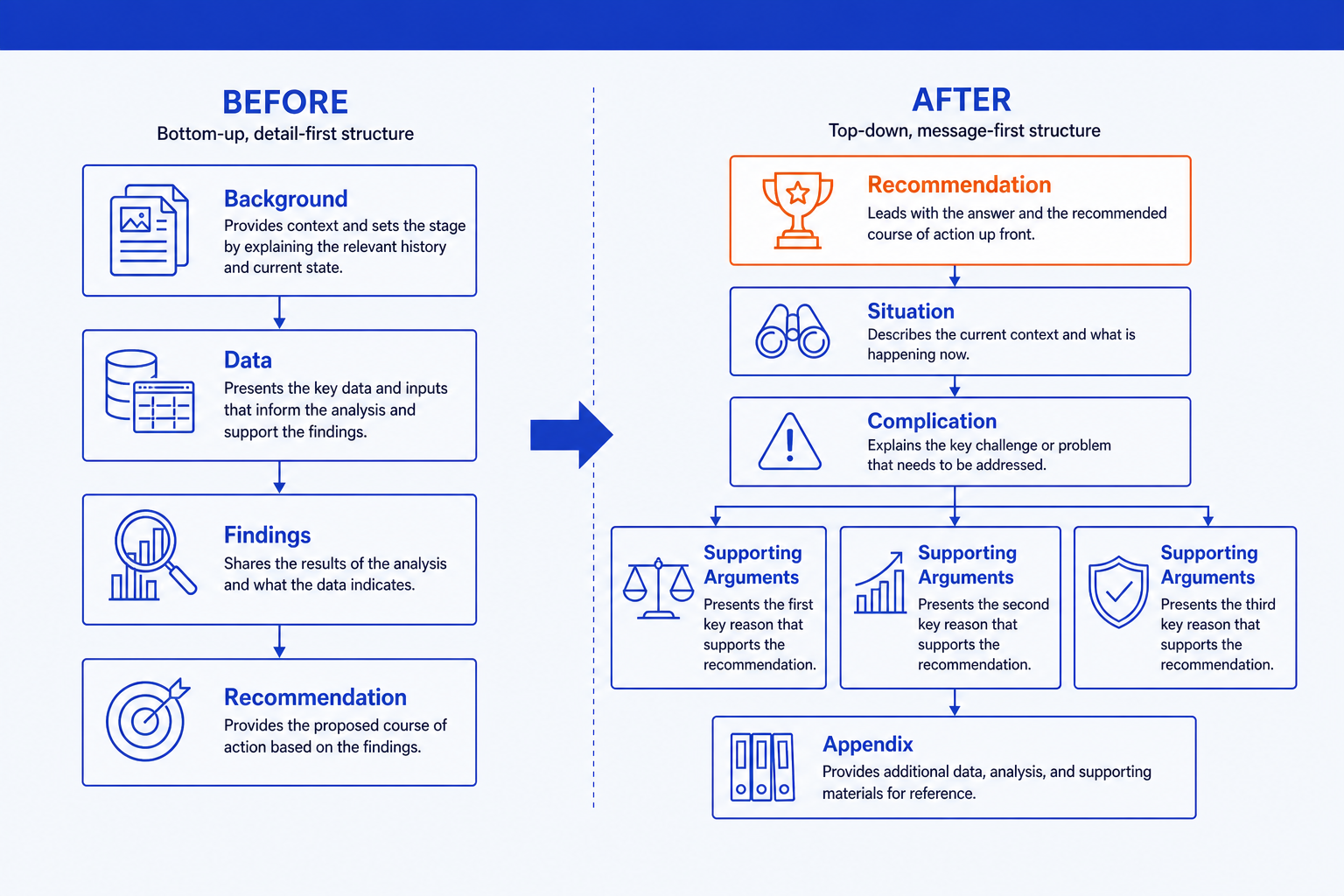
In the after version, the executive summary states the recommendation to fix onboarding and renewal pricing before adding another retention offer. The situation and complication explain why that decision is due now: churn has been rising while the cost of retention offers keeps climbing, and those offers are masking two structural problems instead of fixing them. The three sections that follow are the supporting arguments, each with its own governing thought: onboarding drop-off explains most of the early churn, renewal price increases are outpacing the value customers see, and retention offers are being spent on accounts that were leaving regardless. Every slide in the appendix still exists, it has just moved to where a reader who wants to check the work can find it, instead of sitting between the reader and the answer.
Common Storylining Mistakes
Sequencing by workstream, not by argument. Ordering sections by which team produced them, market first, then operations, then finance, instead of by the logic a reader needs. Reorder by argument, not by author.
Saving the recommendation for the end. Building up through background and analysis and only stating the recommendation on the closing slide. A partner who has ninety seconds needs the answer on slide one, not slide forty.
Section headers that are topics, not assertions. Headers like "Pricing" or "Operations Review" tell a reader what a section is about, not what it argues. If the header could be followed by a question mark, it is not doing its job yet.
Turning the Storyline Into Slides
Once the storyline is written as section headers and transition sentences, the deck build becomes mechanical: one slide per governing thought, with the same situation-complication-resolution shape carried through the executive summary slide. Our guide to the executive summary slide walks through that specific layout step by step.
Oria's Text-to-Slide workflow can take the storyline directly: describe a section's governing thought and its supporting arguments, and it returns 2 to 5 fully editable design options in 30 to 40 seconds, on your template, without a blank layout to fight through first.
Example prompt
"Create a slide with the headline stating that onboarding drop-off explains most of the early churn. Below it, add a short situation line, then three supporting bullet points with a small icon next to each, and a callout box on the right summarizing the recommended fix."
For a deeper library of ready prompts covering every stage of building a storyline, from governing thought to a final logic check, see 22 Claude prompts for storyline.
Frequently asked questions
What does storylining a consulting deck mean?
Storylining a consulting deck means sequencing every section so the whole deck reads as one top-down argument. The recommendation comes first, then the situation and complication that created the decision, then the supporting arguments in the order a reader needs them, with detail pushed to an appendix.
How is storylining different from the pyramid principle?
The pyramid principle structures a single argument: one governing thought, a small set of supporting arguments, and data underneath each one. Storylining applies that same top-down logic across an entire deck, where each section is a governing thought of its own and the sections are sequenced like a key line.
Where should the executive summary sit in a storylined deck?
Right after the title slide. It states the governing thought for the whole deck in one sentence, then previews the three or four supporting sections that follow, so a reader who stops there already has the full argument at a high level.
What belongs in the main flow versus the appendix?
The main flow holds only what a reader needs to follow and trust the recommendation: the situation, the complication, and each supporting argument with its lightest layer of evidence. Full data tables, detailed exhibits, and methodology notes belong in the appendix, referenced but not shown.
Should the storyline be written before or after building slides?
Before. Write the governing thought and every section header as full sentences first, in the order they will appear, before opening a slide template. This storyboard step is where most structural problems get caught, while they are still one line of text to fix.