

42 Strategy Consulting Agents for Claude, Insight to Impact
Not prompts. 42 strategy consulting agents for Claude that size the market, diagnose the real problem, design the operating model, and run the transformation through to realized value, so strategy work stops living in scattered files and starts running itself.
What these strategy consulting agents are
A full strategy consulting function, agentized. These are 42 strategy consulting agents for Claude, not one-off prompts. Together they run an entire engagement end to end: size the market, diagnose the strategy, design the operating model, stand up the transformation, manage the programme, and drive implementation from first insight to realized value.
Each agent is a small, uploadable workflow that teaches Claude to perform one high-value strategy task with a repeatable, named method. Run one on its own, run a group for an engagement phase, or chain the full set so the work flows from first hypothesis to captured value without living in a pile of files. They pair naturally with our 67 autonomous strategy agents for Claude and our 21 strategy skills for Claude.
Mechanically, each agent is one folder with a SKILL.md file, grouped by function inside the zip. Install just the ones you need, or load the full set into a Claude Project.
Download all 42 agents
One zip, one folder per agent. Free, no signup.
The 42 Strategy Consulting Agents You Get
The set is grouped into eight functions. They run in the order a real engagement does, read the market first, realize the value last, but every agent is also useful on its own.
One engagement, eight agent functions
Group 1 · 3 agents
Market and Competitive Intelligence Agents
Size the opportunity, map every competitor, and build a grounded view of what customers actually want before the work begins.
Market Sizing
Use when: You need a defensible size for the opportunity
Output: A sized market with top-down and bottom-up reconciliation
Competitive Landscape
Use when: You need to see who competes and how they win
Output: A competitor map with positioning and likely moves
Customer Insights
Use when: Decisions rest on assumptions about customers
Output: A customer insight synthesis of needs, drivers, and evidence
Group 2 · 6 agents
Corporate Strategy Agents
Diagnose where value is created and destroyed, then build the growth, portfolio, and business model choices that follow, stress-tested across scenarios.
Strategic Diagnosis
Use when: Leadership is debating symptoms, not the real problem
Output: A diagnosis of the core issue with an evidence-backed issue tree
Growth Strategy
Use when: Growth has stalled or lacks a clear source
Output: A ranked set of growth pathways with the case for each
Portfolio Strategy
Use when: Capital and attention are spread across too many bets
Output: A portfolio view with invest, hold, and exit calls
Business Model Design
Use when: How the business creates and captures value must change
Output: A business model design across value creation and capture
Scenario Planning
Use when: The future is uncertain and one forecast is not enough
Output: Named scenarios on a two-axis matrix with signposts
Strategic Roadmap
Use when: The strategy needs sequencing into a credible path
Output: A phased roadmap with horizons, owners, and gates
Group 3 · 6 agents
Customer and Growth Strategy Agents
Turn strategy into commercial reality: who to serve, what to promise, what to charge, and how to reach them.
Customer Segmentation
Use when: One-size targeting is failing across different buyers
Output: Needs-based segments with size, value, and priority
Value Proposition
Use when: The offer does not connect to what customers value
Output: A value proposition mapped to jobs, pains, and gains
Pricing Strategy
Use when: Pricing power, packaging, or discounting is unclear
Output: A pricing recommendation with willingness-to-pay logic
Go-to-Market Strategy
Use when: An offer needs a coherent route to the customer
Output: A go-to-market plan across motion, funnel, and metrics
Channel Strategy
Use when: You must choose how to reach and serve buyers
Output: A channel mix with economics and coverage logic
Growth Initiatives
Use when: Growth ambition needs concrete, sized initiatives
Output: A ranked initiative set with value and effort
Group 4 · 5 agents
Organization and Operating Model Agents
Design the structure, capabilities, and governance the strategy actually needs to work.
Operating Model
Use when: Strategy has no clear way of getting done
Output: An operating model across process, people, and structure
Organization Design
Use when: The structure fights the strategy
Output: An org design with spans, layers, and accountabilities
Capability Assessment
Use when: You must know what the organization can actually do
Output: A capability map with maturity levels and gaps
Workforce Strategy
Use when: Talent supply does not match the strategy's demands
Output: A workforce plan across build, buy, and borrow
Governance Design
Use when: Decisions stall because no one owns them
Output: A governance model with forums, cadence, and decision rights
Group 5 · 6 agents
Performance and Transformation Agents
Stand up the transformation office, find the cost and process gains, and track every benefit through to the P and L.
Transformation Office
Use when: A transformation needs a spine to run on
Output: A transformation office design with cadence and value tracking
Cost Optimization
Use when: The cost base must come down without breaking delivery
Output: A cost baseline with sized savings levers
Process Redesign
Use when: A core process is slow, costly, or error-prone
Output: A redesigned process with waste removed and handoffs fixed
KPI Framework
Use when: Metrics are noisy, lagging, or gamed
Output: A KPI tree of leading and lagging measures tied to decisions
Benefits Tracking
Use when: Promised benefits must be proven, not assumed
Output: A benefits ledger tracking committed value to the P and L
Change Management
Use when: A change could stall on people rather than plan
Output: A change plan with readiness, actions, and adoption measures
Group 6 · 5 agents
Digital and Data Strategy Agents
Build the digital, data, and AI agenda, sequenced into a roadmap and a portfolio of use cases with real business cases behind them.
Digital Strategy
Use when: Digital investment lacks a value-linked plan
Output: A digital strategy tied to value pools and maturity
Data & AI Strategy
Use when: Data and AI ambition needs structure and focus
Output: A data and AI strategy across value, foundations, and governance
Technology Roadmap
Use when: Technology work needs sequencing against dependencies
Output: A technology roadmap with sequencing and dependencies
Analytics Use Cases
Use when: Use-case ideas are everywhere and focus is missing
Output: A prioritized use-case portfolio with value and feasibility
Innovation Portfolio
Use when: Innovation spend lacks balance and a clear thesis
Output: An innovation portfolio balanced across horizons
Group 7 · 4 agents
Program Management Agents
Orchestrate hundreds of moving pieces across workstreams, clients, and partners to keep every milestone on track.
Workstream Coordination
Use when: Many workstreams and partners must stay aligned
Output: A workstream map with owners, interfaces, and dependencies
Timeline & Milestones
Use when: A programme needs a credible schedule to delivery
Output: A programme timeline with milestones and the critical path
Risk & Dependency Management
Use when: Risks and cross-team dependencies threaten delivery
Output: A risk and dependency register with owners and mitigations
Quality Assurance
Use when: Client-facing deliverables must meet a consistent bar
Output: A QA checklist and review log for every deliverable
Group 8 · 7 agents
Implementation and Value Realization Agents
Prioritize initiatives, build the business cases, align stakeholders, monitor performance, and transfer knowledge so the impact outlives the engagement.
Initiative Prioritization
Use when: Too many initiatives compete for the same capacity
Output: A ranked roadmap with an explicit stop list
Business Case
Use when: A decision needs economics, risks, and sensitivities
Output: A business case with costs, benefits, and payback
Implementation Planning
Use when: A decision must become sequenced, owned execution
Output: An implementation plan with phases, owners, and first 90 days
Stakeholder Alignment
Use when: The recommendation must survive the room
Output: A stakeholder map with a pre-wiring engagement plan
Performance Monitoring
Use when: Execution needs a regular, honest performance view
Output: A performance dashboard design with review cadence
Value Realization
Use when: Benefits must be captured after go-live, not assumed
Output: A value realization plan with owners and tracking to run rate
Knowledge Transfer
Use when: Capability must stay with the client after the team leaves
Output: A knowledge transfer plan with artifacts and capability handover
Groups 1 to 3 read the market and set the commercial strategy. Groups 4 and 5 design the organization and drive performance. Group 6 builds the digital and data agenda. Groups 7 and 8 run the programme and realize the value.
Setup Guide
Download the agents pack
The zip contains all 42 agents, one folder per agent. Each agent is a single SKILL.md file. Unzip it anywhere. Keep the whole set, or pull out just the folders you need.
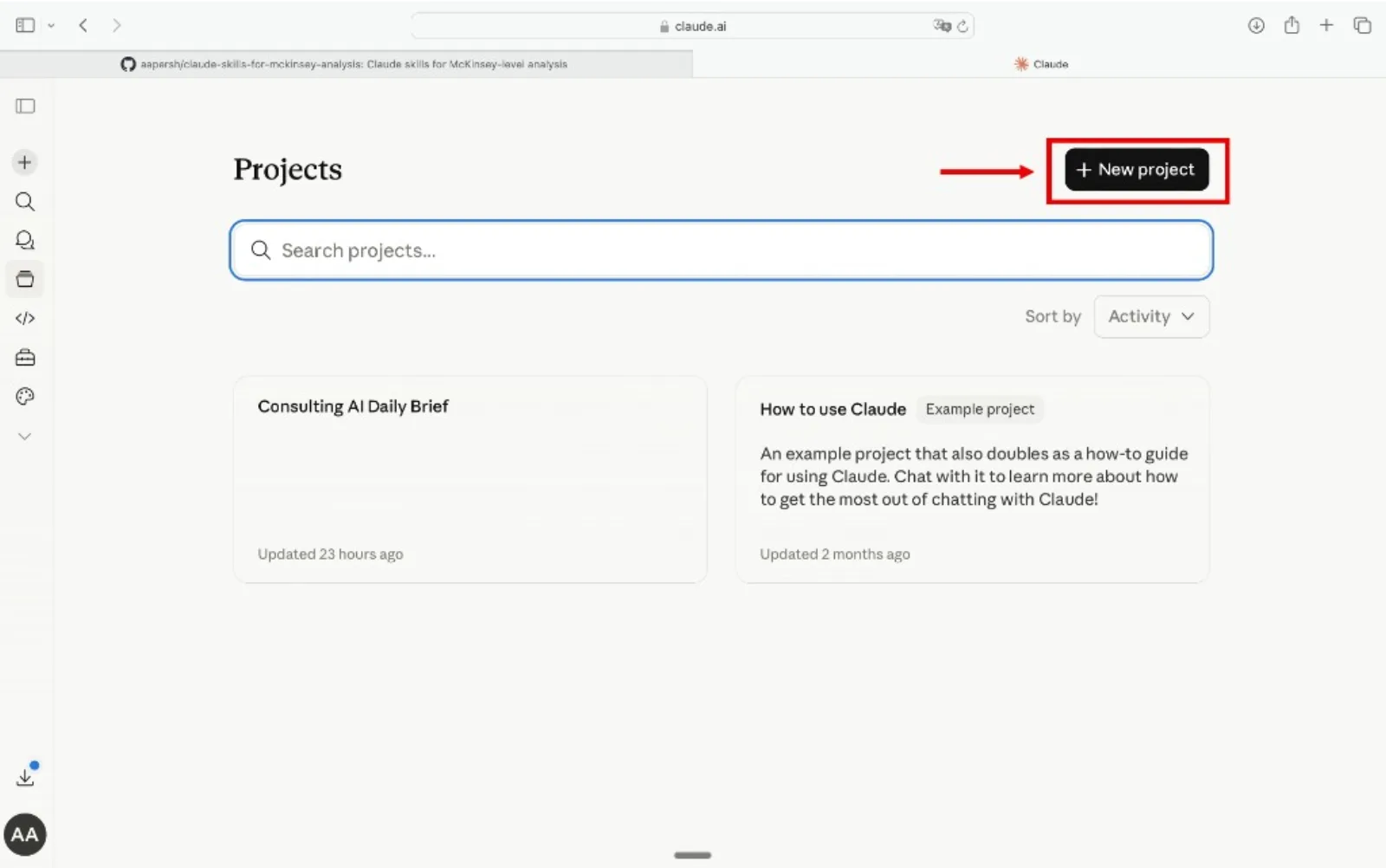
Create a Claude Project
Go to claude.ai, open the left sidebar, click Projects, then Create Project. Name it something like "Strategy Engagement Desk" so you can reuse it across engagements.
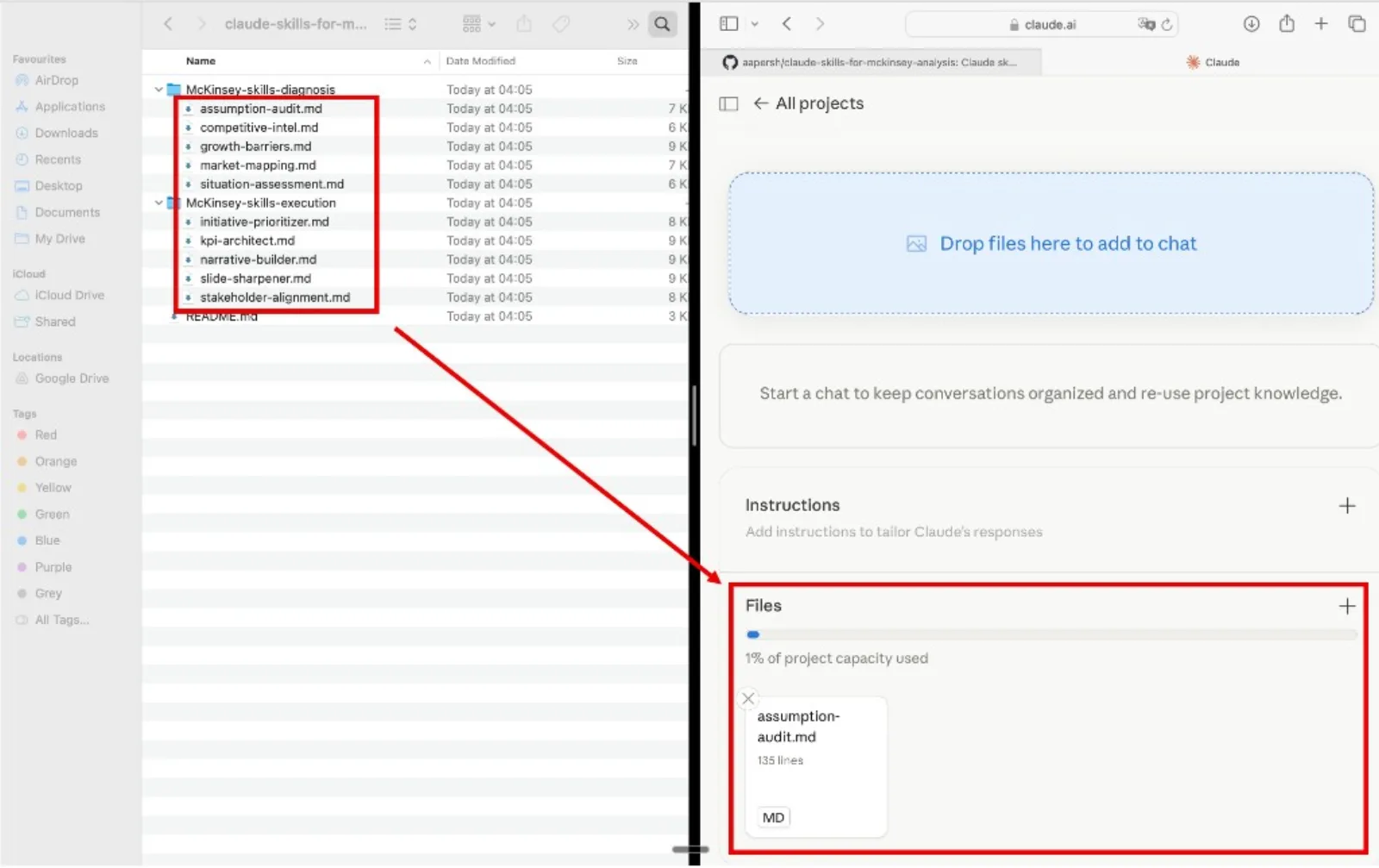
Add the agents as Project Knowledge
Inside your project, open Project Knowledge, click Add Content, and upload the .md files. Add as many as you want, one agent, an entire group, or all 42. Claude references them automatically in every conversation inside that project.
Run the agents
Open a new conversation inside the project, paste in your data, and name the agent you want Claude to run. Claude reads it from project knowledge and runs the analysis with the framework already loaded. Chain several to move from first hypothesis to an implementation plan in one sitting.
Tip
Refer to the agent by name in your prompt. Phrases like "Run the market-sizing agent" or "Use the strategic-diagnosis agent" point Claude at the right framework instead of leaving it to guess.
Example prompts
- "Run the market-sizing agent on this category, then the growth-strategy agent to choose where to play."
- "Use the strategic-diagnosis agent to find the real problem behind flat margins."
- "Run the operating-model agent, then the governance-design agent, to turn the strategy into how work gets done."
- "Use the business-case agent to build the economics for the top three initiatives."
Where to start
Forty-two agents is an engagement team, not a to-do list. Pick the row that matches what you need this week and run that agent first.
The quality bar
Every agent is designed to push Claude toward outputs that meet the same quality bar, the standard a senior partner would hold each deliverable to before it leaves the room.