

Claude for Finance: The Complete Skills Pack
The ultimate guide to Claude for Finance, with a free downloadable pack: one main prompt that turns Claude into a senior finance co-pilot, 12 skills, 12 guides, and 7 end-to-end workflows for valuation, FP and A, diligence, and board reporting. Then hand the analysis to Oria to turn it into a board-ready deck.
Everything in the Claude for Finance pack
This is the ultimate guide to Claude for Finance, and it ships as a single free download. Inside are four things that work together: a main prompt that turns Claude into a senior finance co-pilot, 12 skills that each teach Claude one named method, 12 guides that walk the work end to end, and 7 workflows that chain the skills into the plays a finance team actually runs. Every skill is written so Claude separates assumptions from confirmed figures and never invents a number.
Claude does the analysis. Oria does the slides. When a model, a valuation, or a board narrative is ready, it goes into Oria inside PowerPoint and becomes a fully editable, on-brand exhibit in minutes. For the wider finance skill library, see our institutional-grade Claude skills for finance and the six-stage finance operating system.
1 main prompt
Turns Claude into a senior finance co-pilot that routes to the right skill.
12 skills
One named method each, from a three-statement model to a board narrative.
12 guides
Walkthroughs and reference sheets for the work around the skills.
7 workflows
Skills chained into valuation, diligence, close, and board plays.
Download the Claude for Finance pack
Main prompt, 12 skills, 12 guides, 7 workflows. One zip, free, no signup.
The main prompt
One prompt sits above the whole pack. Paste it at the start of a Claude conversation and it turns Claude into a senior finance co-pilot: answer-first, disciplined about assumptions, and able to invoke any of the 12 skills by name. The full version ships in the pack as MAIN-PROMPT.md. Here is the shape of it.
You are a senior finance co-pilot for a corporate finance and
investing team. Operate by these rules on every task:

1. Answer first. Lead with the recommendation or the number, then
   the support.
2. Never invent figures. Separate assumptions from confirmed
   figures, label every assumption, and ask for missing inputs
   instead of guessing.
3. State ranges, not false precision. Show the drivers behind any
   output.
4. You have a library of named skills (for example dcf-valuation,
   three-statement-model, variance-analysis, cfo-board-narrative).
   When a request maps to one, use that skill's method. For a
   bigger job, chain skills and synthesize between them.
5. When the analysis is ready to present, hand it off for slides
   in Oria rather than formatting by hand.

Ask me for the inputs you need, then begin.
Tip
Name the skill you want in your prompt, for example "use the dcf-valuation skill." It points Claude at the exact method instead of leaving it to guess.
The 12 finance skills
12 skills across 3 domains. Each is a standalone SKILL.md that teaches Claude one named method and ships with example prompts. Install the whole set, or pull out just the skill you need.
12 skills across 3 finance domains
Valuation and deals
4 skillsDCF Valuation
Value a business on discounted cash flow: free cash flow, WACC, terminal value, and a sanity-checked range.
Skill file: dcf-valuation
Trading Comparables
Build a peer comps set and derive an implied range from EV/EBITDA, EV/Sales, and P/E.
Skill file: trading-comparables
Precedent Transactions
Screen comparable deals and derive a range from transaction multiples and control premia.
Skill file: precedent-transactions
LBO Model
Model a leveraged buyout: sources and uses, debt schedule, and returns (IRR, MOIC) with sensitivities.
Skill file: lbo-model
Modeling and planning
4 skillsThree-Statement Model
Build or audit an integrated income statement, balance sheet, and cash flow that ties out.
Skill file: three-statement-model
Driver-Based Forecast
Build an operating forecast and budget from volume, price, and cost drivers.
Skill file: driver-based-forecast
Scenario and Sensitivity
Build base, upside, and downside scenarios and sensitivity tables around the key drivers.
Skill file: scenario-and-sensitivity
Working Capital Optimization
Analyze the cash conversion cycle (DSO, DIO, DPO) and free up trapped cash.
Skill file: working-capital-optimization
Analysis and communication
4 skillsFinancial Statement Analysis
Run ratio, trend, and quality-of-earnings analysis to read the health behind the numbers.
Skill file: financial-statement-analysis
Variance Analysis
Explain budget versus actual with price-volume-mix bridges and named drivers.
Skill file: variance-analysis
Investment Committee Memo
Write the IC memo: thesis, returns, risks, and a clear recommendation.
Skill file: investment-committee-memo
CFO Board Narrative
Write the answer-first financial story a board reads before the numbers.
Skill file: cfo-board-narrative
The 7 workflows
Skills are more useful chained than alone. Each workflow below runs several skills in order and synthesizes between them, ending where the finance work usually ends: a memo, a board narrative, or a deck in Oria. The full descriptions ship as WORKFLOWS.md.
Valuation
You need a defensible value and a range.Buy-side diligence
You are assessing a target before you commit.Monthly close and FP&A
The month is closed and the story is due.Annual budget
It is planning season.LBO screening
You are testing whether a deal clears the return hurdle.Cash and working capital
Cash is tight and you need it back.Board pack
The board meets and needs the picture.The 12 guides
The guides are the reading around the skills: prompt patterns, walkthroughs, checklists, and a metrics glossary. Each is a short markdown file in the pack.
How Claude Fits the Finance Workflow
Where Claude helps across the finance workflow, and where a human stays in control.
Prompting Claude for Financial Analysis
Prompt patterns that make Claude precise: give it a role, structure, data, and its assumptions.
Build a Three-Statement Model With Claude
A step-by-step walkthrough of building an integrated model with Claude.
Run a DCF With Claude
From free cash flow to WACC to a sanity-checked valuation range.
From Model to Board Deck
Turn a finished analysis into a board-ready deck, the Oria handoff.
Quality of Earnings Checklist
A reference checklist for testing earnings quality and spotting red flags.
Monthly Close and FP&A Playbook
A playbook for a faster close and a cleaner FP&A cycle.
Financial Due Diligence With Claude
Run buy-side financial diligence with Claude as the analyst.
Data Room to Insight
Turn a messy data room into structured, ranked findings.
Avoid Hallucinated Numbers in Finance
Guardrails so Claude never invents figures, plus verification habits.
Finance Metrics and KPIs Glossary
A concise glossary of the core finance metrics and KPIs, defined plainly.
Earnings Call Preparation
The narrative, the likely questions, and the rehearsal before the call.
Set up the Claude for Finance pack
Add the 12 actual SKILL.md files through Claude Skills. Keep MAIN-PROMPT.md, WORKFLOWS.md, and the 12 guide files as support material rather than uploading them as Skills.
- Step 1Claude for Finance pack (.zip)
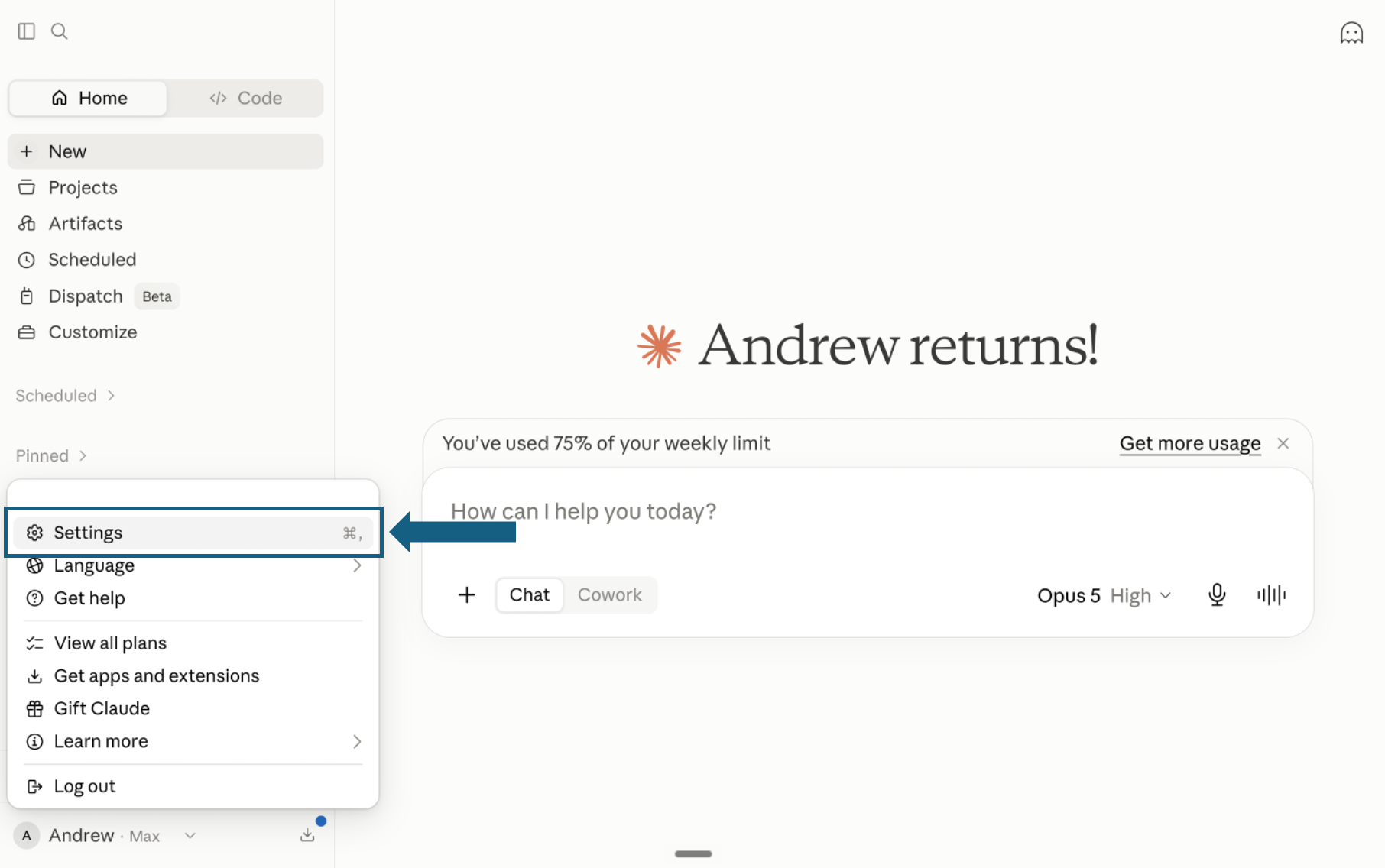
Download the hybrid pack and open Settings
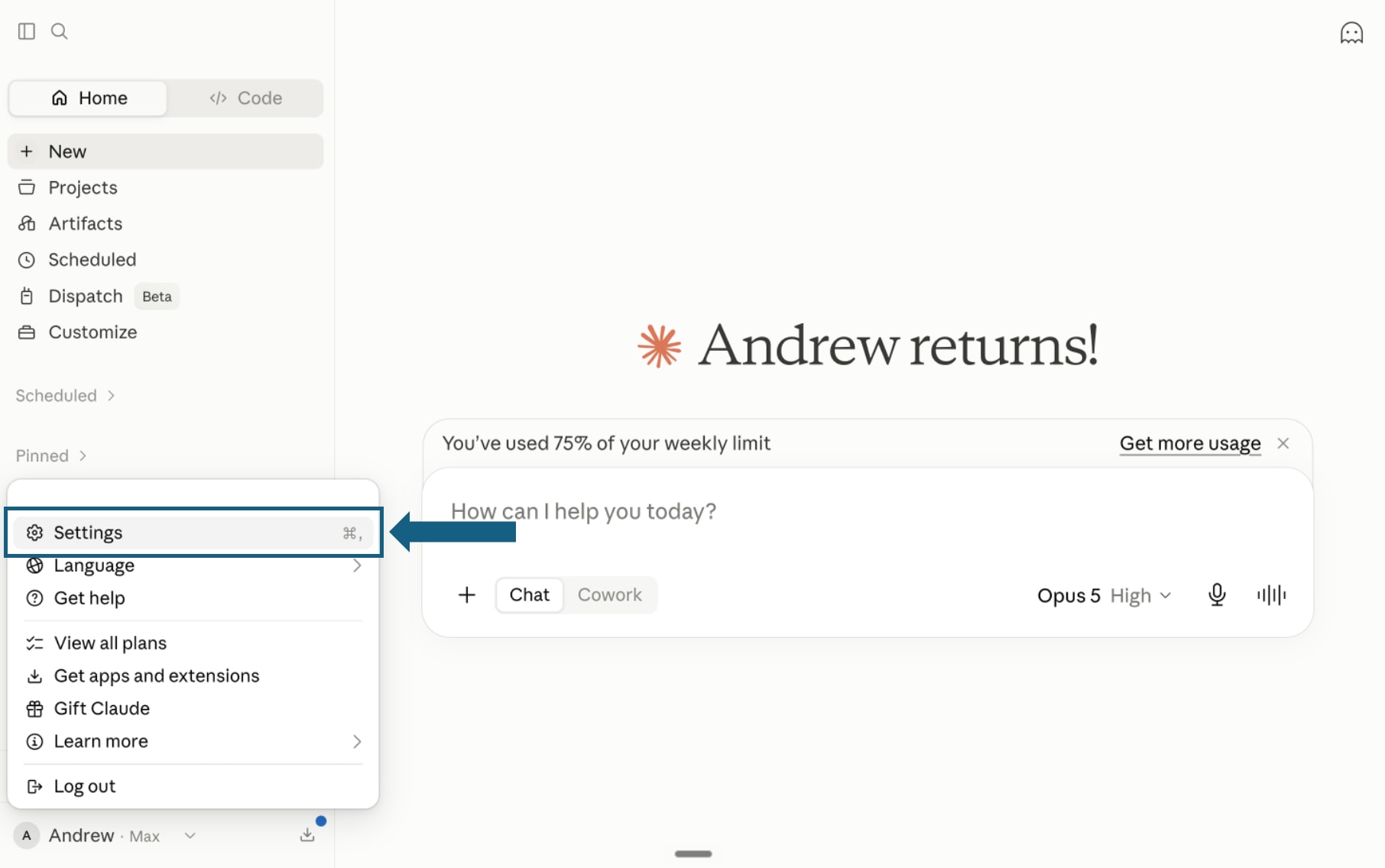
Unzip the pack. It contains 12 folders with a SKILL.md file, plus MAIN-PROMPT.md, WORKFLOWS.md, and 12 guides. In Claude, open your profile menu and select Settings.
Open the screenshot to view it full size. - Step 2
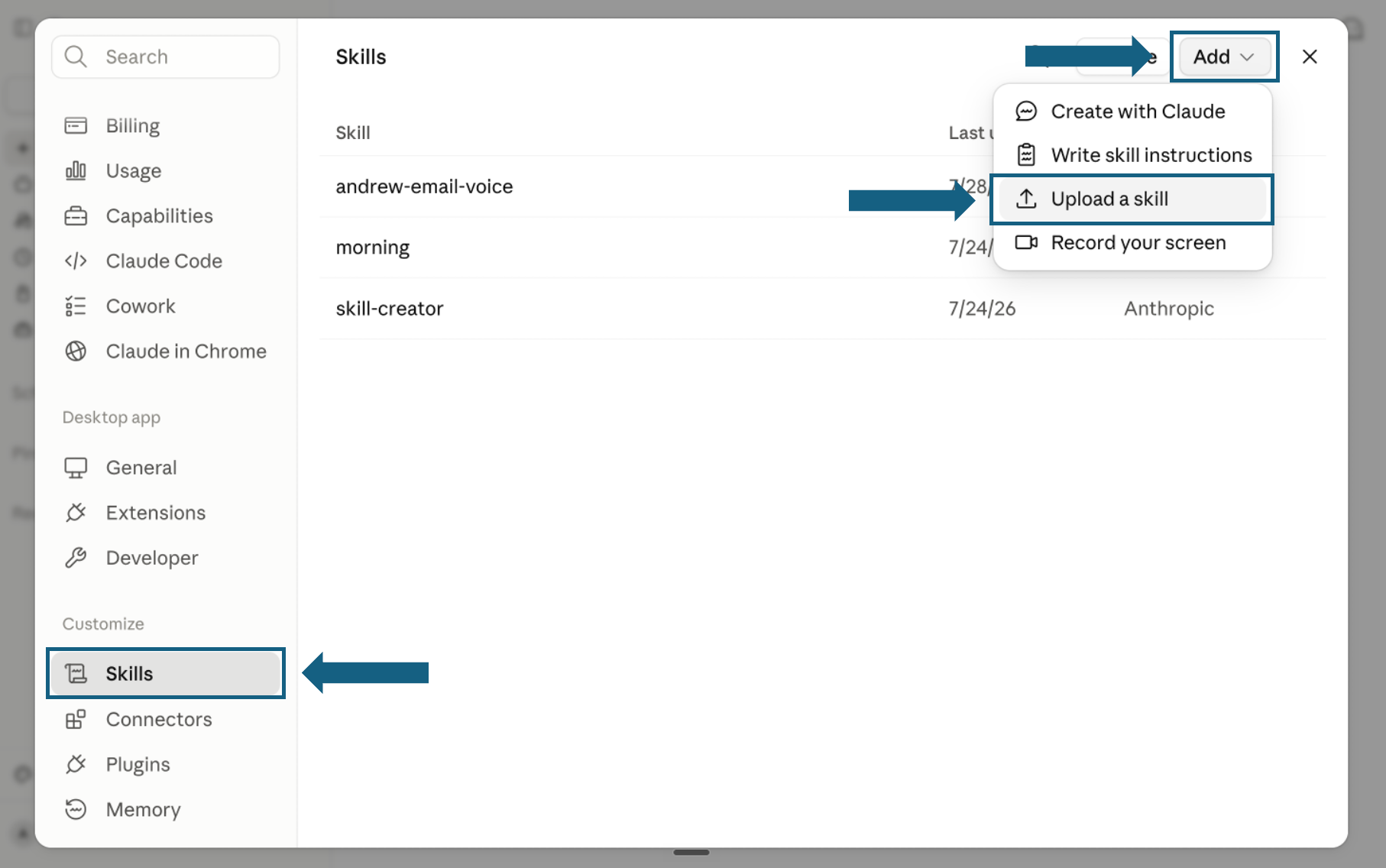
Open Skills and start an upload
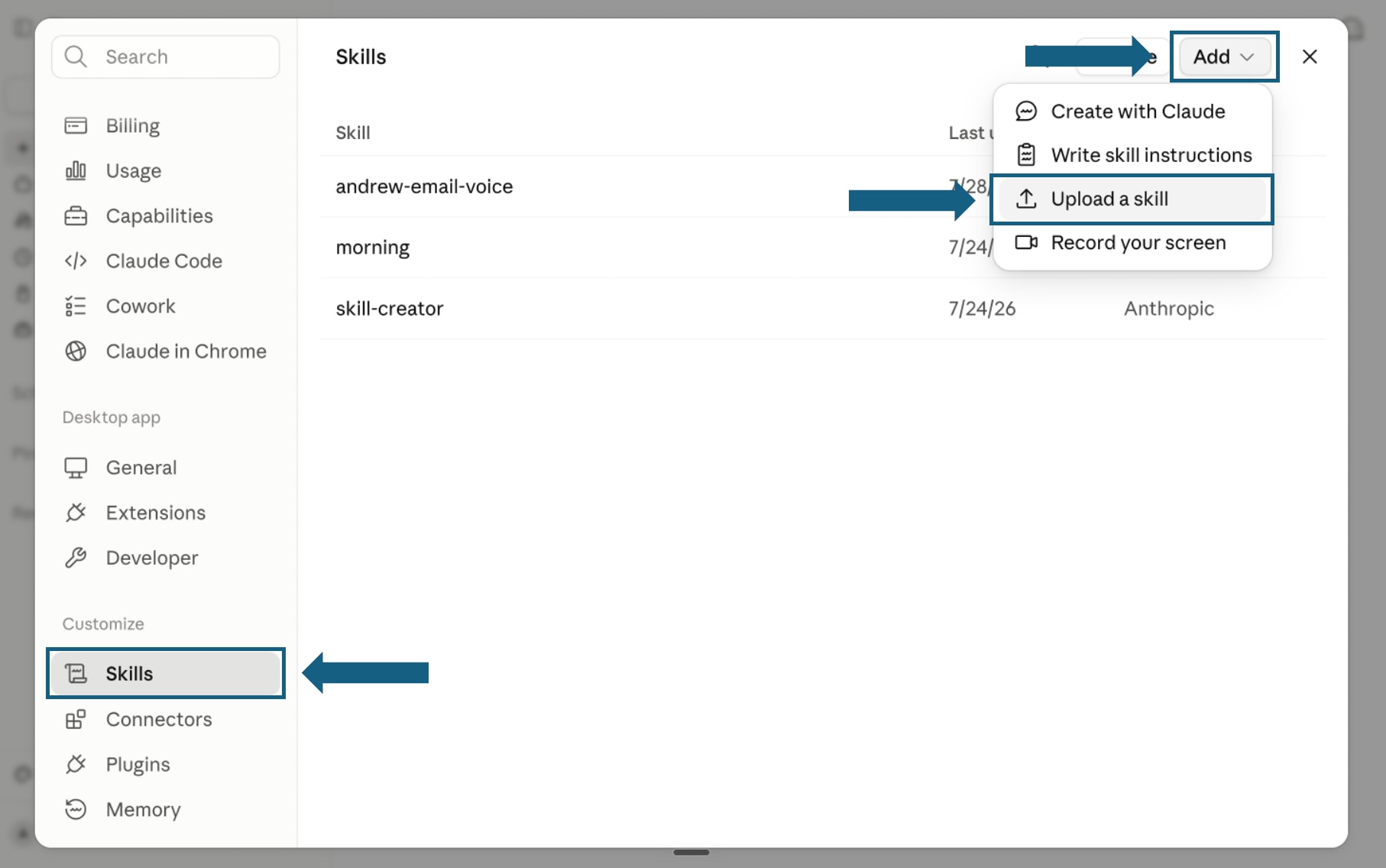
In Settings, select Skills under Customize. Open Add and choose Upload a skill.
Open the screenshot to view it full size. - Step 3
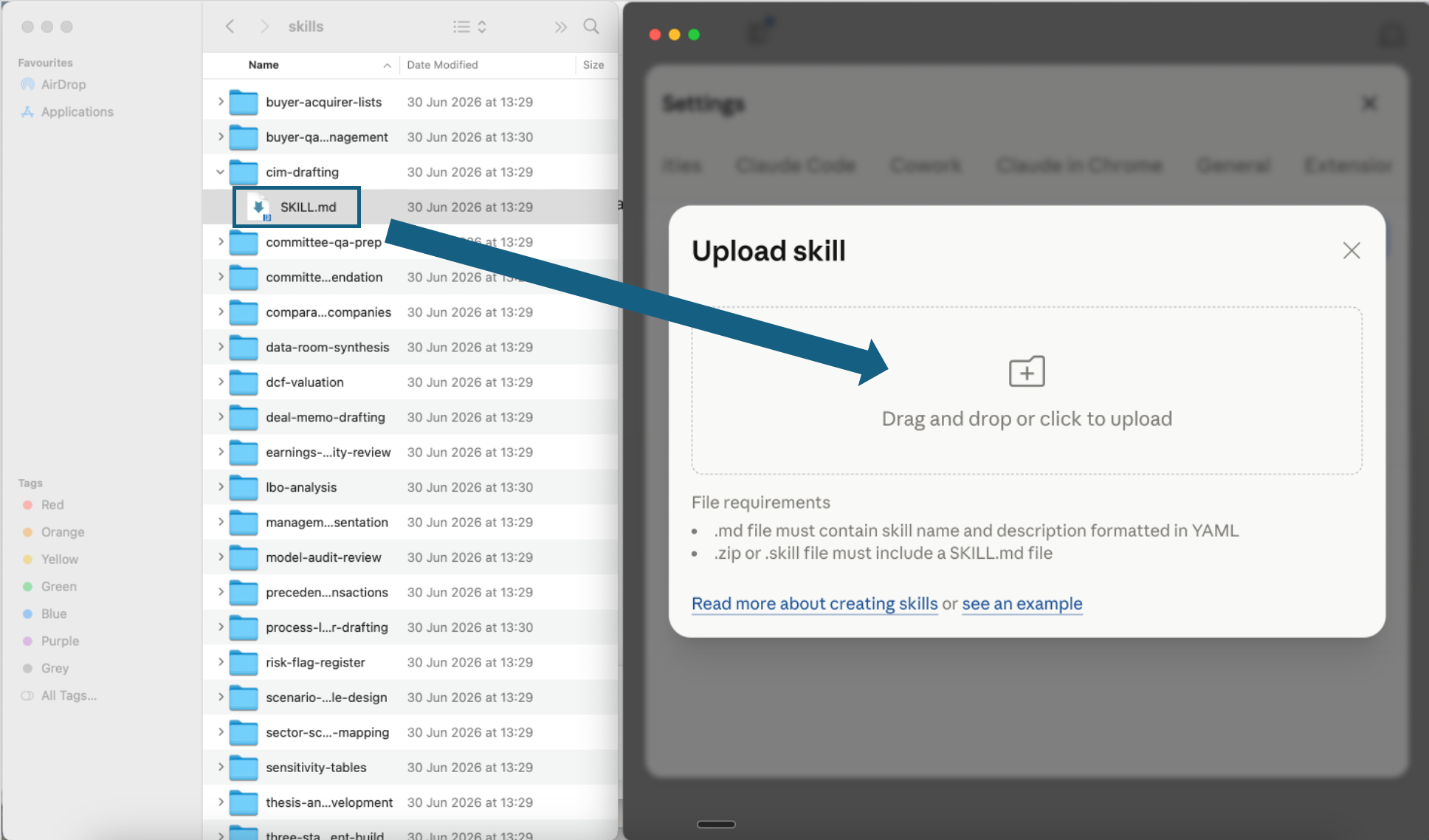
Upload one of the 12 skill files
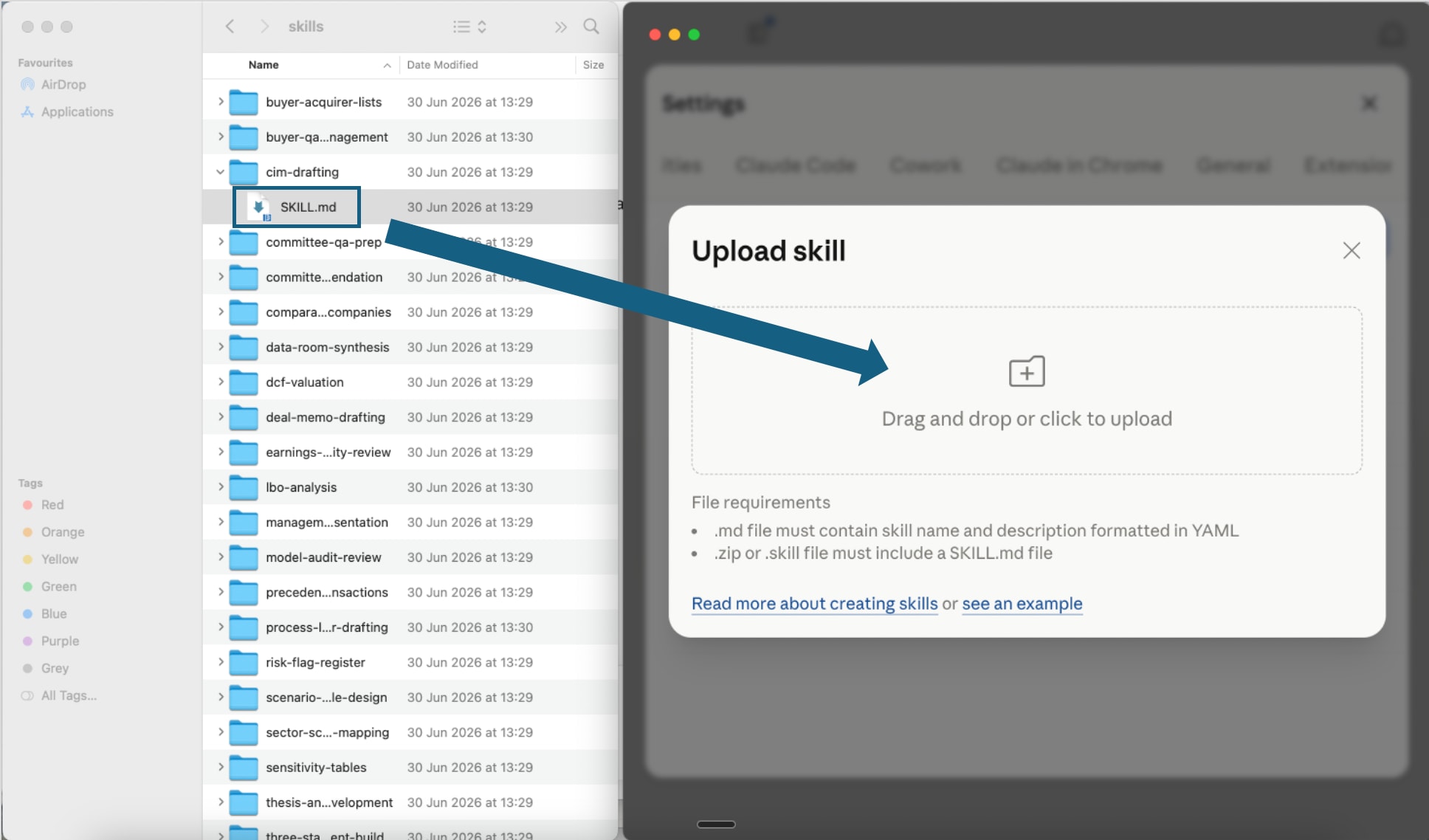
Open one extracted folder inside skills/ and drag its SKILL.md file into the upload window, or choose it with the file picker. Repeat for the finance skills you want. Do not upload MAIN-PROMPT.md, WORKFLOWS.md, or files under guides/ as Skills.
Open the screenshot to view it full size. - Step 4
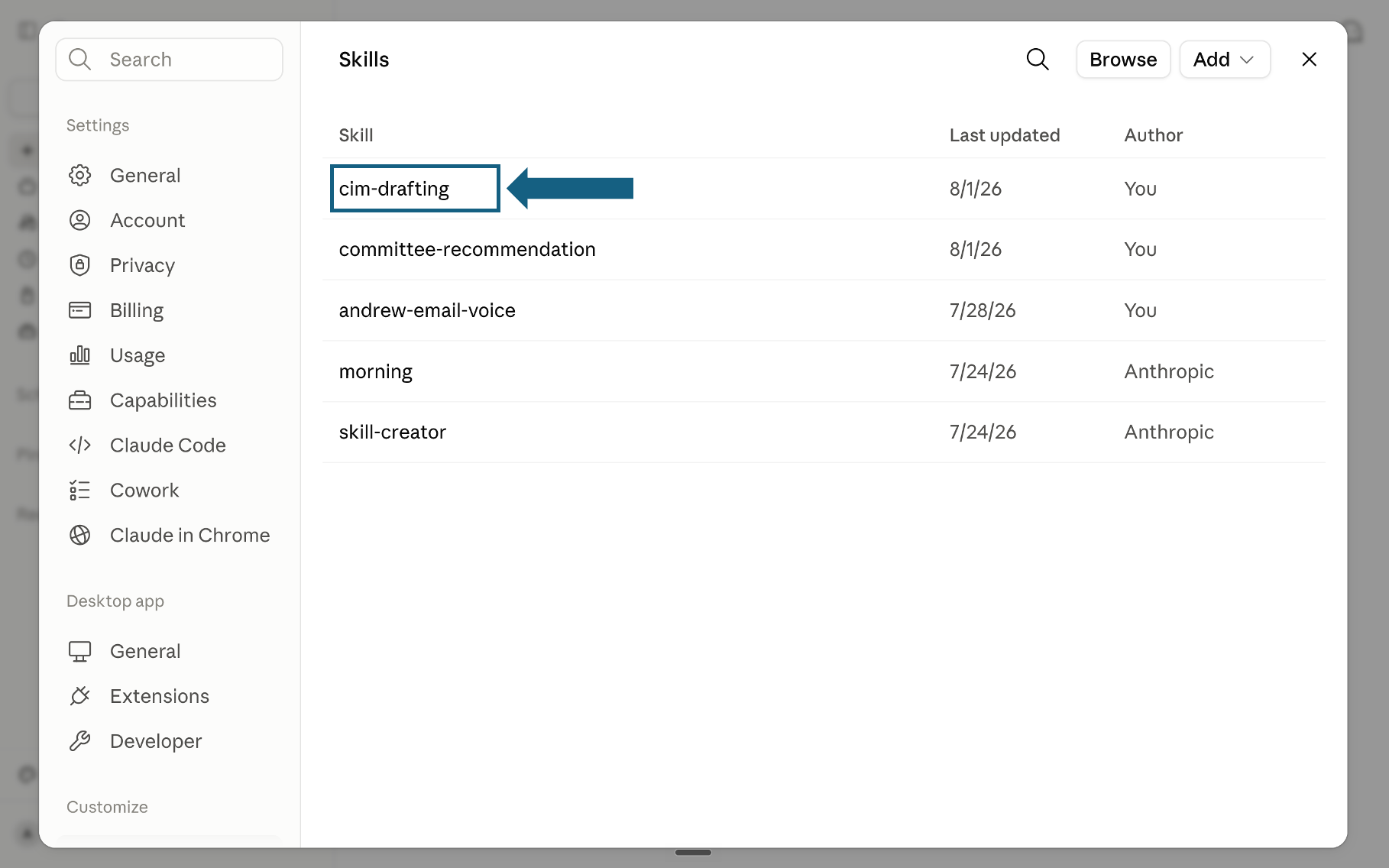
Confirm the finance skill was added
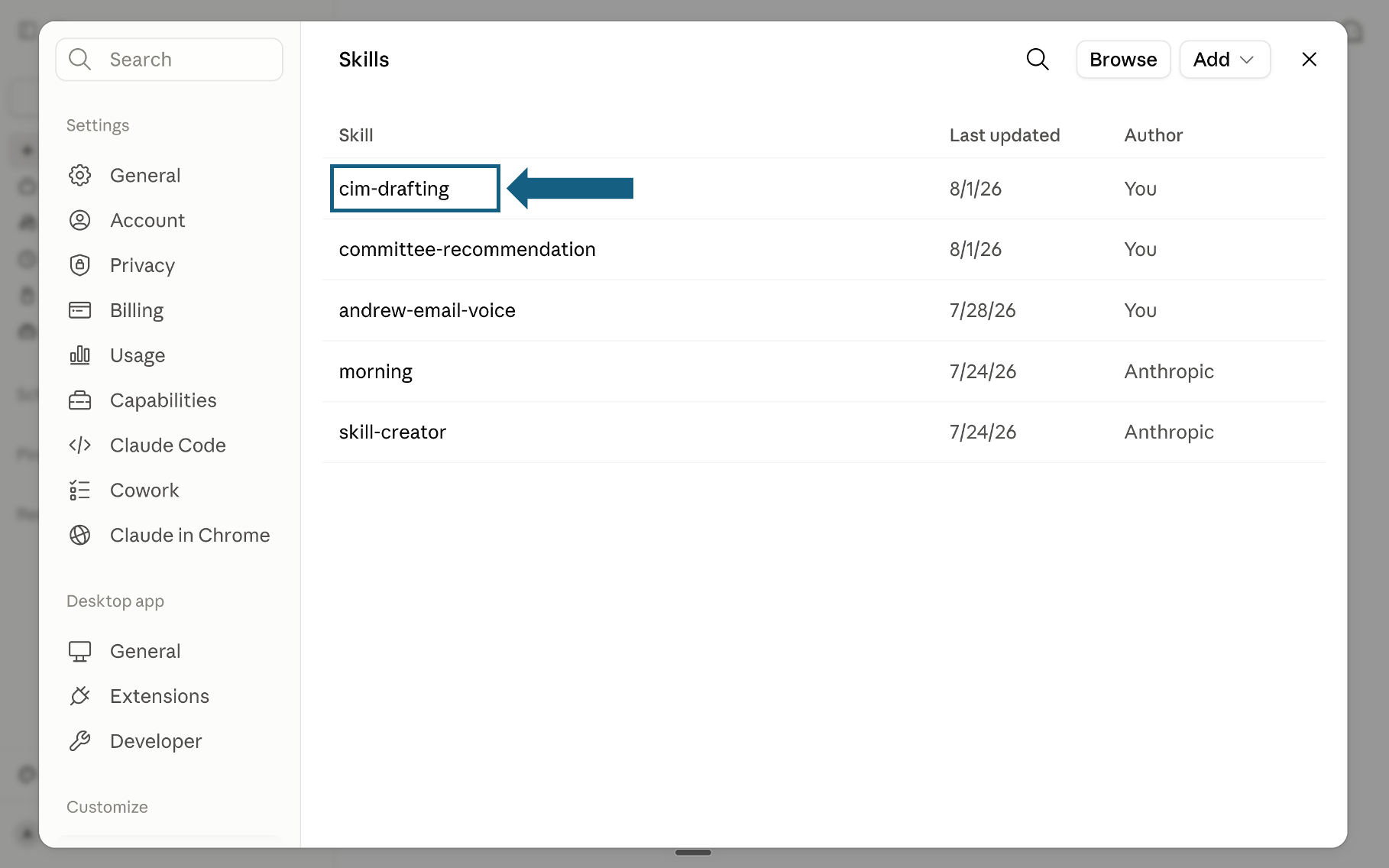
Return to the Skills list and check that the uploaded skill appears. Select its name to review the details.
Open the screenshot to view it full size. - Step 5
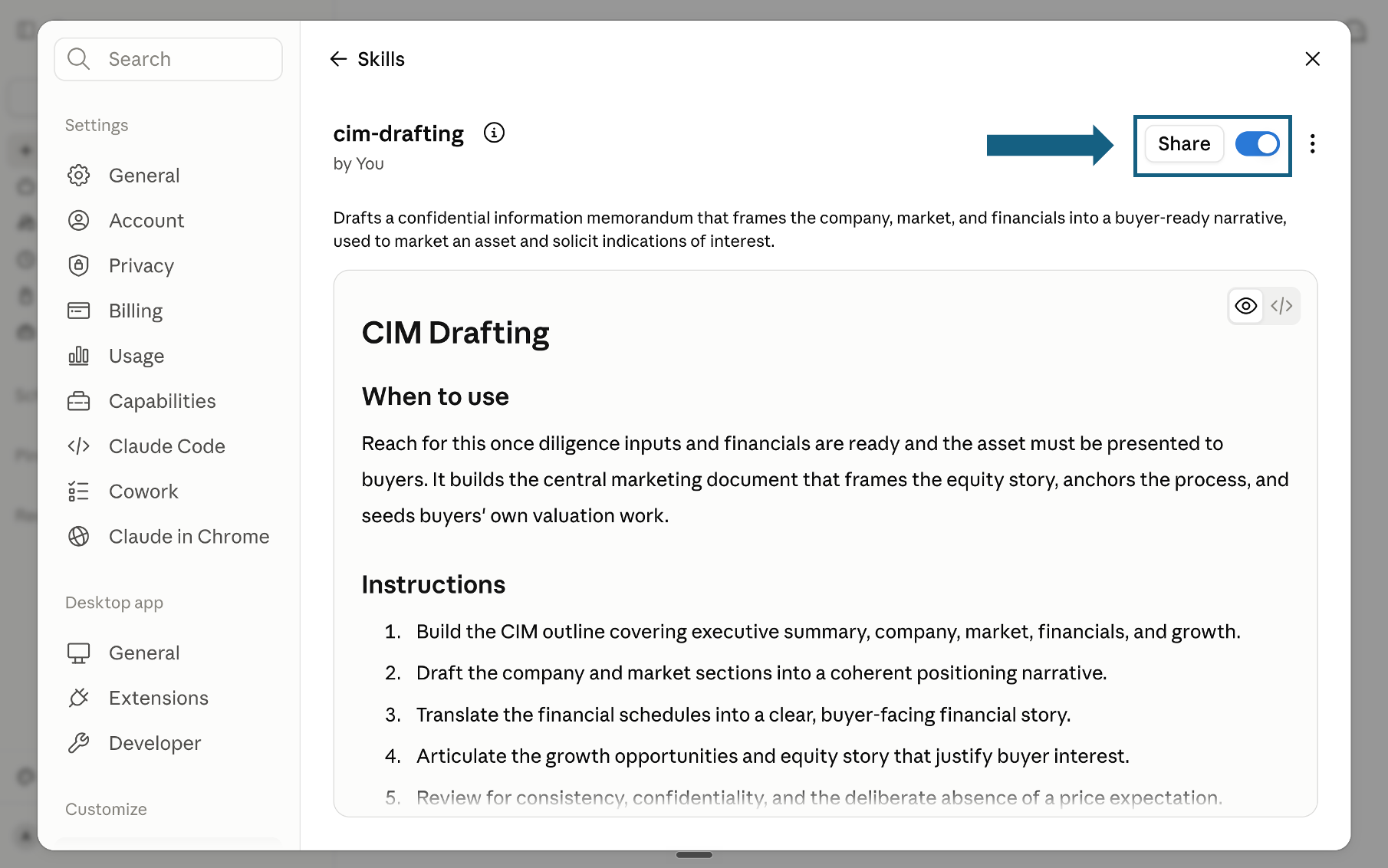
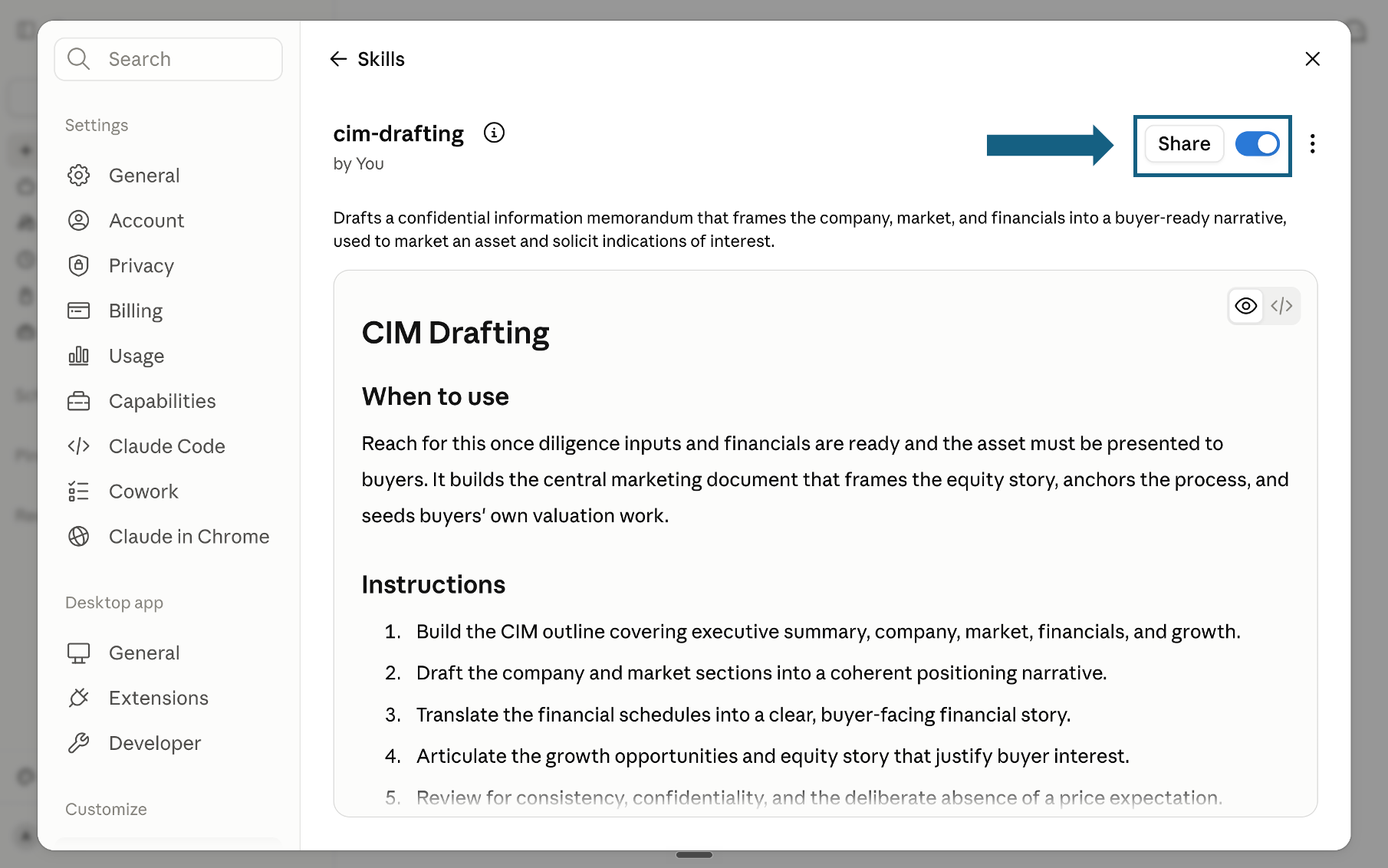
Review and turn on the skill
Review the skill's name, description, and instructions, then make sure the switch beside Share is on. A blue switch means the skill is turned on; sharing it is optional.
Open the screenshot to view it full size.
Use the support files correctly
Paste MAIN-PROMPT.md into a conversation when you want the senior finance co-pilot behavior. Use WORKFLOWS.md to choose a sequence of skills, and open the files under guides/ as walkthroughs and reference sheets. These support files remain separate from the 12 installed Skills.
Try a skill
Tell Claude which installed finance skill to use and provide the relevant files or context. Review every output before sharing it.
- "Use the dcf-valuation skill to value this business from the attached financials."
- "Use the variance-analysis skill to explain why we missed the quarter, with a price-volume-mix bridge."
- "Use the cfo-board-narrative skill to turn this into an answer-first story for Thursday's board."
From the analysis to the board deck with Oria
The pack ends its job at the analysis: the model, the valuation range, the variance bridge, the memo. Then it has to become slides a board will actually read, on your template, without a manual formatting pass. That is where Oria takes over.
Claude does the finance. The skills produce the model, the comps, the returns, and the narrative, with assumptions marked and numbers kept honest.
Oria makes the deck. Paste the output into Oria inside PowerPoint and it becomes a fully editable, on-brand slide in two to three minutes: a football-field chart, a variance bridge, a KPI exhibit, on your corporate template.
For the clean handoff from Claude to an editable slide, see how to use Claude for PowerPoint.
Frequently asked questions
What is in the Claude for Finance pack?
A single free zip with four things: one main prompt that turns Claude into a senior finance co-pilot, 12 skills (each a named method for one finance job, from a three-statement model to a board narrative), 12 guides (walkthroughs and reference sheets), and a workflows file that chains the skills into end-to-end plays like valuation, diligence, and the monthly close.
How do I install these Claude finance skills?
Download and unzip the pack, then add each desired SKILL.md file through Claude Settings, Skills, Add, and Upload a skill. Paste MAIN-PROMPT.md into a conversation when you want the finance co-pilot behavior. WORKFLOWS.md and the 12 guides are reference files, not uploadable Skills.
Will Claude make up numbers?
The main prompt and every skill are written to stop exactly that. Claude is instructed to separate assumptions from confirmed figures, to state ranges rather than false precision, and to ask for missing inputs instead of inventing them. The avoid-hallucinated-numbers guide adds a verification routine. You still own the review; the pack makes the output checkable.
Does this replace a finance team or a model?
No. It removes the assembly work: the first-draft model, the comps set, the variance bridge, the memo, the board narrative. The judgment, the review, and the final numbers stay with your team. The pack exists so that work happens in hours instead of days, with a consistent method every time.
How does this connect to Oria?
Claude and these skills do the analysis. Oria does the slides. When the model, the valuation, or the board narrative is ready, paste it into Oria inside PowerPoint and it becomes a fully editable, on-brand slide in two to three minutes, on your corporate template, instead of a manual formatting pass. The analysis and the deck stop being two separate jobs.