

Business Case Template: The Five-Question Structure
The five questions every business case template needs to answer, what belongs in each one, the mistakes that sink a business case at review, and a working template plus the prompts to build it fast.
How to build a business case template
A business case template should answer five questions, each carried by its own case: the strategic case (is this the right thing to do), the economic case (does the preferred option maximize value), the commercial case (is the deal deliverable), the financial case (can we afford it), and the management case (can we deliver it well). State the recommendation up front, name a single sponsor, and put a number on every cost and a date on every milestone.
This guide walks each of the five cases, the mistakes that make a business case easy to reject, a working template you can copy, and the prompts that build it fast, both to draft the content and to render the slides. Everything you need is here.
What a business case template is and when to use it
A business case is the document that turns a proposal into a funded, approved investment. It states what is being asked for, which option was chosen and why, what it costs, and who is accountable for delivering it. Once a sponsor or investment committee approves it, the business case becomes the reference the delivery team is held against.
Use the five-question structure for any investment decision that needs to survive scrutiny beyond a single sentence of justification: a technology purchase, a restructuring programme, a new market entry, or a capital project. It sits alongside an executive summary slide at the front of the pack, carrying the same recommendation in one paragraph before the detail behind it.
The five-question structure of a business case template
Five cases carry a business case template from rationale to an approvable plan, in order. Get the order right and a sponsor can read the first two sections and still know what they are being asked to approve.
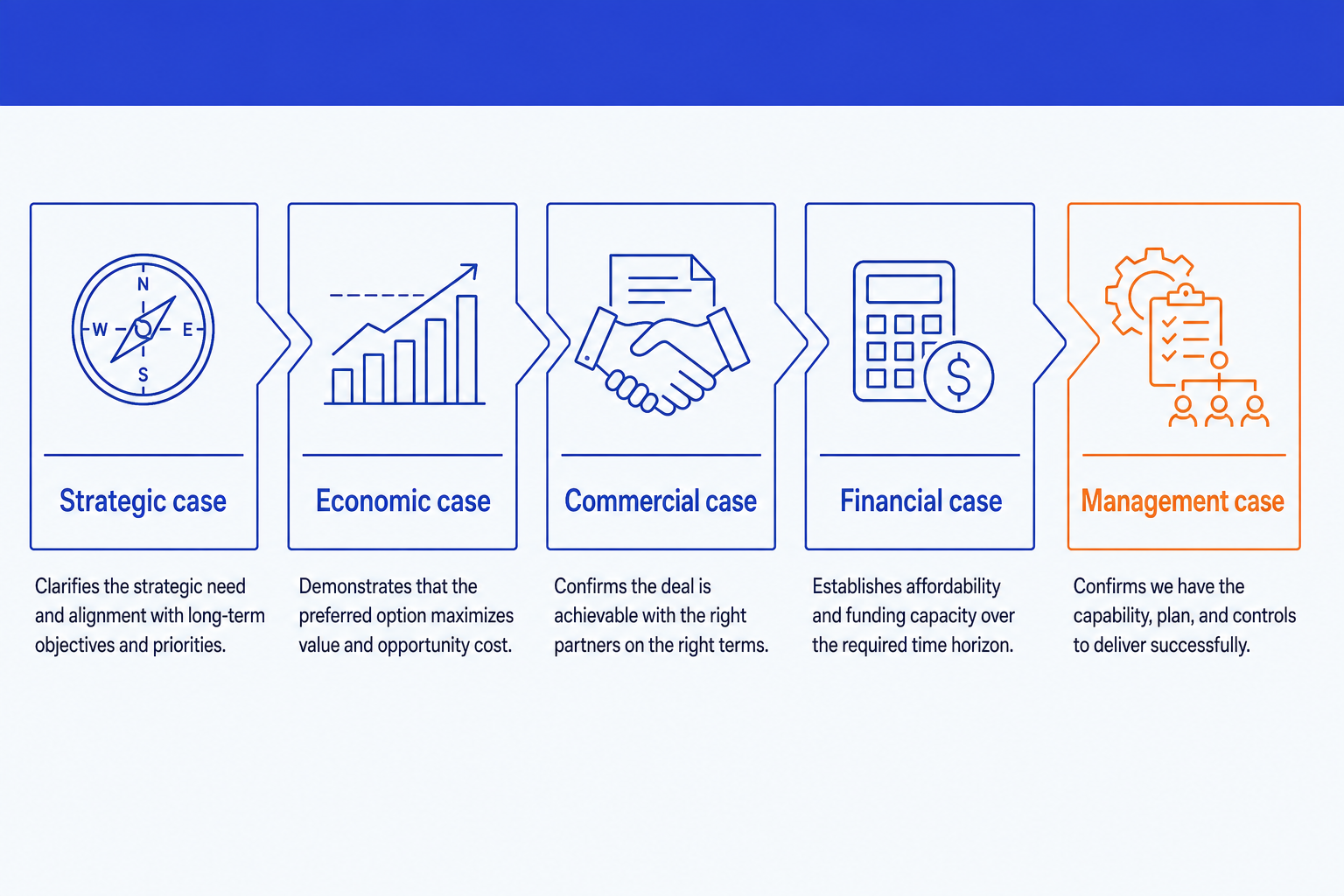
1. Strategic case. The strategic objective or mandate this investment supports, in one sentence.
2. Economic case. The shortlist of realistic options considered, including a do-minimum baseline.
3. Commercial case. The proposed delivery route: build, buy, partner, or deliver in-house.
4. Financial case. The total cost of the preferred option, upfront and ongoing.
5. Management case. The governance and the named owner accountable for delivery.
What goes in each case: the contents checklist
Use this as a build checklist. For each of the five cases, confirm the three items below are present before the business case goes to the sponsor or the investment committee. If one is missing, that is usually the gap someone challenges at review.
Strategic case
Economic case
Commercial case
Financial case
Management case
For the management case specifically, our board pack structure and template covers how governance and delivery tracking should look once the case moves into ongoing reporting.
Common mistakes to avoid
Most of these come down to one habit: writing the business case to defend a decision already made instead of a document that genuinely tests the option against alternatives and against doing nothing. Name an owner and a number for everything that matters.
The one-prompt route: turn your business case into slides
Formatting an options grid, a financial summary, and a delivery timeline by hand, on a strict corporate template, is exactly the kind of mechanical work that slows a business case down before it even reaches review. Oria removes it. It is an AI add-in that runs in the PowerPoint task pane and produces fully editable native PowerPoint elements in your template. You describe each block in a line and Oria renders it.
Because the output is native, every number, column, and date stays editable afterward. You can update a cost line, swap a milestone, or rename the recommended option the night before the investment committee meets, without rebuilding the slide.
One-line strategic case slide prompt for Oria
The prompts that build the five-question business case
These are the exact copy-paste prompts we use to build each of the five cases and to draft the content behind them. The first four are for Oria inside PowerPoint; the last two are for drafting content in Claude before you build. Replace the bracketed parts with your own project details.
Build the slides in Oria
Build the economic case options grid
Build the commercial case slide
Build the financial case slide
Build the management case slide
Draft the content in Claude first
Turn stakeholder notes into the strategic and economic case
Draft the financial and management case from a budget note
Tip
Draft the strategic and economic case in Claude first, then hand the clean lines straight to Oria. For the wider method from framing to a finished deck, our 21 strategy skills for Claude include prompts built for exactly this kind of framing work.
A working business case template you can copy
Seven blocks cover a routine business case on two to four pages. Copy this order, then size each block to how much the investment actually needs to say.
Cover band. Project name, sponsor, and version or date, nothing else.
Executive summary. One paragraph stating the recommendation, up front, before any of the five cases.
Strategic case block. The objective this supports and the cost of doing nothing.
Economic case block. The options considered, the evaluation criteria, and the recommended option.
Commercial case block. The delivery route and the evidence it is achievable.
Financial case block. Total cost, funding source, and the affordability check over time.
Management case block. Governance, delivery plan, and how risk and benefits will be tracked.
A larger investment, spanning multiple business units or requiring external procurement, may need a short appendix behind these seven blocks, but the core five-question structure above stays the same regardless of the investment's size.
Frequently asked questions
What is the five-question business case structure?
It is a business case built around five questions, each answered by its own case: the strategic case (is this the right thing to do), the economic case (does the preferred option maximize value), the commercial case (is the deal deliverable in the market), the financial case (can we afford it), and the management case (can we deliver it well). Together, the five cases carry a proposal from rationale to an approvable plan.
What is the difference between the economic case and the financial case?
The economic case compares options on cost, benefit, risk, and strategic fit, and recommends the one that delivers the most value. The financial case takes that recommended option and answers a narrower question: can the organization actually afford it, given the budget available and the funding it competes against. One is about which option is best. The other is about whether the best option is affordable.
Who should own a business case?
A single sponsor should own the business case and be named across all five sections, especially the management case, where they hold delivery accountability. On larger investments, a steering group reviews the case alongside the sponsor, but the approval decision and the accountability for benefits realization sit with one named person, not a committee.
How long should a business case be?
Most business cases run two to four pages when each of the five cases is kept tight: a paragraph or a short grid per section, not a full narrative. Larger, higher-risk investments can run longer, but the discipline of the five-question structure is what keeps even a long business case readable, because every section answers one specific question and nothing else.
Where does the five-case model come from?
The five-case structure was originally developed for large-scale public-sector business cases, where every major investment has to answer the same five questions before it gets funded. Corporate and consulting teams have since adapted the same structure for internal investment decisions, because it forces a proposal to justify itself on strategy, value, deliverability, cost, and execution, rather than on cost alone.