

12 Claude Skills for Cost Cutting
12 standalone Claude skills for cost reduction work. Spend diagnosis, procurement, workforce, process waste, overhead, and savings governance. Built for strategy consultants and corporate finance teams running structured cost programs.
Claude skills for cost cutting
12 standalone Claude skills covering the full cost-cutting engagement workflow. Each skill is a small, uploadable file that teaches Claude how to run one high-value cost-reduction task with a repeatable, named method.
The skills are grouped into six workstreams: diagnose the spend base, extract value through sourcing, reduce workforce overhead, eliminate process waste, rationalize overhead budgets, and track realized savings. Use them in sequence on a full program or pull individual skills for a specific workstream.
Each skill is one folder with a SKILL.md file. Upload the file through Claude's Skills settings, then name the skill in your prompt whenever you want Claude to apply its method.
Download all 12 skills
One zip, one folder per skill. Free, no signup.
The 12 skills you get
The collection follows the order of a real cost-cutting engagement: understand the cost base first, then pull the levers in order of speed and impact. Every skill is also useful on its own for targeted workstream work.
The cost-cutting workflow
Domain 1 · 2 skills
Spend Diagnosis
Start here. These two skills build the fact base before any lever is pulled. The baseline tells you where money goes; the driver analysis tells you why costs moved.
Spend Baseline
Use when: You need a categorized view of the cost base before choosing interventions
Output: MECE spend breakdown, top vendors by category, YoY movement, anomaly register
Cost Driver Analysis
Use when: Total cost has moved and you need to separate volume, rate, and mix effects
Output: PVM decomposition, dominant driver, intervention map, sensitivity estimate
Domain 2 · 3 skills
Procurement and Sourcing
Three skills for extracting value from vendor relationships. Consolidation finds fragmentation; the RFP scope builder structures the tender; the leakage audit recovers what is already owed.
Spend Consolidation
Use when: The vendor base is fragmented or multiple BUs buy the same category separately
Output: Consolidation opportunity register, quick-win list, recommended sourcing path
RFP Scope Builder
Use when: A consolidation or renewal decision is made and the team needs a tender document
Output: Draft RFP with scope, commercial requirements, technical criteria, and evaluation weighting
Contract Leakage Audit
Use when: You suspect vendors are billing above contracted rates or rebates have not been claimed
Output: Leakage register, recovery estimate, immediate claim actions
Domain 3 · 2 skills
Workforce and Org Efficiency
Two diagnostic skills for workforce cost. Layer analysis finds structural redundancy; the benchmark mapper checks whether absolute headcount levels are defensible against peers.
Org Layer Analysis
Use when: The hypothesis is too many management layers or narrow supervisory spans
Output: Layer-by-span diagnostic, narrow-span register, restructuring cost estimate
FTE Benchmark Mapper
Use when: You need an external view of whether specific functions are overstaffed
Output: Function-by-function benchmark comparison, gap analysis, reduction potential
Domain 4 · 2 skills
Process and Operations
Two skills for operational cost reduction. The waste scan finds non-value-adding steps inside a process; make-vs-buy compares the total cost of internal delivery against an outsourced alternative.
Process Waste Scan
Use when: A process is described and the hypothesis is that it contains rework, waiting, or unnecessary steps
Output: Step classification (VA/NNVA/NVA), waste type register, FTE-hours of waste, top 3 elimination actions
Make vs Buy Analyzer
Use when: The team is evaluating whether to outsource an internal function or insource an outsourced one
Output: TCO comparison, 5-year NPV, qualitative risk assessment, recommendation
Domain 5 · 2 skills
Overhead and SG&A
Two skills for overhead cost. The rate audit challenges discretionary spend line by line and flags fixed cost renegotiation windows. The zero-based budget builder forces every cost center line to earn its place.
Overhead Rate Audit
Use when: SG&A has grown incrementally and the team needs a structured line-item challenge
Output: Discretionary audit, fixed-cost renegotiation flags, allocation accuracy review, reduction plan
Zero-Based Budget Builder
Use when: A cost center needs to re-justify every spend line from first principles against a saving target
Output: ZBB line-item review, Level 1/2/3 totals, saving versus prior year, justification sentences
Domain 6 · 1 skill
Savings Governance
One skill that ties the program together. The savings tracker creates the register that leadership reviews each week, flags at-risk initiatives before they slip, and shows cumulative progress against target.
Savings Tracker
Use when: A multi-workstream program needs a single view of committed, in-progress, and realized savings
Output: Initiative register, workstream summary, at-risk register, 30-day priority actions
Setup Guide
- Step 1Download all 12 skills (.zip)
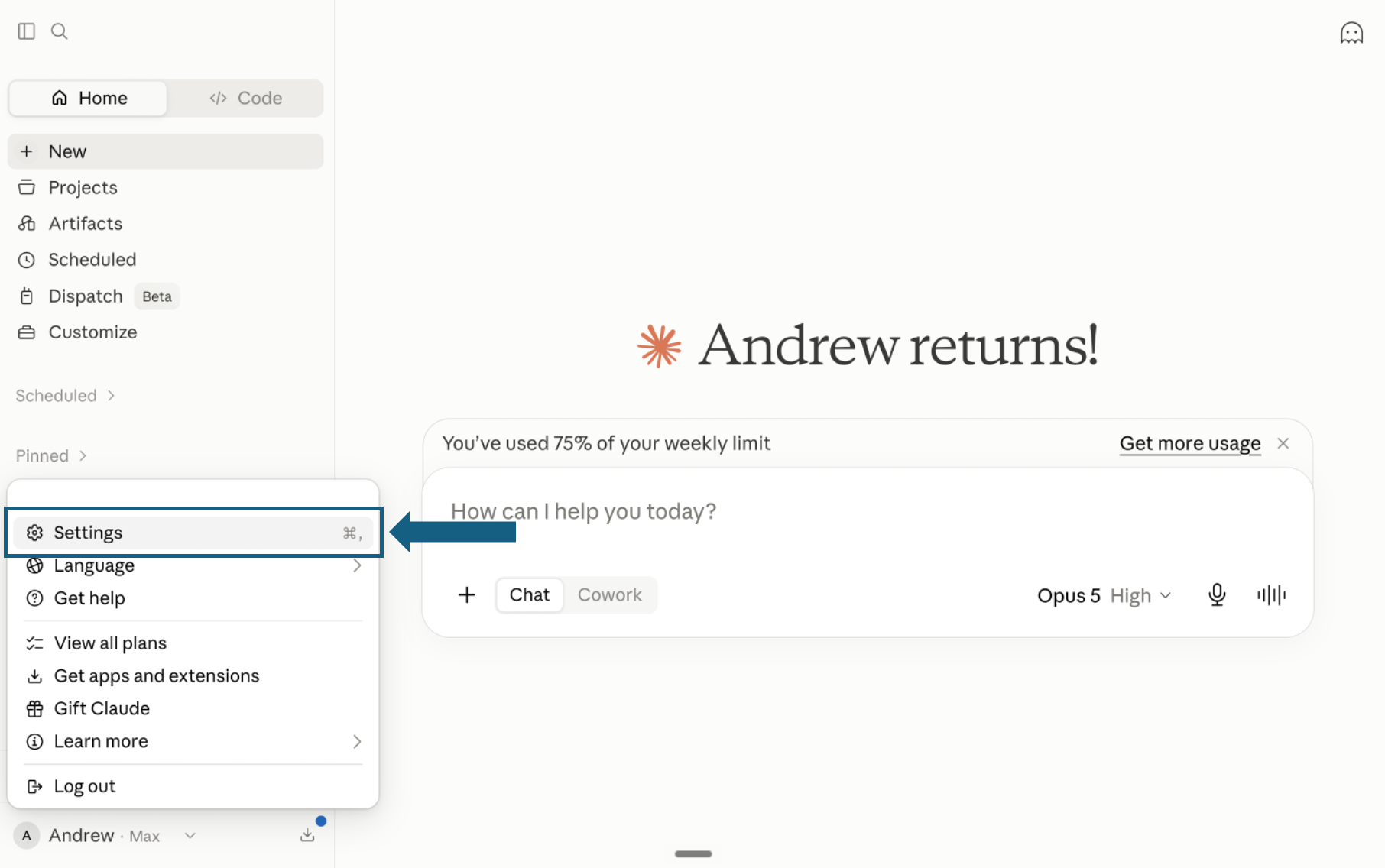
Download the pack and open Settings
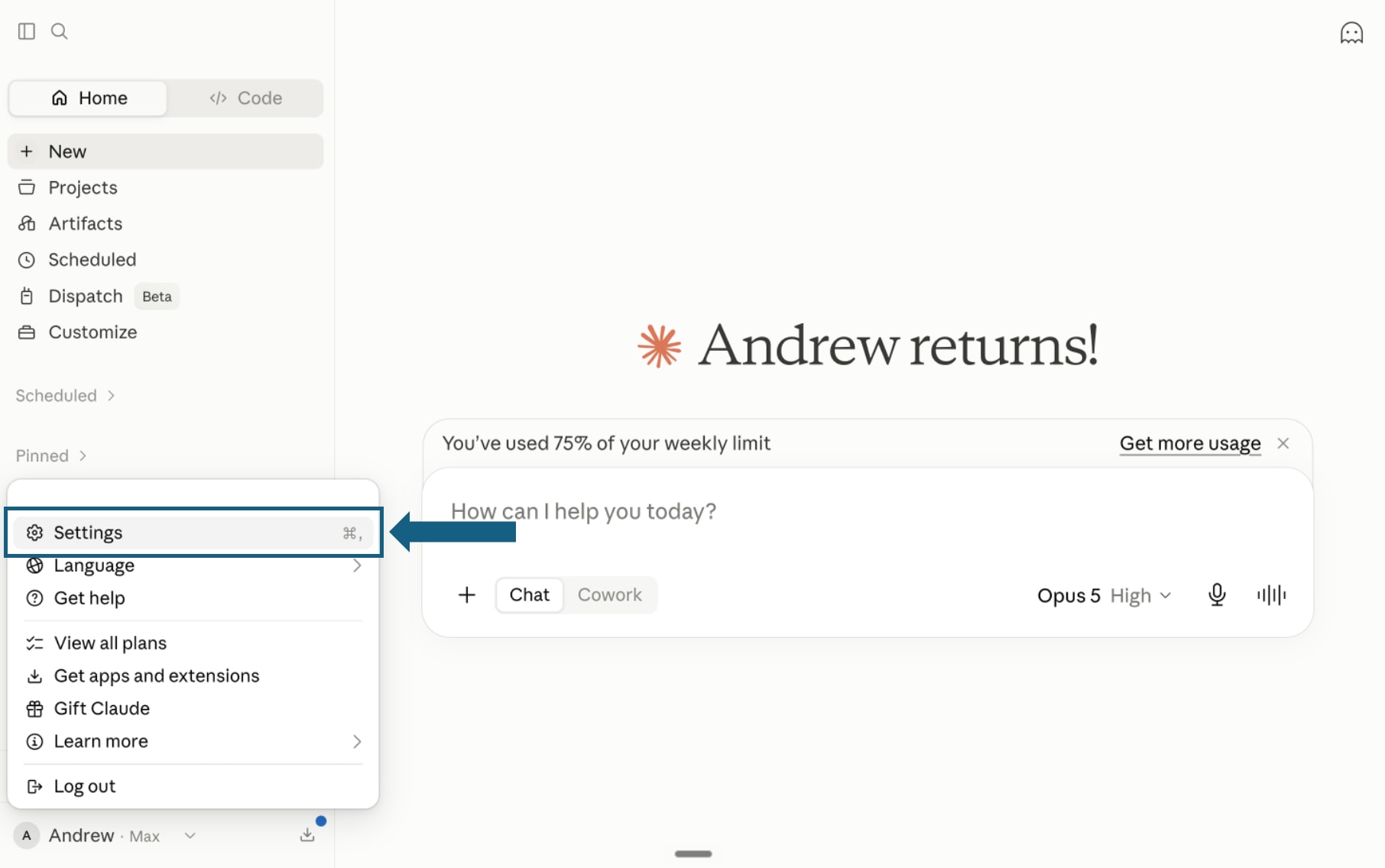
Download the pack and unzip it so each skill remains in its own folder with its SKILL.md file. In Claude, open your profile menu and select Settings.
Open the screenshot to view it full size. - Step 2
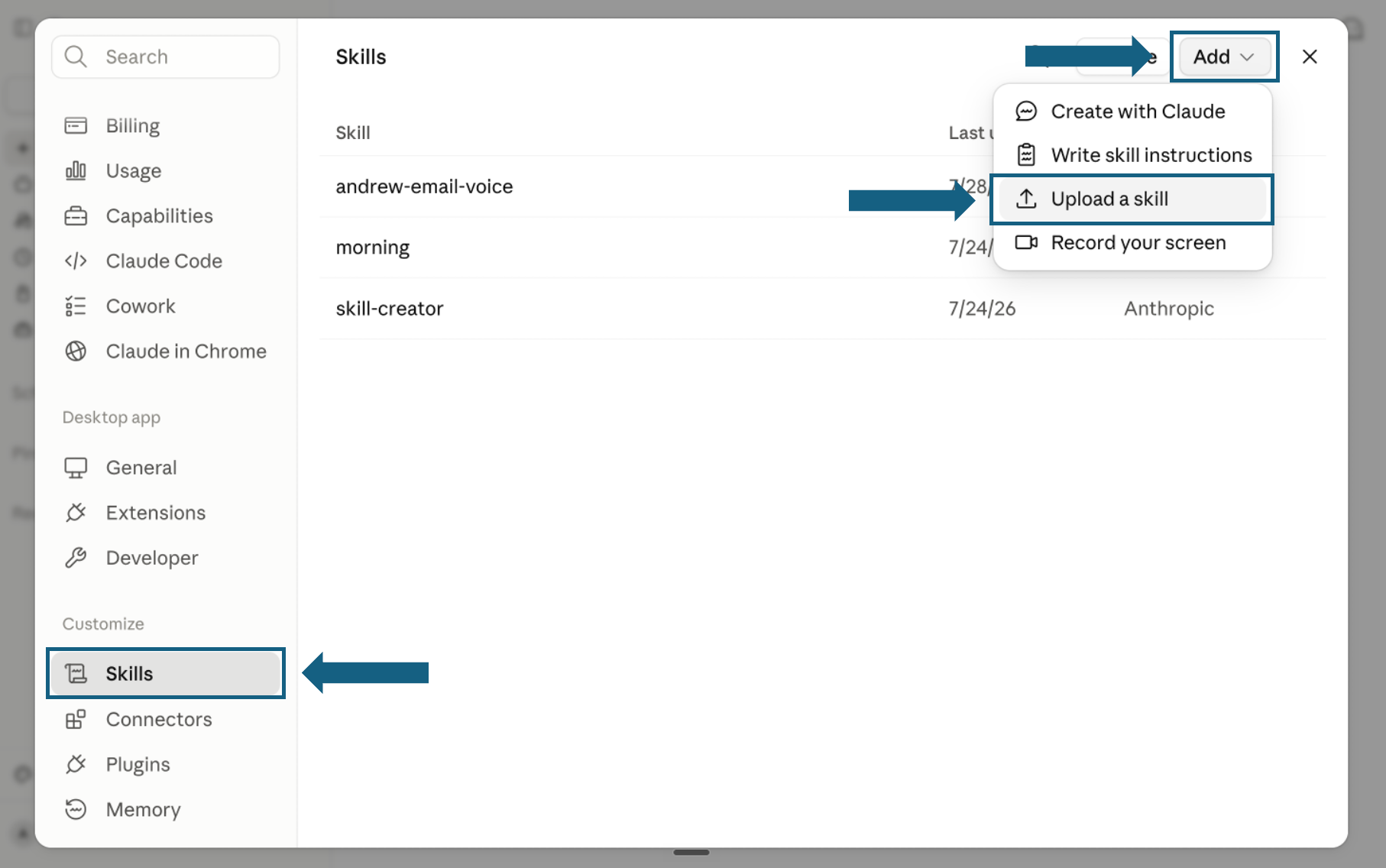
Open Skills and start an upload
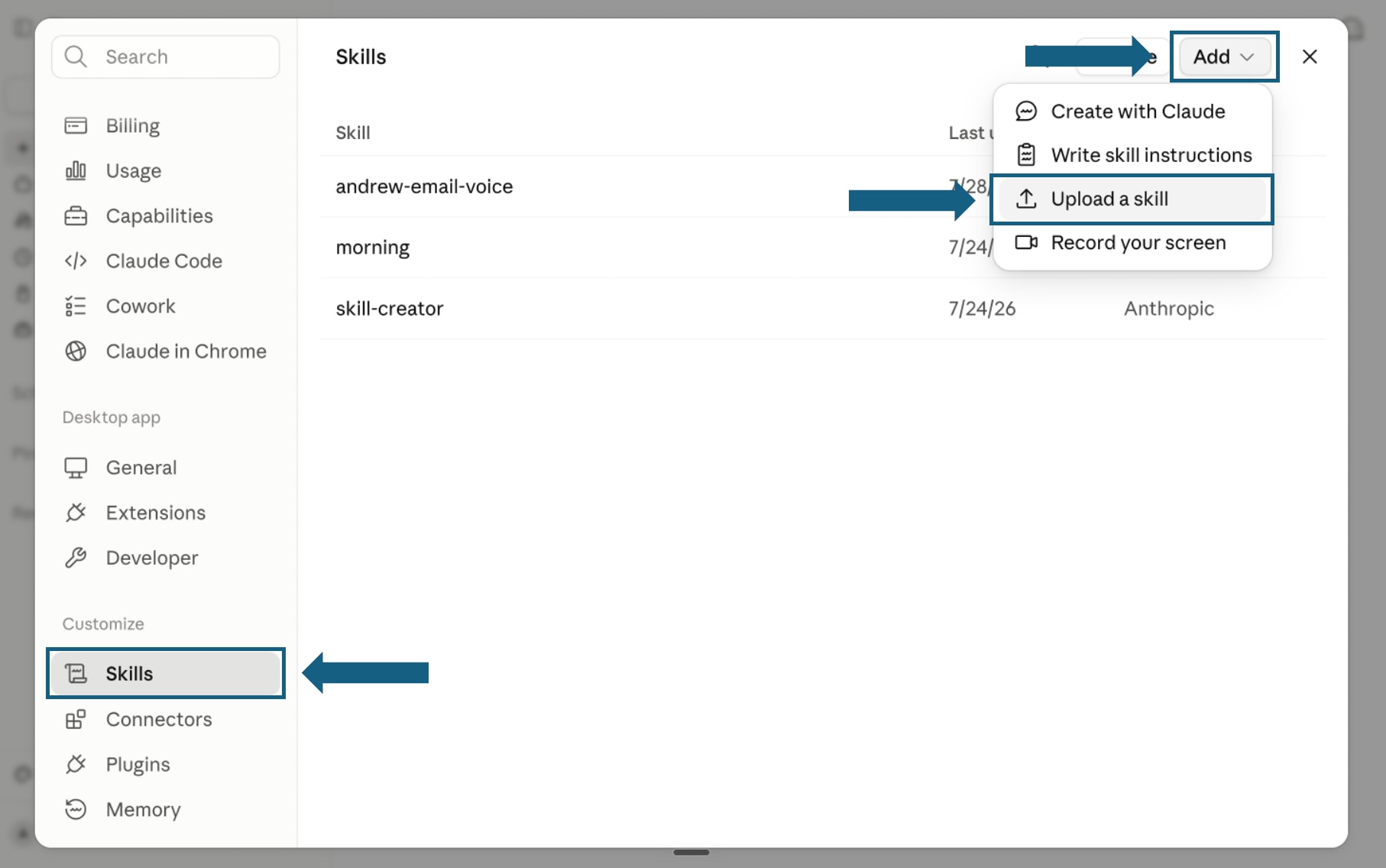
In Settings, select Skills under Customize. Open Add and choose Upload a skill.
Open the screenshot to view it full size. - Step 3
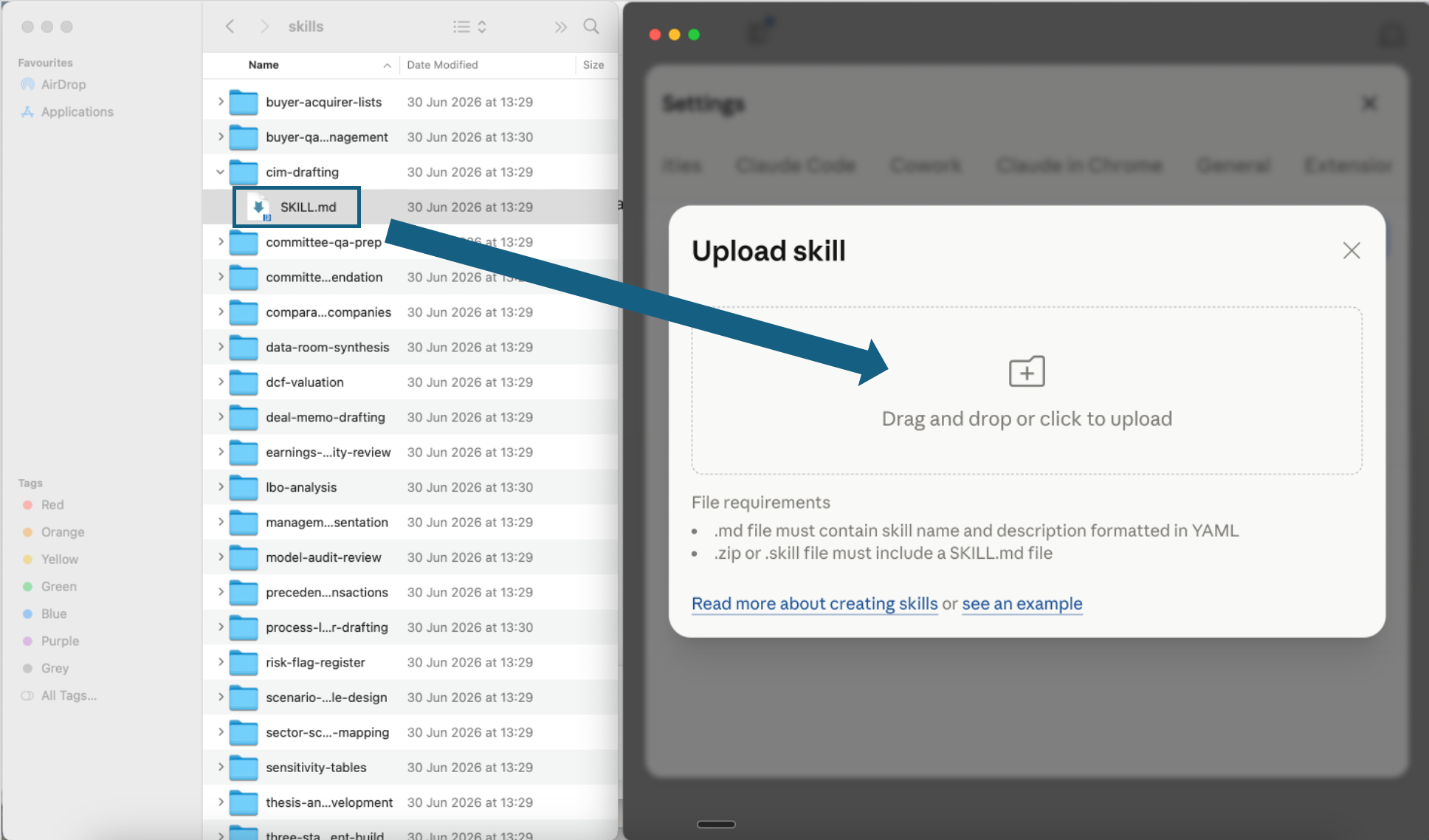
Upload one skill file
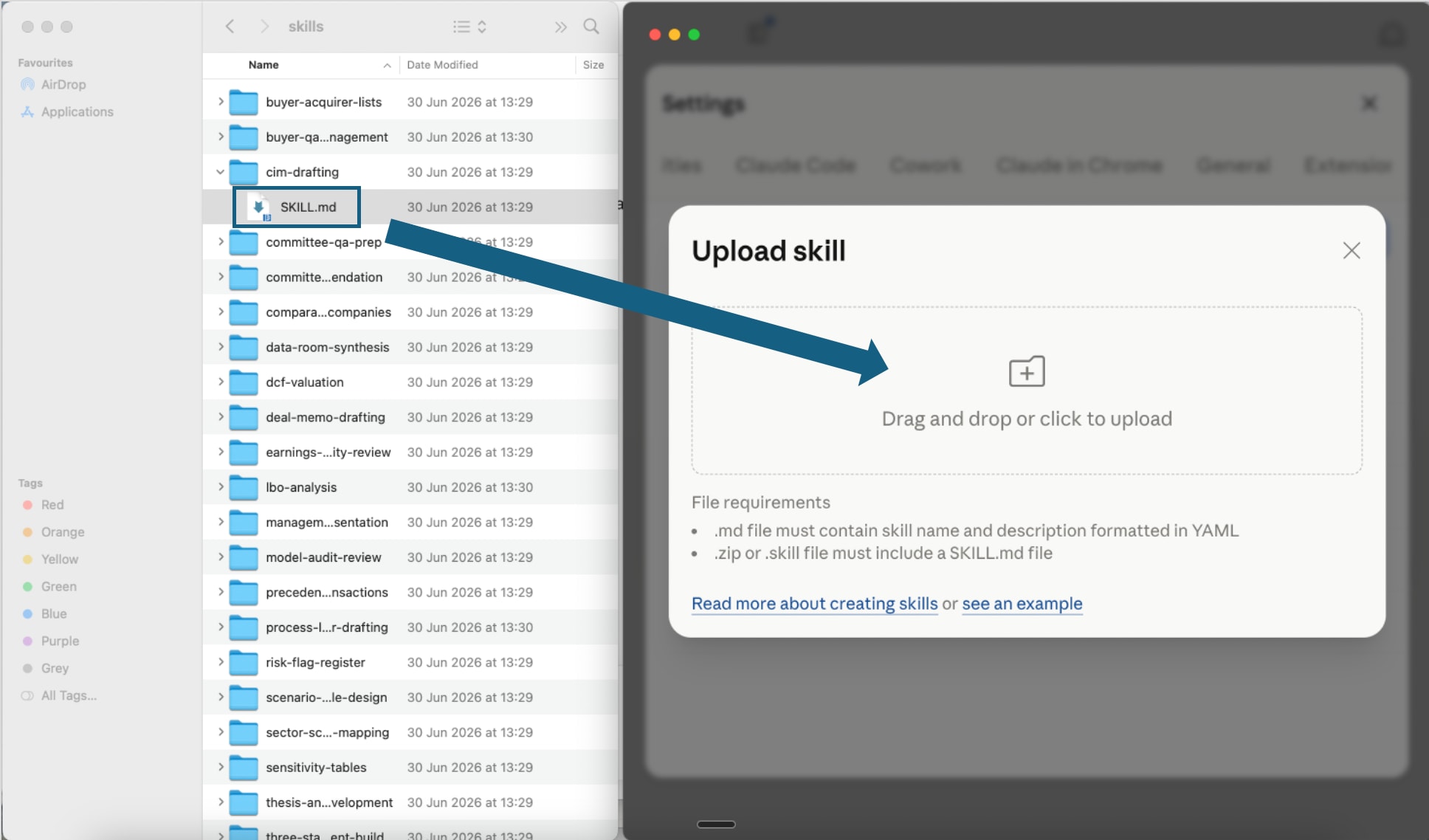
Open one extracted skill folder and drag its SKILL.md file into the upload window, or click the upload area to choose it. Repeat this step for each skill you want to add.
Open the screenshot to view it full size. - Step 4
Confirm the skill was added
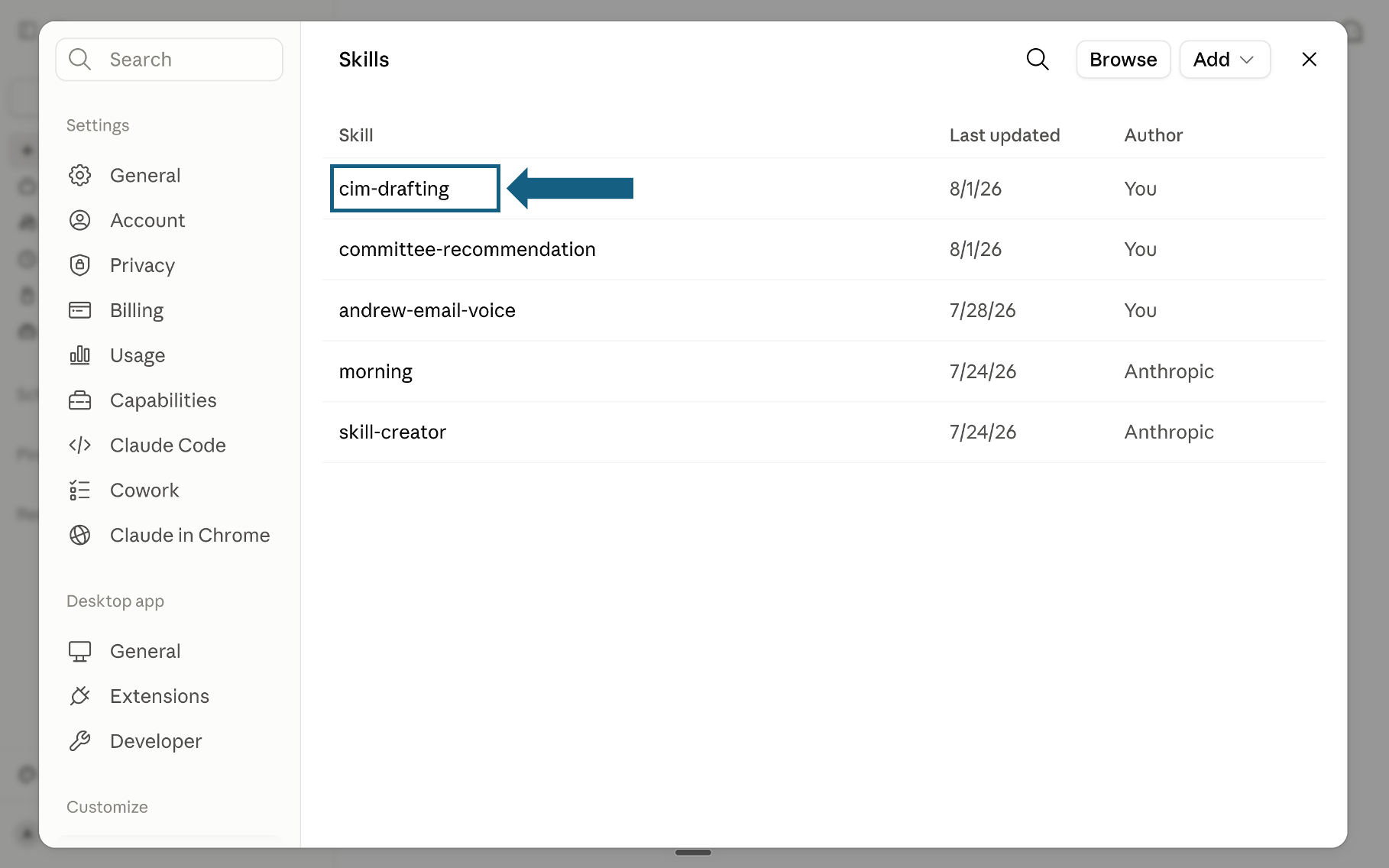
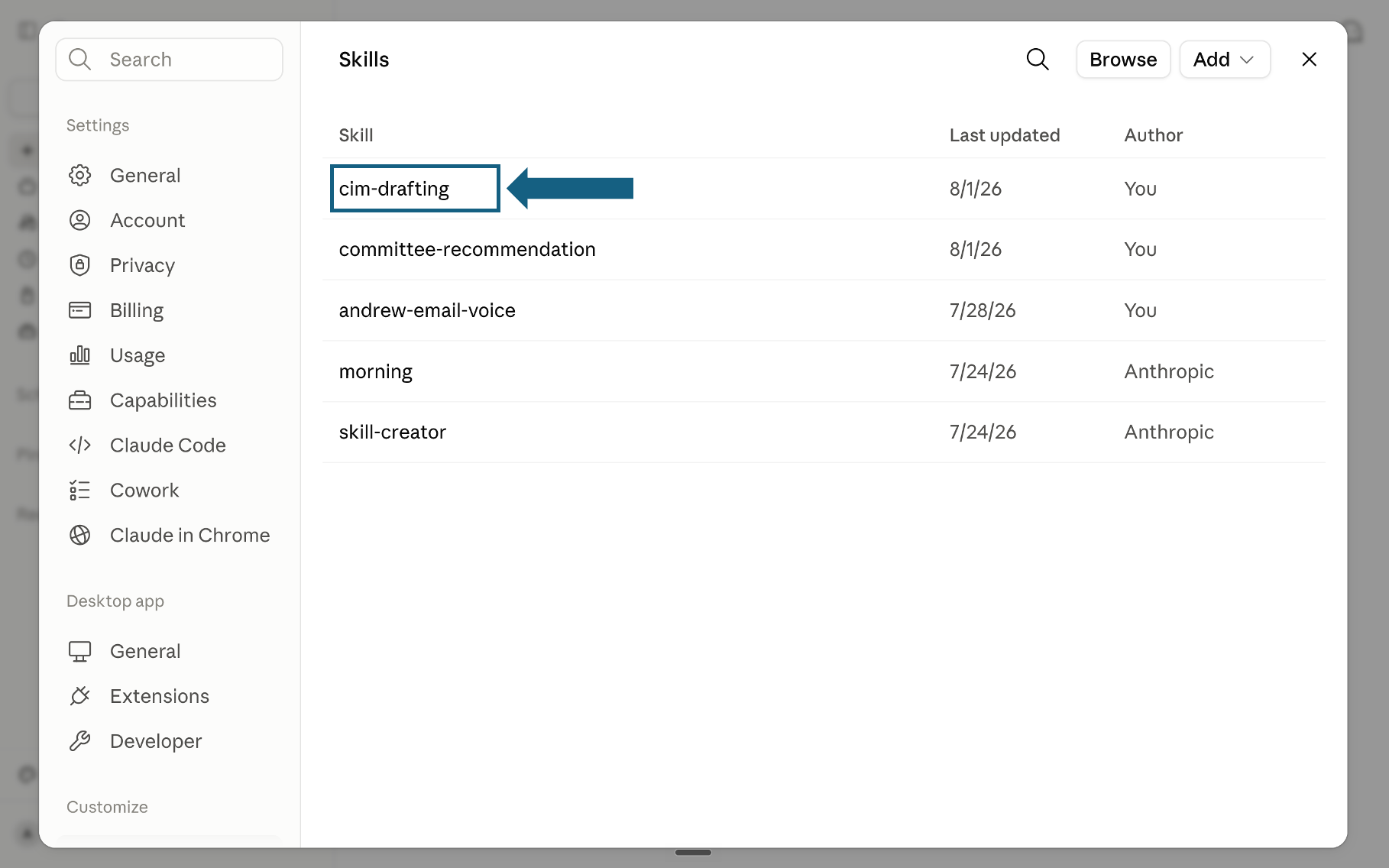
Return to the Skills list and check that the skill appears. Select its name to open it.
Open the screenshot to view it full size. - Step 5
Review and turn on the skill
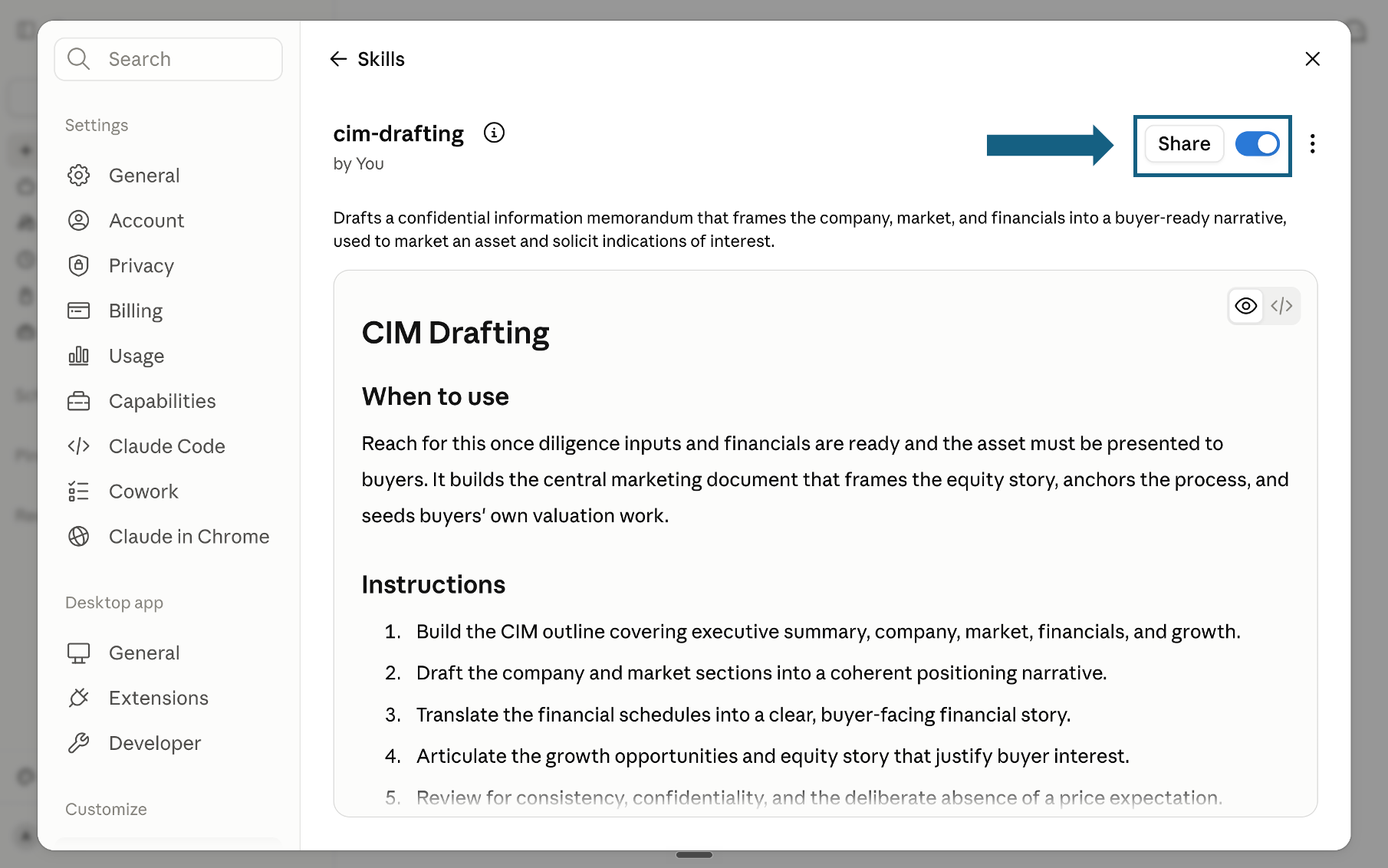
Review the skill's name, description, and instructions, then make sure the switch beside Share is on. A blue switch means the skill is turned on; sharing it is optional.
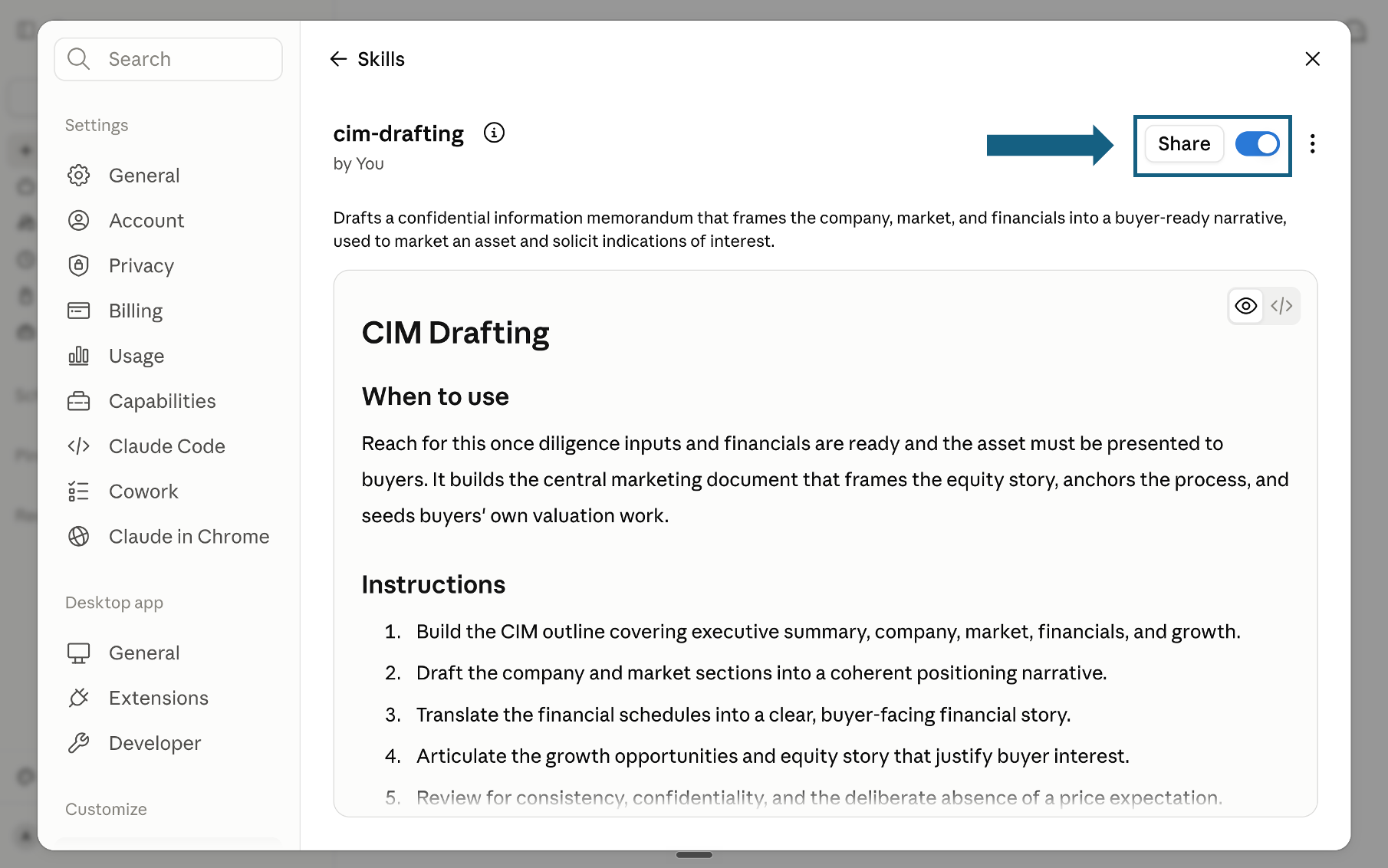
Open the screenshot to view it full size.
Try a skill
Tell Claude which skill to use and provide the relevant files or context. Review every output before sharing it.
- "Use the spend-baseline skill to categorize this G&A spend extract and flag the top vendor concentration risks."
- "Use the cost-driver-analysis skill to decompose this $4M cost increase into volume, rate, and mix effects."
- "Use the org-layer-analysis skill to assess whether our 8-layer structure is appropriate for a $600M company."
- "Use the savings-tracker skill to build a program register and flag initiatives at risk of missing the in-year target."
How to choose a skill
Match your immediate question to the right skill. Each one maps to a specific diagnostic question a cost-cutting program typically faces.
The quality bar
Every skill is designed to push Claude toward outputs that hold up in a partner or CFO review. Each uses a named method where one exists: PVM decomposition, TCO analysis, Lean Muda classification, ZBB level logic, or savings registry governance. No invented statistics, no vague recommendations.

Andrew Persh
Founder, Oria
Former top-tier strategy consultant turned product builder. Andrew founded Oria to help professionals create boardroom-ready presentations without the formatting overhead.