

Commercial Due Diligence Report Template and Structure
The exact section-by-section structure a commercial due diligence report needs, what belongs in each part, and where most reports lose the reader: the point where the financial cut and the commercial cut have to agree. Download the free slide-shaped template below.
Download the commercial due diligence report template
Most commercial due diligence report templates are a blank slide deck with section titles and nothing underneath them. This one is different: it is six Claude skills, one per section, that each produce the actual section content, plus a first skill that lays out the whole slide-shaped structure before you write a word. Together they cover the section-by-section structure below, what belongs in each part, and the reconciliation between the financial cut and the commercial cut that most reports skip.
The pack downloads as one zip with 6 SKILL.md folders inside, free, with no signup. Load the first skill to generate the outline, then load the section skills you need as the engagement moves from market sizing through to the financial and commercial reconciliation.
Download all 6 skills
One zip, 6 folders, one per report section. Free, no signup.
The commercial due diligence report structure
Seven sections cover a complete commercial due diligence report. Skip one and the report either opens without a conclusion, closes without evidence, or asks the reader to trust a market number nobody built. The order below is the order a reader expects, not the order you research it in; most teams build the market and customer sections first and write the executive summary last.
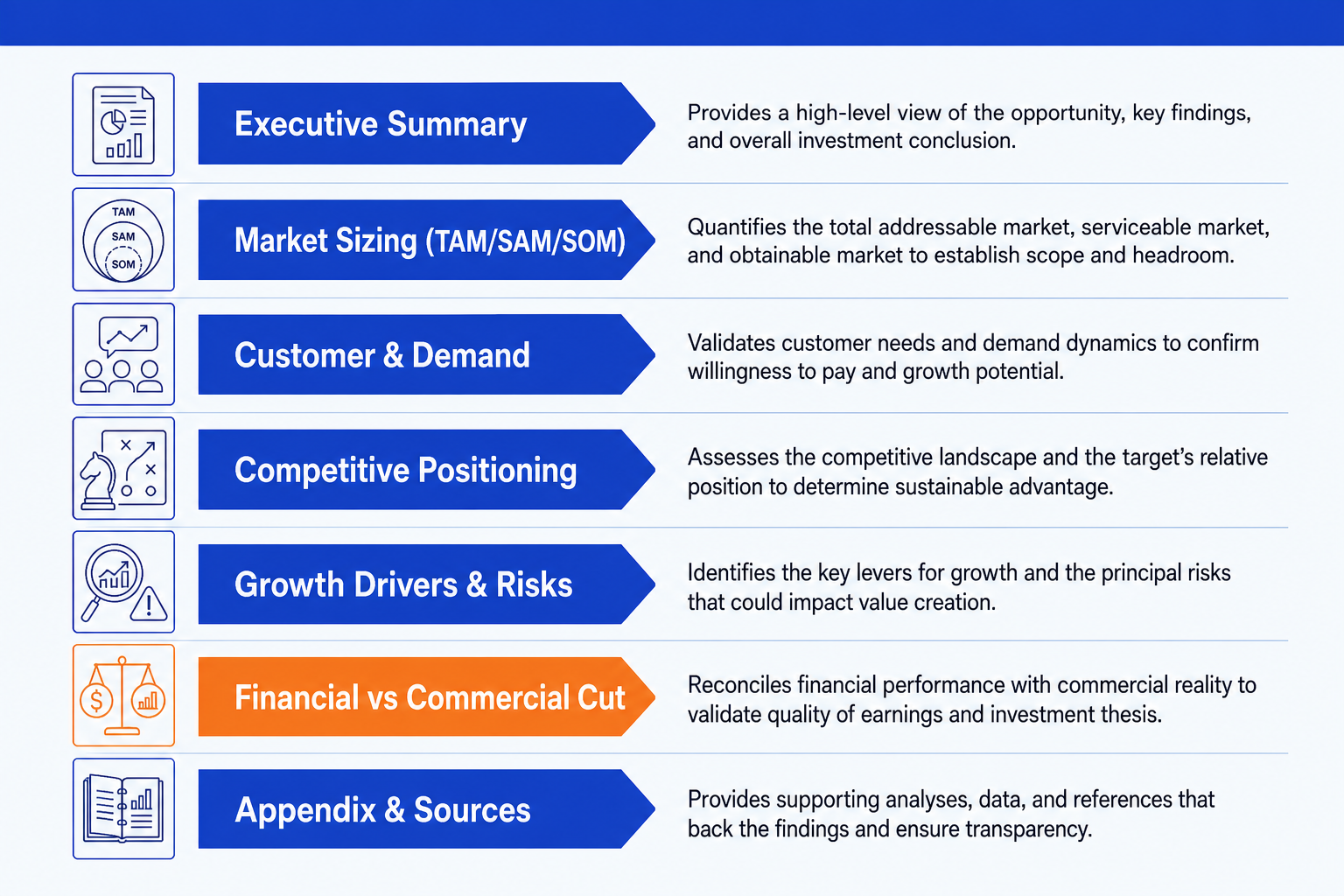
Executive Summary. The recommendation stated in one paragraph, the three or four findings that support it, the deal-breaker risks if any, and the overall investment conclusion. Written last, read first.
Market Sizing (TAM/SAM/SOM). The total addressable market, the serviceable segment the target can actually reach, and the obtainable share given its current position. Both a top-down and a bottom-up build, with the two cross-checked against each other.
Customer and Demand. Customer concentration by revenue, retention or cohort behavior, and the demand drivers that explain why customers buy and stay. Ends with the top customer-side risks.
Competitive Positioning. A named peer set, the basis of competition in the category, where the target sits on it, and how defensible that position is against the peers most likely to erode it.
Growth Drivers and Risks. Every credible lever for growth, sized individually, next to a risk register that names each commercial risk, its likelihood, its impact, and the mitigant already in place or still needed.
Financial vs Commercial Cut. The reconciliation between what the numbers say and what the market evidence says. This is the section most commercial due diligence reports get wrong, and it gets its own section below.
Appendix and Sources. The interview list, the data sources with dates, the detailed workings behind the market build, and any analysis that supports the report but would clutter the main narrative.
The financial cut versus the commercial cut
A financial cut, usually a quality of earnings review, asks whether the reported numbers are clean: it rebuilds the EBITDA bridge, classifies every add-back as accepted, rejected, or contested, and produces a range for adjusted EBITDA. A commercial cut asks a different question entirely: does the market, customer, and competitive story behind those numbers hold up? A target can pass a clean financial review and still be a poor investment if the market is smaller than claimed, three customers carry the growth, or a competitor is about to undercut on price.
The two cuts have to reconcile before the report reaches the investment committee. If the financial cut shows revenue growing at 12 percent and the commercial cut's market build only supports 6 percent of obtainable growth, that gap is either a wrong assumption in one of the two workstreams or a real risk the report has to name. The sixth skill in the pack, Financial and Commercial Cut Reconciliation, exists for exactly this handoff: it lines up the financial cut's adjusted EBITDA and growth trajectory against the commercial cut's revenue and demand assumptions and lists every gap that has not been resolved yet.
For the financial side of the workstream, the companion private equity due diligence skills pack includes a dedicated quality of earnings skill that pairs directly with the reconciliation skill here.
The 6 Claude skills in the pack
Each skill maps to one part of the report structure above. Load the first to generate the outline, then load the section skills in the order you research them.
CDD Report Structure
cdd-report-structure
Use when: a commercial due diligence engagement is starting and the team needs the full section-by-section report shell before any analysis begins
Output: a slide-shaped section outline, one heading per section from Executive Summary through the Financial vs Commercial Cut to the Appendix, each with a placeholder action title and the analysis it needs to carry
Market Sizing Section
market-sizing-section
Use when: writing the market overview section and the report needs a defensible TAM, SAM, and SOM rather than a single unsourced market-size number
Output: a TAM/SAM/SOM build with a stated methodology, a top-down and bottom-up cross-check, and a one-page market overview narrative for the section
Customer and Demand Section
customer-demand-section
Use when: writing the customer section and the deal team needs to test concentration, retention, and whether demand is durable rather than assumed
Output: a customer concentration table, a retention or cohort read, a demand driver list, and the top three customer-side risks for the report
Competitive Positioning Section
competitive-positioning-section
Use when: writing the competitive landscape section and the target needs to be placed against named peers on the dimensions buyers actually decide on
Output: a competitive positioning map, a peer comparison grid, and a moat and defensibility read for the target's position
Growth Drivers and Risk Register
growth-risk-register-section
Use when: writing the growth and risk section and every growth lever and every commercial risk needs to be named, sized, and owned rather than gestured at
Output: a growth driver list with a sizing estimate per driver, and a risk register with likelihood, impact, and mitigant for each named risk
Financial and Commercial Cut Reconciliation
financial-commercial-cut-reconciliation
Use when: the financial workstream and the commercial workstream are both underway and the two sets of numbers need to agree before the report reaches the investment committee
Output: a reconciliation table tying the financial cut's adjusted EBITDA to the commercial cut's revenue and growth assumptions, plus a list of any unresolved gaps between the two cuts
Setup guide
The skills work as uploaded Skills in Claude. Follow these steps once, then reuse the pack on every engagement.
- Step 16 skills (.zip)
Download the pack and open Settings
Unzip the pack so each skill keeps its own folder with its SKILL.md file inside. In Claude, open your profile menu and select Settings.
- Step 2
Open Skills and start an upload
In Settings, select Skills under Customize. Open Add and choose Upload a skill.
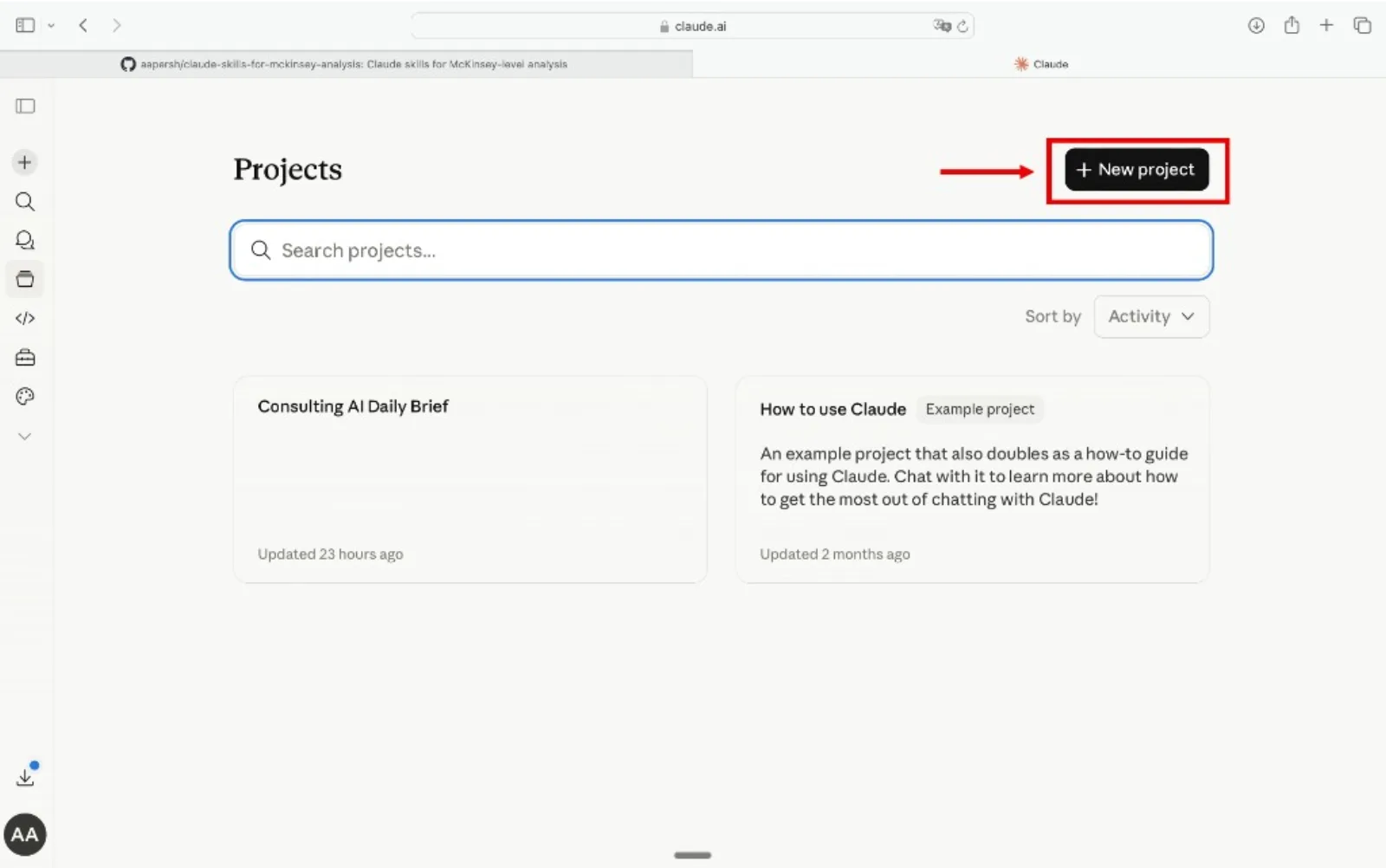
- Step 3
Upload one skill file
Open one extracted skill folder and drag its SKILL.md file into the upload window, or click the upload area to choose it. Repeat for each section skill your engagement needs.
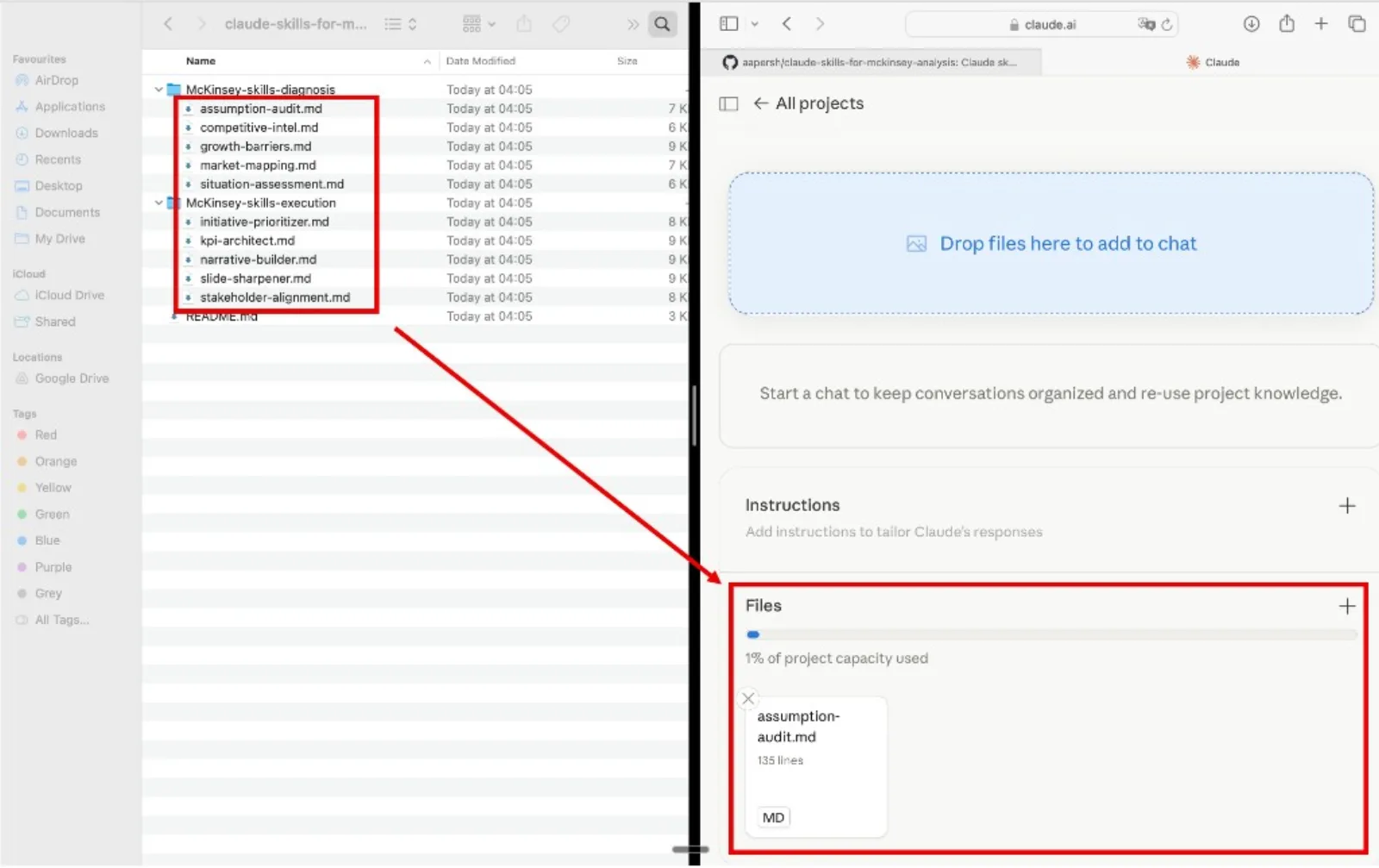
- Step 4
Confirm the skill and run it
Return to the Skills list, confirm the skill appears, and make sure it is turned on. Then start a conversation, attach your source documents, and name the skill you want Claude to use.
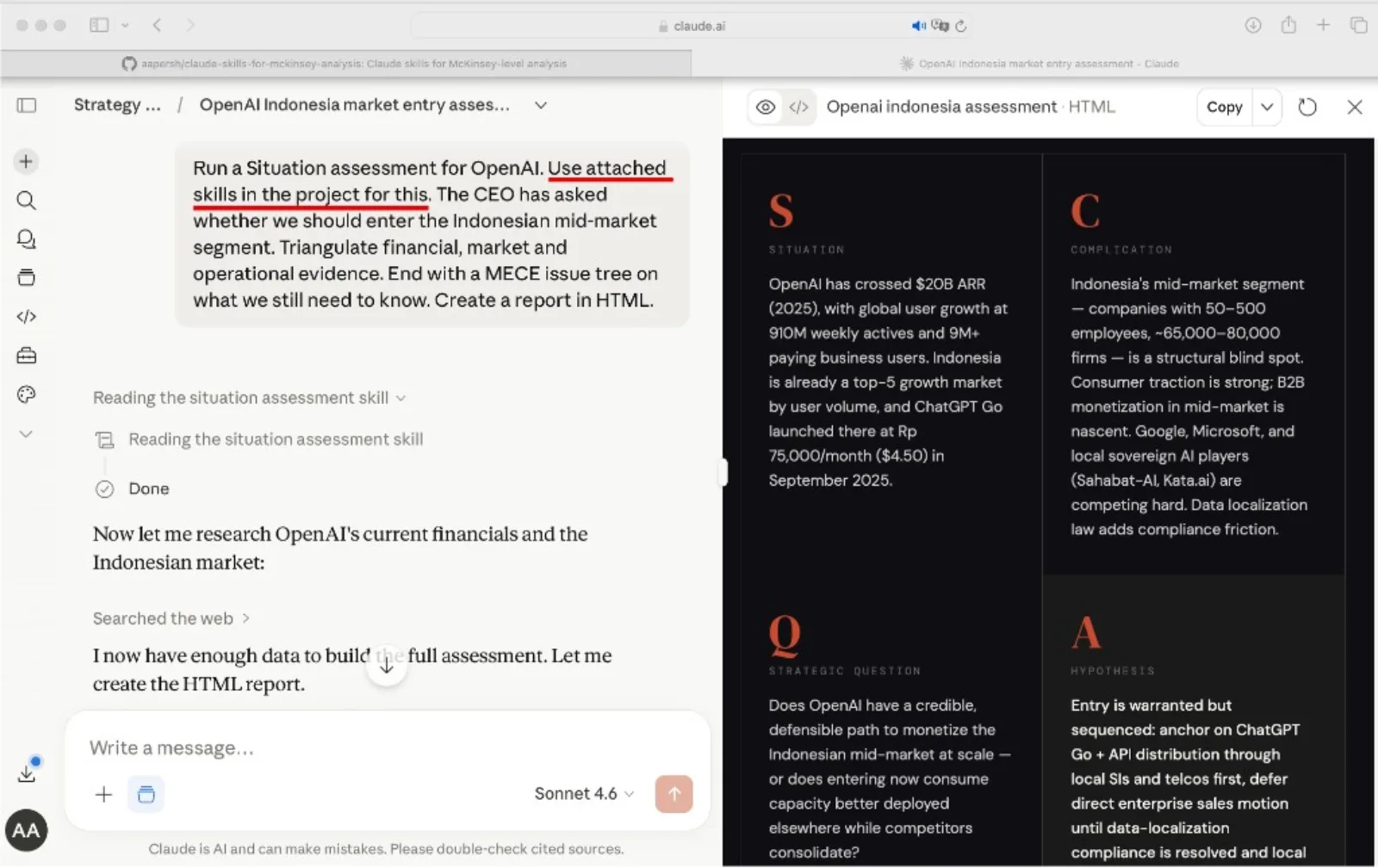
Example prompts
- "Use the cdd-report-structure skill to lay out the full report outline for a mid-market industrial services target."
- "Run the market-sizing-section skill on this market research and build a TAM, SAM, and SOM: [attach files]."
- "Use the financial-commercial-cut-reconciliation skill to check whether this quality of earnings output ties to this commercial market build."
From report skill to Oria slide
Each skill returns section content in plain text: the outline, the market build, the risk register, the reconciliation table. Paste the approved section into Oria inside PowerPoint and describe the slide you want, for example a TAM/SAM/SOM funnel or a risk register grid. Oria renders the layout as fully editable native PowerPoint elements in your firm's template, so the numbers stay reviewable and every shape can still be moved, recolored, or corrected after generation.
Keep the model and the deck in sync: when a skill output changes after a review comment, refresh the underlying section text first, then update the slide, so the report and the deck never drift apart. For the wider workflow from analysis to a finished deck, see the ultimate guide to Claude for finance.
Common mistakes in a commercial due diligence report
For a related output built for the investment committee itself rather than the underlying analysis, see the investment memo template for a PE deal team.
Frequently asked questions
What sections does a commercial due diligence report need?
A commercial due diligence report needs seven sections at minimum: an executive summary with the recommendation, market sizing (TAM/SAM/SOM), customer and demand analysis, competitive positioning, growth drivers and a risk register, a section reconciling the financial and commercial cuts, and an appendix with sources. The template on this page ships all seven as a slide-shaped outline.
What is the difference between financial and commercial due diligence?
Financial due diligence, often called quality of earnings, tests whether the reported numbers are clean and sustainable: it rebuilds the EBITDA bridge and classifies add-backs. Commercial due diligence tests whether the market, customer, and competitive story behind those numbers actually holds up. A complete report reconciles the two, because a business can pass a clean quality of earnings review and still fail on market size or customer concentration.
Is there a free commercial due diligence report template?
Yes. This page's pack downloads as one free zip with no signup: six Claude skills, one per report section, that each produce the section content and a section-by-section outline you can drop straight into a deck.
How long should a commercial due diligence report be?
Length depends on deal size, but the section structure stays the same whether the report runs 15 slides or 60. Keep the executive summary to one page regardless of length. The appendix is where extra detail belongs, not the main narrative sections.
Can Claude write a commercial due diligence report?
Claude can draft each section of a commercial due diligence report when it is given the source documents, the market data, and a named method for each section, which is what the six skills in this pack provide. A partner or VP should still review every section before it reaches the investment committee.