

Investment Memo Template for PE Deal Teams (IC-Ready)
An investment memo template for a PE deal team needs nine sections to survive an investment committee vote: the recommendation, the thesis, the company and market view, the deal terms, the financial case, the diligence findings, the value creation plan, the exit route, and the appendix. This guide walks each one, gives a ready slide-by-slide template, and includes the exact prompts to build it fast.
What to Include in an Investment Memo Template
An investment memo template needs nine sections: the recommendation, the investment thesis, the company and market overview, the deal structure, the financial analysis and projected returns, the diligence findings and key risks, the value creation plan, the exit strategy, and an appendix. Each answers a question the investment committee is quietly asking, and skipping one leaves a gap someone in the room will notice.
This guide walks each section, gives a ready slide-by-slide template you can copy, the common mistakes that make a memo read as unfinished, and the exact prompts to draft the content and build the deck fast.
What an Investment Memo Is and Who Reads It
An investment memo, also called an IC memo or deal memo, is the document a PE deal team builds to bring a deal to its investment committee for a decision. It is not a status update. It is an argument: here is the asset, here is why it fits the fund's thesis, here is what the diligence found, here is the return math, and here is the specific approval being requested.
The depth changes by stage. A preliminary screen memo leans on the thesis and the market view with an early, rough return range. A final approval memo carries completed diligence, a negotiated deal structure, a risk register, and a value creation plan the team is ready to execute from day one. For the slide format that opens the deck at either stage, see how to build an executive summary slide.
The 9 Things Every Investment Memo Template Must Include
Each section below carries its own job. Cut one and the memo reads as incomplete, even to an IC member who could not name what was missing.
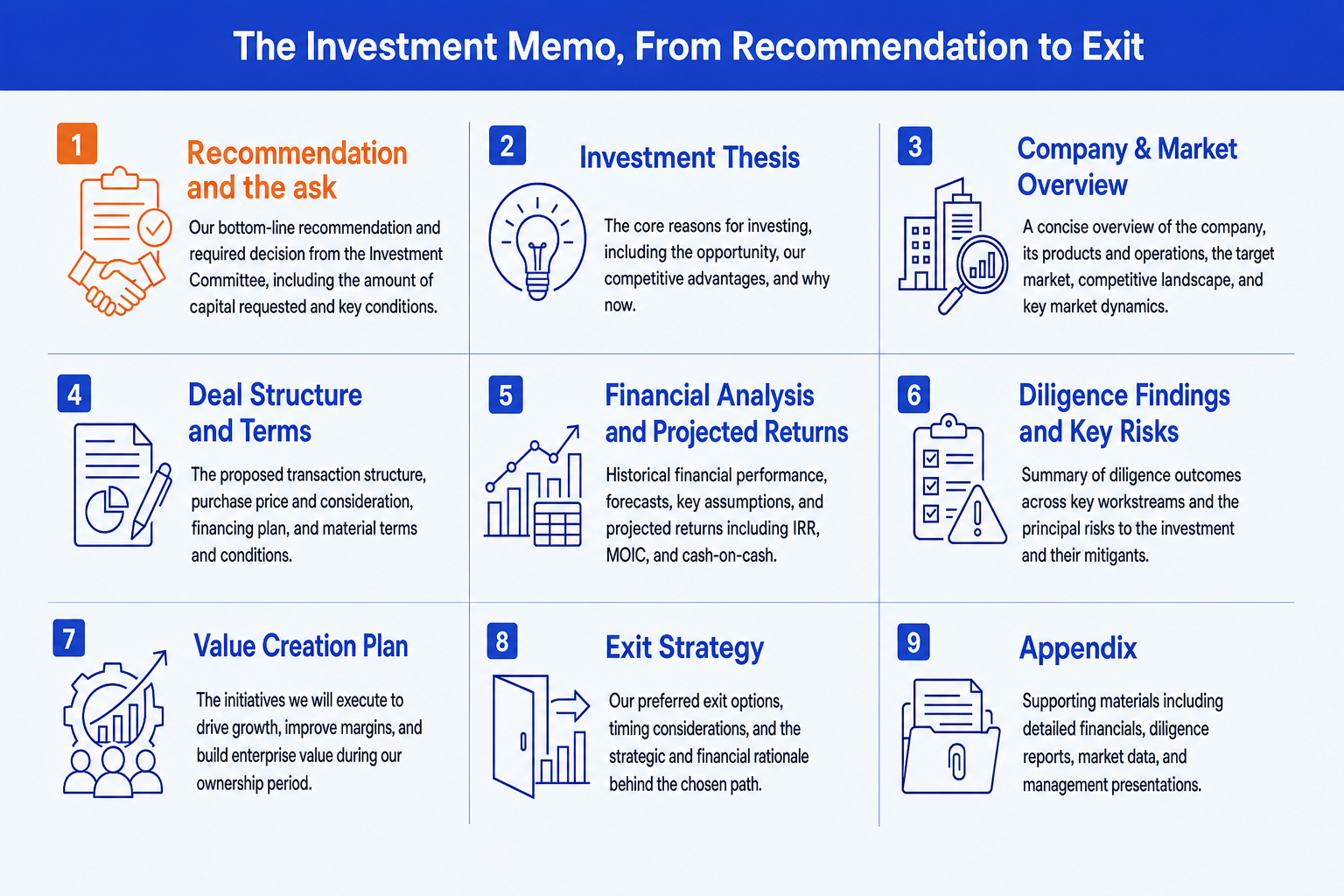
Recommendation and the ask. The one-line call the IC is being asked to approve, stated before any data: proceed, decline, or advance to the next stage. Pair it with the proposed structure and the headline return math, entry multiple, target IRR, and target MOIC.
Investment thesis. The three to four pillars of value creation, written as claims the diligence has to prove, not as a description of the business. Why this asset, why this price, why now, and why this team can execute the plan.
Company and market overview. What the business does, how it makes money, and who it sells to, sized against a TAM, SAM, and SOM view that frames the growth runway behind the thesis.
Deal structure and terms. Purchase price, the equity and debt split, the resulting ownership stake, governance and board rights, and the key conditions the seller and any lenders have agreed to.
Financial analysis and projected returns. Historical revenue and EBITDA next to the base, upside, and downside cases, with a sensitivity table showing how IRR and MOIC move as the key assumptions change.
Diligence findings and key risks. A summary of the commercial, financial, legal, and management diligence completed so far, plus a risk register that names each flagged item alongside its mitigant.
Value creation plan. The operational levers the deal team will pull after close, sequenced into a 100-day plan, tied directly back to the return bridge from entry multiple to exit multiple.
Exit strategy. The plausible exit routes, a strategic sale, a sponsor-to-sponsor transaction, or an IPO, each with an expected timing window and a rough view of the buyer universe.
Appendix. Full model outputs, the data room index, and management team bios, so the main flow can stay short while the IC still has everything it might ask to see.
Tip
Build the returns sensitivity as a proper range, not a single number. See how to build a football field valuation slide for the method rows and floating range bars that make a valuation range easy to read at a glance.
The Investment Memo Template, Slide by Slide
This is the ten-slide skeleton the checklist above maps onto. Copy it as your outline, then fill each slide with your own deal specifics before you touch layout.
Ten slides is the right length for the main flow. Longer memos tend to bury the recommendation on slide one; shorter ones tend to skip the risk register, which is where an IC member's eye goes first. Push the full model, the data room index, and management bios to the appendix so the main flow stays readable in one sitting.
Common Mistakes to Avoid
Build the Investment Memo Deck Fast: the One-Prompt Route
Once the nine sections are drafted as plain text, the slide build is the part that usually eats the night before the IC meeting: aligning tiles, formatting a risk register, matching the fund's template. Oria removes that step. It is an AI add-in that runs in the PowerPoint task pane and turns a text description into a fully editable native slide, on your firm's template, in two to three minutes.
Because the output is native PowerPoint, every tile, bar, and callout stays editable afterward. You can swap a return figure or restyle a section without rebuilding the slide from scratch.
One-line prompt for the recommendation slide
The Prompts That Build an Investment Memo Deck
These are the exact copy-paste prompts we use to draft investment memo content in Claude and build the slides in Oria. Replace the bracketed parts with your own deal detail.
Draft the content in Claude
Draft the investment thesis pillars
Turn diligence notes into a risk register
Build the slides in Oria
Build the financial analysis and returns slide
Build the diligence findings slide
Build the value creation plan slide
Pattern
Draft the thesis and the risk register in Claude first, then hand the clean content to Oria one slide at a time. For a deeper set of ready-made diligence skills that feed straight into this template, see 6 Claude skills for PE due diligence, past the CIM.
Frequently Asked Questions
What is an investment memo?
An investment memo, also called an IC memo or deal memo, is the document a PE deal team puts in front of its investment committee to get a decision on a deal. It states the recommendation, the thesis, the deal terms, the financial case, the diligence findings, and the exit route, so the IC can approve, decline, or ask for more work in a single sitting.
What sections does a PE investment memo template need?
Nine sections cover most investment memos: the recommendation, the investment thesis, the company and market overview, the deal structure, the financial analysis and projected returns, the diligence findings and risks, the value creation plan, the exit strategy, and an appendix. Each answers a question the IC is quietly asking before it will vote.
How long should an investment memo be?
Ten to fifteen slides for the main flow, plus an appendix for full model detail and diligence back-up. The template in this guide maps to ten slides: a cover, the nine core sections, condensed to fit the main flow. Longer decks tend to bury the recommendation; shorter ones tend to skip the risk register, which is where IC members focus first.
Is the memo different for a preliminary screen versus a final IC vote?
The nine sections stay the same, but the depth changes. A preliminary memo leans on the thesis, the market overview, and an early diligence read, often with a placeholder return range. A final approval memo carries full diligence findings, a negotiated deal structure, a completed risk register, and a value creation plan the team is ready to execute on day one.
What is the fastest way to build an investment memo deck?
Draft the nine sections as plain text first, using the structure in this guide, then hand the content to Oria one slide at a time. Oria is an AI add-in that runs in the PowerPoint task pane and turns a text description into a fully editable native slide on your firm's template, so the deck build never eats the evening before the IC meeting.