

One-Pager Examples: 8 Formats That Survive Exec Review
Eight one-pager examples for eight real decisions, each written out section by section with the sentences that would sit on the page, why it works, and a copyable template you can reuse for the next one.
Nobody searching for one pager examples is short of layouts. Template marketplaces sell them by the hundred, and they all look fine until you try to put a real decision inside one.
The decision is narrower than it looks: given who reads the page and what you are actually asking them to do, which structure should carry it, and what should the words on the page actually say. So the eight examples below are written out in full, each naming a situation, a reader and a structure, then showing the sentences that would sit on the page, why it works, and what it costs you. A copyable template follows the examples. Copy the wording, change the numbers, keep the shape.
What makes a one-pager survive an exec review?
Most one-pagers fail for the same reason: they describe the topic instead of stating the decision.
Quick answer
A one-pager survives exec review when it states the decision, status, or ask in the title as a full sentence, carries it in four to six short sections such as problem, options, recommendation, and ask, and includes only the two or three numbers that would change the reader's mind if they were different. The strongest formats, a business case, a board pre-read, a deal teaser, name what was ruled out and put a named owner and a date on the ask, so a reader can approve without a follow-up email.
How we chose these one-pager examples
The bar was set by how rarely a one-pager survives a sceptical reader. Jakob Nielsen's Nielsen Norman Group analysis of how little users read found that on an average page "users have time to read at most 28% of the words during an average visit; 20% is more likely", drawing on Weinreich and colleagues' instrumented study of 45,237 page views. And when Board Intelligence surveyed corporate directors with the National Association of Corporate Directors for its 2024 US boardroom study, fewer than one in five, 17 percent, rated their board pack effective at communicating key messages, and 59 percent named three or more separate areas of concern. A one-pager exists because the alternative, a long document skimmed at 20 percent, works this badly. Five filters were applied to each example here, and one category was deliberately ignored.
One real decision per example, not one layout shown eight ways
Each example carries a different decision for a different reader. Two share a structure only where the decision calls for the same one.
The actual wording, not placeholder text
Every example is written out section by section. A layout full of Lorem ipsum tells you nothing about whether it can carry a real decision.
The ask has to be specific
A number, an owner, or a date. Any example whose ask read as a general request for approval was rewritten or cut.
Numbers only where they change the recommendation
Economics rows, funnels and status lines had to earn their place by answering the reader's next question. Numbers that only decorate came off.
What we ignored
Visual styling, brand templates, icon sets, and any one-pager that looked polished but carried no real decision.
Key takeaways
Pick the format from the decision, not the topic. A committee approving spend reads a business case. A board reads a decision paper. A steering group that saw last month's page reads a status update. Match the format to what the reader is actually being asked to do.
Every one-pager needs one number that would change the answer. A payback period, a TAM-to-SOM funnel, an error rate. If a number on the page would not change the recommendation were it different, it belongs on a backup page, not this one.
State the ask with an owner and a date. "For approval" is not an ask. "Approve 85k by 30 September" is. The strongest examples above name who signs and by when, every time.
Name what you left out as clearly as what you kept. Scope excluded, options ruled out, a risk not yet resolved. Stating the boundary is what stops the one-pager growing in the first follow-up conversation.
Budget the read to under two minutes and cut to fit. Four to six short sections, one or two sentences each. A one-pager that needs a second page is carrying a second decision that deserves its own document.
The eight one-pager formats compared
The five columns are the five decision rules above. Read across your own row: the format you want is the one whose failure mode your situation does not trigger.
| Format | Who reads it | What it has to prove | The one number it needs | Time to read | Where it breaks |
|---|---|---|---|---|---|
| Project | A sponsor approving a kickoff | The objective and what is out of scope | The target date or metric | 45 to 60 seconds | When the plan is not yet fixed and the date gets renegotiated |
| Business case | A committee funding the request | That the alternatives were considered and ruled out | The payback period | 60 to 90 seconds | When the economics assumptions are contested |
| Status update | A steering group with the prior context | What changed since last time | The RAG status | 30 seconds | In front of anyone new, who needs the background you cut |
| Deal teaser | A buyer or investor before an NDA | Why this deal, why now | The growth rate or margin | 20 to 30 seconds | When too much detail identifies the seller before signing |
| Market sizing | A reader who wants the funnel, not the appendix | That the filters at each step are named | The SOM figure | 45 to 60 seconds | When the TAM source is not named or checkable |
| Org / team | The people the change affects | Who has sign-off during the transition | The effective date | 30 to 45 seconds | Once the transition date passes and nobody updates it |
| A3 problem-solving | The team closest to the problem | That root cause is separated from symptom | The current miss rate against the goal | 60 seconds | When it is filled in from a desk, not from seeing the problem |
| Board pre-read | A director reading on a phone the night before | That the risk has a named owner | The cost or margin delta between options | 60 to 75 seconds | When two options are genuinely close and get compressed away |
Read times are working budgets, not measured averages. For the deck-opening version of this page, see the executive summary slide examples.
None of the eight is universally correct. Match it to the decision and to how much background the reader already carries, then hold the wording discipline steady across whichever one you write.
Eight one-pager examples, with the wording
The order below moves from the one-pager you will draft most often, a project brief or a business case, through the recurring and external-facing formats, to the two where a single sentence carries the most weight: an A3 problem-solving page and a board pre-read.
The numbers below are illustrative; the sentence shapes are not. These are the constructions that survive a hostile read: a decision rather than a topic, a named boundary, an ask with an owner and a date on it.
Project one-pager: what goes on it?
Objective, scope, approach, timeline, owner
A kickoff brief for a project that needs sign-off before work starts, read by a sponsor who was not in the scoping meetings.
Stating the objective as a number rather than a theme gives the sponsor something to hold the team to later. Naming what is explicitly out of scope stops the project growing at the first status conversation.
The trade-off: it commits to a date before the detailed plan exists. Sign it only once the pilot scope is genuinely fixed, or the timeline becomes the first thing renegotiated.
Business case one-pager: what goes on it?
Problem, options considered, recommendation, economics, ask
A capital or resourcing request to a committee that funds a dozen of these a year and reads them before the meeting, not during it.
Naming the options actually considered, including doing nothing, pre-empts the questions a finance director asks before they get asked. The ask carries a number and a date, not a general request for approval.
The trade-off: the economics row invites an argument about the assumptions behind the payback figure. Keep the sensitivity case as a backup page, not on this one.
Status update one-pager: what goes on it?
Status headline, what changed, what's next, risk and ask
A recurring update to a steering group that saw the last version four weeks ago and does not need the background repeated.
Leading with the status colour and the one live risk, rather than a recap, respects a group that already has the context. Putting the contingent decision on the page now buys the fallback plan time to start.
The trade-off: an amber status with no fresh news reads as filler. Skip the update, or fold it into the next one, rather than send a page that just repeats last month's line.
Deal teaser one-pager: what goes on it?
Overview, investment highlights, financial snapshot, process
The first document a potential buyer or investor sees, sent under a blind or semi-anonymised name before any NDA is signed.
The highlights are the three facts that decide whether a buyer requests the NDA, ranked in the order they answer a buyer's first questions: growth, quality of revenue, and why now. Everything else waits for the information memorandum.
The trade-off: an anonymised teaser has to be vague enough to protect the seller and specific enough to get a response. Too much detail identifies the company; too little gets ignored.
The four that follow swap the audience: a market-sizing summary for a growth study, an org one-pager for a restructure, a Toyota-style problem-solving page, and a board pre-read. The market-sizing example pairs with the full TAM, SAM and SOM build guide.
Market sizing one-pager: what goes on it?
TAM, SAM, SOM funnel plus the so-what
A single page pulled out of a longer market-entry study, built for a reader who wants the number and the logic behind it, not the appendix.
Funnelling from TAM to SOM on one page, with the source and the filter named at each step, is what lets a sceptic check the arithmetic instead of only the conclusion. The so-what line ties the number to the actual ask.
The trade-off: a TAM-to-SOM page is only as credible as its named sources and stated filters. An unattributed TAM number is the fastest way to lose the room.
Org or team one-pager: what goes on it?
Mandate, structure, roles, interim risk
Announcing a new team or a restructure to the people it affects, before the org-chart software catches up.
Naming the interim risk, rather than leaving the transition period silent, is what stops a real decision from falling through the gap between the old structure and the new one.
The trade-off: a structure page dates fast. Put an owner and a review date on it, or it becomes the wrong org chart within a quarter.
A3 problem-solving one-pager: what goes on it?
Background, current condition, goal, root cause, countermeasures, follow-up
A structured method for a recurring operational problem, built to fit on one side of paper and force the team to understand the problem before proposing a fix.
The format comes from Toyota, built on the constraint that a problem which cannot fit on one page has not been understood well enough yet. Separating current condition from root cause is what stops a team countermeasuring the symptom.
John Shook, an industrial anthropologist and senior advisor to the Lean Enterprise Institute who spent a decade working inside Toyota, writes in MIT Sloan Management Review that the A3's constraints and its structure, specific categories, ordered in steps, adding up to a story, are the keys to the A3's power.
The trade-off: the format assumes a team that has actually gone to see the problem firsthand. Filled in from a desk, the root-cause box turns into a guess with a box drawn around it.
Board pre-read one-pager: what goes on it?
Decision requested, context, options, recommendation, risk
A single decision paper circulated before a board meeting, read on a phone the night before, competing with everything else in a director's inbox.
Naming the risk and its owner on the same page as the recommendation, rather than in a separate risk register, is what lets a director approve without a follow-up email asking who is watching the downside.
The trade-off: a one-pager forces every option down to a sentence. Where the real debate is between two close options, attach a one-page appendix rather than compress the trade-off away.
The one-pager template that survives an exec review
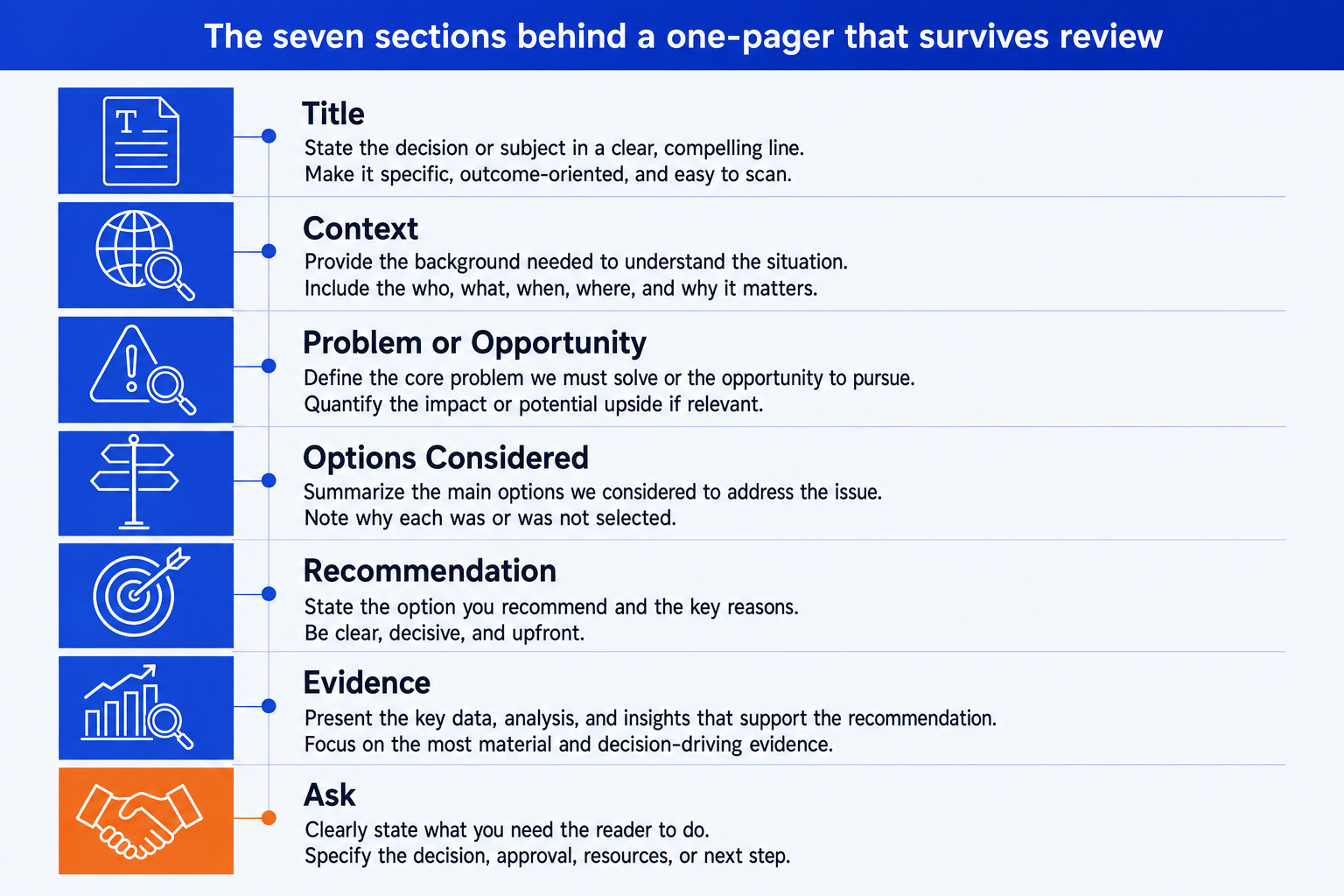
A generic skeleton, built from the eight examples above, that adapts to most of them by keeping some sections and dropping others. Copy the structure, write your own sentences into each bracket, and delete any section that does not apply.
The seven-section one-pager skeleton
A status update or an A3 problem-solving page will not use all seven sections; a board pre-read or a business case usually uses every one. The examples above show which sections each format keeps and which it drops.
Where do you actually build a one-pager?
Four routes, cheapest first, which is not the same as best first. Each is right for somebody and none for everybody.
Building it by hand: who is it built for?
Drafting the sections and setting the layout yourself in Word or PowerPoint. For a one-off business case or a single board pre-read, this is the most controllable option and the only free one.
The trade-off: total control, no cost, and the slowest path if you produce these weekly. Alignment and spacing are the first things to slip under a deadline.
A one-pager template pack: who is it built for?
Marketplaces such as SlideModel and SlideUpLift, and template libraries from tools such as Deckary, sell editable one-pager layouts by the hundred. The layout is already drawn.
The trade-off: the fastest route to a decent shape, and no help with the hard part. A one-pager template with the wrong sentences in it fails the same review a blank page would.
Oria: who is it built for?
Oria is an AI slide tool aimed at corporate and consulting output: board packs, business cases, diligence exhibits and dense one-pagers held to an enforced company template. It reaches you two ways, as a PowerPoint add-in running in the task pane on Windows, macOS and PowerPoint for the web, and as a connector for Claude and ChatGPT over MCP, so a one-pager can be built from the chat you are already in. It returns native, editable PowerPoint shapes in your own template rather than an image or a web embed, which is what lets these pages survive being handed on. Customer content is not used for training, Professional and Team do not persist presentation content after delivery, and Enterprise adds private cloud deployment.
The trade-off: it is built for the corporate environment and only that. Where the job is visual polish rather than defensible content, a marketing one-pager, an event flyer, a product sheet, a design-led tool will beat it and look better doing it.
A design-led tool: who is it built for?
Canva, Gamma and Beautiful.ai generate a polished one-pager from a prompt or a template and apply a coherent visual system across it. They suit brand-facing collateral: a marketing one-pager, a launch sheet, an event flyer.
The trade-off: the best-looking output of anything here, and the hardest to force into someone else's corporate master. Check how the file exports before committing a board pack to one.
On the Oria route the request is one line, and the format name does the work.
One-line prompt for any of these formats
For the drafting side, before layout, the same wording discipline used above carries over from the executive summary slide examples.
Which one-pager should you build?
Routed by what is in your way. Several of these rows send you to a different page entirely, including off this site.
Frequently asked questions
What is a one-pager?
A one-pager is a single page that carries one decision: a recommendation, a status, or an ask, plus just enough evidence to defend it. In a corporate or consulting context it replaces a longer report or deck for a reader who needs the conclusion before the meeting, not during it. The eight formats above share that constraint; only the wording and the numbers change.
What should a one-pager include?
Four things, whatever the format: a title stating the point rather than the topic, the decision or status in the first section, the two or three facts that would change the reader's mind if they were different, and a specific ask with an owner or a date. Scope out everything that does not serve one of those four.
How long should a one-pager be?
One page, held to under two minutes of reading time, roughly 300 to 450 words depending on how dense the sections run. If the content needs more room, the honest fix is cutting a section, not shrinking the font or the margins to force a fit.
What is the difference between a one-pager and an executive summary?
They overlap. An executive summary is usually the opening page of a longer report or deck, read alongside what follows it. A one-pager stands alone as the entire document, most often a business case, status update, or deal teaser sent with nothing behind it. The wording disciplines are close to identical.
What is a business one-pager template?
A reusable skeleton, title, context, problem, options, recommendation, evidence, ask, that a team fills in for a new decision rather than starting from a blank page each time. The template below is that skeleton, written out with guidance on what belongs in each section.
What is an A3 report?
A one-page problem-solving format that originated at Toyota, built on the constraint that a problem which cannot fit on one page has not yet been understood well enough. It runs background, current condition, goal, root cause, countermeasures and follow-up in that order, and reads closer to a structured worksheet than a persuasion document.
Is there a free one-pager template?
Yes. Google Docs, Canva and several template marketplaces publish free one-pager layouts, and they solve the blank page and nothing else. The wording, the one number that backs the recommendation, and the specificity of the ask decide whether the one-pager actually survives the meeting it is built for.