

Confidential Information Memorandum: Structure and Template
A confidential information memorandum (CIM) is the detailed, confidential document a seller's banker sends to qualified buyers after they sign an NDA in an M&A sale. It replaces the blind teaser with the company's real name, financials, and operations, so buyers can move to an indicative bid.
What a Confidential Information Memorandum Is
A confidential information memorandum sits between the teaser and the data room in a sell-side M&A process. The teaser goes out blind, describing the business without naming it, to gauge interest from a wide list of prospects. Once a prospective buyer signs a non-disclosure agreement, the seller's investment bank sends the CIM: the company's real name, its financials, its products, its market position, and its management team, organized so a buyer can move from curiosity to a written, non-binding indicative offer without a management meeting first.
Bankers use the terms confidential information memorandum, information memorandum, and offering memorandum more or less interchangeably. All three describe the same sell-side marketing document. A private placement memorandum is a different animal: it is the disclosure document used to raise capital by selling securities, not to sell a company outright, and it carries securities-law obligations a CIM does not. A full CIM commonly runs 50 pages or more, per Mergers & Inquisitions founder Brian DeChesare's review of published examples, against the 5 to 10 page teaser that preceded it.
The audience is narrow by design: buyers who have already signed an NDA and shown real interest, whether a strategic acquirer, a private equity firm, or a family office. That narrowness is what lets the document name the company and disclose real financials in the first place.
The 9 Sections of a Confidential Information Memorandum
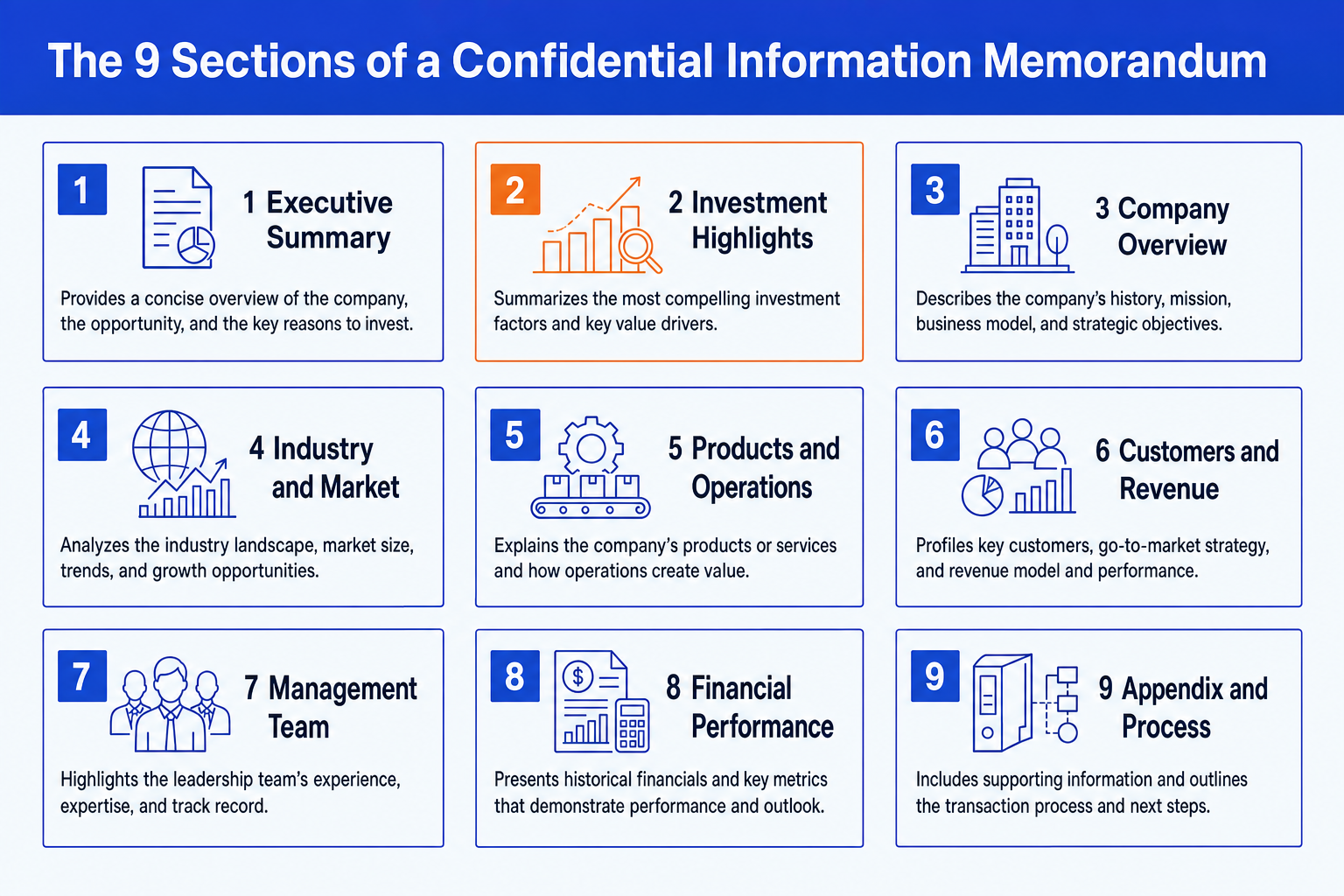
Practice varies by advisor and by deal size, but nine sections appear in almost every CIM built for a real process. Each one answers a question a buyer's investment committee is going to ask before it approves an indicative bid. Skip one and the gap shows up as a follow-up email during the bid window instead of an answer already on the page. The wording under each section is a starting point to adapt with your own figures, not to copy verbatim.
Executive Summary
One page that compresses the whole memorandum: what the company does, why it is for sale, the headline financial profile, and the process timeline. A reader who stops here should still understand the opportunity well enough to decide whether to keep reading.
For the slide that carries this section, see how to build an executive summary slide.
Investment Highlights
4 to 6 bullet-length claims about why the business is attractive, each one a claim the rest of the document has to back up with evidence, not a slogan a reader has to take on faith.
Company Overview
History, ownership, legal structure, locations, and headcount in plain language, before the highlights section gets tested against the operational reality underneath it.
Industry and Market Overview
The market the company actually competes in, sized realistically, not a headline total addressable market borrowed from an adjacent category, plus the 2 or 3 trends actually moving its growth.
For the funnel visual this section usually needs, see how to build a market sizing slide.
Products, Services and Operations
What the company actually sells, how it delivers it, and the operational footprint that makes delivery possible: production, technology, service, or distribution infrastructure.
Customers and Revenue Model
Customer concentration, contract structure, pricing, and retention. This is where a buyer tests whether the revenue in the financial section is durable or dependent on a handful of relationships.
Management Team and Organization
The people staying on after close, their track record, and the org chart, since a buyer is underwriting a team as much as a balance sheet, especially when the seller is not staying on.
Historical and Projected Financial Performance
3 years of historical financials, a normalized EBITDA bridge that names every add-back, and a forward projection with the assumptions stated, not just the output.
Appendix and Process Instructions
The bid procedure, key dates, and data room access instructions, plus any supporting detail too granular for the main flow: full financial statements, customer contracts, org charts.
Worked Example: a CIM Outline, Section by Section
Here is how those nine sections read once real numbers replace the brackets. Meridian Fleet Services is a hypothetical company built to show the method, not a real business or a real deal.
Executive Summary. Meridian Fleet Services is a fleet maintenance and logistics support provider serving regional trucking operators across three states, generating $40.2M in revenue and $8.0M in adjusted EBITDA for the twelve months ended June 2026. The founder is exploring a full sale to fund a management buyout by the existing operating team. Indicative bids are due within four weeks of CIM distribution.
Investment Highlights. 76% of revenue sits under multi-year service contracts. Meridian holds an estimated 9% share of a $450M regional serviceable market. A telematics upsell currently attached to 22% of customers has a realistic path to 45%, worth roughly $3M of incremental annual revenue at current pricing.
Company Overview. Founded in 2011, Meridian operates 22 depot locations across three states with 140 employees. The business is organized as a single operating company, wholly owned by its founder.
Industry and Market Overview. The regional fleet-services market was an estimated $2.1B in 2025, growing at a 6% CAGR on rising outsourcing of maintenance by mid-size trucking fleets. Meridian's serviceable segment, contract maintenance for fleets of 50 to 400 vehicles within its three-state footprint, is roughly $450M.
Products, Services and Operations. Meridian provides scheduled maintenance, roadside repair dispatch, and compliance inspections through a network of 22 depots and 3 mobile service units. A 45-minute average technician response time on roadside calls is the differentiator its sales team leads with.
Customers and Revenue Model. The top five customers represent 38% of revenue, with the largest single customer at 11%. 76% of revenue is under contracts of two years or longer, and gross customer retention over the past three years has averaged 91%.
Management Team and Organization. The founder-CEO has run the business since founding in 2011 and plans to stay on as an advisor through a 12-month transition. A CFO hired in 2022 and a VP of Operations with nine years at the company round out the team staying on post-close.
Historical and Projected Financial Performance. Revenue grew from $28.4M in FY2023 to $34.1M in FY2024 to $40.2M for the twelve months ended June 2026, a year-over-year increase of roughly 18% ($6.1M over $34.1M). Reported EBITDA of $7.1M normalizes to $8.0M after adding back $0.5M of above-market owner compensation, $0.3M of one-time relocation costs, and $0.1M of transaction-related legal fees, an adjusted EBITDA margin of about 20% ($8.0M over $40.2M).
Appendix and Process Instructions. Indicative bids are due four weeks after CIM distribution and must include proposed valuation, financing sources, and diligence scope. Shortlisted bidders receive data room access and move to management presentations in weeks five and six.
When You Actually Need a CIM
A CIM belongs to a specific moment in a sale: after the teaser has generated interest and a buyer has signed a non-disclosure agreement, before management presentations and site visits begin. It is the standard document in a broad or narrow auction process, where a banker runs multiple prospective buyers through the same information in parallel to build competitive tension on price and terms.
Not every sale needs one. A bilateral deal, where the seller is already in exclusive talks with a single buyer who knows the business well, sometimes skips a formal CIM and moves straight to a data room and management meetings. A very small deal run without an advisor might use a lighter information summary instead. The nine-section structure still holds in both cases; it is the formality and the length that scale down.
Build the full CIM whenever more than one or two genuinely qualified buyers need to evaluate the business on the same footing. That is what makes the extra weeks of drafting worth it: one document every bidder reads once, instead of the same story told slightly differently on a dozen individual buyer calls.
Where a CIM Can Mislead a Buyer
A CIM is written by the seller's advisor to sell the business, and it is worth reading with that in mind. Brian DeChesare, founder of the investment banking training site Mergers & Inquisitions, describes it plainly: a CIM is "a marketing document intended to make a company look as shiny as possible." It is not an audited filing and it is not a neutral assessment, so three specific places in the document deserve a buyer's skepticism before an indicative bid gets written.
The EBITDA bridge. Research from S&P Global found that add-backs in the average sale process account for 29% of adjusted EBITDA, that 26% of all add-backs are synergies and projected cost savings rarely realized after closing, and that only 8% of companies go on to post actual EBITDA that exceeds the management projections shown to buyers before signing. Every dollar of add-back moves the headline number, and at a mid-market multiple, a few hundred thousand dollars of soft add-backs can shift enterprise value by several million. A buyer's answer is a quality of earnings report from an independent accountant, checking that each add-back is real, non-recurring, and documented, not asserted.
The market section. A CIM commonly opens the industry overview with a large, top-down total addressable market that has little to do with the segment the company actually competes in. The number that matters is the serviceable market the company can plausibly win, not the gross figure that makes the opportunity look bigger.
The projection. A CIM's forward-looking numbers are built by the same team that wrote the investment highlights, and a hockey-stick curve with no disclosed driver behind it is a common pattern. Ask what specifically changes to produce the jump, whether it is already priced into the contract backlog, and treat anything without a named driver as upside, not as the base case.
Reading a CIM alongside a proper buy-side workstream, the kind covered in our commercial due diligence report template, is what turns a seller's pitch into a number a buyer can actually underwrite.
Turning the Outline Into a Deck
Once the nine sections exist as plain text, whether from this template or an advisor's own house style, building the actual slide deck is a separate, mechanical step. Draft the content first: the investment highlights, the financial narrative, the management bios, all as clean paragraphs and bullets, before touching layout at all.
From there, Oria turns that plain text into slides. Oria is an AI add-in for PowerPoint that also runs as a connector inside Claude and ChatGPT over MCP, so the deck gets built either directly in PowerPoint's task pane or from the chat window where the content was drafted, with no export step in between. Give it one section's worth of text and it returns 2 to 5 editable design options on your firm's template.
Two numbers have to tie before the deck goes out: the revenue in the executive summary must match the revenue in the financial section exactly, and the adjusted EBITDA in the investment highlights must match the number in the EBITDA bridge to the dollar. A CIM where the summary page and the financial appendix disagree, even by a small rounding difference, reads as a document nobody proofread, and a buyer's team will find it.
For the financial section, a football field valuation slide communicates a return range faster than a paragraph of prose. Once the CIM has done its job and a buyer moves to a formal recommendation, the investment memo template for PE deal teams is the next document down the funnel on the buy side.
Frequently Asked Questions
What is a confidential information memorandum?
A confidential information memorandum, or CIM, is the document a seller's investment bank prepares during an M&A sale process to give qualified, NDA-bound buyers the detailed information they need to submit an indicative, non-binding bid. It covers the company's financials, operations, market, and management team, and it is the central marketing document of a sell-side process.
What is the difference between a CIM and a teaser?
A teaser is a one or two page, anonymous summary sent to a broad list of prospective buyers before any confidentiality agreement is signed; it never names the company. A CIM is the full, named document sent only after a buyer signs an NDA, and it runs far longer, typically 30 to 80 pages, because it has to carry enough detail to support an actual bid.
How long is a confidential information memorandum?
Most run 30 to 80 pages, though a complex business can push past 100. Length should track what a buyer actually needs to underwrite a bid, not a target page count: a memorandum padded with generic industry background is a weaker document than a shorter one that answers every question in the nine core sections.
Who prepares a confidential information memorandum?
The seller's investment bank or M&A advisor prepares the CIM, working from management's financials, operating data, and input on the growth story. Legal counsel reviews it for disclosure risk before it reaches any buyer, and management typically reviews the financial and operational sections closely, since those numbers get tested again in diligence.
Is a CIM the same as an information memorandum or offering memorandum?
Practically, yes. Confidential information memorandum, information memorandum, and offering memorandum are used interchangeably across banks and advisors for the same sell-side document. A private placement memorandum is different: it is a securities-law disclosure document used to raise capital by selling securities, not to sell a company, and it is not the document this guide describes.
What happens after a buyer receives the CIM?
A buyer reviews the CIM and typically submits an indicative, non-binding offer by the bid deadline stated in the process section. Bidders who make the shortlist get access to a data room, attend management presentations, and move into confirmatory diligence before submitting a final, binding offer.