

Meeting minutes examples that actually work
Good meeting minutes record decisions, owners, and deadlines, not a transcript of who said what. What belongs in them changes with the kind of meeting: a board meeting needs a formal resolution and a vote count, while a daily standup needs almost nothing beyond a list of blockers. A one-to-one is different again, closer to a shared note than a formal record.
Below are six real formats, a project meeting, a board meeting, a steering committee, a workshop, a one-to-one, and a daily standup, each annotated line by line so you can see what each one keeps, what it throws away, and why. They are ordered from the most common and general-purpose format down to the lightest, quickest ones, since most readers need the first two or three far more often than the last.
The 6 meeting minutes formats compared
Each format below solves a different problem: some exist to prove a decision was made correctly, others exist purely to stop the same blocker from being forgotten overnight. Knowing what each one is actually for makes it obvious why the examples further down look so different from each other.
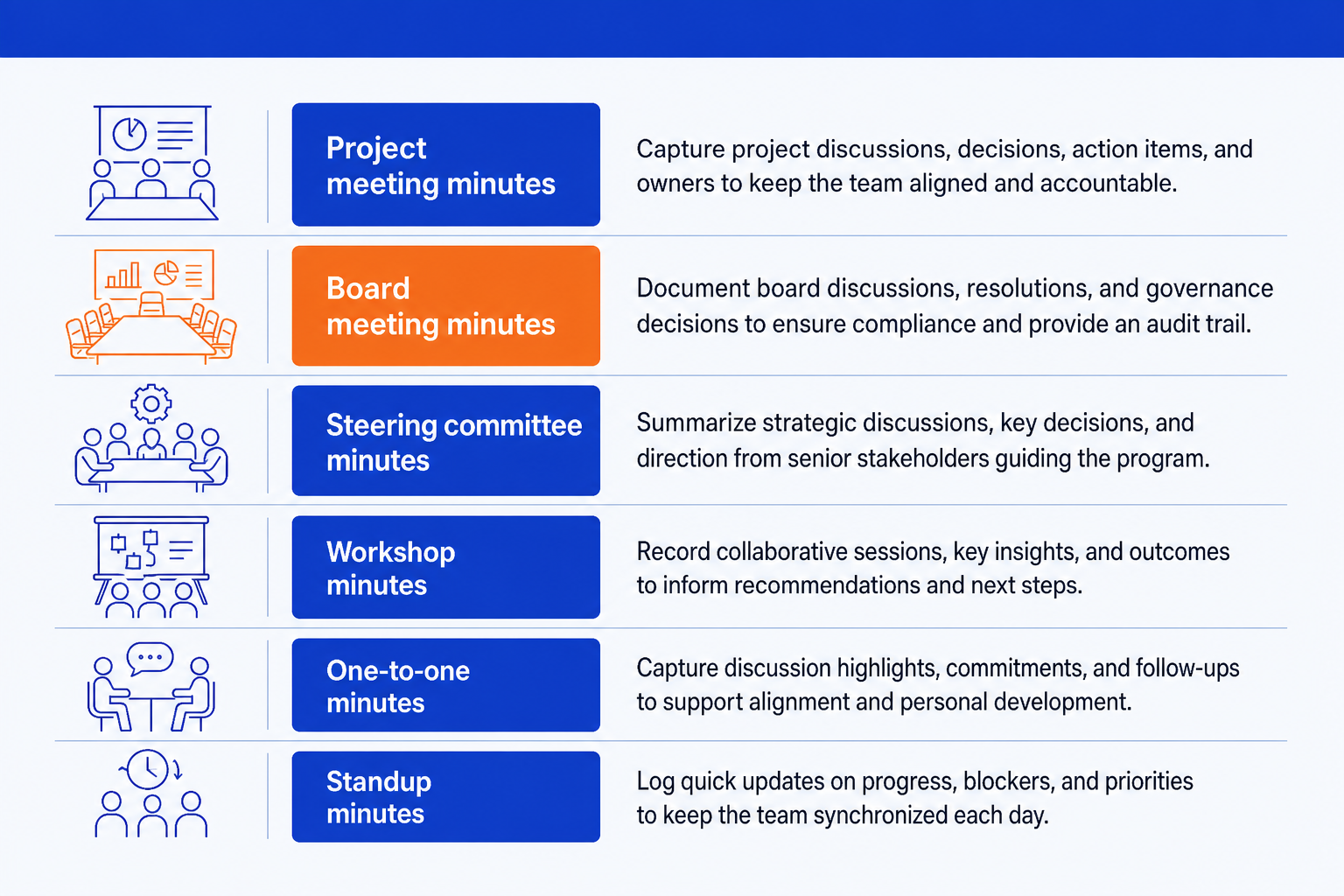
| Criteria | Project | Board | Steering committee | Workshop | One-to-one | Standup |
|---|---|---|---|---|---|---|
| Main purpose | Track decisions and owners | Create a legal governance record | Record direction, not status | Capture ideas and priorities | Hold two people to commitments | Surface only what changed |
| How formal | Light | Very formal | Semi-formal | Light | Informal | Minimal |
| Typical length | Half a page | 1 to 3 pages | Half a page | About a page | A few lines | A few lines |
| Who reads it | The project team | Directors, auditors, regulators | Program sponsor and leads | Participants and their managers | The two people involved | The immediate team |
| Biggest risk if skipped | Action items get forgotten | A decision cannot be proven to have been made properly | The same debate happens again next month | Good ideas from the room get lost | Commitments quietly slip | A blocker sits unresolved for days |
1. Project meeting minutes
A project meeting happens on a fixed cadence for one workstream. The reader is the team itself, so the minutes exist mainly to fix who owns what and by when, not to record who said what.
What was kept
- Every decision, written as a decision, not as a summary of the discussion that led to it.
- An owner and a date on every action item. An action item with neither is a hope, not a task.
- The one open risk that could block the next milestone, flagged so it does not quietly slip.
What was cut
- The back-and-forth about dropping the CSV path. Three people agreed in under two minutes; nobody needs the transcript.
- Status updates that did not change since last week. If nothing moved, it does not go in the minutes.
- Small talk and scheduling logistics for the next meeting, which belongs in a calendar invite, not a record.
Verdict
Best for a recurring team or project meeting where the reader needs to know what changed and who owns it next, not what was discussed.
2. Board meeting minutes
A board meeting produces a formal governance record. It can be read years later by an auditor, a regulator, or a court, so it needs a different level of precision than an internal team meeting.
What was kept
- The resolution wording itself, close to verbatim, plus the exact vote count. This is the part an auditor or regulator will actually check.
- Quorum confirmation at the top. A decision made without quorum is not a valid decision, so this line has to be there.
- Declared conflicts of interest and who recused themselves from which vote, recorded at the moment it happened.
What was cut
- The substance of the debate that led to the vote. Minutes record that the board decided, not a transcript of who argued which side.
- Draft figures and options that were discussed and rejected before the board settled on the final number in the resolution.
- Informal remarks made before the meeting was formally called to order.
Verdict
Best for formal governance bodies, boards, trusts, and committees with legal reporting duties, where the record has to survive scrutiny long after anyone remembers the meeting.
These minutes are usually filed as one item inside the wider board pack. See how to structure a board pack and its contents for what typically surrounds them.
3. Steering committee minutes
A steering committee oversees a program on behalf of senior stakeholders who were in the room last time and do not need the background re-explained. Minutes here exist to record direction, not status.
What was kept
- The one status change that actually moved, red, amber, or green, and the reason it moved.
- The decision the committee was asked to make and the exact scope of what it approved, this workstream only, not the whole program.
- The escalation raised and who owns carrying it forward.
What was cut
- A full re-read of every workstream's status, including the ones that did not change since last month.
- Background on the program's original business case, which the same group has already heard several times.
- The vendor's explanation for the delay, beyond the one-line root cause needed to justify the decision.
Verdict
Best for monthly or bi-weekly program governance meetings with a standing senior audience that already has the context.
When a steering committee's decisions need to reach a wider audience, the same content often gets restructured into a monthly business review deck agenda instead of a page of minutes.
4. Workshop minutes
A workshop produces ideas and options, not usually a single decision. Minutes for a workshop have to capture the output of a group process, not a list of who said what.
What was kept
- Themes grouped across all the breakout groups, not a separate list per group repeating the same three ideas.
- The vote count from the prioritization exercise, so the ranking traces back to the room rather than to whoever wrote the minutes.
- One clearly owned next step for the theme the group agreed to pursue first.
What was cut
- Individual sticky notes and who wrote them. What matters is the theme they rolled up into, not the attribution.
- Ideas raised and then dropped during discussion before the group settled on the three themes above.
- The facilitator's exercise instructions and timings, which belong in the workshop plan, not the output record.
Verdict
Best for facilitated workshops, design sprints, and offsites where the point is the ideas the room converged on, not a decision log.
5. One-to-one minutes
A one-to-one is informal and personal, so the record should be lighter than any of the meetings above. Its main job is to hold both people to what they committed to, not to document the conversation.
What was kept
- Commitments made by either person, so the next one-to-one can open by checking them off instead of guessing what was agreed.
- Anything from a previous one-to-one that is now resolved, closed out explicitly so it does not linger unaddressed.
- Nothing said in confidence. If it should not be written down, it is not written down.
What was cut
- General discussion about workload or morale, unless it produced a specific commitment.
- Personal context shared in confidence. A one-to-one is not the place for a paper trail of a private conversation.
- Anything that reads like a performance review. That belongs in its own documented process, not a weekly note.
Verdict
Best for regular manager check-ins, kept as a short shared note rather than formal minutes.
6. Standup minutes
A daily or twice-weekly standup barely needs minutes at all. The format below reads closer to a change log than a meeting record, because most of what gets said out loud has not changed since yesterday.
What was kept
- New blockers only, the ones nobody already knew about yesterday.
- Anything that changed scope, priority, or ownership since the last standup.
- The date on each entry, so a blocker still open after two days stands out on its own.
What was cut
- The full round-robin of what each person did yesterday, when nothing about it changes anyone else's plan.
- Restating tasks that are still simply in progress with no change.
- Side conversations that ran long and got resolved outside the standup itself.
Verdict
Best for daily or near-daily team syncs where most days produce nothing worth writing down at all.
Frequently asked questions
What should meeting minutes include?
Good meeting minutes include the date and attendees, the decisions that were made, and any action items with a named owner and a date. Most meetings do not need a record of the discussion itself, only its outcome. A more formal meeting, such as a board meeting, also needs a quorum confirmation and, where a vote was taken, the exact result.
How long should meeting minutes be?
As short as the meeting allows. A recurring team or project meeting usually fits on half a page. A steering committee or workshop can run to about a page. A board meeting is the exception: it can run several pages because the formal wording of each resolution has to be recorded closely, not summarized.
Who is responsible for taking meeting minutes?
Usually whoever organizes the meeting, or a designated note-taker if the group rotates the role. For a board or another formal governance body, this is typically a company secretary or a similarly designated officer, since the record carries legal weight.
Do meeting minutes need to be approved?
For a board or other formal governance body, yes. Minutes are typically circulated in draft and then formally approved at the start of the next meeting. For a regular team, project, or steering committee meeting, no formal approval step is expected, though sharing them for a short correction window is good practice.
What is the difference between meeting minutes and meeting notes?
Minutes record the formal outcome of a meeting: decisions, action items, and, for governance bodies, resolutions and votes. Notes are looser and can include more of the discussion, open questions, or reasoning behind a choice. Minutes are the official record; notes are a personal or working aid.
How soon after a meeting should minutes be sent?
Within 24 to 48 hours in most cases, and sooner if an action item is urgent. The whole point of minutes is to prompt action while the meeting is still fresh, so a delay of a week or more defeats the purpose even if the content is accurate.
Turning minutes into a slide, when you need one
Minutes on their own are enough for the meeting they came from. The moment those decisions need to reach people who were not in the room, a steering committee summary going to a board, or a project update going to a client, they usually need to become a slide or two instead of a page of text. Oria is an AI add-in for PowerPoint that can turn a set of meeting notes into an editable, on-brand slide without you rebuilding the layout by hand. See turning meeting notes into editable slides for how that conversion works.