

How to structure a steering committee pack
A steering committee pack should run in six sections: cover and agenda, overall status, progress by workstream, risks and issues, decisions needed, and an appendix. Use this steering committee template as the standing order for every meeting. Rate the whole program before rating any single workstream, and state every decision in the exact words the committee is asked to approve.
This guide walks each section, what goes in it, the mistakes that erode a committee's trust in the pack, a working template you can copy slide by slide, and the prompts that build it fast. Everything you need is here. You will not have to leave to get the substance.
What a steering committee pack is and when it goes out
A steering committee pack is the set of slides circulated to sponsors and workstream leads ahead of a steering committee meeting. It gives everyone the same starting point: the overall delivery status, progress by workstream, the risk position, and the specific decisions on the agenda. A good pack lets a member arrive with a view already formed. A poor one forces the room to read cold, which slows the meeting and weakens the decisions it produces.
Most steering committees meet every two to four weeks while a program is active, tightening around major milestones. Send the pack far enough ahead, two or three working days, for members to read it and raise questions before the meeting rather than during it. The overall status rating deserves the same discipline used in a well-built board pack: stated once, up top, with a clear one-line reason, not rebuilt from scratch each cycle.
The structure of a steering committee pack
Six sections carry a steering committee pack from status to decision, in that order. Get the order right and a sponsor can read only the first two sections and still know exactly where the program stands.
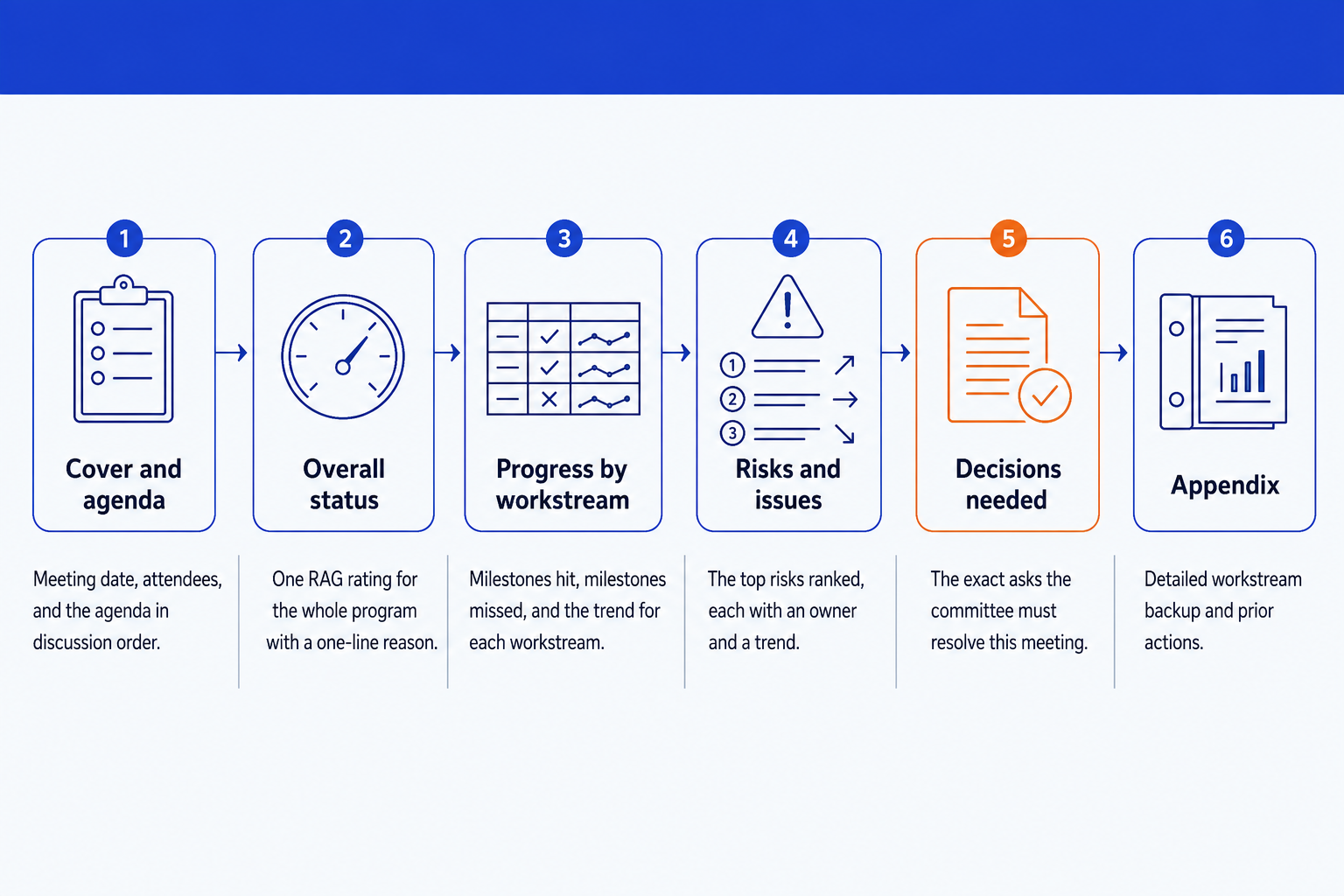
1. Cover and agenda. Meeting title, date, and the pack's version number.
2. Overall status. One RAG rating for the whole program, not just for each workstream.
3. Progress by workstream. Milestones hit and milestones missed against the plan.
4. Risks and issues. The top risks, ranked, with an owner and a trend arrow.
5. Decisions needed. The exact wording of each decision the committee is asked to make.
6. Appendix. Detailed workstream backup and supporting analysis.
What goes in each section: the contents checklist
Use this as a build checklist. For each section, confirm the three items below are present before the pack goes out. If one is missing, that is usually the gap a sponsor will ask about first.
Cover and agenda
Overall status
Progress by workstream
Risks and issues
Decisions needed
Appendix
For the decisions needed and risk sections specifically, our Claude skills for board-ready decks include a risk heatmap and a decision-page skill that map directly onto sections four and five above.
Common mistakes to avoid
Most of these come down to one habit: writing the pack in the order the work happened instead of the order the committee needs to read it. Lead with the status, then the decision, then the support.
The one-prompt route: turn your program update into steering committee slides
Formatting a RAG rollup, a workstream grid, and a decisions needed slide by hand, on a strict corporate template, is exactly the kind of mechanical work that eats an afternoon before a steering committee meeting. Oria removes it. It is an AI add-in that runs in the PowerPoint task pane and produces fully editable native PowerPoint elements in your template. You describe each slide in a line and Oria renders it.
Because the output is native, every tile, row, and label stays editable afterward. You can update a milestone, reword a decision, or recolor a status flag the morning of the meeting without rebuilding the slide.
One-line overall status prompt for Oria
The prompts that build the steering committee pack
These are the exact copy-paste prompts we use to build the highest-stakes slides in a steering committee pack and to draft the narrative behind them. The first three are for Oria inside PowerPoint; the last two are for drafting content in Claude before you build. Replace the bracketed parts with your own program details.
Build the slides in Oria
Build the workstream status grid
Build the risks and issues slide
Build the decisions needed slide
Draft the narrative in Claude first
Turn workstream updates into a status rollup
Summarize risk changes since the last pack
Tip
Draft the rollup and the decision wording in Claude, then hand the clean lines straight to Oria. If the program itself is a digital transformation, our Claude skills for digital transformation include a program-status rollup skill built for exactly this handoff.
A working steering committee pack template you can copy
Eight slides cover a routine steering committee pack. Copy this order, then add appendix pages behind slide eight for whatever the current cycle needs to support.
Cover slide. Meeting title, date, and pack version, nothing else.
Agenda slide. The items in discussion order with time allocated to each.
Overall status slide. One RAG rating for the whole program, the one-line reason, and what changed since last meeting.
Workstream status slide. A RAG rating and trend row per workstream, milestones hit and missed, with the one-line reason for any red or amber.
Risks and issues slide. The top five risks ranked by severity, each with an owner and a trend arrow.
Decisions needed slide. Each decision stated in the exact words the committee is asked to approve.
Actions slide. Open actions from the last meeting, each with an owner and a due date.
Appendix divider slide. A single page marking where the workstream backup detail begins.
A meeting carrying a major decision, a scope change or a go or no-go gate, will need more appendix pages, but the first eight slides above stay the same regardless of what the committee is being asked to decide.
The template above ends at the appendix, but the meeting itself does not: see our guide to what belongs on a PowerPoint questions slide for the closing slide that hosts the discussion once the pack has been presented.
Frequently asked questions
What is a steering committee pack?
A steering committee pack is the set of slides circulated to sponsors and workstream leads ahead of a steering committee meeting. It gives every member the same starting point: the overall delivery status, progress by workstream, the risk position, and the specific decisions on the agenda. A good pack lets a member arrive with a view already formed rather than hearing the update cold in the room.
What sections should a steering committee pack include?
Six sections cover most steering committee packs: cover and agenda, overall status, progress by workstream, risks and issues, decisions needed, and an appendix. Smaller programs can compress these into fewer slides, but the order, status first, then detail, then the decision, should stay the same.
How is a steering committee pack different from a board pack?
A steering committee pack tracks the delivery of one specific program or project: workstream progress, milestones, and program-level risk, for the sponsors and leads running it week to week. A board pack reports company-wide financial and strategic performance to directors who meet less often and sit a level above any single program. Our guide to board pack structure covers the board-level version of the same discipline.
How often should a steering committee meet?
Most steering committees meet every two to four weeks while a program is active, tightening around major milestones or decision points. Whatever the cadence, the pack should reflect only what changed since the last meeting, not the full history again.
What is the fastest way to build a steering committee pack?
Draft the narrative first: the overall RAG rating and its one-line reason, the workstream status rows, and the exact wording of each decision. Then describe each slide in one line and let Oria render it. You get a fully editable native PowerPoint deck on your corporate template, with the RAG rollup, workstream grid, and decisions-needed slide already laid out. You skip the manual formatting entirely.