

Board Presentation: Structure and a Working Template
A board presentation is the set of slides a management team uses to take directors from context to a decision. It opens with the recommendation, supports it with financial, strategic and risk evidence, and closes on resolutions the board can minute.
Quick answer: what is a board presentation?
You are not presenting information to a board. You are asking seven or eight people, most of whom have read the pack once and some of whom have not, to authorise something. That changes what the deck is for. Every page either helps a director reach a decision or gets out of the way.
A board presentation is the slide narrative a management team uses in a board meeting to move directors from context to a decision. It follows seven parts in a fixed order: cover and agenda, executive summary, financial performance, strategic and operational update, risk and compliance, decisions requested, and appendix. The recommendation appears in the executive summary, before the evidence, and the decisions page lists the exact resolutions to be approved. Supporting analysis sits in the appendix so the main narrative stays short enough to leave time for discussion.
The structure of a board presentation in seven parts
The order is the argument. Context first so directors orient, the recommendation second so they read everything after it with a question in mind, the evidence in the middle, and the specific decision last. Everything that would slow that path goes to the back.
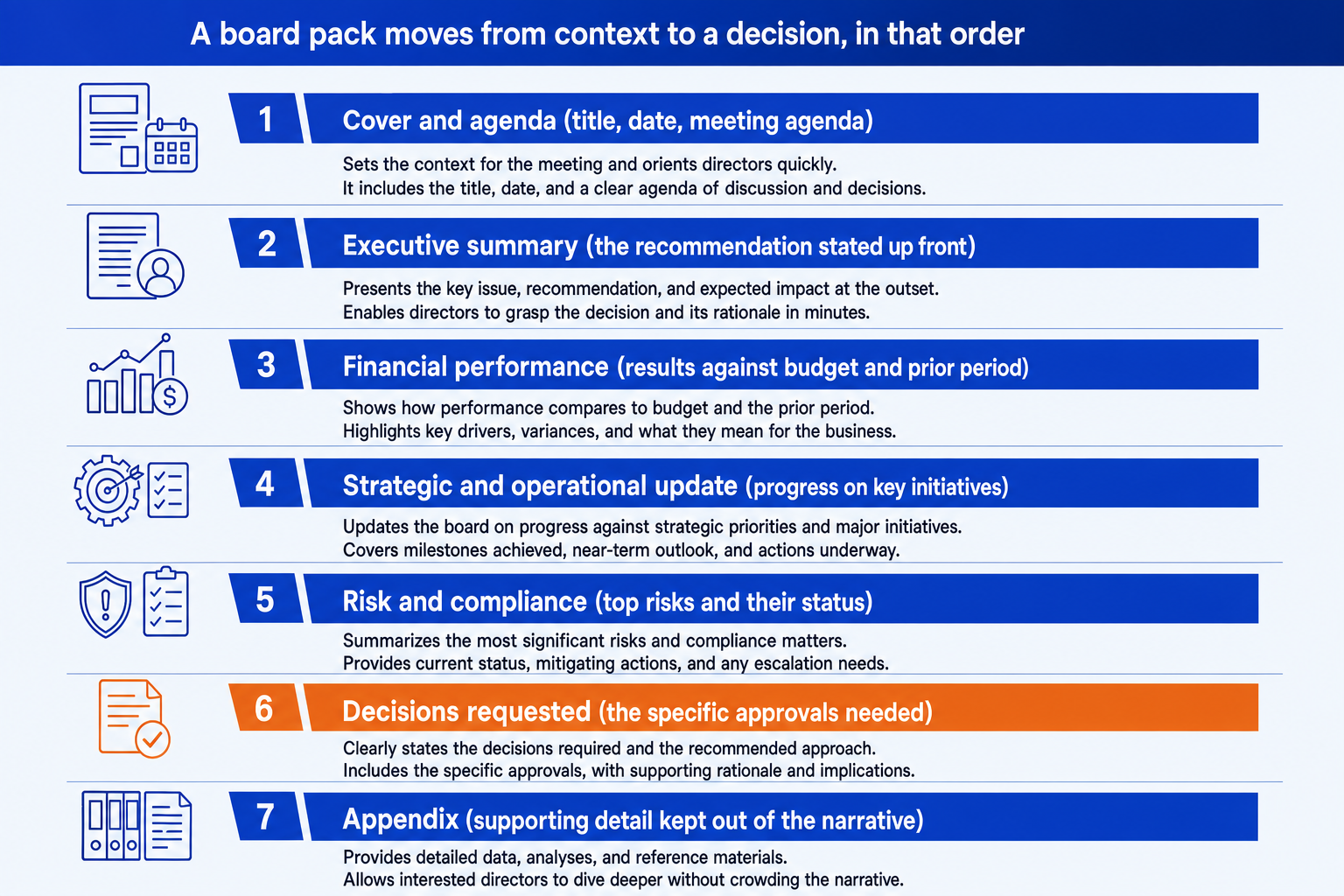
Each part below carries three things: what goes in it, wording you can copy, and an example entry. The example entries all belong to one illustrative company, called Halden Components, so the pages tie to each other the way a real pack must. The numbers are worked through in the example section further down.
Parts 1 to 3: context, recommendation and results
The opening three parts answer three questions in order: what is this meeting for, what are you asking us to do, and how is the business doing. They take roughly a quarter of the time in the room.
1. Cover and agenda
The meeting, the date, who is presenting, and the one or two items that need a decision. Directors read this to learn how much of the meeting is theirs to decide.
Wording for part 1
Example entry: Halden Components, Board of Directors, 12 March. For decision: second production line. For noting: Q4 results, risk register.
2. Executive summary
The recommendation, stated first, with the three numbers that justify it and the single risk the board should weigh. If a director reads only this page, they should still be able to vote.
Wording for part 2
Example entry: We recommend approving $18.0m for a second production line because current capacity is sold out. Payback 3.5 years. Leverage peaks at 2.4x against a 3.0x covenant.
3. Financial performance
Results against budget and against the prior period, with the two or three drivers that explain the gap. Directors want the variance and its cause, not a restatement of the management accounts.
Wording for part 3
Example entry: Revenue $412m, 1.7% above budget and 5.9% above last year. EBITDA $60.0m, 2.4% below budget on higher input costs.
The executive summary is the page to get right first. The longer treatment, with eight layouts, is in the guide to building an executive summary slide, and the executive summary examples show what the same page looks like across eight kinds of decision.
Parts 4 to 7: progress, risk, decision and appendix
The closing four parts are where boards spend their time. Progress and risk produce the discussion. The decisions page converts it into a resolution. The appendix is what lets a sceptical director test the work without slowing the room.
4. Strategic and operational update
Progress on the initiatives the board already approved: milestone, status, next step, owner. This is the part of the pack that most often grows without limit, so cap it at one page per initiative.
Wording for part 4
Example entry: Line 2 commissioning is 6 weeks behind plan because of a supplier delay. The recovery plan is on page 9.
5. Risk and compliance
The top risks with their status, the action under way, and anything that needs escalation. Five to seven risks is the working limit. A register of forty is an appendix.
Wording for part 5
Example entry: Single-supplier dependency on the line 2 press moved from medium to high. Mitigation: second source qualified by June.
6. Decisions requested
The exact resolutions, worded so they can be minuted. This is the page the meeting exists for, and the only one in the orange position on the structure diagram above.
Wording for part 6
Example entry: To approve capital expenditure of up to $18.0m for a second production line. If deferred one quarter, the first customer deliveries slip to the following fiscal year.
7. Appendix
Supporting analysis kept out of the narrative: full financial tables, sensitivity cases, the long risk register, vendor comparisons. Directors who want to test the argument can; the rest never have to wade through it.
Wording for part 7
Example entry: A2 shows payback at 3.0, 3.5 and 4.5 years under three volume cases, so a director can see how the recommendation holds if demand disappoints.
For the progress section, a strategy roadmap slide is the usual exhibit: initiatives down the side, quarters across the top, status shown as a single marker per milestone.
Board presentation example: one decision worked end to end
Take the Halden Components decision used in the example entries above. The business is illustrative, and every figure below is built from the inputs shown, so you can swap in your own and keep the same arithmetic.
The inputs are an $18.0m capital request, $5.2m of added annual EBITDA once the line is running, current EBITDA of $60.0m, current net debt of $126m, a board payback hurdle of four years and a leverage covenant of 3.0x net debt to EBITDA. The question the pack has to settle is whether the board can approve this without breaching either limit.
| Step | Arithmetic and result |
|---|---|
| Decision | Approve $18.0m of capital for a second production line at Halden Components (an illustrative company). |
| Payback | $18.0m cost divided by $5.2m of added annual EBITDA = 3.46 years, shown as 3.5 years. Board hurdle: 4.0 years or less. |
| Leverage today | Net debt $126m divided by EBITDA $60.0m = 2.1x. |
| Leverage if debt funded | Net debt $144m (126 + 18) divided by EBITDA $60.0m = 2.4x. Covenant limit 3.0x, so headroom is 0.6x. |
| Leverage once the line earns | EBITDA $65.2m (60.0 + 5.2). $144m divided by $65.2m = 2.2x. |
| Conclusion for the page | The investment clears the payback hurdle and keeps leverage inside the covenant at its peak. The board is asked to approve. |
That table becomes the executive summary title, almost word for word: we recommend approving $18.0m for a second production line because current capacity is sold out; payback is 3.5 years and leverage peaks at 2.4x against a 3.0x covenant. The financial performance page then explains why EBITDA is 2.4% below budget (1.5 divided by 61.5), so a director does not discover the variance in the middle of the discussion. The risk page names the supplier dependency, and the decisions page carries the single resolution. Three pages, one set of numbers, no contradictions.
The trade-off: a worked example is only as honest as its inputs. Payback of 3.5 years assumes the added EBITDA arrives in full from year one. The appendix sensitivity page exists so a director can see what happens when it does not, and a pack that omits it has hidden its weakest assumption.
When to use a board presentation
Use the full seven-part structure when the meeting has to produce a decision: a capital request, an acquisition, a financing, a strategy refresh, an annual budget. The structure earns its length because each part answers a question a director will otherwise ask out loud.
For a routine quarterly meeting with nothing to approve, collapse it: keep the executive summary, results and risk, and cut the decision page to a short list of items for noting. For a single contested decision, the live narrative can be one page of evidence and a decisions page, with the rest in the pack. Where the people on the other side of the table matter as much as the numbers, a stakeholder map tells you which directors to brief before the meeting rather than during it.
When a board presentation misleads
The structure flatters a decision that has already been made. Putting the recommendation first is right when the team has a view and the board is there to test it. It is wrong when the board is meant to shape the options, because the recommendation then anchors the discussion and the alternatives are read as straw men. In that case, open with the options and the criteria, and bring the recommendation in once the board has seen both.
It also hides what does not fit a slide. A single payback figure and a single leverage figure look decisive, but they compress the assumptions behind them, and a tidy executive summary can make a fragile case look robust. The failure mode is specific: the summary says 3.5 years, the appendix shows 6.0 years under the downside case, and no director turns to the appendix. If the downside changes the answer, it belongs on a main page, not behind one.
Finally, a deck is a poor vehicle for nuance. Boards that rely on long narrative papers read the reasoning in full before the meeting, and a slide version of the same material loses the argument. Match the format to how your board actually prepares.
Board presentation vs board pack vs board paper
The three terms get used interchangeably, and the confusion produces decks that try to be the whole pack. They are different artifacts with different readers.
| Artifact | What it is | Who reads it and when | What it contains |
|---|---|---|---|
| Board presentation | The slides shown in the room | Directors, live, in 30 to 90 minutes | One narrative that ends in a decision |
| Board pack | The full document sent before the meeting | Directors, alone, in advance | Every paper, report and appendix for the meeting |
| Board paper | A single memo on one agenda item | Directors, in advance, one item at a time | Background, options, recommendation, resolution |
| Investor update deck | Slides sent to shareholders | Investors, often asynchronously | Performance narrative with fewer formal decisions |
A useful rule: the presentation should add nothing the pack lacks, and the pack should be understandable without the presentation. For the underlying exhibit discipline in the room, including what to do with animation, PowerPoint transitions for board decks covers the three that hold up.
How to build a board presentation in PowerPoint
Build it in this order, and the template above does most of the work.
Write the decisions page first. If you cannot state the resolution in one sentence, the deck is not ready to build.
Write the executive summary title from it, then the three numbers. Check each number against the arithmetic before any other page exists.
Draft the evidence pages with action titles: a full sentence stating the finding, not a topic label.
Move everything that supports but does not carry the argument to the appendix, and tie every main-page number to an appendix page.
Put the deck on the corporate master, then read it as a director would: executive summary, decisions page, and one page of your choosing.
Oria builds this kind of deck. It is made for corporate documents and consulting presentations: board packs, steering committee decks, diligence exhibits and dense frameworks held to an enforced corporate template. It reaches you two ways, as a PowerPoint add-in in the task pane on Windows, macOS and PowerPoint for the web, and as a connector for Claude and ChatGPT over MCP, so the deck can be built from the chat you are already in. Output is native, editable PowerPoint on your master. The related guide on boardroom strategy decks with Claude shows the chat route in detail.
One-prompt route
The trade-off: Oria is built for the corporate environment and loses on highly visual work. Founder fundraising and pitch decks, launch and campaign decks, student presentations and marketing one-pagers want visual impact more than defensible content, and a design-led tool such as Gamma, Canva, Pitch or Beautiful.ai will beat it there and look better doing it. It will also not decide what your recommendation is.
Which tool should you use for a board presentation?
| If you need | Use | Why |
|---|---|---|
| A board presentation inside your firm template, as editable slides | Oria | Built for board packs and steering committee decks. Output is native PowerPoint on your master, from the add-in or from Claude and ChatGPT over MCP. |
| Charts and waterfalls that stay linked to a data sheet | think-cell | A mature add-in that owns the chart layer. It does not write the narrative or the structure of the deck. |
| A fundraising, launch or visually led presentation | Gamma, Canva, Pitch or Beautiful.ai | Where the job is visual impact rather than defensible content, a design-led tool will beat a corporate template and look better doing it. |
| A governance portal with agendas, minutes and voting | A board portal | Portals hold the papers, the resolutions and the audit trail. Slides are one input to that record. |
| A sentence-level edit of the argument before any slide exists | A document, or Claude | Settle the storyline in text, then render it once. |
Common board presentation mistakes to avoid
Frequently asked questions
What is a board presentation?
A board presentation is the set of slides a management team uses to take a board of directors from context to a decision. It states the recommendation early, supports it with financial, strategic and risk evidence, and ends with the specific resolutions the board is asked to approve. Detailed analysis sits in an appendix so the main narrative stays short.
How do you structure a board presentation?
Use seven parts in this order: cover and agenda, executive summary, financial performance, strategic and operational update, risk and compliance, decisions requested, and appendix. Put the recommendation in the executive summary, not at the end, and make the decisions slide a list of resolutions that can be minuted word for word.
How long should a board presentation be?
Long enough to carry one decision and short enough to leave time for discussion. Most teams plan one main page per agenda item plus an executive summary, with everything else in the appendix. The test is time, not page count: if the discussion of the decision starts after the halfway point of the slot, there is too much before it.
What is the difference between a board presentation and a board pack?
The board pack is the full document set circulated before the meeting: papers, reports and appendices that directors read alone. The board presentation is the slide narrative used in the room to focus the discussion. The presentation should never contain anything the pack does not, and the pack should never need the presentation to be understood.
What should go on the executive summary of a board presentation?
The recommendation, the reason it is time-bound, the three numbers that support it and the main risk. Write the title as a full sentence that states the recommendation. A director who reads only that page should be able to say what is being asked and why, and whether they would vote for it.
Should a board presentation be a deck or a document?
Both usually exist. The document, or pack, carries the detail and is read in advance. The deck structures the live discussion and keeps it on the decision. If your board prefers narrative papers to slides, the same seven-part structure works as a memo, and the sequence of sections does not change.