

Pitch Deck: What Goes in One, With Worked Examples
A pitch deck is a short slide presentation, usually ten to twelve slides, that a founder uses to persuade an investor to take a meeting or write a cheque. It covers the problem, the product, the market, the business model, the team and the ask, and it produces one outcome: a next conversation.
The decision you are making is not which template to open. It is which questions to answer, in what order, with what evidence, for a reader who will give the file a couple of minutes. Below: every part of the deck, one worked example with the arithmetic shown, the cases where the format misleads, and where to build it.
Quick answer: what goes in a pitch deck?
Eleven or twelve slides in a fixed order: the one-line pitch, the problem, the solution, the product, traction, market size, the business model, competition, go-to-market, the team, financials and the ask. Each slide answers one question an investor reliably asks, and the order moves from why this matters to what you want.
A pitch deck is a short investor presentation that tells one story in about ten to twelve slides. It opens with a specific problem and a simple solution, then spends most of its length on proof: a real product, traction, and a market sized from the bottom up by counting customers and multiplying by price. It closes with the team, a short forecast and a specific ask that states the amount, what it funds and the milestone it reaches. Its job is to win a second conversation, not to close the round, so it should be clear enough to read alone in a couple of minutes.
How we decided what goes in a pitch deck
There is no single canonical list, so we applied four tests to every candidate slide before it earned a place.
Does an investor ask the question
A slide earns a place only if a seed or Series A investor reliably asks the question it answers. Slides that exist because a template had a box for them were cut.
Can it be answered in one slide
If answering needs a page of text, it belongs in the appendix or the data room. We kept the sections that fit on one slide at a readable size.
Is the entry checkable
Each part is described by what goes in it and a concrete entry. An entry an investor cannot check, such as a vague claim about being early, scored zero.
Does it work when read, not presented
Most decks are opened alone and skimmed, not delivered on stage. We favoured the order that reads correctly with nobody talking over it.
What we ignored: visual style, template galleries, colour palettes and animation. Those matter for how a deck looks. They do not change which questions it has to answer, and this page is about the questions.
Key takeaways
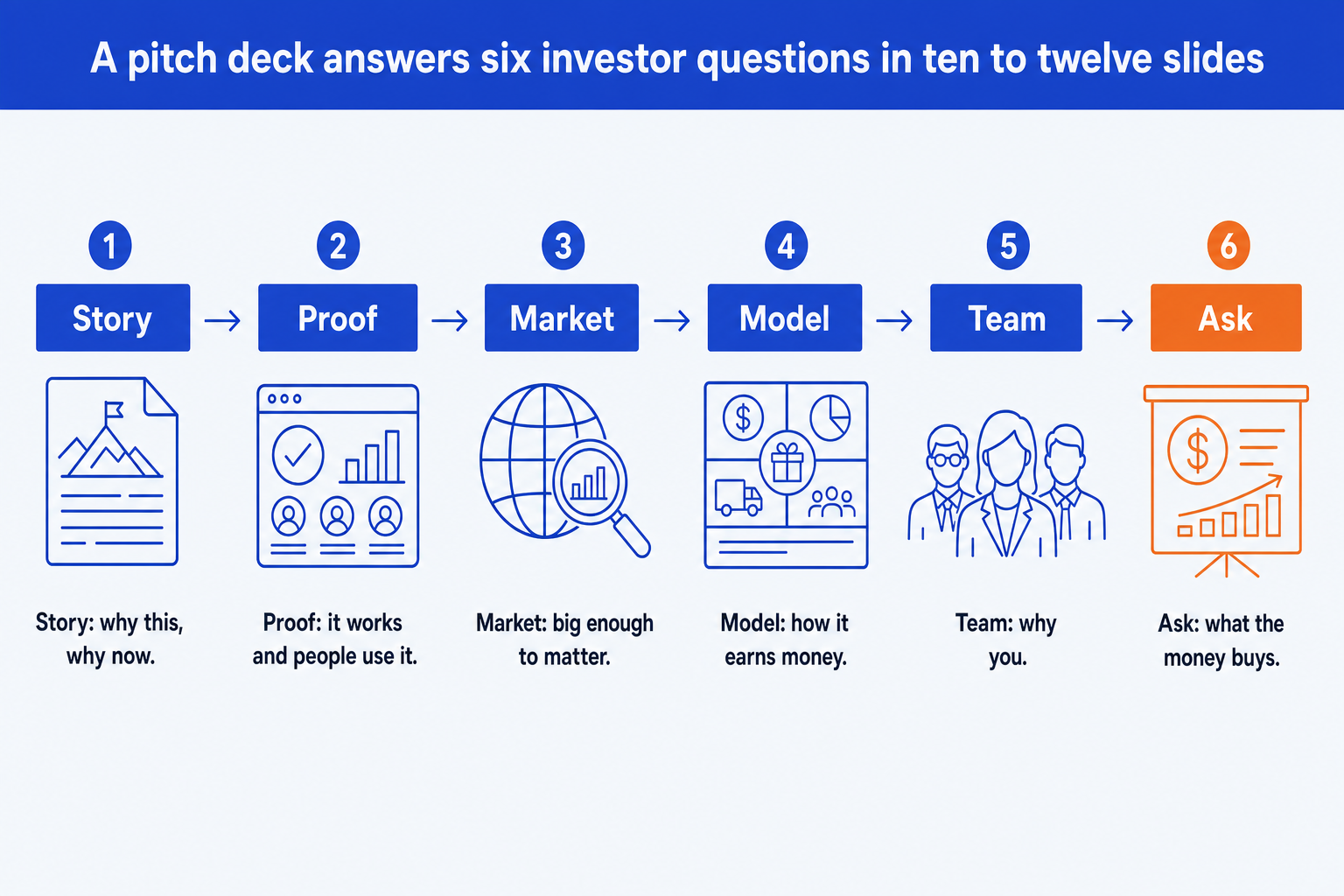
- Build the deck around six questions, not twelve slide names. Why this, does it work, is the market big enough, how does it earn money, why you, and what does the money buy. Every slide serves one of those, and any slide that serves none is cut.
- Put the strongest proof early. An investor who gives a deck a couple of minutes decides on the first few slides, so traction or a sharp customer result belongs before the market-size slide, not after the team slide.
- Size the market from the bottom up. Count customers and multiply by what each pays. A top-down claim that you need one percent of a huge number is the most recognised weak slide in the genre.
- Make the ask specific. State the amount, what it funds and the milestone it reaches, with the runway arithmetic shown. An ask with no milestone gives the investor nothing to underwrite.
- Keep two versions. One is dense and reads alone when sent ahead. The other is sparse and carries the talk in the room. Forcing one file to do both produces a deck that fails at each.
The parts of a pitch deck, slide by slide
Twelve parts, in the order an investor meets them. Each row names what goes in the slide, the question it answers, one concrete entry and the miss to avoid.
| Slide | What goes in it | Question it answers | Example entry | Common miss |
|---|---|---|---|---|
| Title and one-line pitch | What the company is, in one sentence | What do you do? | Software that turns signed contracts into a payment-risk score for finance teams | A tagline instead of a plain description |
| Problem | The pain, who has it, what it costs now | Why does this need to exist? | Finance teams reconcile invoices by hand and discover disputes at month end | A problem only the founder has met |
| Solution | What you built and the one change it makes | Does your answer fit the problem? | Flags at-risk invoices at upload, before they go out | A feature list in place of an outcome |
| Product | A real screen or short flow | Is it real? | The dashboard a customer sees on day one | Mock-ups presented as shipped product |
| Traction | Evidence that people use or pay for it | Is it working? | Paying customers, revenue, retention, signed pilots | Vanity numbers such as sign-ups with no usage |
| Market size | Customers times price, built bottom up | Is it big enough to matter? | 12,000 target firms at 18,000 a year | A top-down percentage of a giant market |
| Business model | Who pays, how much, how often | How does it earn money? | Annual subscription per finance seat, tiered by invoice volume | No price, or a price with no buyer |
| Competition | The alternatives a buyer uses today | Why will you win? | Spreadsheets, an ERP module, two point tools, and the gap each leaves | A quadrant with you alone in the corner |
| Go-to-market | How the first hundred customers arrive | Can you reach buyers? | Direct outreach to controllers, then partner referrals | Naming channels with no cost or conversion logic |
| Team | Why this group can do this | Why you? | Prior roles that map to the problem and the build | A list of logos instead of relevance |
| Financials | A short forecast tied to the ask | What does the plan imply? | Revenue and burn for the next eighteen months | A hockey stick with no stated assumption |
| The ask | Amount, use of funds, milestone | What does the money buy? | Raising 2 million for 18 months to reach a defined revenue milestone | A number with no milestone attached |
What goes in the story slides of a pitch deck?
The story slides are the title, the problem and the solution. They carry no proof yet, so their only job is to make the next ten slides worth reading. The title says what the company is in plain words. The problem names who has the pain, how often, and what it costs them today. The solution says the one thing that changes once your product exists.
Write the problem so a customer would nod and a stranger would understand. A good problem slide has one specific scene, such as a controller finding a disputed invoice on the last day of the month, rather than a statement that finance is broken. The solution slide should mirror it: the same scene, with the dispute caught at upload. Resist the urge to list features here. Features belong on the product slide, where they can be shown.
The trade-off: a vivid problem slide is memorable but it is only an assertion. Without proof two slides later, it reads as a pitch about a pain you imagine, so keep it short and move to evidence quickly.
What proof goes in a pitch deck?
Proof is the product, traction and market slides. This is where an investor decides whether the story is real. The product slide shows an actual screen or a short flow, not a render. Traction shows the numbers that demonstrate demand: revenue, paying customers, retention, signed pilots. Market size shows the ceiling.
Choose the traction metric that matches your stage. Pre-revenue, it is waitlists with conversion, design partners and signed letters of intent. Post-revenue, it is monthly recurring revenue, growth rate and retention. Always show a time axis, because a single number with no date cannot be judged. For the market slide, count the number of target customers, multiply by the price each would pay, and show both inputs. Our worked example below does exactly that.
The trade-off: the market slide is the one most founders inflate. A very large number is easy to write and is also the number investors discount fastest, so a smaller bottom-up figure you can defend beats a large one you cannot.
How does a pitch deck explain the business?
The business slides are the business model, competition and go-to-market. They answer how the company earns money, who it is up against, and how customers will find it. Together they turn a good product into a company.
Business model is one sentence and one number: who pays, how much, how often. Competition lists what a buyer does today, including doing nothing, and states the gap each option leaves. Naming a real alternative earns more trust than a chart where you sit alone in the top-right corner. Go-to-market names the first channel, who owns it, and what you expect it to cost to land a customer. If you cannot state a cost, say what you will test first.
The trade-off: an honest competition slide invites questions you would rather avoid. It is still the better choice, because an investor who finds the competitor you left out will assume you did not know, or hoped they would not.
What goes in the team and ask slides?
The closing slides are the team, the financials and the ask. They convert interest into a decision. The team slide explains why this group can build this product. The financials slide shows a short forecast. The ask states the amount and what it buys.
On the team slide, list only experience that maps to the problem or the build, and name any gap you plan to hire for. Keep the financials to eighteen to twenty-four months of revenue and burn, with each assumption stated beside the number it drives. The ask closes the loop: the amount, the split of spend across hiring, product and go-to-market, and the specific milestone it reaches. Show the runway arithmetic so an investor can check it in their head.
The trade-off: a precise ask exposes you to a precise objection. The alternative, a vague ask, is read as not having a plan, so state the amount and be ready to defend it.
How long do investors spend on a pitch deck?
Less time than you spent writing it. DocSend, whose software tracks how investors view shared decks, reported an average review time of 2 minutes 24 seconds in its 2024 data, a fall of 24 percent since 2021. An earlier DocSend study of funded seed decks, reported by TechCrunch, found investors spent an average of 3 minutes 44 seconds. Across both, the first few slides carry the decision.
The length advice follows from that. Guy Kawasaki, the entrepreneur and former Apple evangelist, popularised the 10/20/30 rule: ten slides, a twenty minute talk, and no font smaller than 30 points. His reasoning is that an audience can absorb about ten concepts in one sitting. Read the rule as a discipline about restraint. It does not mean a deck with eleven slides is wrong, only that every slide beyond ten must justify itself.
The trade-off: averages hide the spread. A short review time may reflect a quick pass on a weak deck as much as carelessness, so use these figures to order your slides, not to cut proof you need.
A worked pitch deck example, with the numbers
One example carried end to end. The company is invented, so the arithmetic is the point, not the business. Replace every input with your own.
The company (illustrative)
Ledgerline, an invented software company that scores payment risk on invoices. It is a worked example, not a real business, and every figure below is made up to show the arithmetic.
Problem slide
Finance teams at mid-size firms find disputed invoices at month end, when fixing them delays the close. The slide shows one scene: a controller, the last working day, three disputes found too late.
Market slide, bottom up
12,000 target firms multiplied by 18,000 a year per firm gives 216 million a year. That is 12,000 x 18,000 = 216,000,000. The slide shows both inputs and where each came from.
Traction slide
Eight paying customers, 14,000 a month in recurring revenue, retention of all eight over six months. Shown as a monthly chart so the investor sees the slope, not just the end point.
The ask slide
Raising 2,000,000 over eighteen months. 2,000,000 divided by 18 is about 111,000 a month of average burn. Milestone: 60 paying customers, which at the same price implies about 105,000 a month in revenue.
The conclusion the deck produces: a defensible 216 million a year market, early proof of retention, and a round sized to a milestone the same price list can check. To size your own market the same way, follow the market sizing slide guide. For the valuation that sits behind the ask, see how Claude can pressure-test a startup valuation, and for the forecast behind the financials slide, the startup financial modelling skills.
The trade-off: a tidy worked example makes every number look obtainable. Real inputs are messier, so show the range you believe and say which input you trust least.
What do real pitch deck examples have in common?
Early decks from well-known companies, including the widely shared 2009 seed deck from Airbnb, are published online and worth reading in full. Read them for order, not content. They tend to open on the problem, move quickly to the solution and early proof, cover market, business model and competition, and close on team and a financial picture. The same sequence appears in the table above.
The more useful distinction is the version, because one file rarely serves every reader. Most founders need three.
| Version | Who reads it | Style | Use |
|---|---|---|---|
| A sent-ahead deck | Read alone, skimmed on a phone | Dense: full sentences, labelled charts, numbers on the page | Reads without you in the room |
| A presented deck | Delivered live, about twenty minutes | Sparse: one idea and one visual per slide | Needs the speaker to make sense |
| An appendix | Held back for questions | Detail: cohorts, pipeline, cap table, unit economics | Do not send unless asked |
Corporate readers want the dense version. If your audience is a corporate development team or a committee rather than a seed investor, the page you want is closer to an executive summary slide than to a story, and pitch book skills for Claude cover the banker's variant of the same document.
When should you use a pitch deck?
Use one when the goal is a specific next step with someone who has money, a contract or a decision to give: a seed or Series A raise, a corporate venture conversation, an accelerator application, a partnership proposal. The format is the right instrument when you need a stranger to understand a company in minutes and decide whether to spend an hour on it.
It is the wrong instrument when the reader needs to verify rather than be persuaded. A late-stage investor will ask for the model, the cohort data and the contracts in a data room. A pitch deck sits in front of that material. It does not replace it. Before the deck, many founders work out who to send it to, which is the subject of fundraising skills for finding the right investors.
When does a pitch deck mislead?
The format rewards the story, so it flatters whichever company tells one best. A fluent founder with thin traction can out-pitch a weaker storyteller with a better business, and a deck cannot tell you which you are looking at. The slides that mislead most are the ones that cannot be checked: a market size with no inputs, a forecast with no assumptions, a team slide listing logos.
It also compresses. Retention across customers of different ages, or revenue that depends on one buyer, vanishes inside a single headline number. If you are reading a deck, ask for the cohort view and the customer list. If you are writing one, show the awkward number yourself, because an investor who finds it unaided trusts the rest less. Below are the failures that appear most often.
How do you build a pitch deck?
Write the six answers as plain sentences first: why this, does it work, is the market big enough, how does it earn money, why you, what does the money buy.
Do the arithmetic outside the slides. Market size, burn and the milestone live in a spreadsheet, and the slides quote them.
Give each answer one slide and an action title that states the point, then add the product, competition and go-to-market slides.
Cut to ten or twelve, move the rest to an appendix, and split the file into a read-alone version and a lighter version for the room.
Oria reaches you two ways: a PowerPoint add-in in the task pane on Windows, macOS and PowerPoint for the web, and a connector for Claude and ChatGPT over MCP, so a deck can be built from the chat you are already in. It is built for corporate documents and consulting presentations, with output as native, editable PowerPoint held to your template. It does not store your presentation content after delivery on the Professional and Team plans, and it does not train on customer content.
The trade-off: Oria is built for the corporate environment and loses on highly visual work. Founder fundraising and pitch decks, launch and campaign decks, student presentations and marketing one-pagers want visual impact more than defensible content, and a design-led tool such as Gamma, Canva, Pitch or Beautiful.ai will beat it there and look better doing it. For a corporate, template-bound investment deck, see Canva alternatives for professional decks.
Which tool should you use to make a pitch deck?
It depends on whether the job is visual impact or defensible content.
| If you need | Use | Why |
|---|---|---|
| A visual-first founder deck that has to look designed | Gamma, Pitch, Canva or Beautiful.ai | Where the job is visual impact rather than defensible content, a design-led tool will beat Oria and look better doing it. |
| A deck in a collaborative workspace, edited with a co-founder | Pitch | Built around shared editing and a presentation workflow for startup teams. |
| A quick first draft from a prompt | Gamma or Beautiful.ai | Strong at generating a designed first pass you then edit. |
| A corporate or boardroom investment deck in your firm template | Oria | Built for board packs, steering committee decks and dense, template-bound exhibits, as a PowerPoint add-in and through a connector for Claude and ChatGPT. |
| Charts and waterfalls inside the same PowerPoint file | think-cell | A mature add-in with an established enterprise footprint for chart-heavy corporate slides. |
| Drafting the story and the numbers before any slide exists | Claude, plus a spreadsheet | Settle the six questions and the arithmetic in text, then render once. |
Frequently asked questions
What should a pitch deck include?
A pitch deck should include a title with a one-line description, the problem, the solution, the product, traction, the market, the business model, competition, go-to-market, the team, financials and the ask. That is eleven or twelve slides. Every one answers a question an investor reliably asks, so a slide that answers none of them can be cut or moved to an appendix.
How many slides should a pitch deck have?
Ten to twelve is the working range. Guy Kawasaki's well-known 10/20/30 rule asks for ten slides, a twenty minute talk and a font no smaller than 30 points. Treat it as a discipline rather than a law. A sent-ahead deck can run a few slides longer if every slide is dense and earns its place, and detail beyond that belongs in an appendix.
How long do investors spend reading a pitch deck?
Not long. DocSend, which tracks how investors view shared decks, reported an average of 2 minutes 24 seconds in its 2024 data, down 24 percent since 2021. An earlier DocSend study of seed decks, covered by TechCrunch, put the figure at 3 minutes 44 seconds. In either case, the first few slides carry the decision, so the strongest proof should come early.
What is the difference between a pitch deck and a presentation?
A pitch deck is a presentation with one purpose: to earn the next conversation with an investor. A general presentation informs or reports. A pitch deck also has to work when read alone, because most are sent ahead and opened without the founder present, so it carries more words and detail than a deck built only to be spoken over.
What are examples of a good pitch deck?
Several early decks from well-known companies have been shared publicly, including the widely circulated 2009 seed deck from Airbnb. They share a pattern: a clear problem, a simple solution, early proof, and a specific ask. Study the order and the way each slide makes one point. Do not copy the content, because your proof and your market are different.
Can I make a pitch deck with Oria?
You can, but it is not where Oria is strongest. Oria is built for the corporate environment: board packs, consulting presentations and dense, template-bound slides. For a founder fundraising deck where visual impact matters most, a design-led tool such as Gamma, Pitch, Canva or Beautiful.ai will usually look better. Oria fits corporate investment decks held to a firm template.