

The Consulting Toolkit: Core Methods, Skills, and Prompts
A consulting engagement runs through the same handful of decisions every time, whichever team or company you sit inside: how to frame a question that is currently too broad to act on, how to get from a first guess to a defensible answer, and how to put that answer in front of someone who was not in the room for the analysis. This hub routes you to the right tool for whichever of those decisions you are facing right now, fast, rather than explaining any one of them in full. It works for two readers at once: someone about to open a blank slide who needs the right method in the next two minutes, and someone who already knows these methods and wants them running inside Claude as a reusable skill instead of re-explaining the same instructions on every new engagement. Start with the quick answer just below, then use the routing table to skip straight past this page to the guide you actually need.
Quick Answer: What Are the Core Consulting Methods?
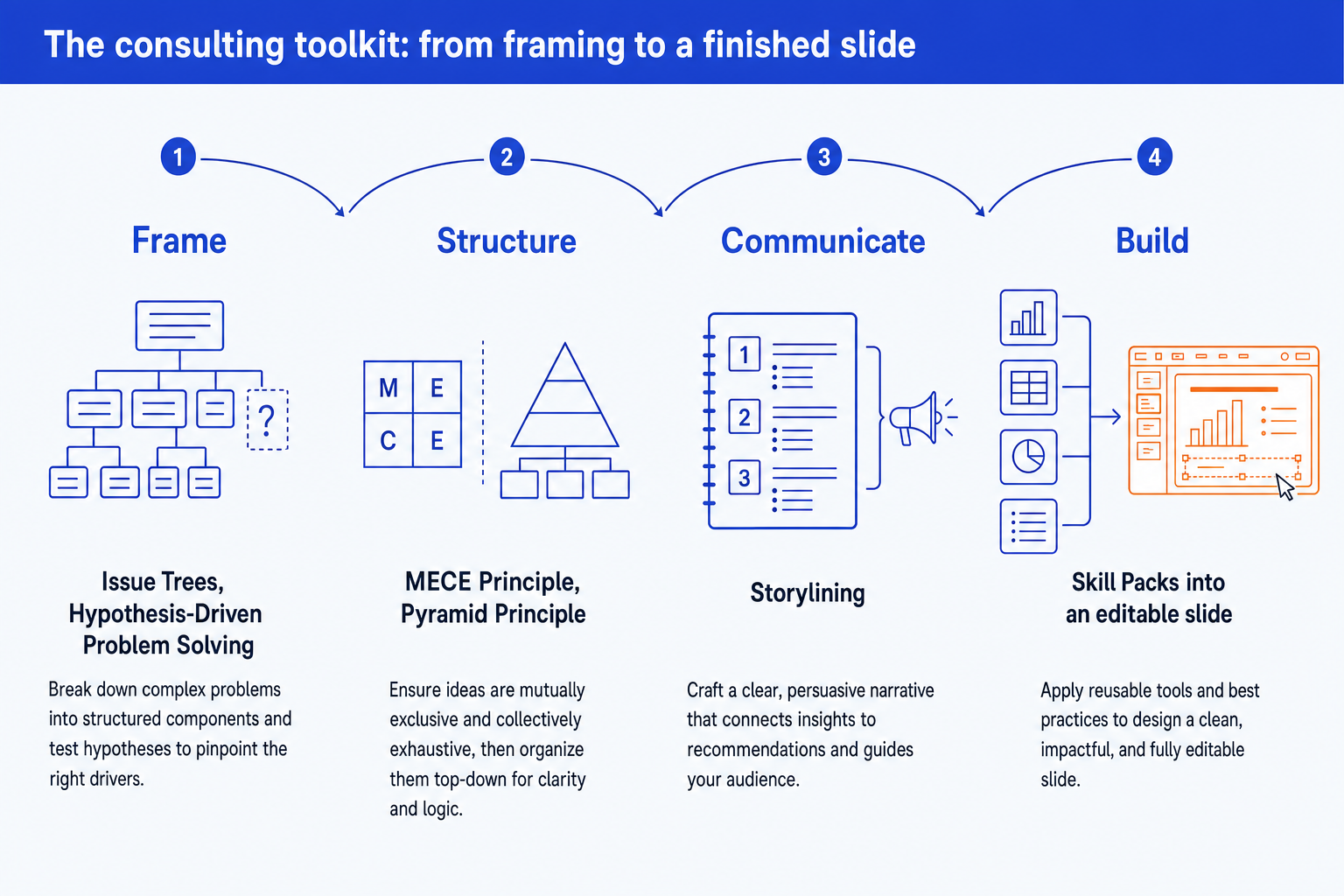
There is no single "consulting method." A real strategy engagement moves through four distinct stages, and a different tool owns each one, which is why this page is organized as a toolkit rather than one framework explained at length.
The core methods used in management consulting are issue trees and hypothesis-driven problem solving, which frame and test the question; the MECE principle, which checks that a breakdown does not overlap or leave a gap; the pyramid principle, which states the governing answer before the supporting detail; and storylining, which sequences that answer across a deck of action-titled slides. Sixteen further frameworks, such as a value chain map or a RACI matrix, are used selectively once these five are already in place, when a specific analysis calls for one of them.
How This Toolkit Is Organised
This hub holds three different kinds of resource, and picking the right one saves a wasted click. A method guide is the full explanation: what the method is, when it applies, worked examples, and the exhibit it produces, written for someone learning the method or explaining a reasoning choice to someone else. A skill pack is that same method installed once as a small file in a Claude project, so Claude applies it the same way on every future engagement without being re-explained each time. A prompt is the narrowest slice of the two: the specific copy-paste instruction sitting at the end of every method guide below, for a single one-off use when nothing needs installing at all.
Reach past all three only when the analysis needs a specific named framework, a 2x2, a value chain map, a RACI matrix, which the field guide covered under Go Deeper below handles separately from the five core methods.
Key Takeaways
- If the question is still broad and there is no candidate answer yet, start with an issue tree; splitting it MECE first is what makes it assignable and testable in parallel.
- If early evidence already points somewhere, skip the open-ended study and test a named hypothesis instead; it is faster whenever the first guess is a reasonable one.
- Never present a breakdown that has not passed the MECE test, and never present a validated breakdown without compressing it through the pyramid principle first.
- A structured argument is not a deck until it is storylined into action titles, and a comparison inside that deck needs a rating notation, not just a table.
- Once a method is second nature, install it as a Claude skill so it runs the same way on every engagement instead of being re-explained from memory each time.
Find the Right Page for What You Need
Use this table instead of reading every guide top to bottom. Find the job actually in front of you, then follow the one link that answers it; most readers only need two or three rows below, not the whole page.
If you need to frame or test the problem
Issue trees: the right starting point when the question is still broad and no candidate answer exists yet, because splitting it MECE is what makes it assignable across a team.
Hypothesis-driven problem solving: switch to this once early interviews or data already point toward a likely answer, and test it directly instead of researching everything open-ended.
If you need to structure or check an argument
The MECE principle: run this test on any breakdown, an issue tree branch, a hypothesis's sub-claims, a slide's bullet groups, before trusting it enough to present.
The pyramid principle, applied to a slide: once findings are validated, lead with the governing answer before the supporting detail, worked directly into an executive summary slide.
If you need to size the market or quantify the opportunity
Market sizing with TAM, SAM and SOM: use it whenever the recommendation depends on the size of an opportunity, with worked top-down and bottom-up examples and how to reconcile them.
If you need to build the exhibit itself
Executive summary slide: the one slide a partner reads if they read nothing else, built with the SCR method, situation, complication, resolution, the same answer-first logic as the pyramid principle.
Executive summary with KPI tiles: use this version when the recommendation is metrics-heavy and a plain SCR paragraph undersells the numbers.
8 executive summary slide examples, word for word: use these when the method is clear but the exact wording on the slide is not.
Harvey balls in PowerPoint: the filled-circle rating notation a comparison or capability slide needs, the same scale from a capability assessment to a vendor shortlist.
If you need a framework beyond these five
16 more management consulting frameworks: grouped by the stage of the engagement where each one earns its place, from Porter's Five Forces and a value chain map to a RACI matrix for the rollout.
If you want the method running inside Claude, not read off a page
21 Strategy Skills for Claude: a broad starter set covering the everyday tasks a strategy team repeats, framing, sizing, synthesis and slide storylines.
5 Strategy Claude Skills for the Full Engagement: five skills sequenced to match a real engagement from kickoff to final deck, rather than a grab-bag of prompts.
50 Tier-1 Strategy Skills for Claude: a deep set spanning every stage of an engagement, for teams who want full coverage rather than a starter pack.
MECE Issue Tree Skill for Claude: the issue tree and the MECE test above, packaged as one reusable skill so every problem gets split the same disciplined way.
A Claude Skill for Problem Solving: the hypothesis-driven method above, running on command from a day-one claim to a validated, tested answer.
Claude Skill Factory for Strategy: for a method that does not match a pre-built pack, a skill for building new skills out of a team's own playbook.
15 Claude Skills for Executive Summary Writing: for teams that write executive summaries constantly and want the SCR structure automated rather than rebuilt each time.
Enterprise Strategy Skills for Claude: a governance guide, not another skill pack, for rolling skills out past one user: ownership, review, version control and template enforcement across a team.
How Do You Frame and Test a Consulting Problem?
Every engagement starts the same way: a question broad enough that nobody can act on it yet. An issue tree splits that question into MECE branches a team can assign and test in parallel, the right move whenever there is no candidate answer yet, covered in the full guide to building and presenting an issue tree. Once early evidence already points toward a likely answer, switch to hypothesis-driven problem solving instead and test that answer directly, covered in the guide to hypothesis-driven problem solving. The gap matters: Thomas Wedell-Wedellsborg's 2017 Harvard Business Review survey of 106 C-suite executives across 17 countries found 85% agreed their organizations were bad at diagnosing problems in the first place. The trade-off: an issue tree is slower but safer when the question itself might be wrong; a hypothesis is faster only when the first guess is already a good one.
How Do You Structure the Argument Once You Have Findings?
Findings do not structure themselves. Before trusting any breakdown, an issue tree branch, a hypothesis's sub-claims, a slide's bullet groups, check it against MECE: no overlap, no gap, covered with worked examples and a four-question test in the full MECE guide. Paul Nutt's 1999 Academy of Management Executive study tracked 356 real decisions and found managers who generated more than one option saw their success rate rise from 56% to 70%, yet did so in fewer than 20% of cases. A wide MECE breakdown is how a real second option gets onto the table at all. Once the breakdown holds, the pyramid principle compresses it into a governing thought plus three or four supporting arguments, the same answer-first logic the guide to building an executive summary slide applies directly to a slide. The trade-off: MECE without the pyramid principle is a correct but unreadable breakdown; the pyramid principle without MECE is a confident answer built on a structure nobody checked.
How Do You Communicate a Structured Argument?
A pyramid-structured argument still is not a deck until it runs across slides in an order a reader can follow without anyone narrating it. Storylining sequences that argument into action-titled slides, so the titles alone carry the story to someone who only skims them, covered inside the guide to building an executive summary slide as the anchor slide of that storyline. Comparison slides in the same deck need a rating notation too: the filled-circle Harvey ball scale is the standard, and it travels unchanged from a capability assessment to a vendor shortlist, covered in the guide to adding Harvey balls in PowerPoint. The trade-off: storylining takes longer than writing slide by slide, and it is the only version a partner actually reads start to finish.
When Do You Need a Framework Beyond These Five?
These five methods carry most engagements from a blank page to a signed-off deck. When the analysis calls for a named framework instead, a value chain map, a 2x2, a market sizing model, reach for the field guide to 16 more frameworks, grouped by engagement stage. Market sizing deserves its own mention: CB Insights' 2026 analysis of 431 venture-backed companies that shut down since 2023 found weak product-market fit cited as a contributing cause in 43% of them, a mismatch a properly triangulated sizing slide is built to surface early, covered in the guide to building a market sizing slide. The trade-off: a named framework is more specific than the five methods above, and narrower, useful for one kind of analysis and useless outside it.
Frequently Asked Questions
What are the core consulting methods?
The core methods are issue trees and hypothesis-driven problem solving to frame and test a question, the MECE principle to check any breakdown for overlap or gaps, the pyramid principle to lead with the answer, and storylining to sequence that answer across a deck. Sixteen further frameworks exist for specific analyses, market sizing, a value chain map, a RACI matrix, but these five carry most engagements.
Where should I start if I am new to these methods?
Start with issue trees and the MECE principle. Hypothesis-driven problem solving, the pyramid principle, and storylining all assume a problem can already be split into parts that do not overlap and do not leave a gap. Once that habit is automatic, work through the rest in the order this page lists them, and reach for the field guide's extra frameworks only once a specific analysis calls for one.
What is the difference between a method, a skill, and a prompt?
A method is a way of thinking applied by hand, explained in a full guide with worked examples. A skill is that method packaged as a file uploaded once to a Claude project, so Claude runs it the same way every time without being re-explained. A prompt is the specific instruction at the end of each guide, for one use without installing anything.
Do I need all five core methods on every engagement?
No. Most engagements use an issue tree or a hypothesis to frame the question, MECE to check the resulting structure, and the pyramid principle plus storylining to communicate the answer. Market sizing and the field guide's other frameworks get pulled in only when the specific analysis calls for them: a sizing question, a competitive scan, or a capability comparison.
How do these methods connect to the actual slide I have to build?
Every guide linked from this page ends with the prompt and the exhibit for that method, so the thinking and the slide layout come from the same source. Once the analysis is done, describe it to Oria, either inside PowerPoint through the add-in or from a Claude or ChatGPT chat over its connector, and it returns 2 to 5 fully editable design options in 30 to 40 seconds, on your own template.
What is the pyramid principle and how is it different from MECE?
MECE tests whether a breakdown overlaps or leaves a gap; it is a check run on the parts. The pyramid principle is about the whole: state the governing thought, the one-sentence answer, before the three or four arguments that support it. A breakdown can be perfectly MECE and still be presented backwards if the pyramid principle is skipped, which is why this page treats them as two separate, sequential steps.