

16 Management Consulting Frameworks and When to Use Each
Reaching for the wrong framework wastes a slide, and reaching for none at all wastes the meeting. The real decision is not which of these sixteen tools is "best": it is which one matches the stage you are actually in, framing the question, analyzing the business, comparing options, or planning execution, and what you already have in hand before you start. This field guide sorts all sixteen by that decision and tells you plainly what each one needs, how long it takes, and where it fails.
Quick answer: which management consulting framework should you use?
Pick by stage first and familiarity second. A framework built for framing a question will not size a market, and a framework built for sizing a market cannot tell you whether your breakdown of it has a gap. Stage narrows sixteen options down to three or four candidates before you compare anything else, and the comparison table further down turns that same stage-first logic into a lookup you can scan in seconds.
For most engagements, four frameworks do the bulk of the work: the pyramid principle and MECE structure the problem and the argument, an issue tree splits an ambiguous question into pieces a team can actually divide up, and hypothesis-driven problem solving tests one candidate answer instead of researching from a blank page. Layer in Porter's Five Forces or the Business Model Canvas for analysis, and a RACI matrix once the open question shifts from strategy to who is actually responsible for doing it.
How we chose these sixteen
Every framework below was tested against the same four questions, asked about a real engagement rather than a case-interview drill:
- Whether it answers one clear question rather than several at once, so it earns a specific place in an engagement instead of a vague claim to being generally useful.
- Whether a completed version of it survives being challenged out loud: a grid or matrix should hold up when someone asks why a box is filled one way and not another.
- How quickly it turns into one slide someone can actually read, since a framework that needs a week of formatting before anyone sees it rarely makes it into the deck.
- Whether it still has a standalone page on this site or has been folded into a broader guide, which is why four of the sixteen entries below are described here but not linked elsewhere.
- Whether the version taught here still matches how the framework is actually used today, since several of these predate modern presentation software and their names have drifted a little from the original diagrams over sixty-plus years of use.
Ignored on purpose: how a framework sounds in an interview, any usage or adoption statistic that traces back only to a firm's own unpublished survey rather than a source we could name and check, and any claim that one framework has universally replaced another, since in practice most real engagements still reach for several of these in the same week.
Key takeaways
- Stage determines the candidate set. Every framework belongs to one of four stages, framing, analysis, comparison, or execution, and pulling one from the wrong stage forces you to use data or a hypothesis you do not have yet. Check the stage column in the table below before you check anything else.
- Some frameworks need nothing, others need a head start. An issue tree only needs the open question; a hypothesis test needs a signal already pointing somewhere; a Business Model Canvas needs an idea, not yet a running business. Confusing what a framework needs with what it produces is the fastest way to stall on it.
- Time to a defensible slide varies by an order of magnitude. A 2x2 matrix or a RACI grid can go on a slide the same day; a real customer journey map or a full value chain analysis needs actual research first. Promising a same-day turnaround on the slower frameworks is how deadlines slip.
- Each framework should drive one decision, not decorate a page. If a completed SWOT or Porter's Five Forces grid does not change what you recommend next, it was an exercise, not an input to the recommendation. Ask what decision the finished grid unlocks before you start filling it in.
- The most common failure is stopping at the framework. A finished grid, canvas, or matrix is an input, never the deliverable itself. Across all sixteen entries below, that is the single failure worth watching for, and it is usually the first thing an experienced reviewer checks.
All 16 frameworks compared
The same five questions from the takeaways above, answered for every framework in this guide. Rows follow the same four-stage order as the sections below; treat it as a lookup, not a ranking.
| Framework | Stage | Needs Before You Start | Time to a Defensible Slide | Decision It Drives | Common Failure Mode |
|---|---|---|---|---|---|
| Pyramid Principle | Frame | A conclusion you can defend | Same day | Whether the reader can act from slide one | Stating a conclusion without the structure behind it |
| MECE Principle | Frame | Any grouping you want to test | Minutes | Whether a breakdown has a gap or overlap | Treating “other” as a real, sized category |
| Issue Tree | Frame | An open question, no hypothesis yet | Half a day | How to split work across a team | Branches that are not the same kind of thing |
| Hypothesis-Driven Problem Solving | Frame | One signal pointing at an answer | A day or two to a kill test | Which analysis is worth running first | Hunting evidence for an answer you already wrote |
| Porter's Five Forces | Analyze | Basic knowledge of the industry | Half a day | Whether an industry is worth competing in | Scoring five forces without weighing which one dominates |
| SWOT Analysis | Analyze | A room and a whiteboard | Under an hour | A shared starting point for discussion | Stopping at the list instead of prioritizing it |
| Value Chain Analysis | Analyze | A map of how the business runs | A day or more | Where to cut cost or invest | Listing activities without connecting them to margin |
| Business Model Canvas | Analyze | A business idea, new or existing | An afternoon | Whether a new line holds together | Filling every block without testing the riskiest one |
| TAM SAM SOM Market Sizing | Compare | A defined customer and product | A day, more with real data | Whether the market is big enough | Sizing the total market, not the reachable one |
| 2x2 Positioning Matrix | Compare | Two dimensions that actually matter | An hour | Where an option sits versus rivals | Picking axes that do not really differentiate |
| Ansoff Matrix | Compare | A specific growth move in mind | Under an hour | How much risk a growth move carries | Treating diversification like penetration with a bigger budget |
| Prioritization Heatmap | Compare | A list of initiatives to score | An afternoon | Which initiatives get funded first | Scoring impact and effort with no shared scale |
| RACI Matrix | Execute | A plan that is ready to assign | An hour, once roles are agreed | Who owns what once execution starts | More than one Accountable on the same task |
| Customer Journey Map | Execute | Real customer research, not guesses | Several days | Where the experience breaks for the customer | Mapping the journey your team wants, not the real one |
| Strategy Roadmap | Execute | A sequenced set of initiatives | A day | What happens first and what depends on it | Sequencing everything as if nothing will slip |
| KPI Dashboard | Execute | Metrics someone already agreed to track | An hour to design | Whether the plan is actually working | Tracking metrics nobody revisits after the launch meeting |
Read the table by row, not by column: a framework's stage tells you when it is even a candidate, and its failure mode tells you what a reviewer will probe first. The four sections below walk each stage in the same order, with the context and the sources the table has no room for.
1. Frame the Problem
Before you analyze anything, get the question right. These four frameworks structure the problem itself, not the answer, and every other framework in this guide works better once they are in place.
Pyramid Principle
State the governing thought, the one-sentence answer, before any supporting detail, then group everything that defends it into three or four arguments. It turns a slide or a memo into an answer up front instead of a slow build-up, and every grouping under it still has to pass the MECE test.
MECE Principle
Split a problem into groups that are mutually exclusive and collectively exhaustive, so nothing overlaps and nothing is missing. It is the test every pyramid grouping and issue tree has to pass before it holds up under questioning, with five worked examples and the four-question test in our MECE guide.
Issue Tree
Break one broad question into a hierarchy of smaller, answerable sub-questions, each branch narrower than the one above it. It is how a team splits an ambiguous problem into workstreams that can be assigned and solved in parallel, and Claude can help build the branches through the MECE issue tree skill.
Hypothesis-Driven Problem Solving
Start with a testable answer instead of an open-ended research plan, then design the smallest analysis that could prove it wrong. It stops a team from analyzing data that would never change the recommendation anyway, and the six-step method is covered in our hypothesis-driven problem solving guide.
2. Analyze the Market and the Business
Once the question is clear, these four frameworks turn a broad look at the market and the business into specific, defensible findings, the kind a partner or a client will expect you to defend line by line.
Porter's Five Forces
Assess how attractive an industry is by weighing five competitive forces: rivalry, supplier power, buyer power, new entrants, and substitutes. Michael Porter introduced the framework in Harvard Business Review in 1979 and later put the discipline behind it in one line: “The essence of strategy is choosing what not to do.” The five-force breakdown itself belongs on a slide, laid out in our competitive landscape slide guide.
SWOT Analysis
Lay out strengths, weaknesses, opportunities, and threats in one view to connect internal capability with the external market. It earns its keep as a fast, shared starting point for a discussion, not as a stand-alone conclusion, and it works best paired with a sharper tool such as Porter's Five Forces or the value chain right after it.
Value Chain Analysis
Map a business as a sequence of activities, from inbound logistics to after-sales service, to see where value is created and where cost sits. Michael Porter laid out the same activity-by-activity structure in his 1985 book Competitive Advantage, and it still surfaces which activities are worth owning and which are worth outsourcing, even without a dedicated page of its own here.
Business Model Canvas
Lay out a business on one page across nine blocks, from customer segments and value proposition to channels, revenue, and cost. Alexander Osterwalder and Yves Pigneur, who created it, define a business model simply: “the rationale of how an organization creates, delivers, and captures value.” Their template has been downloaded more than five million times from Strategyzer, the company Osterwalder co-founded to publish it, a reasonable proxy for how often teams reach for it before writing a full strategy document.
3. Size and Compare Options
With the analysis done, these four frameworks help you size the opportunity and compare the paths forward against each other, using evidence rather than whoever argues loudest in the room.
TAM SAM SOM Market Sizing
Size an opportunity in three narrowing rings: the total addressable market, the segment you can serve, and the share you can realistically capture. CB Insights, reviewing its database of startup post-mortems, found that no market need is the single most cited reason startups fail, showing up in roughly 42 percent of the failures it analyzed, which is exactly the risk this framework exists to catch before you build anything. The slide layout itself is in our market sizing slide guide.
2x2 Positioning Matrix
Plot options or competitors across the two dimensions that matter most, then read off which quadrant each one falls into. It is the fastest way to make a prioritization or positioning argument visual instead of verbal, and the build steps are in our 2x2 positioning matrix guide.
Ansoff Matrix
Map four growth strategies across existing and new products against existing and new markets: penetration, product development, market development, and diversification. Igor Ansoff introduced the grid in a 1957 Harvard Business Review article, Strategies for Diversification, and it still clarifies how much risk a given growth move actually carries, even though it no longer has a standalone page here.
Prioritization Heatmap
Score every initiative on impact and effort, then plot them on a grid to separate quick wins from long shots. It replaces a debate about which project matters most with a shared, visual scoring exercise, and when to reach for one instead of a plain list is covered in our heat map guide.
Once the options are scored, the scores have to land on a slide. The convention is a grid of filled circles, one per option per criterion, which lets a reader compare five options across ten criteria in a single pass without reading a single row of prose.
Which Framework Fits Which Stage
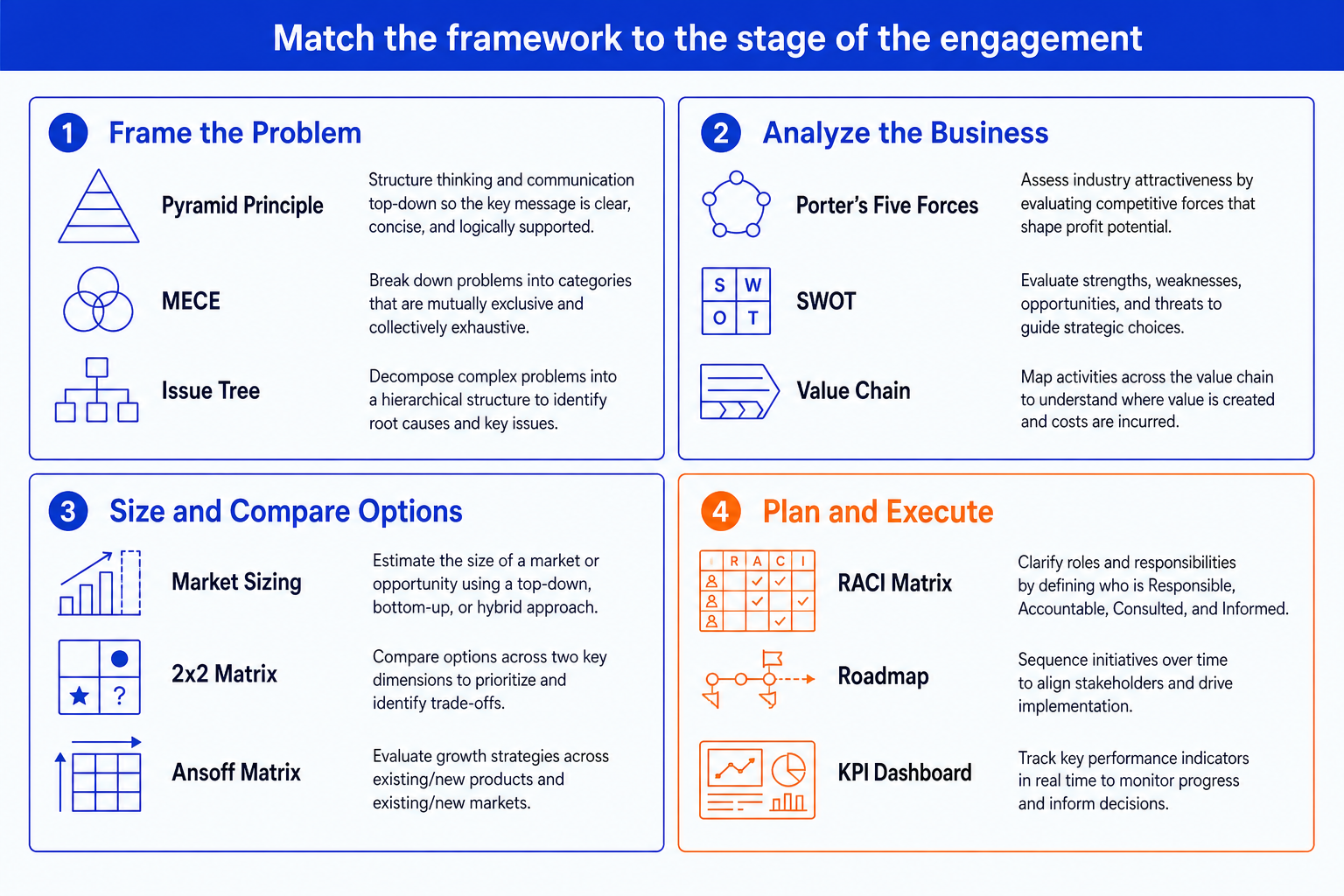
The exhibit below maps the same four stages to their core management consulting frameworks, so you can see the whole field guide as one picture before reading each entry in detail. Four stages, sixteen frameworks: reading down one column of the exhibit is a faster way to see how framing, analysis, comparison, and execution actually differ than reading all sixteen definitions in a row.
4. Plan, Assign, and Track Execution
A recommendation is only as good as its execution. These four frameworks turn a decision into an assigned, scheduled, and measured plan that can survive contact with an actual calendar and an actual org chart.
RACI Matrix
Assign every task a Responsible, Accountable, Consulted, and Informed owner so nothing stalls on unclear ownership. The Project Management Institute's own research on project communication found that for every one billion dollars spent on a project, about 135 million dollars is put at risk, and 56 percent of that, roughly 75 million dollars, traces back to ineffective communication rather than the plan itself. A RACI grid is one of the cheapest ways to close that gap, and the layout is in our stakeholder map slide guide.
Customer Journey Map
Lay out every step a customer takes, with the pain points and the initiatives that address each one, side by side. It connects a strategy recommendation directly to the customer experience it is meant to change, and the swimlane layout that presents it well is in our swimlane process flow guide.
Strategy Roadmap
Sequence initiatives across a timeline so stakeholders can see what happens first, what depends on what, and when results should show up. It is the slide that turns a plan into a schedule, built step by step in our strategy roadmap slide guide.
KPI Dashboard
Track the handful of metrics that actually indicate whether a plan is working, updated on a regular cadence. It closes the loop on every framework above by measuring whether the recommendation produced the result, and the KPI tile layout is in our executive summary slide guide.
For the wider workflow that connects analysis to a finished deck, our consultant's guide to Claude walks the full path from thinking to slides, including the parts of the workflow that happen before any of these sixteen frameworks come into play.
Building the Slide by Hand: When Does That Still Make Sense?
Every framework above eventually has to become an actual slide, and the default route is still native shapes: rectangles for a 2x2 grid, SmartArt for a process flow, a manually drawn grid for a RACI matrix. Building a Porter's Five Forces diagram or a RACI grid this way means placing shapes, aligning columns, and getting the spacing even before a single insight is written down, and it is genuinely the right call when the framework is simple, the deck is small, or a firm-specific template already has the exact shape saved as a reusable object. It is also the only route available when a workplace blocks third-party add-ins entirely, which some regulated environments still do.
The trade-off: total control over every pixel, at the cost of your own time. A four-box grid takes minutes by hand; a sixteen-box value chain map or a customer journey map with pain points annotated at every step can eat an afternoon before the content itself is even right.
Oria: Who Is It Built For?
Oria is built for exactly the kind of document this guide is about: corporate and consulting output, meaning board packs, steering committee decks, diligence exhibits, operating-model slides, and dense frameworks held to an enforced corporate template. It reaches you two ways, as a PowerPoint add-in in the task pane on Windows, macOS, and PowerPoint for the web, and as a connector for Claude and ChatGPT over MCP, so the slide can be built from the chat where the analysis was actually argued out, without opening PowerPoint first.
Describe the framework and your specific content in one prompt, the axes, the boxes, and the labels, and Oria returns two to five fully editable design options in thirty to forty seconds, built on your own template rather than a generic one. This matters most on the frameworks earlier in this guide that already assume a finished analysis, a scored Porter's Five Forces grid or a validated hypothesis, since re-typing that analysis into a separate design tool is where teams lose the most time.
Example prompt
"Create a 2x2 positioning matrix slide. Horizontal axis is price, low to high. Vertical axis is feature depth, low to high. Plot four competitors as dots, with a one-line label under each explaining its position. Add a short callout box on the right summarizing where the white space is."
The trade-off: Oria is built for the corporate environment only, so it loses on highly visual work. For a founder fundraising deck, a launch or campaign deck, a student presentation, or a marketing one-pager, a design-led tool will beat it and look better doing it, which is the next section.
Design-Led Tools: When Do They Beat a Framework Slide?
Gamma, Canva, Pitch, and Beautiful.ai are built for a different problem: visual impact rather than a defensible, template-locked argument. A founder fundraising deck, a launch or campaign deck, a student presentation, or a marketing one-pager is judged on how it looks and how it makes someone feel in the first few seconds, not on whether a partner can defend the box in the middle of a matrix. On that kind of deck, a design-led generator will out-design a framework-first tool, because that is the entire job it was built for.
The trade-off: design-led tools are not built to hold a dense sixteen-box canvas or a five-force grid to a strict corporate template, and they will not stop you from filling a slide with more text than a board will read. For a full side-by-side of AI presentation tools, including these design-led options, see our guide to the best AI for PowerPoint. The same holds in reverse: asking a design-led tool to hold a dense sixteen-box canvas to a strict corporate template is fighting the tool, not using it.
If You Need X, Go to Y
This guide is the hub for the cluster: the capsule above each framework gives the one-line rule, and the table below sends you to the deeper page for the pieces that still have one, or to a different tool entirely when the job in front of you is not a framework problem at all.
| If you need | Go to | Why |
|---|---|---|
| A deep, worked walkthrough of MECE with five tested breakdowns | Our MECE guide | The capsule above gives the one-line rule; the full page has the four-question test and five examples that survive being challenged. |
| The full method for building and presenting an issue tree | Our issue tree guide | Walks the branches, the workstream split, and how to present the tree itself, beyond the one-paragraph summary here. |
| The six-step method for testing one candidate answer instead of mapping the whole problem | Our hypothesis-driven problem solving guide | Covers the day-one hypothesis, the sub-claim test, and when to use it instead of an issue tree. |
| A grid of filled circles to score several options against many criteria on one slide | Our Harvey balls guide | Is the layout convention once a comparison, this one or your own, runs past two or three criteria. |
| The full path from a validated recommendation to a finished, templated deck | Our consultant's guide to Claude | Walks the whole workflow end to end, not only the slide step covered here. |
| A visually striking pitch, launch, or fundraising deck rather than a defensible framework-heavy one | Gamma, Canva, Pitch, or Beautiful.ai | Design-led tools built for visual impact. On that kind of deck they will look better doing it than a framework-first tool. |
| This exact framework built on your firm's template in minutes, from the chat you are already in | Oria | Built for board packs, steering committee decks, and dense frameworks held to an enforced corporate template, reachable as a PowerPoint add-in or a Claude and ChatGPT connector. |
Most of these rows are not mutually exclusive. A real engagement typically uses three or four of them in the same week, roughly in the stage order this guide follows.
Common Mistakes When Applying These Frameworks
Picking the framework before the question. Reaching for a 2x2 matrix or a value chain map before you know what decision you are actually making tends to force-fit the data. Choose the framework once the stage and the question are clear, using the comparison table above rather than habit.
Stacking too many frameworks on one slide. A single slide that tries to be a SWOT, a 2x2, and a roadmap all at once serves none of them well. Give each framework its own slide, or its own moment in the narrative, and let a KPI dashboard at the end tie them together.
Treating the framework as the deliverable. A completed Porter's Five Forces grid or value chain map is an input, not the recommendation itself. A framework earns its place only when it changes what you tell the client to do next, the same failure mode the takeaways above call out.
Ignoring which stage a framework belongs to. Sizing a market with TAM SAM SOM before an issue tree has even confirmed it is the right market to size wastes the analysis twice, once on the wrong question and once redoing it afterward. Match the framework to the stage column in the comparison table, not to whichever one you remember best from the last engagement.
None of these four are unique to management consulting: they are the same failures that turn a structured framework in any field into a slide nobody ever acts on.
Frequently asked questions
What are the most important management consulting frameworks to know?
Start with the four under Frame the Problem: the pyramid principle, MECE, the issue tree, and hypothesis-driven problem solving. Every other framework in this guide is easier to apply correctly once those four are second nature, because they govern how you structure the thinking underneath whichever one you pick next.
Do I need to memorize all 16 frameworks?
No. Most people use four or five of these regularly and reach for the rest only when a specific situation calls for them. Treat the comparison table above as a lookup you return to, not a list to memorize in one sitting.
What is the difference between a framework and a slide template?
A framework is a way of thinking, like grouping arguments MECE or sizing a market top-down. A slide template is the visual layout that presents that thinking, like a 2x2 grid or three concentric rings. The framework decides what goes on the slide, and the template decides how it looks.
Which framework should I use first on a new problem?
Start with an issue tree or the pyramid principle to frame the question itself, before reaching for an analytical framework such as Porter's Five Forces or the Business Model Canvas. Frameworks that structure the problem come first, and frameworks that analyze it come after the problem is actually clear.
How do I turn a framework into an actual slide quickly?
Describe the framework and your specific content in a single prompt, the axes, the boxes, and the labels, rather than opening a blank slide and placing shapes by hand. Oria's Text-to-Slide workflow does this for the corporate frameworks on this page; for a visual pitch deck instead, a design-led tool will serve you better.
Is Porter's Five Forces still relevant?
Yes, as an analysis structure: rivalry, supplier power, buyer power, new entrants, and substitutes still describe where profit in an industry can be defended or lost, regardless of the year. What has changed since Michael Porter's 1979 article is the data available to score each force, not the structure itself.
What is the difference between an issue tree and a hypothesis tree?
An issue tree splits an open question into an exhaustive set of branches before you have a candidate answer, while hypothesis-driven problem solving starts from one proposed answer and breaks it into the sub-claims that would all have to be true for it to hold. Use an issue tree when you have nothing yet, and the hypothesis method once you have a signal worth testing.